



You've bought a poster advertised as a UK Quad, found a frame you like, then noticed that the artwork doesn't match the release you thought you were buying. The seller's description sounds confident, but it never quite says which cinema campaign the sheet belongs to.
That's a common trap with a 2001: A Space Odyssey movie poster. Before judging the image, the condition or the price, you need to establish exactly what the seller has.
Table of Contents
- Why One 2001 Poster Can Mean Several Objects
- Major 2001 Poster Variants by Country and Format
- Dating a 2001 Poster from Release and Classification Records
- How to Tell an Original 2001 Poster from a Reprint
- What Different 2001 Posters Sell For in the UK
- UK Quad Sizes, Framing and Wall Planning
- Preserving and Handling Original 2001 Posters
- Confirm These Details Before You Buy a 2001 Poster
Why One 2001 Poster Can Mean Several Objects
2001 posters are a family of campaign materials, not one definitive image. A genuine cinema poster can still be the wrong purchase if you wanted an original-release example and bought a later reissue.
The identification problem spans the original 1968 campaign, a 1978 British Quad re-release and a 2001 UK re-release, with British Style A and Style B Quads sitting alongside smaller Cinerama display pieces in the campaign history described through the Science Museum Group's poster record and associated variant details. Those distinctions matter more than a listing's use of vintage, classic or iconic.
Think of different editions of the same book. The text remains recognisable, but the cover, publisher, printing and intended audience change. You wouldn't price a first edition from the cover illustration alone; the same caution belongs here.
Establish the object before judging it
Separate the description into its useful parts:
- Release period: Which theatrical campaign did this particular poster advertise?
- Format: Is it a British Quad, portrait US One Sheet or a lenticular Cinerama display?
- Artwork credit: Is Robert McCall credited for this variant, or has the seller attached his name to familiar imagery?
A later theatrical re-release can be an entirely legitimate collectible. It may also make a more affordable display purchase than an earlier campaign, without needing to pretend to be something else.
Buy the campaign you want, not the release year you've inferred from the film title.
Identify the variant, establish whether it's original to that campaign, then decide how to display it. Before spending money, ask the simplest question: which release does this poster advertise?
Major 2001 Poster Variants by Country and Format
Major 2001 poster variants by country, year and format
| Variant | Country | Year | Format | Key difference |
|---|---|---|---|---|
| 1968 British Quad, Style A | United Kingdom | 1968 | Landscape, 30 × 40 in | Original British artwork at standard Quad size |
| 1968 British Quad, Style B | United Kingdom | 1968 | Landscape, 30 × 40 in | Second British design; check the style code |
| 1968 US One Sheet | United States | 1968 | Portrait, 27 × 40 in | US artwork, not a British Quad |
| 1968 Cinerama display poster | Cinerama houses | 1968 | Landscape display, lenticular, 36.5 × 28.5 cm framed | Holographic effect with McCall artwork |
| 1978 British Quad re-release | United Kingdom | 1978 | Landscape British Quad | Re-release reportedly linked to Lucas's Star Wars-era comparison |
| 2001 UK re-release | United Kingdom | 2001 | Landscape, reported about 29¾ × 40 in | Check the artwork credit; BBFC classification 21 March 2001 |
British and American paper formats
The British Style A and Style B are separate designs, not different names for the same sheet. Their shared Quad dimensions won't distinguish them. Ask for the style designation and a complete photograph rather than accepting a tightly cropped image of the central artwork.
A US One Sheet isn't a British Quad with a different border. Its portrait composition changes the balance of the image, the lettering and the wall space it needs. The practical difference between a One Sheet and a Quad movie poster is worth understanding before comparing listings from different countries.
British collectors don't need to favour British material automatically. An American design may be the artwork you prefer. The mistake is paying for one country's campaign while receiving another because the listing uses cinema poster as a catch-all description.
Cinerama displays and later campaigns
The Science Museum Group records a pair of MGM Cinerama display posters designed by Robert McCall and issued in 1968, each measuring 36.5 × 28.5 cm framed and approximately 34.5 × 26.2 cm unframed. Their lenticular process produces a holographic effect, connecting the object's surface to its futuristic subject.
The museum's account describes Cinerama as using three synchronised projectors to produce an ultra-wide image. That exhibition connection makes these pieces something different from ordinary flat-paper advertising, not merely miniature Quads.
Later British campaigns deserve their own descriptions. The re-release associated with George Lucas's comparison and Star Wars-era interest belongs to a distinct marketing moment. The later McCall-attributed reissue also needs checking against the actual sheet rather than a seller's recycled description.
For these formats, insist on:
- A complete view: Borders and bottom credits must remain visible.
- A clear format description: Paper sheet and framed display object aren't interchangeable.
- Campaign-specific attribution: Recognising McCall's imagery doesn't establish when the object was produced.
Artwork helps narrow the search. Release period and format establish which comparison is worth making.
Dating a 2001 Poster from Release and Classification Records
Dating clues and what each one proves
| Dating clue | What it tells you | Example |
|---|---|---|
| BBFC classification of the original cinema version | Places a first release in 1968 | Classified 24 April 1968, running time 132 min 52 sec |
| BBFC classification of the 2001 cinema version | Places a re-release, not a 1968 first run | Classified 21 March 2001, running time 149 min 40 sec, Warner Brothers |
| Producer credit | Identifies the campaign's studio connection | Metro-Goldwyn-Mayer on the Cinerama displays |
| Artist credit | Links artwork to a campaign, but doesn't independently date the sheet | Robert McCall on original material and attributed later reissue material |
| Advertised running time | Provides a version check when a duration is printed | Compare with 132 min 52 sec or 149 min 40 sec |
| Printed format and style code | Helps separate British designs and re-release material | Check landscape proportions, style identification and campaign wording |
The British Board of Film Classification records the original cinema version as classified on 24 April 1968, with a running time of 132 minutes 52 seconds, and the later cinema version as classified on 21 March 2001, running 149 minutes 40 seconds with Warner Brothers as distributor. These are version records, not certificates of authenticity for individual posters.
Use a mismatch test
Read the small print before studying the main image. A studio credit, distributor line, printer's name or reissue wording can be more useful than a spacecraft you immediately recognise.
Metro-Goldwyn-Mayer and Robert McCall help establish the identity of the Cinerama campaign. Neither name, taken alone, proves that another object belongs to the original release. Reused artwork and retained film credits can survive into later publicity.
Say a seller describes a sheet as first-release material, but its distributor information points towards a later campaign. That doesn't automatically make it a counterfeit. It does mean the seller needs to explain the discrepancy before you pay a first-release price.
Check the description against the physical evidence:
- Printed date: Establish whether it's a copyright date for the film or evidence of the poster's issue.
- Distributor credit: Compare it with the theatrical version being claimed.
- Campaign wording: Treat re-release slogans and endorsements as identification clues, not decorative extras.
The Lucas-associated British Quad should be assessed as its own campaign, not squeezed into an original-release category because it advertises the same film.
Dating rule: A genuine re-release poster is original to its re-release. It isn't an original first-release poster.
A printed running time can support a version match, but not every poster carries one, and advertising may round durations. Classification dates tell you when a version was approved for UK cinemas, not when a particular sheet came off the press.
How to Tell an Original 2001 Poster from a Reprint
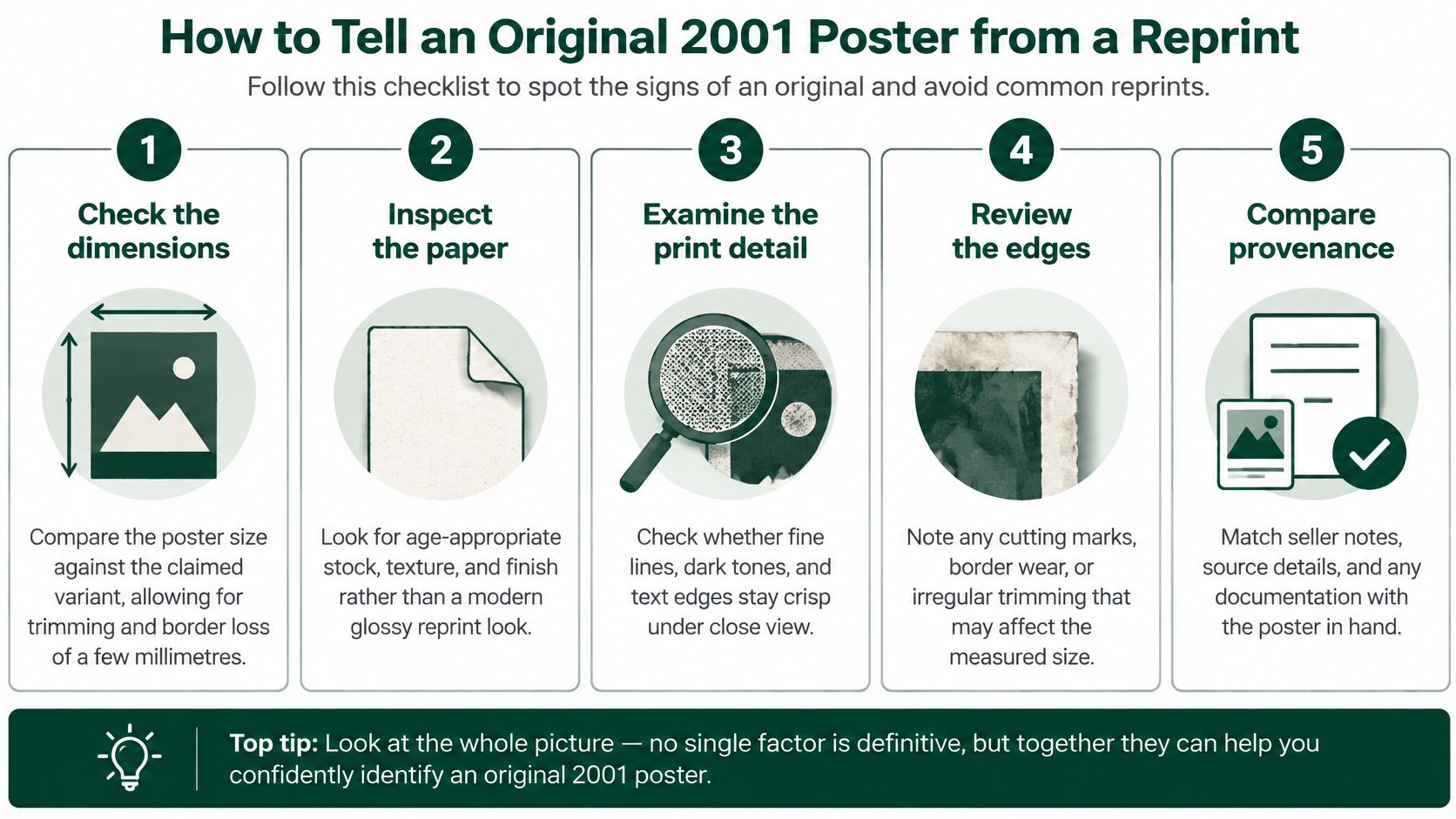
An original needs several details that agree. For an initial overview, use this checklist before examining the sheet more closely.
Inspect the whole sheet
- Measure the actual poster. Use a clean tape measure on a supported sheet, recording height and width separately. Allow for minor trimming and border loss, but ask for an explanation if the proportions are wrong. A frame measurement tells you little about the paper inside it.
- Examine the printing. Use a loupe and a neutral light to inspect lettering, colour separations and the dot structure. Period British screening posters commonly used colour offset lithography, but a regular screen alone doesn't prove age: modern reproductions can also be offset printed.
- Read the margins. Photograph printer and distributor credits sharply enough to transcribe them. Blurred lettering that appears to be copied from another sheet deserves attention, especially when the surrounding image is also soft.
- Inspect the paper and reverse. Look at texture, thickness, finish and the relationship between exposed and protected areas. Ageing should make physical sense. Brown paper isn't automatically old, while a carefully stored original needn't look distressed.
Separate condition from authenticity
- Study the folds. Folded-as-issued material can retain useful evidence of cinema distribution and handling. Examine intersections for splits, reinforcement and retouching. Don't mistake an attractive flattened surface for an untouched sheet.
- Recognise specialist surfaces. A lenticular Cinerama display should not be judged by flat-paper expectations. An unusual optical effect can belong to the original object; establish the claimed format before treating it as suspicious.
- Ask what lies beneath the presentation. Linen backing can support weak paper and improve handling, but it doesn't authenticate anything. Request disclosure of infilling, bleaching, repainting, trimming and repairs, together with information about adhesives and reversibility.
The At the Movies listing illustrates the dealer vocabulary buyers encounter, including original-release attribution, folded condition and linen backing; the associated UK asking-price examples range from roughly £1,195 to £2,975. Those descriptions need supporting evidence rather than being accepted as guarantees in themselves.
For wider buying criteria, compare the seller's answers with this guide to original movie posters in the UK. Provenance should connect to the actual object, not just describe the history of the film.
For a supplementary visual reference, this video can accompany the hands-on checks.
No single test settles originality. A reproduction can copy dimensions, a genuine sheet can be trimmed, and restoration can conceal useful evidence. I would favour a plainly described poster with consistent details over a pristine-looking example supported only by confident adjectives.
What Different 2001 Posters Sell For in the UK
The price depends first on which campaign object is being offered. A 1968 Style C Cinerama poster and a British Style A poster are different variants, not direct substitutes for a UK Quad from a later release. Compare the same country, style, format and release before judging a price.
Auction estimates and recorded prices for 2001 posters
| Poster | Sale reference | Figure |
|---|---|---|
| US Style C Cinerama poster (1968) | Sotheby's London online auction catalogue | Estimate £4,000–£6,000 |
| British Style A poster (1968) | Same Sotheby's London online auction catalogue | Estimate £1,200–£1,800 |
These Sotheby's figures are estimates, not confirmed sale prices. An estimate is the auction house's pre-sale range; bidding may finish above or below it. The two estimates also reflect distinct designs and formats, so they should not be used to price a UK Quad directly.
Compare like with like
Dealer asking prices show what sellers seek, not what buyers ultimately pay. Auction and dealer figures also involve different terms, including premiums, returns, delivery and any preparation still needed.
Build a useful comparison around:
- Matching identity: Same release, country, format and style.
- Comparable condition: Account for missing borders, staining, fold damage and fading.
- Disclosed treatment: Distinguish simple support from extensive reconstruction.
- Purchase costs: Check premiums, delivery and any framing work still needed.
A guide to estimate collectible resale value can help organise comparable evidence, but a useful comparison for this title still needs campaign-specific detail. A later Quad should not be priced against first-release material without allowing for the difference in release and format.
Linen backing alone does not establish a premium. Its value depends on the quality and extent of the work, alongside the poster's identity and condition. Compare the object and the sale terms, not just the headline figure.
UK Quad Sizes, Framing and Wall Planning
Poster sizes and framing notes by format
| Format | Size (inches) | Size (cm) | Orientation | Framing note |
|---|---|---|---|---|
| UK Quad | 30 × 40 | 76.2 × 101.6 | Landscape | Standard landscape frame; allow a mount |
| US One Sheet | 27 × 40 | 68.6 × 101.6 | Portrait | Tall, narrow wall space |
| 1968 Cinerama display, framed | Approx. 14.4 × 11.2 | 36.5 × 28.5 | Landscape display classification | Smaller frame; measure the display piece |
| 1968 Cinerama display, unframed | Approx. 13.6 × 10.3 | Approx. 34.5 × 26.2 | Landscape display classification | Approximate; check the actual poster |
| 2001 UK re-release | About 29¾ × 40 | Approx. 75.6 × 101.6 | Landscape | Slightly smaller in height than a standard Quad |
Optimum Fine Art's format guide describes the UK Quad as approximately 40 by 30 inches, or about 102 by 76 centimetres, and the portrait US One Sheet as normally 27 by 40 inches. The table's more precise metric equivalents are conversions, not manufacturing tolerances.
The museum display measurements also need care: its recorded dimension order shouldn't be treated as a frame-order width and height. Confirm the object's actual orientation and measure it directly.
Use this visual comparison for wall planning, but order from the sheet's measurements rather than a format label.
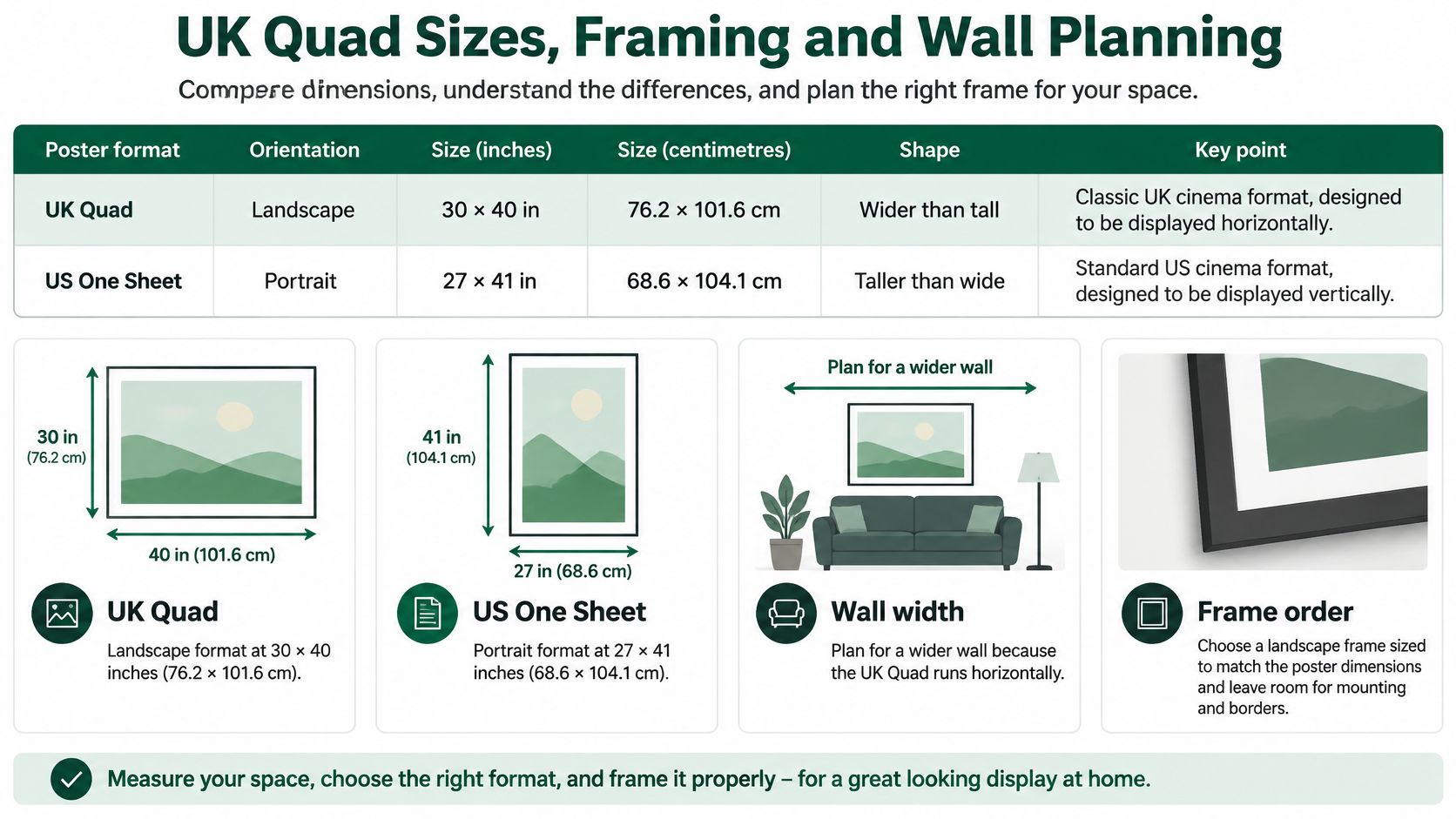
The infographic uses a different One Sheet specification from the table. That discrepancy is precisely why a generic size guide mustn't substitute for measuring the object you own.
Turn measurements into a frame order
Lay the poster on a clean, flat surface and record its height and width without including backing overhang. If it's linen-backed, record the backing dimensions separately so the framer can accommodate them without confusing them with the original sheet.
Choose the visible border deliberately. A mount can conceal damaged margins, but it may also hide printer information; a conservation framer can leave important credits visible while supporting vulnerable edges.
Specify conservation-quality board, UV-filtering glazing, and enough depth to keep the poster away from the glazing. Don't let a framer dry-mount a collectible sheet just to remove ripples.
Plan the outside dimensions
Mark the proposed frame outline on the wall with low-tack tape, testing the tape on the wall finish first. Include the frame moulding and mount, not just the poster's image area.
A horizontal Quad needs width; a vertical One Sheet needs height. Check nearby furniture, switches and doors before choosing the mount width.
Frame-order note: Write height, width, orientation, campaign and backing status together. Never send a framer a bare pair of numbers.
Keep the measured sheet size distinct from the finished frame size. That small administrative habit prevents expensive misunderstandings when the poster is reframed or sold.
Preserving and Handling Original 2001 Posters
Light, humidity, rough handling and acidic enclosures can damage paper even when the poster looks secure in its frame. A spare bedroom cupboard is usually a better storage choice than a loft, cellar or wall beside a radiator.
The V&A's cinema-poster catalogue records a British screening poster in colour offset lithography, with paper and ink among its materials. That's a useful reminder to treat the object as a vulnerable printed surface, not merely a picture; it doesn't establish that every campaign used identical materials.
Choose storage that supports the sheet
Store suitable paper posters flat in archival enclosures wherever space allows. Use buffered boards or boxes intended for paper conservation, and choose materials whose suitability is documented rather than relying on an acid-free label alone.
A calcium carbonate buffer helps maintain an alkaline storage environment. Acid-free polyester pockets protect appropriate flat sheets from repeated handling, but they don't repair brittle paper or make damp storage safe.
Keep lenticular displays and other composite objects separate from routine paper-storage assumptions. Their surfaces, mounts and plastics may need advice from an object conservator.
For practical storage choices, the movie-poster storage FAQ is a useful companion when deciding between flat files, sleeves and tubes.
Flatten gently and handle with support
A sound rolled paper poster can be relaxed under evenly distributed weight between clean protective boards. Allow several weeks if necessary, checking periodically; heavier modern stock may resist flattening and spring back.
Don't iron it, mist it or force it backwards around a tight tube. Brittle sheets, flaking ink and laminated or lenticular pieces need specialist assessment rather than home flattening.
- Prepare the surface: Clear away drinks, tools and jewellery that could catch an edge.
- Use clean hands: Clean, dry hands give good control of sound paper; suitable gloves are an option when surface sensitivity requires them.
- Support the sheet: Move it on a rigid board rather than lifting a large poster by its corners.
- Respect existing folds: Don't create new folds for convenience or repeatedly open fragile intersections.
For display, use reversible attachments and keep the frame away from direct sun and damp external walls. UV-filtering glazing reduces one source of damage, but it doesn't make prolonged bright exposure harmless.
Keep conservation records separate from authentication evidence. Record treatment materials, the conservator's details and photographs before and after work, so a later owner can distinguish repaired damage from original construction.
Confirm These Details Before You Buy a 2001 Poster
A good seller should be able to answer specific questions about the object, not just repeat the film's significance. Put these questions to a specialist dealer, an auctioneer or a private seller alike.
Ask for evidence you can assess
- What are the exact sheet dimensions? Ask whether the measurement covers the paper, linen backing or frame. A useful answer identifies each separately and explains any missing border.
- What supports the claimed release year? Request the printed date, printer credit, distributor details and campaign identification. A film copyright date alone isn't enough; the seller should explain how the physical sheet fits the advertised release.
- What restoration has been carried out? Ask about linen backing, repairs, replaced paper, retouching and adhesives. A strong answer identifies materials and treatment dates where known, states whether backing is reversible, and admits gaps in the record.
- Can you provide detailed photographs? Request the complete front, margins, fold intersections, printer's details and reverse. If backing prevents a reverse view, ask for earlier photographs or an explicit statement that the original reverse can't be inspected.
Apply the same standard to every seller
Famous Movie Posters is one option for guaranteed original cinema posters; put the same questions to its team that you would put to any other dealer. A guarantee is useful, but you should still understand the object and the purchase terms.
An expensive listing isn't authentication evidence. Clear photographs and a candid explanation of uncertainty are more useful than a persuasive description.
Before contacting a seller, write down the variant you want, its claimed release year and the expected dimensions. Keep the seller's measured dimensions beside that note, so you can separate a suitable purchase from an attractive but different campaign.
Famous Movie Posters offers guaranteed original cinema posters, framing options and a Request a Poster service for titles you're trying to source. Visit Famous Movie Posters to explore available posters or ask about a specific 2001 campaign, with your preferred variant and format clearly identified.