



You've found a large poster advertised as a “6 sheet”, measured your wall, and then discovered that different UK sellers seem to mean different things. One gives a modern billboard measurement, another describes a vintage cinema poster made from several panels, and both may use the same name with complete confidence.
That confusion is understandable. In Britain, 6 sheet posters have two legitimate histories. The term can describe a current out-of-home advertising format, or a large heritage cinema display whose dimensions and construction depend on its period. Before you buy a frame, commission a reproduction, or judge a poster's rarity, you need to establish which meaning applies.
A useful starting point is to separate what the poster contains from how it was made and used. A modern digitally printed sheet may be supplied at a fixed billboard scale, while an original cinema six sheet may consist of overlapping sections designed to be pasted outdoors. The subject matter alone won't identify it. Details such as paper, folds, panel joins, country of issue and provenance matter more. For background on the wider subject of original film-poster design, this guide to what a poster should include provides helpful context.
Table of Contents
- Why the Term Confuses Most Buyers
- The Modern UK Billboard Six Sheet
- The Heritage Cinema Six Sheet Explained
- How Six Sheets Compare to Quads and One Sheets
- What Collectors Should Look for Before Buying
- Storing and Handling Large Originals Safely
- Common Misconceptions and Smart Questions to Ask
Why the Term Confuses Most Buyers
The phrase 6 sheet posters sounds as though it must describe one exact piece of paper. In the modern UK advertising trade, that assumption is often close enough. In film-poster collecting, it can lead you badly astray.
Today, a six sheet is commonly understood as a billboard-size format measuring 1.2m x 1.8m, or 47.2 x 70.9 inches, according to UK poster-size guidance. It's normally a portrait-format advertising display intended for a bus shelter or another public location. A printer can produce it digitally as one finished piece at 1:1 scale.
The heritage meaning comes from older British cinema advertising. Historic six sheets were large outdoor cinema posters assembled from several overlapping sections. References describe formats around 80 x 120 inches, while later British examples are also associated with a size around 81 x 81 inches. Those dimensions don't match the modern 1.2m x 1.8m standard, and that mismatch is the first warning that the label alone isn't enough.
Four questions settle the issue
Before treating a poster as a collectible, ask:
- What is its origin? Is it a modern print supplied by a UK printer, or a cinema poster issued for a historical film release?
- How was it produced? A digital print and a multi-panel pasted display may share a title but not a collecting category.
- What are the actual measurements? Measure the poster itself, not the frame or packaging.
- What evidence supports the description? Country, release period, panel configuration and seller provenance should agree.
Practical rule: Never buy on the words “six sheet” alone. Buy the object you've identified, not the label you hope is accurate.
Once those checks are complete, the practical decisions become clearer. Modern advertising stock may suit a temporary indoor display, while an original cinema piece needs conservation-led framing, careful transport and realistic wall space. The two meanings aren't competing definitions. They're different chapters of British poster history.
The Modern UK Billboard Six Sheet
In current UK out-of-home buying, the six sheet is a workhorse for transport, retail and public-venue advertising. Its portrait footprint influences the print run, display case, delivery route and frame choice before the artwork reaches the wall. A buyer ordering one for an indoor setting should measure the wall, doorways, lifts and installation area first.
The format is large enough to command attention while remaining practical for dedicated advertising units. At roughly the height of a tall adult and wider than a standard domestic doorway, it needs more planning than a poster intended for a room above a sofa. The physical object, not just the image, determines whether the display will work.
Common placements include:
- Bus shelters, where portrait panels fit standard advertising cases.
- Train stations, especially circulation routes and waiting areas.
- Shopping centres, where busy walls and display units carry promotional campaigns.
- Gyms and similar public venues, where a large message can occupy an entrance or foyer.
These settings also explain why the modern six sheet should not be confused with a heritage cinema six sheet. The former is a current advertising specification, supplied for planned installation and replacement. The latter belongs to historical film distribution and may involve very different dimensions, paper, folding and panel construction.
Material changes the display decision
Modern production prioritises visibility, handling and straightforward deployment. UK billboard guidance identifies 170g blue-back paper as an outdoor-friendly substrate for billposting and describes six sheets in settings such as bus shelters, train stations, shopping centres and gyms. The specification is covered in this UK billboard format guide.
Blue-back paper has a practical advertising function. Its backing reduces show-through when a new poster is pasted over an earlier campaign or a marked surface. That feature suits temporary public display, but it does not by itself make the sheet suitable for long-term collecting. A collector's priorities are different: stable support, controlled light, safe mounting and the ability to reverse the treatment.
A digital six sheet can make an effective decorative statement. Its size alone does not establish cinema origin. Before commissioning a frame or describing it as an original film artefact, check the print method, paper specification, intended use, dimensions and supporting provenance. Historic terminology can describe a modern advertising product, so the physical evidence should decide the category.
The Heritage Cinema Six Sheet Explained
The heritage cinema six sheet grew from an older British measurement system rather than from today's billboard specification. The double crown provided a base unit in British film-poster practice, and a 40x90 poster was treated as a six sheet because it represented six times the size of the older UK one sheet. Later, the format was reduced to about 40x81 inches, but the name remained in circulation, as explained in this historical poster-size reference.
That history explains why collectors can encounter more than one set of dimensions. Archival references describe the UK six sheet as a large cinema poster that could reach about 80 x 120 inches, while collector material also records a later British size around 81 x 81 inches. The measurements reflect changes in practice, not necessarily a mistake by one particular seller.
A poster made in sections
Older cinema six sheets weren't normally handled like a single domestic art print. They were commonly produced in four to six overlapping sections, each printed so the panels could be joined during installation. Some were factory folded for distribution. At the cinema, workers could paste the sections to an outdoor hoarding or wall with wallpaper glue.
That method was practical for a large advertising surface, but unforgiving over time. Paper exposed to weather absorbs moisture, dries unevenly and attracts dirt. Paste can stain or weaken fibres, folding creates permanent creases, and removing a poster from an outdoor site may tear the surface. The original display method helps explain why intact examples are scarce.
UK collector references describe six sheets as large outdoor advertising formats, often around 81 x 81 inches, assembled from four or more panels. They also note that very few pre-war examples survive, making complete early examples unusually scarce in the UK market, as outlined by this UK cinema-poster size guide.
Why the 1980s matter
Studios phased out six sheets in the 1980s, and UK production continued until roughly that decade. That makes earlier examples a finite historical group rather than an endlessly reproduced format. Scarcity doesn't make every surviving piece valuable, however. Condition, completeness, title, artwork, restoration and country of issue still determine whether a poster deserves serious collector attention.
For a buyer, the important distinction is simple. A heritage six sheet is not merely a modern poster printed larger. It's a cinema advertising object whose folds, panel joins and surviving condition are part of its history.
How Six Sheets Compare to Quads and One Sheets
Collectors usually have a familiar reference point. The UK Quad is a horizontal cinema poster measuring 30 x 40 inches, while the US One Sheet is generally a portrait format of roughly 27 x 41 inches. A heritage six sheet sits in a different physical category, and the modern billboard version introduces a separate orientation and measurement again.
The table below is a working guide rather than a substitute for measuring an individual poster. Historical six sheets vary, so the dimensions column needs to be read alongside the poster's era and construction.
Six Sheet vs UK Quad vs US One Sheet
| Format | Dimensions | Orientation | Typical Use |
|---|---|---|---|
| Heritage UK Six Sheet | Around 81 x 81 inches in later British examples, with earlier references describing larger formats | Often square or dependent on historical format | Outdoor cinema advertising, assembled from multiple panels |
| Modern UK Six Sheet | 1.2m x 1.8m, or 47.2 x 70.9 inches | Portrait | Bus shelters, stations, shopping centres and other out-of-home sites |
| UK Quad | 30 x 40 inches | Landscape | Indoor and outdoor cinema promotion |
| US One Sheet | Roughly 27 x 41 inches | Portrait | Cinema advertising, usually as a single printed sheet |
The UK Quad's name comes from quadruple crown, with the crown measured at 15 x 20 inches, according to this explanation of UK cinema-poster sizes. That naming tradition helps place the Quad in the same old imperial system, but it doesn't make a six sheet a simple oversized Quad.
A heritage six sheet has roughly four times the surface area of a Quad when using the later square-style dimensions. That difference affects everything, from the room it can occupy to the handling needed during mounting. For a broader explanation of the distinction between the familiar cinema formats, see the difference between a One Sheet and a Quad movie poster.
What Collectors Should Look for Before Buying
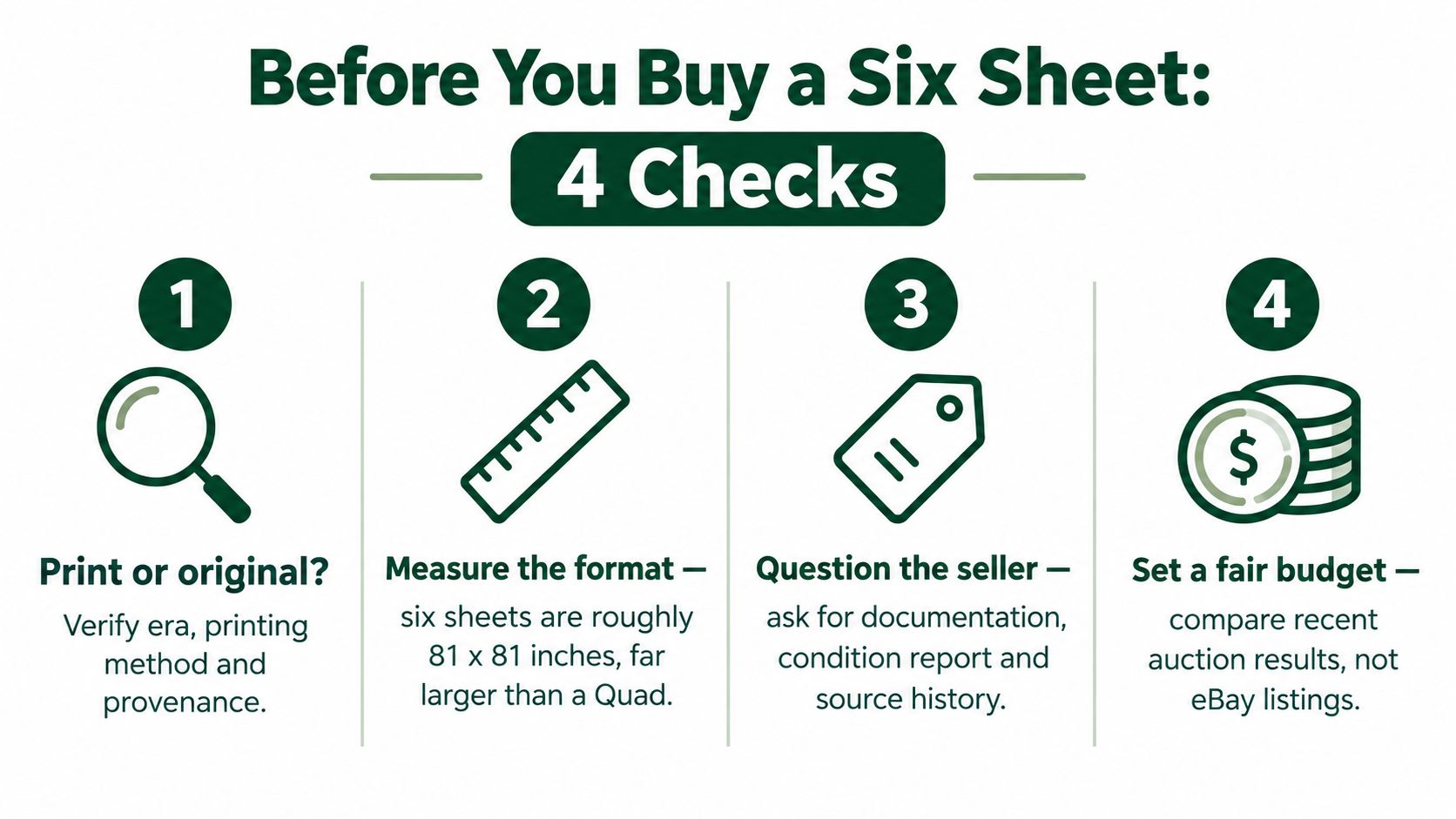
A six sheet purchase should begin with identification, not enthusiasm. Large posters create an immediate visual impact, and that can make buyers overlook basic questions about issue, construction and condition. Run the checks in the order you'll face them.
Start with the object itself
First, establish whether it's modern or original. Ask whether the poster was digitally printed for contemporary advertising or issued as cinema publicity during the film's release period. A seller should explain the printing method and intended use without vague language.
Next, verify the era and country of issue. “Vintage” isn't a sufficient description. A genuine British cinema piece should have a credible connection to the UK market, and its dimensions, paper, folds and artwork should make sense for the stated period.
Then, confirm the panel count. Older six sheets were commonly printed in overlapping sections. Ask whether all panels are present, whether joins are original, and whether any section has been replaced. A poster can still be attractive with losses or restoration, but the condition must be disclosed clearly.
Finally, request a restoration report. Look for details about linen backing, paper replacement, trimmed edges, repainting, colour enhancement and conservation work. Restoration isn't automatically a defect. Concealed restoration is the problem.
Price the practical burden as well
Measure the route from delivery entrance to display wall. A large assembled poster can be awkward to move, and the frame may require professional handling. Don't judge the total cost by the paper price alone. Framing, glazing, mounting, transport and suitable storage all form part of the decision.
A useful collecting principle is to separate authenticity, condition and presentation. Resources discussing what defines a fine art collectible can help clarify why provenance and preservation affect an object's importance alongside its visual appeal.
If the exact title isn't listed, a dealer's Request a Poster service can be more useful than searching broad marketplaces with inconsistent terminology. Give the title, country, approximate release period and desired format, then ask for photographs of the panels and a written condition description before making a commitment.
Storing and Handling Large Originals Safely
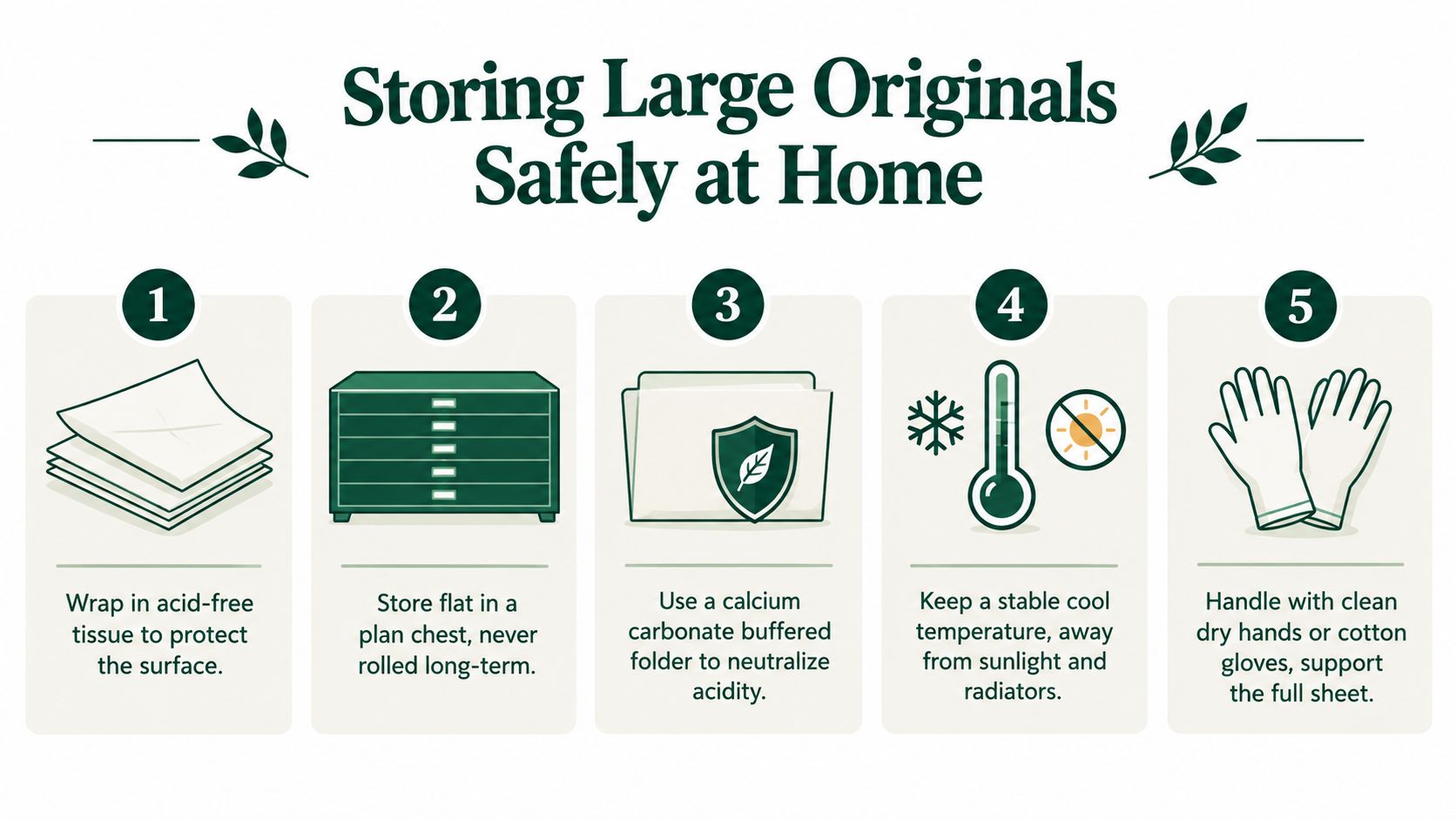
Large original posters need support across their full surface. A six sheet can flex under its own weight, and a fold or weak edge can worsen if you lift it from one corner. Work on a clean, broad surface and keep food, drinks, moisture and direct sunlight away from the handling area.
For a premium piece, archival materials are the sensible starting point. Acid-free tissue provides a low-risk contact layer, while a folder or board with a calcium carbonate buffer helps neutralise acidity in the storage environment. Acid-free polyester pockets can add another protective barrier for particularly important sections, although the enclosure must be large enough to avoid forcing folds or bends.
Flat storage is the preferred option
A plan chest or flat-file cabinet is ideal because it prevents the long-term pressure and distortion associated with rolling. The storage drawer must be larger than the poster, with no need to force the sheet against a wall or fold it to fit.
Most homes don't have a cabinet built for cinema advertising. In that case, choose a rigid, clean, acid-free folder or archival board and store the poster flat in a dry interior room. Avoid basements, lofts and spaces beside radiators. These areas can expose paper to damp, temperature swings or excessive heat.
If rolling is unavoidable
Rolling should be a last resort for a heritage six sheet, particularly when the poster has fragile folds, lifting ink or old paste residue. A custom poster tube with a generous diameter, acid-free tissue and stable support is safer than forcing the piece into a narrow commercial tube. Don't tape directly to the poster or allow the printed surface to rub against rough packaging.
For a practical overview of protecting artwork during transport, TLC Moving & Storage artwork help offers useful packing principles that can be adapted to large paper. For broader film-poster storage advice, see this guide to storing movie posters.
When mounting, insist on reversible, acid-free materials and professional advice. A large original shouldn't be permanently glued to a board just because that is the quickest way to make it lie flat. The mount should support the poster while respecting its future conservation needs.
Common Misconceptions and Smart Questions to Ask
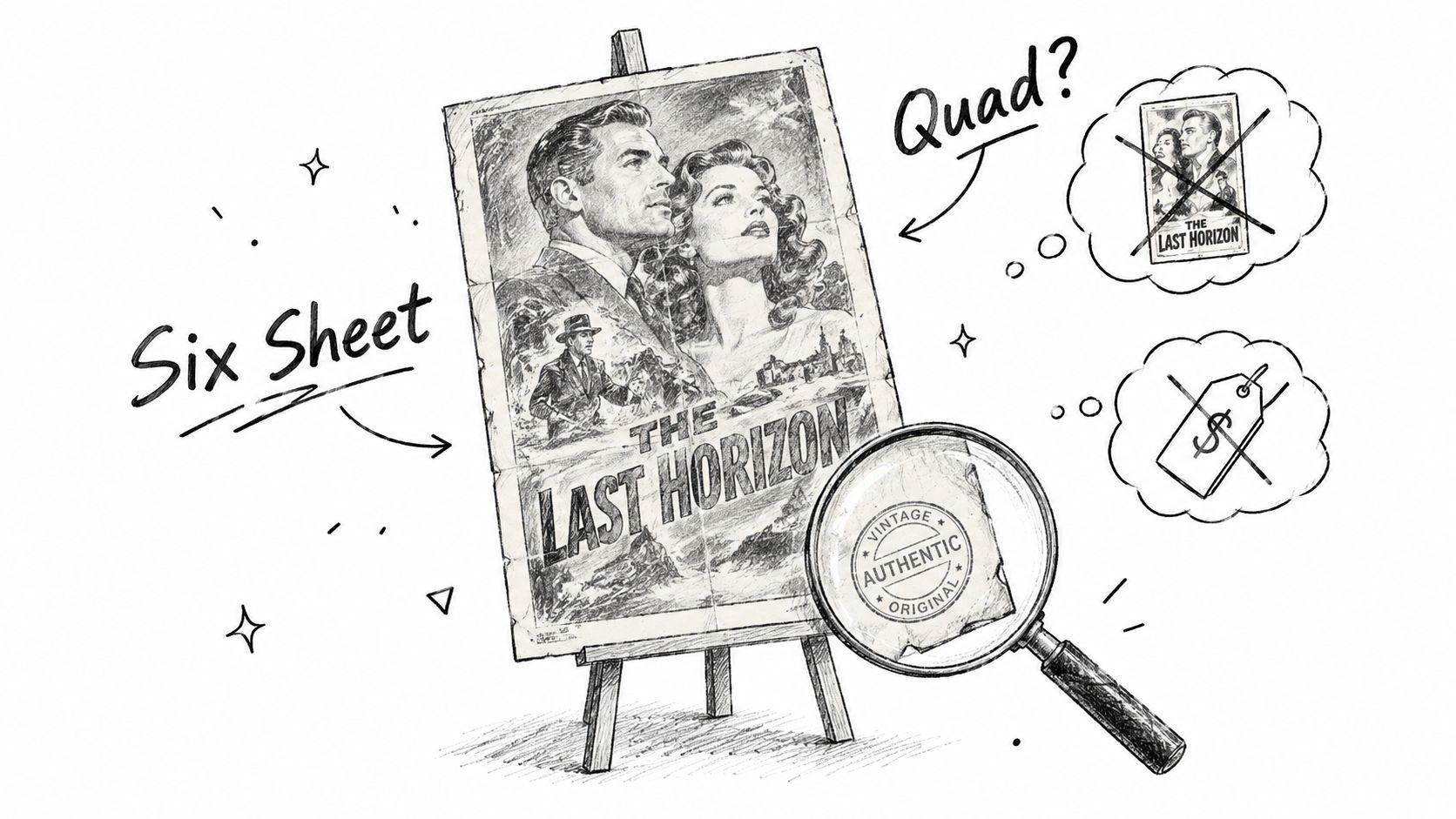
A six sheet is a larger Quad. The formats serve different traditions. A Quad is a recognised UK cinema size with a wide presentation, while a heritage six sheet belongs to a larger outdoor display system and may consist of several panels. Modern advertising also uses the term for a standardised billboard format. Ask: “What are the exact dimensions, and was this issued as a UK cinema six sheet or produced for modern advertising?”
Every large poster described as a six sheet is original. Size proves very little. The item could be a reproduction, digital print or later advertising display. Ask for evidence of date and origin, then request photographs showing the paper, folds, panel joins, edges and any printer information. The UK six-sheet advertising guide helps clarify the modern outdoor meaning of the term, but it does not authenticate a heritage poster.
A six sheet is easy to frame at home. Its scale affects mounting, glazing, wall loading and access far more than a Quad or One Sheet. Ask: “What mounting method do you recommend, and can the framing be reversed without damaging the poster?” A conservation-minded framer should discuss support and future removal before quoting for the frame.
Outdoor use means condition is unimportant. Original display can explain folds, paste marks, staining, edge wear and repairs, but those features still affect value and handling. Request a written condition report, not a general statement such as “good for its age.”
Ask the seller to photograph paste stains and fold lines in straight, even light, with close views and a full view of each panel. The report should state whether marks are surface residue, staining, retouching or restoration. It should also confirm whether every panel is present and whether any joins have been replaced.
If the seller cannot distinguish a modern billboard six sheet from a heritage cinema six sheet, pause the purchase. A reputable dealer should explain the format, issue, completeness, restoration and storage history plainly.
Famous Movie Posters specialises in guaranteed original film and cinema posters, with verified sourcing, archival storage and protective packaging. Visit Famous Movie Posters to browse original UK Quads and other formats, or use its Request a Poster service when the title is not listed.