



You've probably got one or two posters that already live this way. They're in a decent sleeve, they look safe enough at a glance, and they sit inside whatever box was available when you ran out of space. For many collectors, that means a polypropylene sleeve inside an ordinary cardboard carton, a spare mailing box, or a thin under-bed storage case that was never designed for paper worth keeping.
That setup feels sensible until a corner softens, the edge nearest the lid starts to spot, or the whole stack picks up a slight bow from weak support. With original film posters, especially older UK Quads and folded US One Sheets, the sleeve usually isn't the part that fails first. The box is.
Table of Contents
- Why the Box Matters as Much as the Sleeve
- What Makes a Box Genuinely Archival
- Matching the Box to Your Poster Format
- Preparing a Poster Before It Goes In
- Loading and Stacking Posters Inside the Box
- A Long-Term Storage Scenario Five Years Out
- Quick Decision Guide for New Collectors
Why the Box Matters as Much as the Sleeve
A collector buys a decent sleeve, slides in a folded Quad, and files it in the spare carton from a recent print delivery. Six months later the poster still looks clean from the front, but the lower edge has started to ripple and one corner has taken a knock. I see that far more often than sleeve failure.
For original film posters, the box does the heavier work. It carries the weight, resists knocks, limits light, and stops the poster flexing every time the stack is moved. The sleeve is only one layer in that system.
The weak point in most home storage
Home storage usually falls down at the outer enclosure. Ordinary cardboard cartons, reused mailing boxes, and thin retail storage cases are made for transport or short-term tidying, not long-term paper storage. They bow in the middle, soften at the corners, and pass acidity from the board to everything sitting inside for years at a time.
That is where archive guidance becomes useful for private collectors, not just institutions. BS 4971 and UK archive practice are not telling you to build a museum store at home. They are giving you a buying filter. If a box maker cannot tell you what the board is made from, whether it is buffered, or whether it is suitable for paper archives, I would not put a linen-backed one sheet or an unrestored Quad in it for the long haul.
The National Archives advises using boxes or wrappers that prevent contact damage, avoiding overfilling, and filling empty space so contents do not shift in storage or handling (The National Archives storage guidance). That lines up with what happens in the world with posters. Most avoidable damage comes from movement, pressure, and poor support, not dramatic accidents.
Practical rule: if the box bends, sags, or leaves the contents room to slide, the sleeve is only doing part of the job.
A proper box also changes how safely you handle the collection. Pulling one poster from a loose stack in a soft carton usually drags the others with it. In a rigid archival case with sensible capacity, each bundle stays flat and you are not fighting the container every time you want one item.
For collectors, the box has four jobs:
- Separate the poster from poor surrounding materials, including acidic shelves, cartons, and room dust
- Hold the stack flat so edges and fold intersections are not repeatedly stressed
- Reduce handling damage when the box is lifted, shelved, or moved house
- Create a controlled enclosure that works with the sleeve rather than undoing it
This matters even more if the poster will alternate between storage and display. A poster that has been flattened properly and stored in a rigid archival box usually goes into a frame in better condition than one kept in a soft carton, then pulled out every few months. If framing is part of the plan, it helps to understand the trade-offs in movie poster framing choices before you settle on a storage setup.
A good sleeve stops surface scuffs. A good box preserves shape, edges, and handling safety over time. For posters, that is often the difference between something that still presents cleanly in five years and something that has slowly picked up preventable wear.
What Makes a Box Genuinely Archival
“Acid-free” is only a starting point. I see it used on everything from decent conservation cases to ordinary office cartons, and those are not the same purchase. For poster storage, a useful box specification needs to answer three practical questions. What is the board made from, what chemical reserve does it carry, and is it stiff enough to support large paper without sagging at the corners.
The specification that matters
The standards side is fairly clear. BS 4971 and the usual UK archives guidance both point you towards stable enclosure materials for long-term paper storage, not vague retail claims. In practice, for private collectors, the numbers worth checking are a pH in the neutral to mildly alkaline range, lignin-free fibre, and an alkaline buffer, usually calcium carbonate, to help deal with acids that migrate from paper and the surrounding environment.
Good product listings will often go further than “acid-free”. One UK supplier specifies clamshell boxes lined with white lignin-free paper and buffered with 3% calcium carbonate to help protect contents from migrant acidity and atmospheric pollutants (Heirloom clamshell box specification). Another gives similarly useful detail for document cases, listing lignin-free cellulose fibres, a pH of approximately 8.5, and a 3% calcium carbonate buffer (premium document case specification).
That level of detail is what separates an archive enclosure from a box that has borrowed the language.
What I would actually buy for posters
For folded and flat film posters, I usually trust four material types. Buffered archival board. Lignin-free document case board. Blue-grey conservation board from established preservation suppliers. Inert plastics, but only for specific handling-heavy jobs and only when the design does not encourage flexing or edge knock.
If you want to compare what is sold in the UK, a specialist range of Archive Boxes and Storage Boxes makes the difference fairly obvious. Proper archive products tend to publish board composition, pH or buffering information, and intended use. Cheap decorative storage almost never does.
The weak options are familiar. Standard corrugated card can be too acidic and too soft. MDF presentation boxes look tidy but introduce poor materials into a confined space. Generic “art storage” sold with no board spec leaves you guessing, and I do not like guessing with original paper.
| Archival Box Material Specifications for Movie Posters | pH Range | Alkaline Reserve | PAT Pass | Typical Use |
|---|---|---|---|---|
| Buffered archival paper or board | Neutral to mildly alkaline | Calcium carbonate buffer | Check supplier data | Long-term flat storage for paper posters |
| Lignin-free cellulose archive board | Often around pH 8.5 | Often 3% calcium carbonate | Check supplier data | Document cases and clamshell boxes |
| Blue-grey archival board with lined surface | Supplier should state this | Often buffered | Check supplier data | Higher-value flat storage and presentation boxes |
| Corrugated polypropylene or inert plastic box | Not rated in the same way as paper board | None | Check supplier data | Mixed-media storage or frequent handling |
Marketing language versus useful detail
A serious listing should tell you the board type, whether it is lignin-free, whether it is buffered, and whether the box is built for permanent storage of paper. If those points are missing, the word “archival” is doing too much work.
I use a simple rule. If the seller cannot tell you what the board is, I assume they do not know or do not want to say.
Collectors also need to balance conservation ideals against real-world use. A drop-front metal-edge case can be excellent for access and support, but it is heavier and costs more to ship. A lighter archival board box is easier to move and often cheaper, but only if the board weight and construction are good enough for the poster size. For a stack of original UK Quads or US One Sheets, rigidity matters just as much as chemistry. A chemically safe box that bows in the middle is still the wrong box.
Matching the Box to Your Poster Format
A collector buys a Quad at a fair, gets it home, and slides it into the first “archival” box that looks close enough. Six months later, the long edge has a soft wave because the box was built for a narrower format and the poster never sat fully supported. I see that sort of mismatch far more often than actual chemical damage.
Size and support come first. BS 4971 and National Archives guidance point you toward stable materials and sensible enclosure design, but the private collector still has to buy a box that fits the object in the world. For posters, that means checking the internal dimensions, the board stiffness, and whether the box shape suits flat storage or rolled storage.
Start with the poster, not the product category
These are the formats that turn up again and again in UK collections:
| Poster Format to Archival Box Sizing Guide | Poster Size (mm) | Box Internal Size (mm) | Orientation |
|---|---|---|---|
| US One Sheet | 686 x 1041 | About 736 x 1091 to 786 x 1141 | Flat portrait |
| UK Quad | 762 x 1016 | About 812 x 1066 to 862 x 1116 | Flat, horizontal |
| US Half Sheet | 559 x 711 | About 609 x 761 to 659 x 811 | Flat portrait |
| UK Double Quad | 1016 x 1524 | About 1066 x 1574 to 1116 x 1624 | Flat, horizontal |
| US Insert | 356 x 914 | About 406 x 964 to 456 x 1014 | Flat portrait |
| Lobby Card | 279 x 356 | About 329 x 406 to 379 x 456 | Flat portrait |
| Japanese B5 | 182 x 257 | About 232 x 307 to 282 x 357 | Flat portrait |
| Japanese B2 | 515 x 728 | About 565 x 778 to 615 x 828 | Flat portrait |
The usual allowance is 25 to 50 mm on each side. That gives enough room for a polyester sleeve, a folder, or a sheet of interleaving tissue without forcing the lid down onto the edges.
I stay nearer 25 mm for smaller items like lobby cards, where too much spare room just lets the contents drift. For Quads, One Sheets, and anything larger, closer to 50 mm usually works better, especially if the box is opened often.
Where collectors get the sizing wrong
The first mistake is buying by label. “A1”, “art print”, or “document case” often tells you very little about whether a folded One Sheet or a flat Quad will sit properly inside.
The second mistake is checking external dimensions instead of internal ones. Board thickness, drop-front construction, and cloth-covered walls all eat into the usable space.
The third is ignoring depth. A box can be chemically suitable and still be awkward in practice if the stack is either rattling around or compressed under the lid.
If you need a quick mental model for space planning, use the same approach storage firms use for awkward, oversized items. Even a non-collectibles example like this size guide for RV and boat parking makes the point clearly. Dimensions first, assumptions second.
- Too tight: corners catch on the way in, and repeated handling scuffs the edges.
- Too deep: posters shift inside the box, which makes neat retrieval harder.
- Too shallow: the top sheet takes pressure from the lid or from any slight bow in the box top.
Format-by-format buying advice
UK Quads are the format that catches newer collectors out. They are wide, and many boxes sold for One Sheets do not suit them once you account for sleeves and board inserts. Always measure the Quad as housed, not bare.
US Inserts create a different problem. They are narrow and long, so a generic flat box can leave too much side-to-side movement unless you use a fitted folder or spacer board.
Japanese B2s and B5s are easier to house, but cheap document boxes are often overkill in depth and underwhelming in rigidity. For smaller posters, a shallower archive box with decent board weight is usually the better buy.
Oversized formats need honesty. A Double Quad or a large commercial billboard section may demand a custom box, and custom means higher cost, more storage footprint, and harder handling. That trade-off is still usually better than forcing an oversized sheet into a box that flexes in the middle.
Flat storage versus rolled storage
For most paper posters up to Quad size, flat storage is the safer choice. It reduces curl, makes access easier, and avoids the repeated stress of rolling and flattening.
Rolled storage still has a place. It is often the practical answer for oversized material, duplicates, or lower-priority stock that cannot live flat. The problem starts when collectors use a shipping tube as a storage tube.
For long-term rolled storage, use a properly sized archival tube with about 100 mm internal diameter rather than a narrow postal tube. The wider diameter puts less set into the paper and makes retrieval less rough on older stock. If you want a clear comparison between storage tubes and transit tubes, this guide to poster tube packaging explains where shipping materials fall short for long-term housing.
Preparing a Poster Before It Goes In
The box can only preserve what you put into it. If the poster goes in dusty, stressed, taped, or still carrying old housing materials, the enclosure is being asked to solve the wrong problem.
Safe routine versus damaging shortcuts
The safest prep routine is dull, which is exactly why it works. Inspect the piece under clean light, remove nothing that feels structurally risky, and start with dry surface cleaning only. A soft conservation brush is enough for loose dust on most posters.
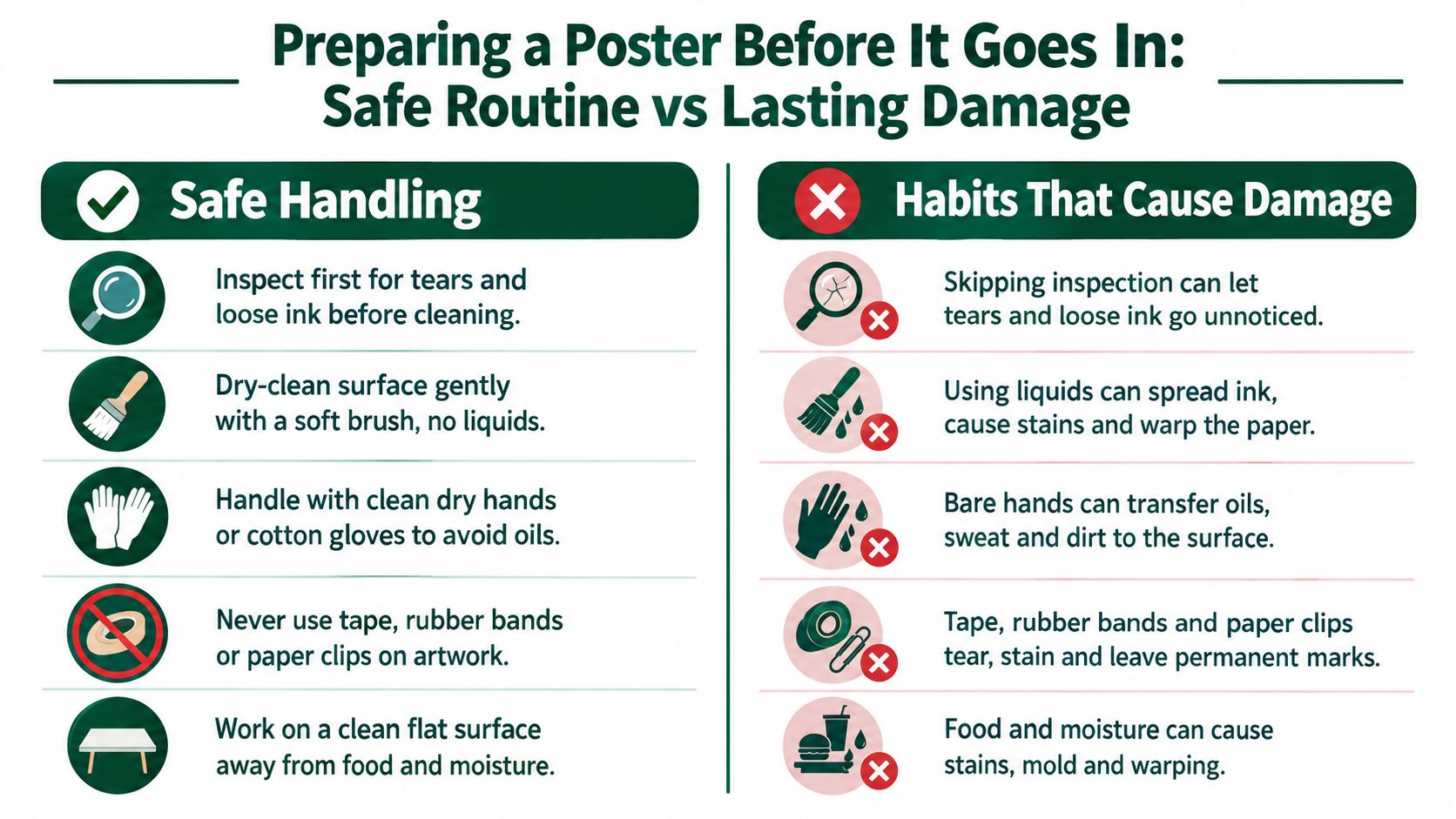
Old glassine, pressure-sensitive tape, rubber bands and improvised paper wraps are often doing more harm than the owner realises. The Archives and Records Association guidance, referenced on a UK archival box listing, also notes that archive materials shouldn't be placed loose in boxes and should first go into a sleeve, envelope or folder before boxing (archival clamshell box guidance).
What I'd do with a freshly unframed poster
Take a poster straight from a frame and put it into a box, and you often trap surface dust, bits of backing board debris, or tension from poor previous mounting. Give it a moment to relax on a clean flat support first.
A sound prep sequence looks like this:
- Check condition first: note tears, lifting folds, brittle corners or flaky ink before any handling.
- Brush, don't scrub: use dry cleaning only unless a conservator is involved.
- Interleave sensibly: acid-free tissue works well as a barrier layer for paper-on-paper contact.
- Keep the bench clean: no drinks, no hand cream, no rough tabletop underneath.
Clean, dry hands are often better than ill-fitting gloves. What matters is control, not ceremony.
Collectors who want a broader baseline routine can compare their setup against this movie poster storage FAQ, especially if they're moving from casual storage into more deliberate long-term care.
Loading and Stacking Posters Inside the Box
Most box damage happens after purchase, not before. The material can be right and the housing can still fail because the stack is too tight, too loose, or loaded in a way that puts the lid onto the artwork.
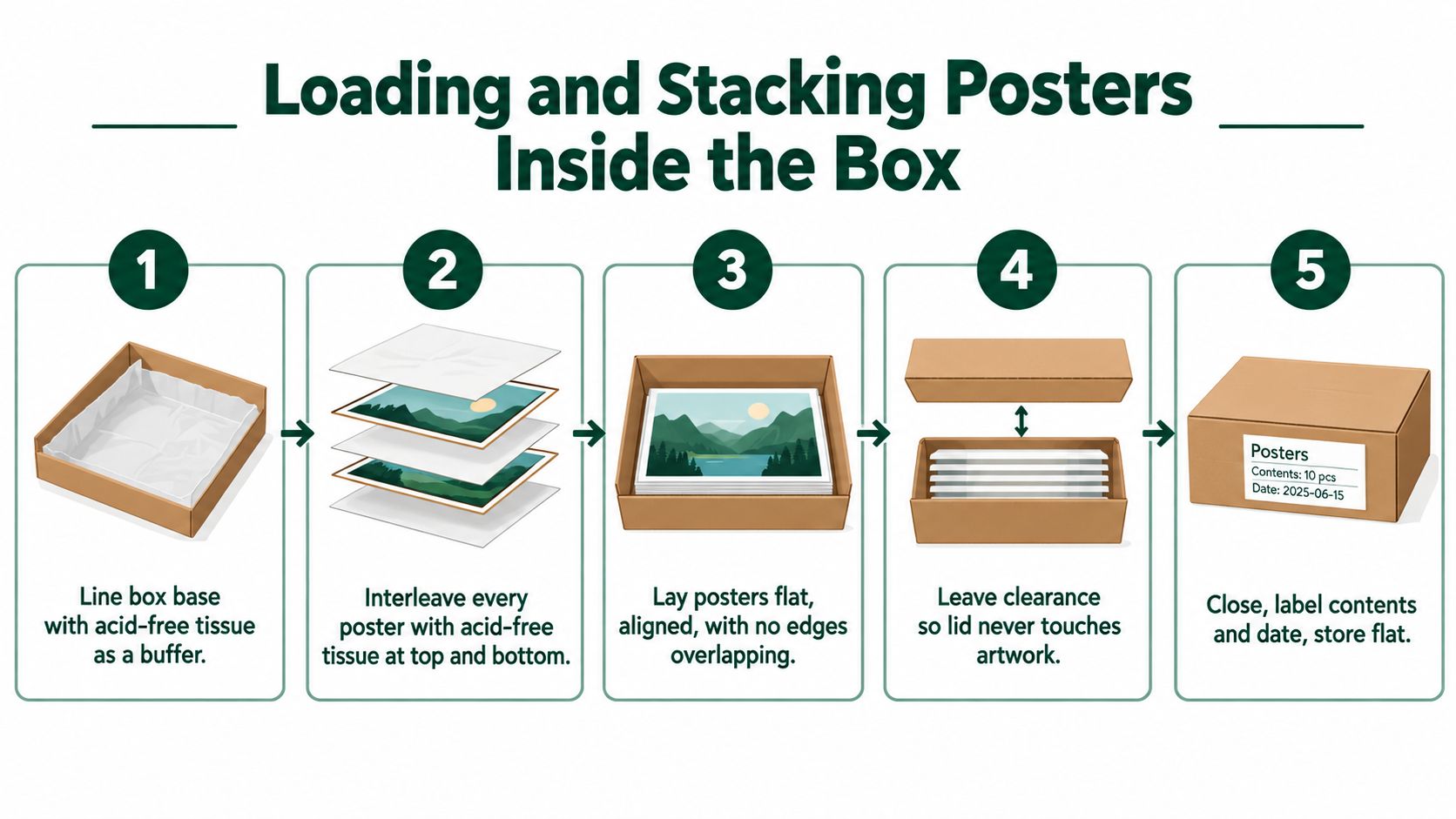
A simple visual workflow helps when you're packing a new box for the first time.
How to build the stack properly
Start with a clean base. I like a sheet of acid-free tissue at the bottom, then the first poster, then interleaving where needed, then another tissue layer at the top of the stack. The point isn't to create a thick sandwich. It's to stop friction and minor surface transfer.
Keep the stack level. Edges should align, no corner should hook under another sheet, and the lid should close flat with space to spare.
Fit and loading discipline matter more than brute capacity
UK archival guidance stresses fit, internal support and avoiding overfilling. It also recommends filling voids with tissue puffs or compartments so contents don't move and notes that conservation-standard boxes can help buffer sudden humidity or temperature changes (Norfolk Record Office packaging guidance).
That translates neatly to poster storage:
- Leave clearance at the top: the lid must sit on the box walls, not on the posters.
- Stop sideways drift: if the box is oversized, use inert support boards or tissue-filled spacing.
- Go easy on stack height: a dense stack saves shelf space but increases compression and handling risk.
- Store flat: don't stand large-format posters on edge inside a box unless the box was designed for that orientation.
For rolled oversized pieces stored in a box, the roll should rest horizontally on a buffered support, not wedge itself against one side. If the poster is fighting the enclosure, the enclosure is wrong.
A Long-Term Storage Scenario Five Years Out
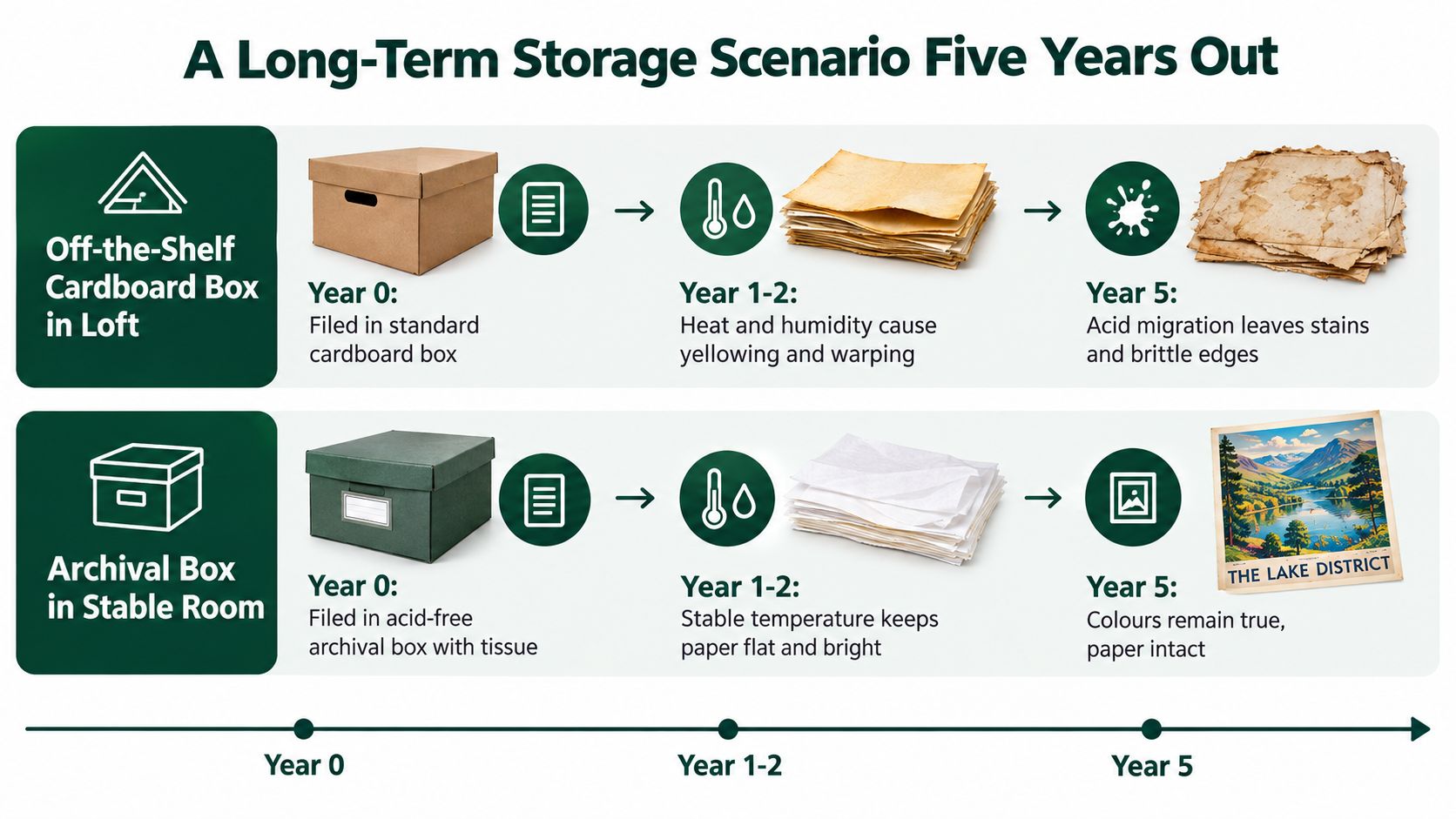
Split the same collection in two and the difference becomes obvious quickly. One half goes into an off-the-shelf cardboard box and then into a loft. The other goes into a buffered archival box and lives in a stable room inside the house.
Five years later, they won't look the same.
What the loft box usually looks like
The ordinary box takes on ambient moisture, dries out again, softens under weight, and transmits every environmental change straight to the paper. The posters nearest the edges often show it first. Browning at the margins, a stale smell, softening of the folds, and a little more resistance when you try to flatten them.
The problem is cumulative. Not dramatic at first. Just enough to turn a crisp paper object into one that feels tired every time it's handled.
What the stable-room box usually preserves
The buffered archival box in a wardrobe or cupboard does a much quieter job. It limits dust, keeps out stray light, reduces handling shocks and gives the paper a chemically safer enclosure.
That sort of storage planning isn't a niche concern in heritage care. A Scottish preservation survey found that 52% of surveyed collections would benefit from widespread boxing or upgraded protective enclosures, and the same report cites a standard box size equivalent to 59 boxes per cubic metre for storage planning (Preservation Assessment Report for Scotland). In other words, better boxes solve both preservation and practical space problems.
Good storage works as a system. The sleeve reduces surface wear, the box controls the enclosure, and the room decides whether all that effort sticks.
At the ten-year mark, skipped steps stop looking like minor compromises. They start showing up as avoidable conservation bills, downgraded condition notes, and posters you no longer want to handle.
Quick Decision Guide for New Collectors
If you're buying your first proper archival storage boxes, the aim isn't to build a museum store. It's to stop making avoidable mistakes with format, material and placement.
The fastest buying checklist I know
Use this before you order anything.
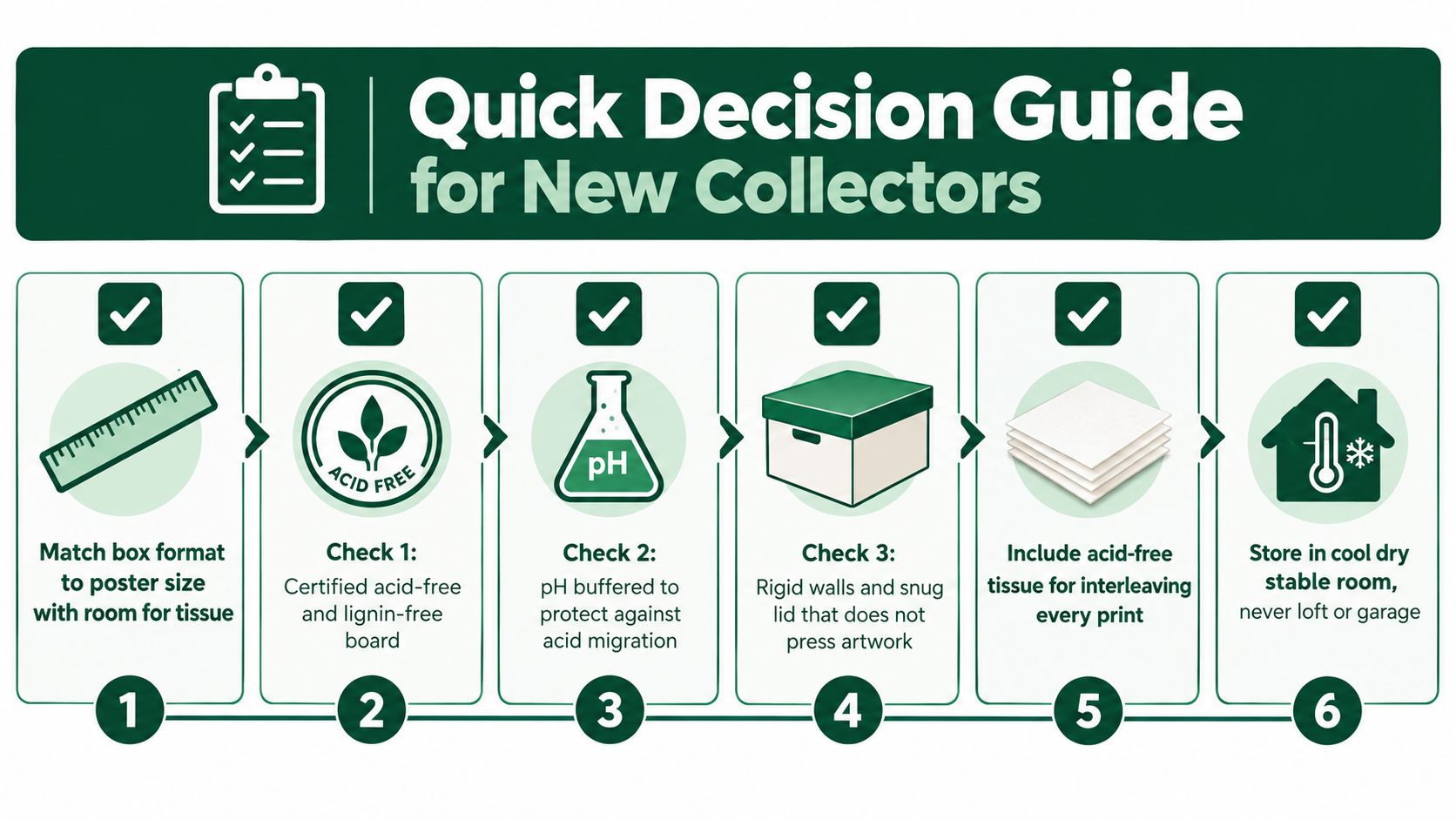
- Match the format first: measure the actual poster, then buy a box with room for interleaving and safe finger clearance.
- Check the board spec: look for acid-free, lignin-free board with a stated buffer. One UK supplier's A-size storage boxes, for example, are made from 1.5 mm thick board with metal edge construction and buffered with 3% calcium carbonate (Preservation Equipment clamshell storage box specification).
- Ignore vague labels: if “archival” appears with no material data, move on.
- Think about handling: a rigid clamshell or metal-edge case is often better for posters you'll access more than once a year.
- Store the poster inside another enclosure first: sleeve, folder or supportive wrap before it goes into the box.
- Choose the room carefully: inside the house beats loft, garage or shed every time.
Flat, rolled or framed
For most collectors, the answer is straightforward.
Flat storage is best for US One Sheets, UK Quads, lobby cards, inserts and similar paper formats when you have the space. Rolled storage is a compromise for oversized items that can't be housed flat. If you must roll, use a broad archival core rather than a narrow dispatch tube. Framing is for display pieces, not long-term backstock.
One practical example from the trade. Famous Movie Posters stores older or higher-value items in PAT-tested flat file boxes with a 3% calcium carbonate buffer, and uses acid-free polyester pockets for selected pieces. That's one workable model for collectors who want to borrow a dealer's storage logic without copying every part of a commercial setup.
The buying rule that saves the most grief
Buy fewer boxes and buy the right ones. A well-sized, properly specified box with breathing room will outperform an overstuffed bargain carton every time.
If you remember only one thing, make it this. The right box is chosen by poster format, board chemistry and handling method together. Not by whether the listing happens to say “acid-free”.
If you're buying, storing or planning to frame original cinema posters, Famous Movie Posters offers guaranteed original film posters across UK Quad, US One Sheet and other formats, along with practical guidance shaped by real handling and storage needs. If you want to compare formats, understand what you're buying, or find posters that have already been housed with preservation in mind, it's a useful place to start.