



You order a B2 film poster online, feel organised for once, and buy the frame before the tube even arrives. Then the poster turns up, you unroll it on the dining table, and something's off. Either the frame opening is too tight by a sliver, or the poster drops in with a border you weren't expecting.
That's the problem with most guides on B2 poster size. They give you the millimetres and stop there. Real buyers need more than that. You need to know what B2 means as a printed object, as a digital file, and as something that has to sit neatly inside a frame in a UK home.
Table of Contents
- What a B2 Poster Actually Means in Practice
- How the ISO B-Series Geometry Works
- B2 Compared to UK Quad and US One Sheet
- Print and Resolution Settings for B2 Posters
- Framing B2 Posters Without the Common Mistakes
- Collector Tips for Storing, Converting, and Displaying B2
What a B2 Poster Actually Means in Practice
A B2 poster gives you a clear paper size to work from, but buying one is rarely as simple as matching two numbers. In UK print terms, B2 is 500 × 707 mm, also commonly shown as 50.0 × 70.7 cm and 19.7 × 27.8 inches (UK POS poster paper size guide).
The part that catches collectors out is what those numbers apply to.
On a printer's bench, B2 usually refers to the finished sheet after trimming. On a product page, it may describe the artwork size the frame is meant to hold. On a frame spec sheet, the visible window can be smaller again because the rebate and mount overlap the edges. Same label. Different measurements. That is why a poster can be sold as B2 and still not show exactly edge to edge once it is on your wall.
A good way to read B2 is as the poster's paper size first, then ask two follow-up questions. Is that the trimmed size, or does the file include bleed? And if you are buying a frame, is the seller giving you the outer frame size, the backing board size, or the aperture you will see?
Where buyers usually get caught out
The mistakes tend to be ordinary ones, not technical ones:
- Buying the frame before checking the poster's true finished size: many collectors assume every B2 poster is cut identically.
- Reading the overall frame dimensions instead of the aperture: the frame may be larger outside but tighter where the poster shows.
- Missing bleed and trim language: a digital file can be set up larger for printing, even though the finished poster is sold as B2.
- Confusing display style with fit: cinema-style presentation often hides a little of the edge, while home framing often aims to show the full sheet.
- Misreading orientation: some listings show 707 × 500 mm rather than 500 × 707 mm. Same sheet, different reading order.
A simple rule helps here. Treat “B2” as the starting size, not the final answer for framing.
That matters most with film posters. Collectors often want the look of a cinema display, where a small amount of the edge disappearing behind the frame does not feel wrong. Home framing is usually less forgiving. If the printer has left a narrow white border, or the artwork runs close to the edge, even a few millimetres of overlap can change how the piece looks.
B2 is popular because it sits in a very workable middle ground. It has more presence than A2, so it reads like a proper poster rather than a large print, but it does not dominate a wall in the way bigger commercial sheets can. For UK homes, that balance is often the reason collectors choose it.
So the practical meaning of B2 is this. It tells you the sheet size. It does not automatically tell you the trimmed image area, the amount of bleed in the file, or how much of the poster a frame will cover. Those are the details that decide whether your poster looks like a clean cinema display or a slightly awkward fit in a ready-made frame.
How the ISO B-Series Geometry Works
B2 comes from a sizing system, not from the film world. That matters because once you know the system, a lot of the odd little buying and framing problems start to make sense.
The ISO B-series is built around one fixed shape. Each sheet keeps the same proportion as it moves up or down the range, so if you halve a larger sheet on its long side, the smaller sheet still has the same overall look. A UK print size guide sets out the chain clearly, starting with B0 at 1000 × 1414 mm and reducing by half through B1, B2, and so on (24K Print paper sizes guide).
The simple way to picture it
The easiest way to see B2 is as part of a paper family where every member has the same shape.
Start with B0.
Halve it and you get B1.
Halve it again and you get B2.
That is why 500 × 707 mm feels precise rather than arbitrary. B2 is the result of the system working as intended, not a poster seller rounding things until they looked tidy.
The proportion behind it is the same square-root-of-two logic used across ISO paper sizing. In plain English, the rectangle keeps its character when it is scaled. For collectors, that explains why a genuine B2 usually looks balanced in a way that random near-matches often do not.
Why collectors should care about the geometry
On paper, this helps printers resize artwork without changing the shape. On your wall, it helps explain why a true B2 can be awkward in frames sold for rounded centimetre or inch sizes.
A frame labelled 50 × 70 cm sounds close. It is close. But it is not exactly 500 × 707 mm. Those missing millimetres are where trouble starts, especially if the frame aperture covers more edge than expected or the poster has a border you want to keep visible.
That is the part many size guides skip. The geometry tells you the sheet shape. Your buying decision still depends on whether you want a cinema-style presentation, where a slight edge cover may be acceptable, or a home display that shows the full sheet cleanly.
Why B2 appears in different units
UK printers, framers, and retailers often describe the same size in different ways. You will see 500 × 707 mm, 50 × 70.7 cm, and a rounded inch version in marketplace listings.
None of those is automatically wrong. The confusion starts when rounded retail sizing gets treated as if it were exact manufacturing size. On screen, that can make one poster listing look interchangeable with another. In a frame, the difference becomes physical.
So the geometry is useful for more than trivia. It tells you why B2 scales neatly in print production, why near-match frames can catch collectors out, and why “close enough” measurements are often where a good display turns into a slightly frustrating one.
B2 Compared to UK Quad and US One Sheet
Collectors often ask for a “film poster” as if that means one universal size. It doesn't. The same title might exist as a B2, a UK Quad, and a US One Sheet, each with a different shape, display style and framing headache.
Here's the side-by-side view that helps when you're deciding what to buy.
B2 vs UK Quad vs US One Sheet
| Format | Dimensions (mm) | Dimensions (in) | Aspect Ratio | Typical Use | Folded or Rolled | Best UK Frame Match |
|---|---|---|---|---|---|---|
| B2 | 500 × 707 mm | 19.7 × 27.8 in | ISO B-series, √2 proportion | Mid-size display poster, art print, promo print | Usually rolled | A frame made for the poster's exact trim size |
| UK Quad | Qualitatively varies by standard UK cinema format | Commonly sold in imperial sizing | Wider cinema poster proportion | UK cinema lobby display | Often folded | A frame made specifically for UK Quad |
| US One Sheet | Qualitatively sold as a taller US cinema format | 27 × 40 in | Taller than B2 | Main US theatrical poster format | Rolled or folded depending on era and seller | A frame made specifically for One Sheet |
The key point isn't just the measurements. It's the shape.
A B2 poster has that clean ISO proportion, so it feels balanced in both commercial and home display settings. A UK Quad is much wider in feel and gives you the classic British cinema-lobby look. A US One Sheet has a different vertical emphasis again, which is why it won't sit naturally in a B2 frame even if it seems “roughly similar” at a glance.
What this means when you're buying
Collectors tend to choose between these formats for four reasons:
- Wall space: A B2 often suits narrower wall runs and smaller rooms.
- Visual style: UK Quads usually deliver the classic British horizontal cinema look.
- Title availability: Some films are easier to find in one market format than another.
- Framing cost and convenience: Matching a poster to a common local frame size is easier when the format is familiar to your framer.
If you're weighing up Quad versus One Sheet specifically, this guide to the difference between a one sheet and a quad movie poster is a helpful companion.
Buy the format that suits the wall and the room, not just the title. A poster you can frame properly gets displayed. One you can't often stays in the tube.
Why B2 often appeals to home collectors
B2 has a strong advantage for domestic display. It gives you more presence than smaller art-print formats without forcing you into the broad footprint of a Quad or the different ratio of a One Sheet. For modern interiors, that balance matters.
It also helps if you're mixing poster types across a collection. A wall of similarly scaled pieces usually looks more intentional than a wall where every frame shape fights the next one.
Print and Resolution Settings for B2 Posters
You buy a poster labelled B2, send a file to print, then wonder why the printer asks for a larger document than the size on the listing. That catches collectors all the time.
The simple answer is that the poster size and the artwork size are not the same thing. For UK print work, B2 is usually treated as 500 × 707 mm once trimmed, but the file you supply needs extra image around the outside so the shop can cut it cleanly. UK print guidance commonly allows 3 mm bleed on each edge, so the working file ends up slightly larger than the finished poster (Go Displays guide to poster and paper sizes).
A good way to picture it is a film still with a safety border around it. The bit you want to keep is the trim size. The extra rim is there so no white slivers appear if the cut shifts by a millimetre or two.
B2 print specifications at a glance
| Setting | Value | Notes |
|---|---|---|
| Finished trim size | 500 × 707 mm | The final poster after cutting |
| Metric shorthand | 50.0 × 70.7 cm | Common retail shorthand |
| Inch shorthand | 19.7 × 27.8 in | Common rounded conversion for UK buyers |
| Bleed | 3 mm on each edge | Extra image area for trimming |
| File setup approach | Larger than finished trim | Build the artwork with bleed included |
| Safe area | Keep text and logos in from the edge | Helps avoid clipped credits or titles |
| Framing check | Confirm trim and visible area separately | Frame apertures can cover edge detail |
That distinction matters more with film posters than many first-time buyers expect. Billing blocks, certificates, studio logos and release credits often sit close to the bottom edge. If your file is set up too tightly, those are the first details that get nipped.
What to send to print
Set the document up to trim size plus bleed, not just the visible poster size. Then keep the important content slightly in from the edge. Printers usually call that the safe area. Framers care about it too, because even a correctly cut poster can lose a few millimetres behind the frame lip or mount aperture.
That is the practical difference between a poster made to look like a cinema display and one made to live happily in a home frame. Cinema display artwork often wants to fill the sheet dramatically, right to the border. Home display usually benefits from a little breathing room, especially if the frame will hide the outer edge.
Home printers are rarely a good fit for B2. The sheet is large, alignment needs to be tidy, and trimming has to be accurate enough that the final poster still behaves like a true B2 once framed.
Resolution, paper and finish
Resolution causes plenty of confusion because people talk about one perfect number as if every file starts from the same place. In reality, the right setting depends on how good the original artwork is and how the poster will be viewed. A clean, well-built file printed at poster scale can look sharp on the wall. A low-quality image stretched up to B2 will still look soft, whatever settings you pick.
Paper choice changes the look just as much as resolution:
- Satin gives a balanced finish and keeps reflections under better control.
- Gloss boosts colour and contrast, but it can throw glare under ceiling lights or glazing.
- Matt suits a softer, art-print look, though colours can appear a little less punchy.
If you plan to frame the poster behind glass or acrylic, gloss-on-gloss can be too reflective for normal rooms. Collectors who want that classic cinema punch often like gloss. Collectors framing for lounges, hallways or bedrooms usually find satin easier to live with.
Lamination also changes the feel. It can help a print stay flatter and tougher to handle, but it can push the result away from the more paper-based character many film poster collectors prefer. That is worth deciding before you order, not after the print arrives.
Framing B2 Posters Without the Common Mistakes
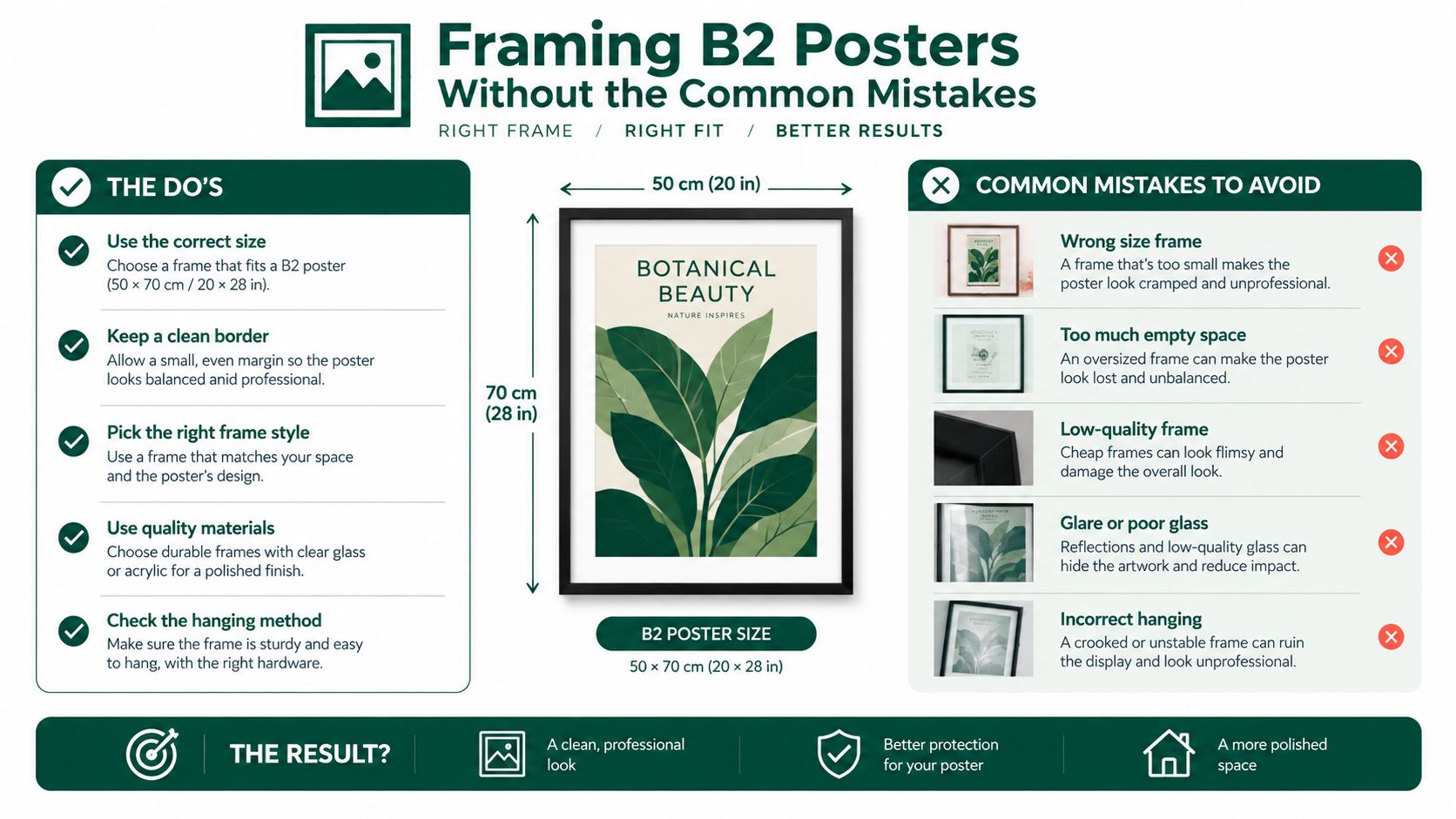
You find a frame labelled B2, the poster arrives, and it still does not sit right. That is a very common UK collector problem because the label on the frame and the actual opening are not always the same thing.
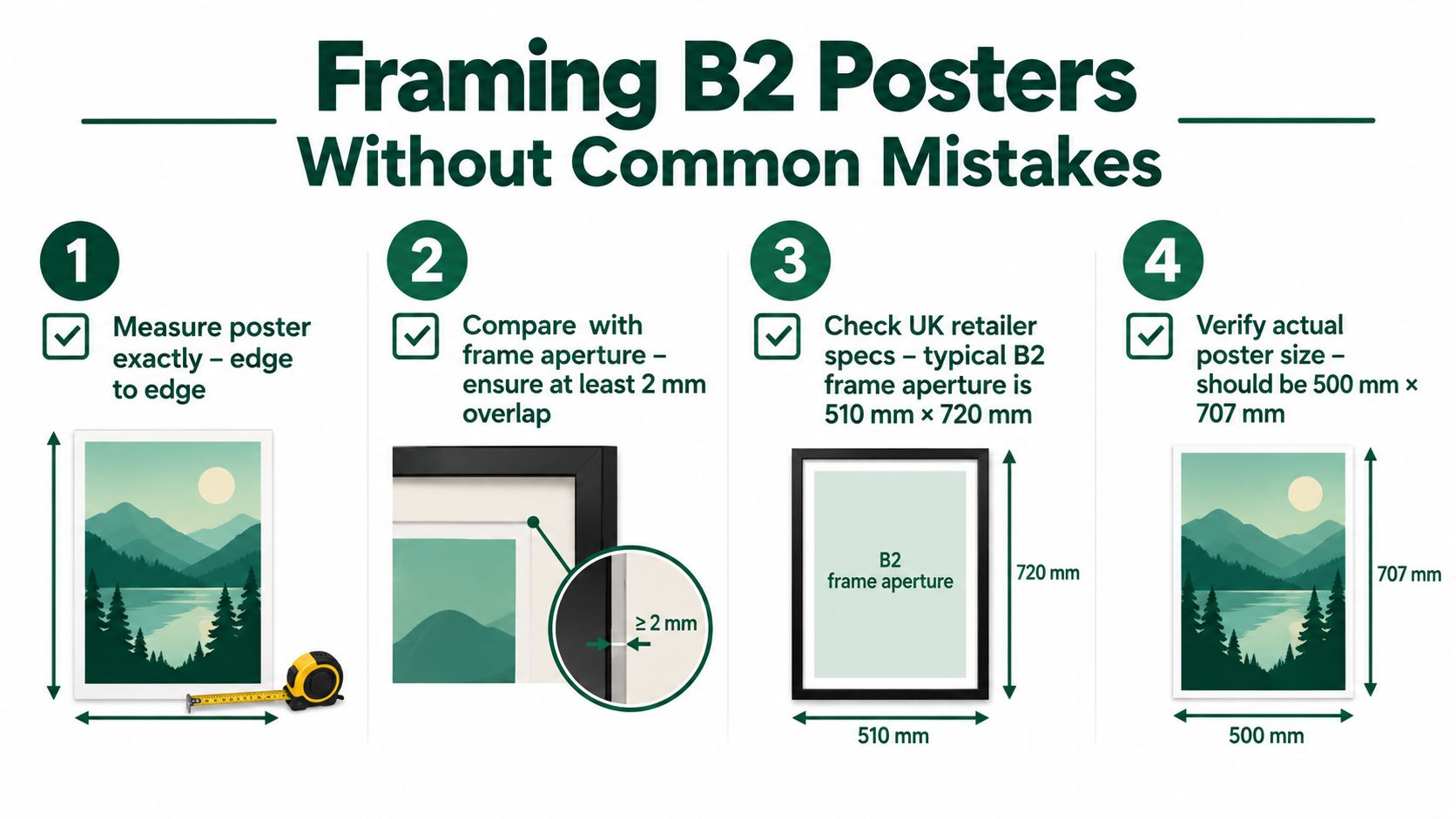
With B2, a few millimetres matter. On paper, the size sounds settled. In a frame, you are dealing with the poster's true trimmed size, the rebate that holds it in place, and the visible aperture at the front. Those are three different measurements. If you only check the name on the listing, you can end up hiding border text, credits, or part of the image.
Measure the poster, then measure the frame opening
A print shop would never frame from the product title alone. Collectors should treat it the same way.
Lay the poster flat and measure the actual sheet edge to edge. Then ask the seller for the visible opening, not just the stated frame size. A frame sold as B2 may still cover more of the poster than you expect, especially if the front overlap is designed to hold the sheet firmly.
Check four things before you buy:
- True poster size: Measure both sides of the sheet itself.
- Visible aperture: Ask how much of the poster will show from the front.
- Rebate depth: Make sure there is enough room for the poster, backing and any mount.
- Orientation: Portrait and landscape listings are easy to mix up, especially on marketplace sites.
A steel rule or tape gives a cleaner reading than eyeballing it against a desk or cutting mat.
Why collectors get caught out by aperture mismatch
This is the part many size guides skip. A frame can be sold under a B2 label, yet the front opening can sit slightly inside that size by design. That small overlap is normal. It helps hold the poster. Trouble starts when the overlap eats into a printed border, a NSS credit block, or a signature in the margin.
That matters even more if you want a cinema-style display at home. Commercial poster displays often hide a little edge area and still look right because they are built to present impact first. Home framing is less forgiving. In a living room or hallway, collectors usually want the whole design to read cleanly, with even borders and no accidental cropping.
The safest habit is simple. Treat "B2" as a starting point, not the final framing measurement.
A better way to order a B2 frame
If you are buying ready-made, ask for the frame's internal size and the visible aperture. If you are using a custom framer, take the poster in and ask for a dry fit before anything is sealed up. That one step catches the usual problems early.
A proper collector-focused guide on how to frame a poster helps if terms like rebate, backing and aperture still feel a bit abstract.
Use this quick check before placing the order:
- Confirm the poster's trimmed size: Do not rely on the listing alone.
- Ask what will be visible: The aperture matters more than the label.
- Check the depth of the frame package: Backing boards and mounts need space.
- Decide on display style: Full-border home framing and cinema-style presentation are not always the same setup.
If the poster is original or valuable, use acid-free backing and avoid any mounting method that sticks tape straight onto the printed surface. Reversible methods give you more options later, especially if you upgrade the frame or sell the piece on.
Collector Tips for Storing, Converting, and Displaying B2
You buy a B2, it arrives in a tube, and the first temptation is to get it on the wall by the weekend. Fair enough. But with paper, the first few days often decide whether it sits flat in the frame or keeps fighting you at the corners.
If a rolled B2 turns up with memory in the sheet, give it time before framing. Lay it on a clean surface, support it with acid-free materials if you have them, and let the curl ease out gradually. Paper behaves a bit like a spring. Force it too quickly and it pushes back, which is how collectors end up with ripples, pressure marks, or corners that never quite settle.

Better habits for long-term storage
Flat storage usually suits original B2 posters better once you have the space. Rolled storage saves room, but the sheet often wants to curl back into the tube, which makes later framing more awkward and increases handling each time you take it out.
A few habits make a real difference over time:
- Use archival sleeves or folders: They help prevent scuffs, edge knocks, and finger marks.
- Store flat where possible: A portfolio, plan chest, or flat drawer puts less stress on the paper.
- Keep posters away from sun, heat, and damp: Light fades inks. Moisture can cockle paper and encourage mould.
- Handle the edges only: Clean dry hands are usually enough, especially on dark areas where marks show quickly.
For more day-to-day care advice, this guide on how collectors store movie posters is a useful next read.
Converting and displaying without expensive regrets
B2 is a real paper size, not just a rough category, so converting it into another format always involves a trade-off. If you trim it, mount it to fit a different aperture, or blow it up to match another ratio, you change more than the measurement. You change what is visible, how the borders sit, and sometimes how the artwork feels on the wall.
That matters most when collectors try to make B2 behave like a UK quad or a US one sheet. On screen, a crop can look minor. In a frame, that missing strip at the edge is obvious. Credits can sit too low, a title can feel cramped, and a design meant for cinema-style display can start to look oddly squeezed in a home setting.
The safest rule is simple. Fit the display to the poster, not the poster to the frame you already own.
Clip frames and magnetic hangers can suit low-value decorative prints, but they offer limited support and protection. A proper frame with decent backing and glazing does more than make the poster look smart. It helps keep the sheet flatter, cleaner, and better protected from day-to-day handling and room conditions.
If the B2 is vintage, signed, limited, or hard to replace, treat it as a paper collectible first. That usually means no trimming, no tape on the printed face, and no rushed workaround just to get it on the wall.