



Search for advice on buying a Black Swan poster and the same line comes back every time: pick the design you love, because the artwork is what you're paying for. For a reproduction above a desk, that holds. For original cinema paper, it's the wrong way round.
The four La Boca designs produced for the 2010 UK campaign are all strong, and several deliberately leave Natalie Portman out of the frame. A buyer who shops by eye alone can pay a premium for the most common variant and walk straight past the scarcer one. Format, side configuration, paper and provenance decide what a Black Swan poster is, and they decide what it's worth far more than the image does.
What follows is written from the paper outwards: the documented UK formats, the four designs, the checks that separate an original from a reprint, what condition really costs, and how to frame and store the thing without undoing its value in the process.
Table of Contents
- Black Swan Poster Formats at a Glance
- The Four La Boca Designs Explained
- Telling an Original From a Reprint
- Condition and Provenance That Move the Value
- Framing a Poster Without Damaging It
- Storing and Preserving a Poster Long Term
- Buy a Verified Black Swan Poster Safely
Black Swan Poster Formats at a Glance
Size first, artwork second. A Black Swan poster sold in the UK is almost always one of two objects, and the product documentation for the cracked-face Black Swan Quad sets out both cleanly: the British Quad at approximately 30 × 40 inches (76.2 × 101.6 cm), printed horizontally, and the British one-sheet at approximately 27 × 40 inches (68.6 × 101.6 cm), printed portrait.
That single difference decides the frame, the wall and what display costs you. A Quad is wide because UK cinema sites displayed posters in wide cases and above foyer entrances, where a portrait sheet reads small and off-centre. A one-sheet needs a portrait frame and less horizontal wall. Order the frame before you confirm the format and you'll be posting it back.
Black Swan poster formats, sizes and frames
| Format | Printed size | Orientation | Frame to use |
|---|---|---|---|
| British Quad, single-sided | 30 × 40 in (76.2 × 101.6 cm) | Landscape | Landscape frame, standard depth |
| British Quad, double-sided (cinema light box) | 30 × 40 in (76.2 × 101.6 cm) | Landscape | Deeper frame, or backlit-suitable frame |
| British one-sheet | 27 × 40 in (68.6 × 101.6 cm) | Portrait | Portrait frame, standard depth |
| Promotional advance one-sheet, heavy stock | 27 × 40 in (68.6 × 101.6 cm) | Portrait | Portrait frame, standard depth |
| US one-sheet (comparison only) | Same width as the UK sheet, slightly taller | Portrait | Portrait frame cut to the measured sheet, not a UK one-sheet frame |
Single-sided and double-sided Quads
The same documentation identifies Black Swan Quads in both single-sided and double-sided versions. Double-sided stock was made for illuminated cinema display, which means printing on both faces and, if you ever want it lit, a deeper or backlight-capable frame. Hold a double-sided sheet to a window and the reverse should carry the mirror image, not blank paper.
That matters to more than framing. Light-box copies were handled by cinema staff rather than pinned to a lobby board, so a double-sided sheet has a different survival profile from a single-sided one. The two aren't interchangeable, and one shouldn't be priced as the other.
Why the US one-sheet trips up UK buyers
A US one-sheet shares its width with the British sheet but runs taller, and listings that quote only a rounded inch figure can describe either object. A portrait frame cut for the UK sheet won't take a taller print without a mat or a bespoke rebate, so a listing that looks compatible on paper can still arrive too long for the frame you bought.
Other territories and promotional sizes exist beyond the rows above, and I wouldn't price or frame against any of them until somebody has put a tape measure on the printed image, border included. Run that tape yourself before you accept a listing's shorthand. For the general rule on telling the two main formats apart across other titles, our explainer on the difference between a one-sheet and a Quad movie poster covers it.
The Four La Boca Designs Explained
The 2010 UK campaign didn't run a single image. It ran four alternatives from the London studio La Boca, built on Art Deco geometry and drawing on Polish and Czech poster traditions rather than Hollywood key art, as Letterboxd's feature on alternative one-sheet design describes. Four designs is an expense a distributor only accepts when the release looks big enough to carry it.
Black Swan's documented UK lifetime gross was $26,014,490, placing it 376th on Box Office Mojo's UK table for 2010. That's the commercial case for a multi-design campaign: enough UK admissions to justify printing and distributing several artworks instead of one, and enough public awareness that people would recognise the film from shapes rather than faces.
Dealers catalogue the set under four titles: "Black and Red Dancer", "Dancer Merged with Swan", "White Dancer in Black Swan" and "Face in Swan". A full set of four La Boca Black Swan posters is the quickest way to see what a complete group looks like before you try to build one piece by piece.
The visual grammar is flat colour, hard edges and a dancer assembled from shapes, a look with older roots in painted street architecture like this.

What the catalogue records, and what it leaves open
Vintage Movie Posters' catalogue entry for Black Swan records three UK Quads measuring about 30 × 40 inches and one British one-sheet measuring about 27 × 40 inches in the complete set. That's the most useful sentence in the whole paper trail, because it tells you the set isn't four identical things. The same entry identifies a final-style Quad carrying credits and critic reviews, and a 27 × 40-inch La Boca one-sheet sold as a promotional advance printed on heavy stock.
What the record doesn't do is tie each named design to one format. Nothing in it says "Face in Swan" is only a Quad, or that the advance is always the one-sheet. Treat design and format as two separate questions until a seller's own record answers both.
Reading a listing against the record
The check I'd make first: ask for the printed image size in centimetres, the number of printed sides, and the artwork title. A reply that answers all three in writing is worth more than every photograph in the listing.
Say a listing shows a portrait item in the "Dancer Merged with Swan" artwork, described as double-sided and 27 × 40 inches. Two of those details can be checked against documented UK examples. The third can't, because the record doesn't map that design to a format. That gap is a reason to ask a question, not evidence of a fake. An unfamiliar official variant is far more common than a forgery of a 2010 poster, and the campaign's habit of dropping the star from the artwork makes unfamiliar variants routine.
Match design, format and side configuration to a documented example before you judge a listing on anything else. Where a detail can't be placed at all, write it down and price the poster as though it's unknown.
Telling an Original From a Reprint
Run the checks below in this order. Each one costs you less than the next, and the first three settle most listings before paper quality comes into it.
Measure, then look at the reverse
Start with a tape measure on the printed image, border included, and compare it against the documented UK sizes. A sheet that matches neither format, or that has a border trimmed along one edge, is a problem before you look at the art. Then check side configuration: hold the poster to daylight and confirm the reverse carries the mirror image if it's sold as double-sided, or plain paper if it's single-sided. A "double-sided" claim with a blank reverse is the most common mismatch in online listings, and it's the easiest one to catch.
The checklist below condenses the sequence into the order that saves you the most time.
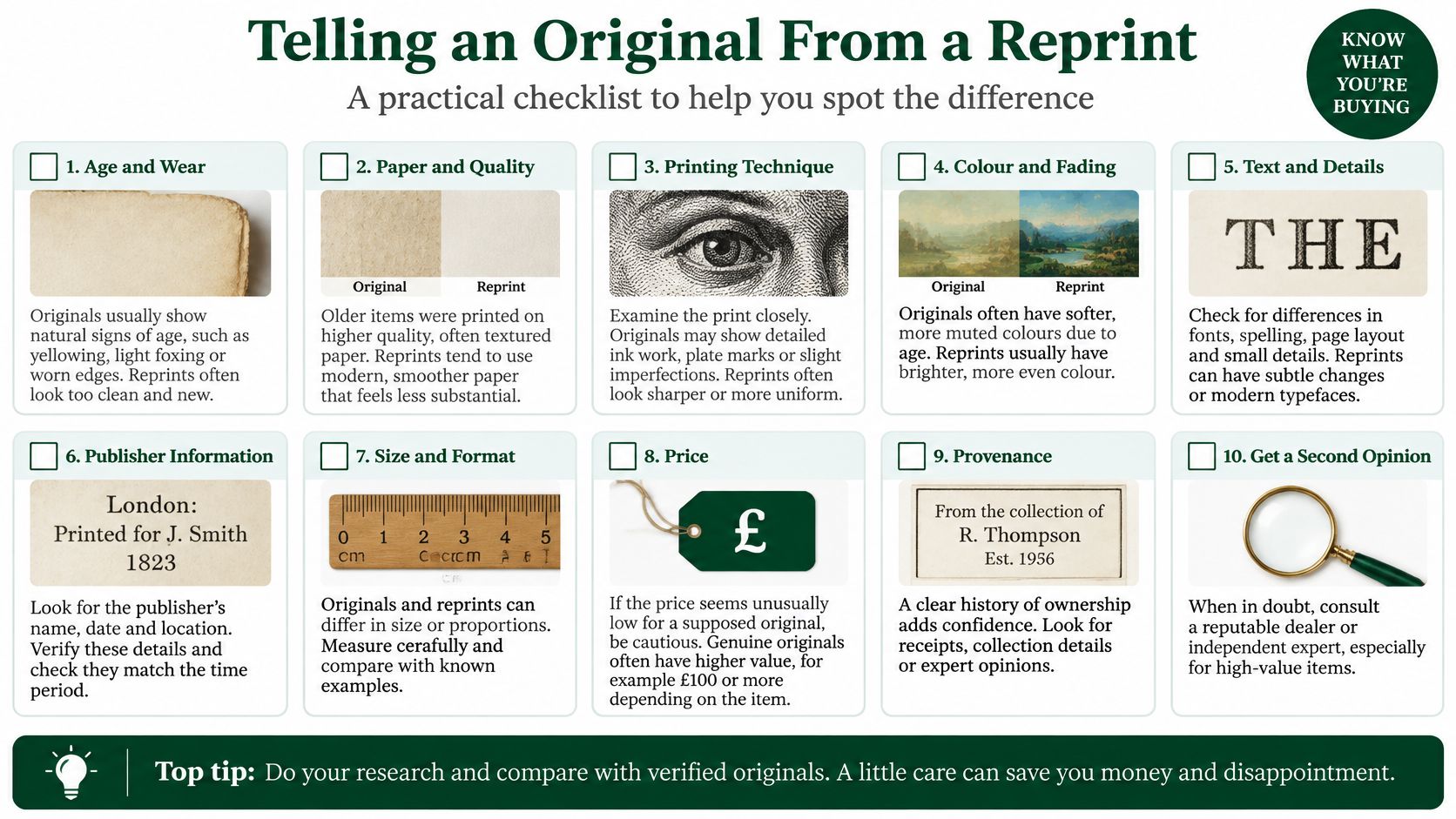
Check the artwork, the billing and the paper
Confirm the design is one of the four documented La Boca images. Then look at the credits block and critic quotes, because a final-style Quad carries credits and reviews while a promotional advance one-sheet was printed on heavy stock. Thin, soft or shiny paper on a sheet described as an advance is a warning, not a bargain. Print quality tells you more than colour does: sharp registration, solid black and clean type edges are what a 2010 offset run produces, while soft dots under a loupe, muddy edges and flat patches point to a scan printed later.
Photographs hide almost all of this. Ask for a close-up of the credits block and a shot of the sheet held to a window, then judge the paper from those rather than from a wide shot on a wall.
Hold the listing against the release record
The BFI's film record for Black Swan gives you a fixed documentary anchor: a 2010 release, classified 15 by the BBFC, with a running time of 107 minutes and 59 seconds. A listing that claims a later release, a different certificate or a streaming-era origin needs an explanation before money changes hands. Use the record as a reference point rather than as proof of anything by itself, since it tells you about the film and not about the sheet in front of you.
Authentication checks for a Black Swan poster
| Check | What an original shows | Warning sign |
|---|---|---|
| Format and size | Dimensions matching a documented UK Quad or one-sheet | Size that matches neither, or a trimmed or added border |
| Side configuration | Printing on the side the variant was produced for | Double-sided claim with blank reverse, or the reverse for a single-sided print |
| Artwork variant | One of the four documented La Boca designs | Artwork absent from every documented UK set |
| Credits and billing | Credits and critic reviews matching a documented final-style example | Missing or mismatched billing block |
| Paper and print quality | Heavy stock on advance prints, sharp registration, solid colour | Thin or soft paper, soft dots, flat colour |
| Release record | Release details matching the 2010 UK record (15 certificate, 107 min 59 sec) | Claimed date or certificate that does not match the record |
No single check settles it
A poster passes when format, side configuration, artwork, credits and paper all line up on a documented example. Any one of those can be misread in a photograph or faked outright, so don't let one strong signal carry the decision. A listing that shows a striking image and no measurements has told you nothing you can verify.
The same discipline applies across the rest of the market. Our guide to identifying original movie posters in the UK sets out the wider checks that sit behind these six.
Condition and Provenance That Move the Value
Ask what a Black Swan poster is worth and the honest answer starts with the paper, not the artwork. Condition moves value more than any other single factor, and it moves it in ways buyers underestimate until the sheet is out of the tube.
Folds, creases and rolled storage
A single fold across the middle is normal for UK cinema paper of this era and isn't damage. Multiple folds, heavy creasing and long-term rolled storage are different: paper that has spent a decade rolled develops persistent cockling and won't lie flat after weeks under weight. That affects display as much as price, because a rippled sheet shows in a frame no matter how good the mount is. Fold lines are a fact of the format; crushed edges and a wave through the middle are not.
Tears, restoration and disclosure
Tears reduce value more than light edge wear, because they're visible in a frame and expensive to reverse properly. Tape, backing paper, trimmed borders and touched-in colour cost more than the repair saves when they're disclosed late, and they damage trust even when they're invisible from the front. Ask directly whether the poster has been restored, trimmed, backed or taped, and keep the reply.
What a seller doesn't mention is worth as much as what they do. A one-line answer that confirms no restoration and no trimming is a document you can hold them to later.
Provenance and scarcity
Provenance is the paper trail: a documented cinema or promotional source, a seller with a history, a catalogue or auction record naming the variant. A poster with a documented source is a different object from one with a good story, and it prices differently. Scarcity sits alongside it. The complete four-design set is rarer than any single campaign poster, so a full set and a single design aren't the same decision and shouldn't share a price assumption.
The research gives no verified price range for Black Swan posters, so build your own from recent sold records of the same format, variant and condition. Asking prices tell you what sellers hope for. Sold records tell you what buyers paid.
Condition and provenance factors and their effect on value
| Factor | What to check | Effect on value |
|---|---|---|
| Folds and creases | Single fold or multiple folds, rolled storage | Multiple folds and rolled storage reduce value |
| Edge wear and tears | Corners, margins, tears | Tears reduce value more than light edge wear |
| Restoration and tape | Repairs, backing, tape marks | Undisclosed restoration reduces value and trust |
| Variant scarcity | Whether the design is one of four in the set | Confirm against recent sold records for that design before paying a premium |
| Provenance | Documented cinema or promotional source | Documented provenance supports value |
| Print specification | Heavy stock on advance prints, single or double-sided | Affects scarcity; confirm against documented examples |
Record condition with dated photographs before you buy, covering the whole sheet plus close-ups of every flaw. Then keep enjoyment and investment apart. A poster bought to hang in a hallway is judged on how it looks on the wall; one bought as a store of value needs documented condition, documented provenance and steady demand, and nothing in the record shows Black Swan prices rising.
Framing a Poster Without Damaging It
A frame does not protect a poster by being expensive. It protects it when the format, depth, glazing and mount all agree with the sheet inside.
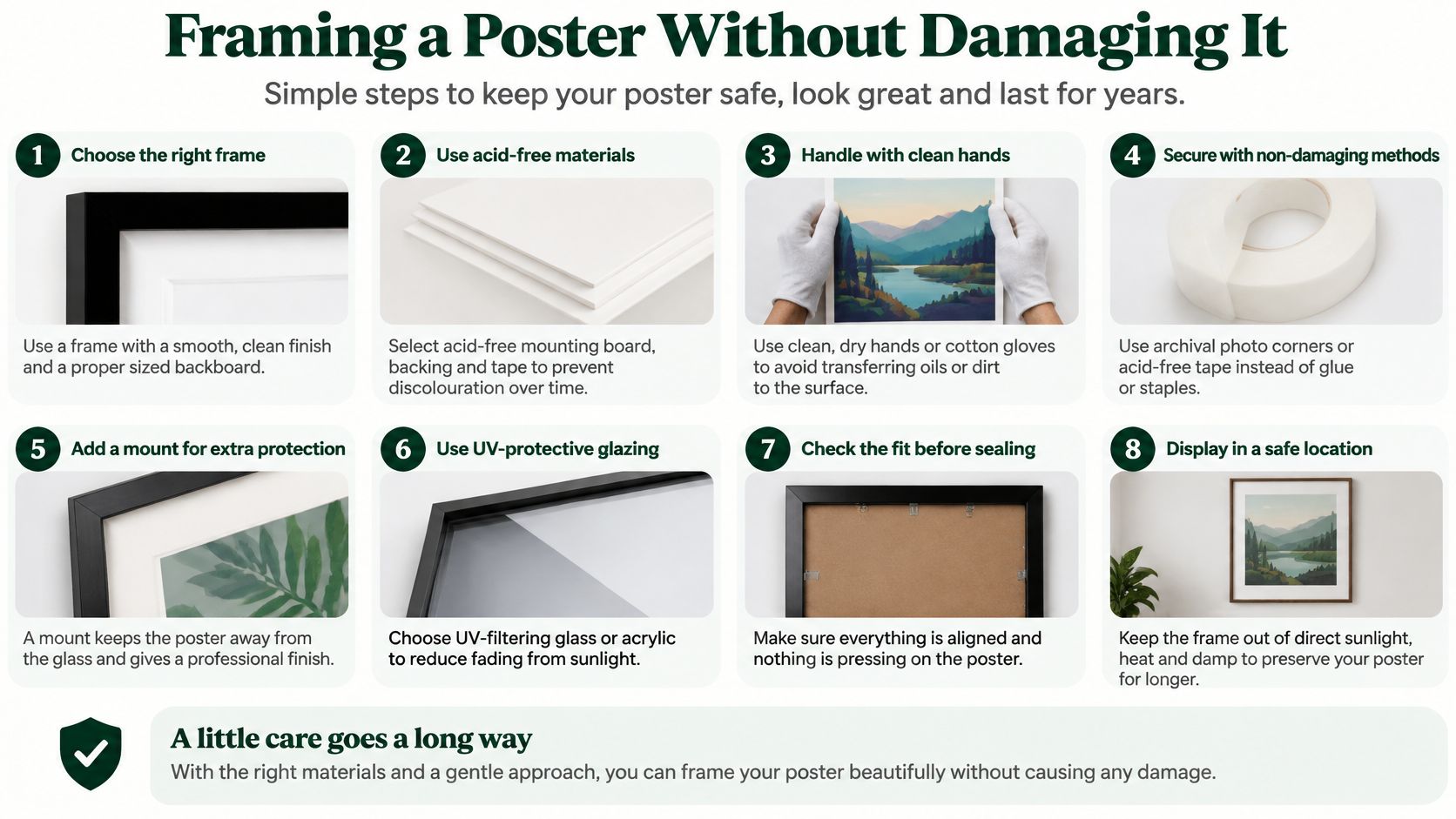
- Match the frame to the format. Horizontal for a British Quad, portrait for a one-sheet, including the advance. A mount can make a smaller sheet sit correctly inside a larger frame; it cannot turn a portrait sheet into a horizontal one.
- Settle the depth before you choose a moulding. A light-box Quad needs a frame built for backlighting, because fixing it against opaque backing removes the point of that format. If backlighting is not the plan, standard depth is cheaper and does no harm.
- Choose glazing for the room. UV-filtering glass or acrylic slows fading from daylight. Acrylic is lighter on large frames but can carry static, which matters with dry mounts and loose dust, so keep the frame off a south-facing wall either way.
- Leave an air gap. The paper should never touch the glazing. Acid-free mount board and spacers keep condensation and abrasion off the surface, and they are the cheapest insurance in the whole job.
- Flatten before you frame. Modern poster paper is thick and can hold a roll for weeks. Lay the sheet face up between acid-free tissue and board, weight it evenly, and check it every few days rather than forcing it into a frame while it still curves.
- Inspect the frame a week later. The poster should sit flat with no rippling and no contact with the glass. Ripples mean the mount is too tight; contact means the spacers are not doing their job.
The framing sequence as a visual summary:
Where there are tears, old tape or a rare sheet, hand it to a conservator instead of flattening it at home. A home flatten applies pressure you cannot control, and on damaged paper that turns a small tear into a longer one.
Mount choice changes the look of any framed piece, not just cinema paper. If you frame other things too, these equestrian photo frame gift ideas show how much the mount and frame pairing does to the finished result.
Storing and Preserving a Poster Long Term
The BFI National Archive's paper conservation work treats film posters as archival paper, held with scripts, designs and sketchbooks in its Screencraft collections and cared for by a dedicated paper conservator. That's the standard to aim at, scaled down for one sheet in a spare room.
The same archive's collections team guidance identifies cold, dry conditions as necessary for long-term preservation and notes that excess heat or moisture accelerates chemical deterioration. It also makes the case for acting early, because intervention after damage is harder and more costly than prevention. A 2010 poster is newer than pre-war paper and still creases, abrades, fades and cockles in the wrong room.
For UK homes that means keeping sheets out of lofts, garages, basements and any room beside a radiator, where damp and temperature swings do the damage over a winter. If your own space can't hold a stable environment, this explanation of climate-controlled storage and humidity control sets out the conditions worth asking a storage facility for.
The kit is straightforward: acid-free polyester pockets or archival sleeves, a flat box that supports the whole sheet rather than one edge, and interleaving tissue between posters. Our own stock is held flat in PAT-tested flat file boxes with a 3% calcium carbonate buffer to keep the environment alkaline, with premium items in acid-free polyester pockets. Keep sheets flat rather than rolled wherever you can.
Record condition before anything goes into storage: folds, edge wear, tears, tape, pinholes and any restoration, all photographed with a date. Then run a short routine. Check the store every few months for damp, keep sleeves closed, handle the poster with clean dry hands and support it by the edges. Our guide to storing movie posters covers the day-to-day version.
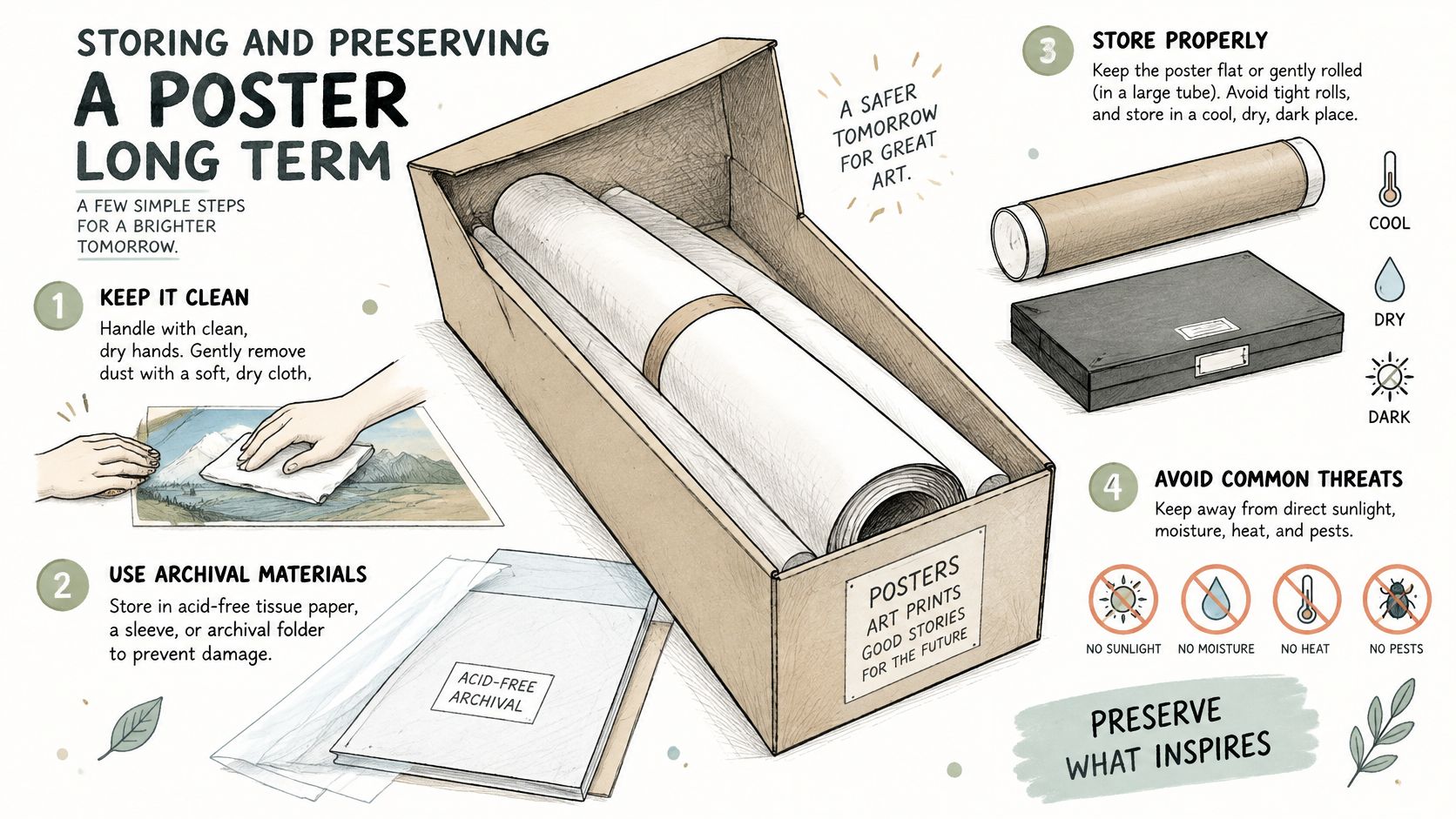
When damage is already there, a conservator is the right call rather than a home repair. Collection-grade care is a specialist job, which is exactly why the archive employs someone to do it.
Buy a Verified Black Swan Poster Safely
Buying comes after the checking. By the time you're ready to pay, the format, the design, the side configuration and the condition should all be written down, and the poster should already have passed the checks above.
Where to buy, and what each route is good for
- A specialist seller with verified originals: the strongest option for a first purchase, because the format should already be described accurately and there's a record to fall back on.
- A sourcing service for a specific title: useful when you want one design in one format and it isn't listed anywhere. We run a Request a Poster service for exactly this, drawing on sources for posters from all over the world.
- Auction and private sales: worthwhile when documented provenance comes with the lot, and risky when the only evidence is a photograph and an asking price.
Whoever you buy from, get the same six answers in writing: printed image size in centimetres, number of printed sides, artwork title, presence of a credits block, any restoration or trimming, and the source of the poster. A seller who can't answer three of those isn't a seller you should be sending money to. Written replies also give you something to hold the sale against later, which a listing photo never does.
Inspect the parcel before you frame anything
UK distance-selling rules give buyers a statutory right to cancel within 14 days of delivery, so the window for sending a poster back is real but short. Each seller's returns policy sits on top of that right, and the details differ. A published example such as the BFI shop's terms and conditions shows how a retailer sets its own refund conditions and states that goods become the customer's risk from the point of delivery, so read the current policy before ordering rather than assuming a standard arrangement.
The practical translation is simple. Open the parcel the day it arrives, keep the protective packaging, and photograph the tube, the sleeve and the poster itself before you do anything else with it. A valuable original is a poor thing to discover a problem with three weeks after the returns window has closed.
The decision that saves the most money
Verify first, buy from a seller whose sourcing you can check, and keep the packaging until you've inspected the sheet in daylight. Write down the title, format, side configuration and condition you're looking for, then compare what you're offered against the format table before you commit.
Two minutes with a tape measure and a written reply beats any amount of confidence in a listing photo.
Famous Movie Posters sells only guaranteed original cinema posters, so the sheet you order is the sheet that was printed for the campaign rather than a later copy. If the Black Swan design or format you want isn't listed, the Request a Poster service will chase it through trusted partners, and orders ship to nearly every country in protective, size-matched packaging. Visit Famous Movie Posters to see what's in stock or to ask for the variant you're after.