



You've found a Black Widow poster with the artwork you want, the price looks reasonable, and there's already a frame waiting at home. Then you notice the listing says Quad, while another seller calls what looks like the same poster a One Sheet. Before you buy, establish exactly what's being offered, because format, theatrical provenance and condition matter more than a familiar image.
For a UK collector, the strongest purchase isn't necessarily the biggest sheet or the cleanest-looking print. It's the poster whose dimensions, printing, campaign details and ownership history support the seller's description, and whose format suits the way you'll display it.
Table of Contents
- Black Widow Poster Sizes and Formats Compared
- Telling an Original From a Reprint
- The 2021 UK Release Behind the Posters
- How to Verify a Black Widow Poster Before You Pay
- What a Black Widow Poster Costs in 2026
- Framing and Storing Your Poster Safely
- Confirm the Format and Terms Before You Buy
Black Widow Poster Sizes and Formats Compared
A frame you already own can make a listing seem like an easy purchase. But Quad isn't another word for a large poster: it identifies a British horizontal format, rather than the portrait format many buyers associate with cinema advertising.
The standard dimensions below distinguish the formats; Tordoff's Black Widow product record documents the approximately 30 × 40-inch British Quad, the approximately 27 × 40-inch One Sheet, and a double-sided Quad intended for light-box display.
Black Widow poster formats and display needs
| Format | Dimensions | Orientation | Display and frame |
|---|---|---|---|
| US/International One Sheet | About 27 × 40 in (69 × 102 cm) | Portrait | Portrait frame, narrower than a Quad |
| UK Quad, single-sided | About 30 × 40 in (76 × 102 cm) | Landscape | Wider landscape frame with glazing or archival mount |
| UK Quad, double-sided | About 30 × 40 in (76 × 102 cm) | Landscape | Light box or backlit display; check before choosing glazing |
These are standard format dimensions, not permission to assume that every advertised sheet measures correctly. The seller should confirm the actual paper size, including its margins, rather than quoting the dimensions of the image file or a frame shown in a photograph.
Orientation changes the purchase
A Quad gives the artwork a broad, horizontal presentation. A One Sheet suits a narrower wall or a portrait-oriented Marvel display, so neither is automatically the better choice.
Putting a One Sheet into a Quad-sized frame doesn't make the formats interchangeable. You'll need a deliberately designed mount, otherwise blank margins or uneven spacing can make the finished display look accidental. Never trim an original to rescue a mismatched frame.
The guide to the difference between a One Sheet and a Quad movie poster is useful when a seller uses those terms loosely. Read the format description before judging whether the artwork will suit your wall.
Read the printing description too
Double-sided describes the printing, not a second collectible poster attached to the first. Cinema light-box printing uses the reverse image to support the appearance of the illuminated front; it isn't intended to be viewed as two independent designs.
A double-sided poster can still be displayed without illumination. However, you should decide between conventional framing and backlighting before choosing the backing and mounting arrangement.
Before ordering: Measure the frame's usable opening, not its outside edge, then ask the seller to confirm the sheet's dimensions and whether it's single-sided or double-sided.
Telling an Original From a Reprint
A reprint is a reproduction printed to look like an earlier poster. Some sellers label reproductions clearly; others leave the description ambiguous or wrongly offer them as original cinema material.
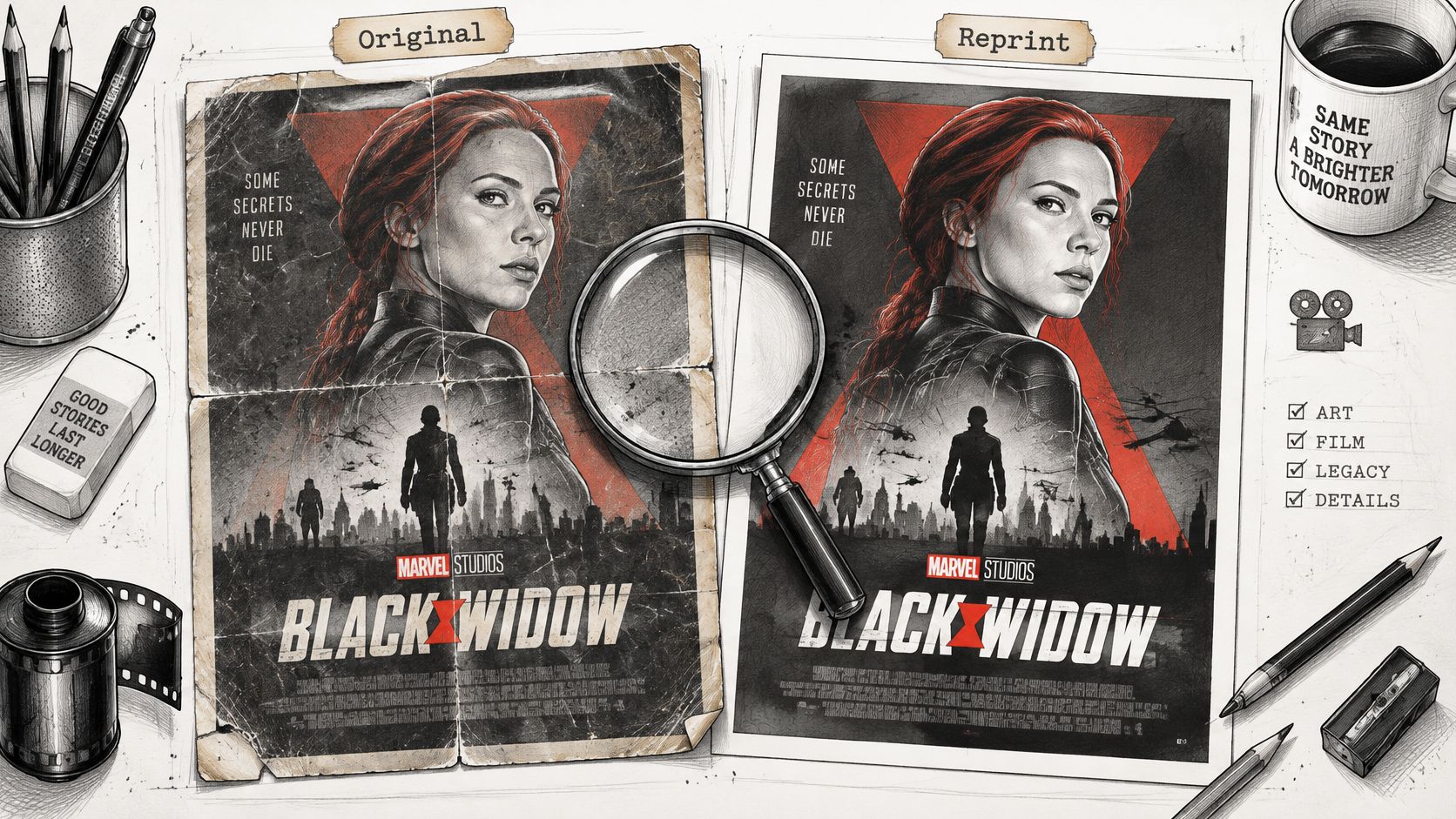
Think of a reprint as a cover version of a record: the tune is recognisable, but it isn't the same recording. With posters, those differences appear in the paper, printing, margins and production history rather than the central artwork alone.
The comparison image illustrates why appearance deserves scrutiny, but artificial ageing and digital restoration make photographs an unreliable verdict on their own.
Use several clues together
Typical signs of an original versus a reprint
| Check | Typical original | Typical reprint |
|---|---|---|
| Printer credit and date line | Small print in the bottom margin, often with printer name and year | Missing, cropped or blurred |
| Paper | May have heavier stock, age-related toning or softness | May be thin or uniformly bright, sometimes glossy |
| Print pattern under a magnifier | Commercial halftone dots; wear may interrupt the printed surface | Fine inkjet dots or pixel-like patterns on some reproductions |
| Size | Matches the advertised theatrical format | Often slightly off, or trimmed to fit |
| Edges and folds | Handling marks consistent with its stated cinema and storage history | Crisp factory folds or no supporting handling history |
Treat these as prompts for inspection, not authentication rules. Genuine modern cinema posters can be bright, smooth and relatively lightweight, while a reproduction can copy credits, dimensions and commercial printing techniques convincingly.
Original campaign posters were produced in batches for distribution. Their paper and finish should be consistent with the particular edition, not with a general idea that valuable posters must feel thick or look old.
The same caution applies under magnification. Age doesn't turn a regular halftone screen into an irregular printing process, although abrasion or deterioration can interrupt what you see. A magnifier is most useful when comparing the suspect sheet with a reliably identified example of the same design and format.
Clean condition isn't evidence of fakery
A carefully stored, unused original may have sharp corners and no folds. Conversely, a reproduction can be creased, rubbed or stained deliberately, so wear only helps when it agrees with the claimed handling history.
Look closely at the billing block and logos. If the main artwork looks sharp but the smallest lettering dissolves into a blur, the seller may be offering a reproduction made from an inadequate image, although a poor listing photograph can create a similar impression.
A pristine poster isn't automatically a reprint, and a battered poster isn't automatically an original.
Printer credits also require judgement. Not every legitimate campaign design carries a conspicuous printer's name, and a copyright line identifies rights information rather than proving when that particular sheet was printed.
A disclosed reprint is a perfectly reasonable decorative purchase. The problem is undisclosed reproduction sold as original, particularly where the asking price depends on a theatrical history the seller can't support.
The 2021 UK Release Behind the Posters
A seller may describe a poster as original British theatrical campaign material. Check whether its wording fits the UK cinema release, rather than a later home-entertainment edition or another territory's campaign. For a UK poster, release context and orientation help establish where it belongs and how to display it.
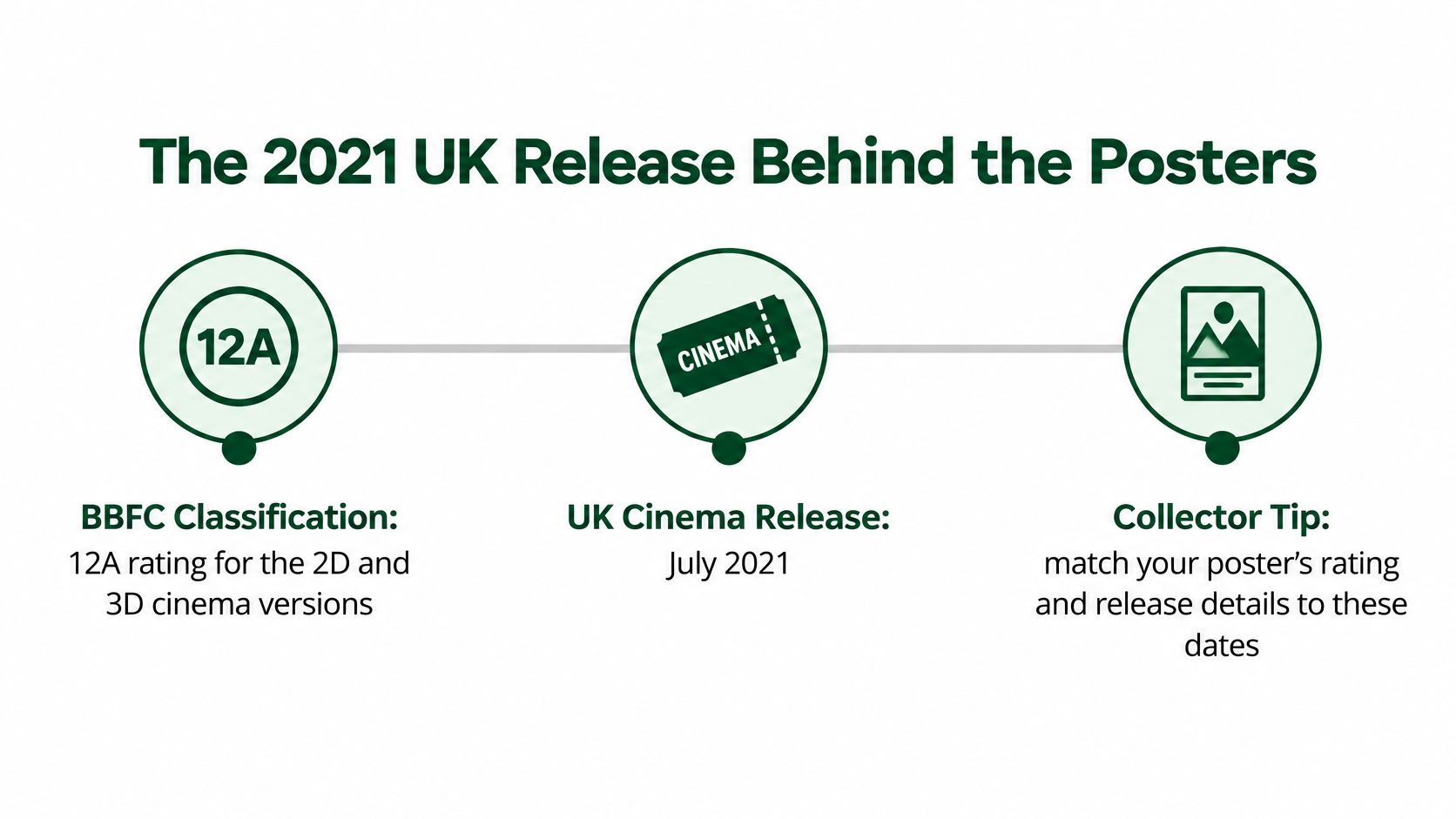
The British Board of Film Classification release record dates classification of the 2D and 3D cinema versions to 29 June 2021, gives a 134-minute running time, and identifies moderate violence and injury detail. Black Widow opened in UK cinemas on 7 July 2021.
The release timeline offers a reference for checking campaign wording against the UK cinema context.
Match the campaign, not just the title
The UK weekend number-one film records list Black Widow at number one for consecutive weekends ending 11, 18 and 25 July 2021. That run places the poster within a sustained UK cinema campaign, rather than a brief engagement.
Standard cinema, 3D and IMAX wording can distinguish campaign variants. A design need not mention every presentation. Check that the format stated by the seller matches the edition shown on the poster, and consider whether its orientation suits the intended display.
Release wording can narrow the campaign period, while distributor information can help establish territory. Neither proves the exact printing day, and advance promotional material may pre-date the cinema opening.
A claimed UK campaign origin should fit the July release context. Treat an unexpected date or format as a reason to investigate before paying, not as automatic proof of a fake.
How to Verify a Black Widow Poster Before You Pay
Verification works best as a buying routine, not a search for a magic authenticity mark. Make the seller connect the photographs, description and provenance to the actual sheet you'll receive.
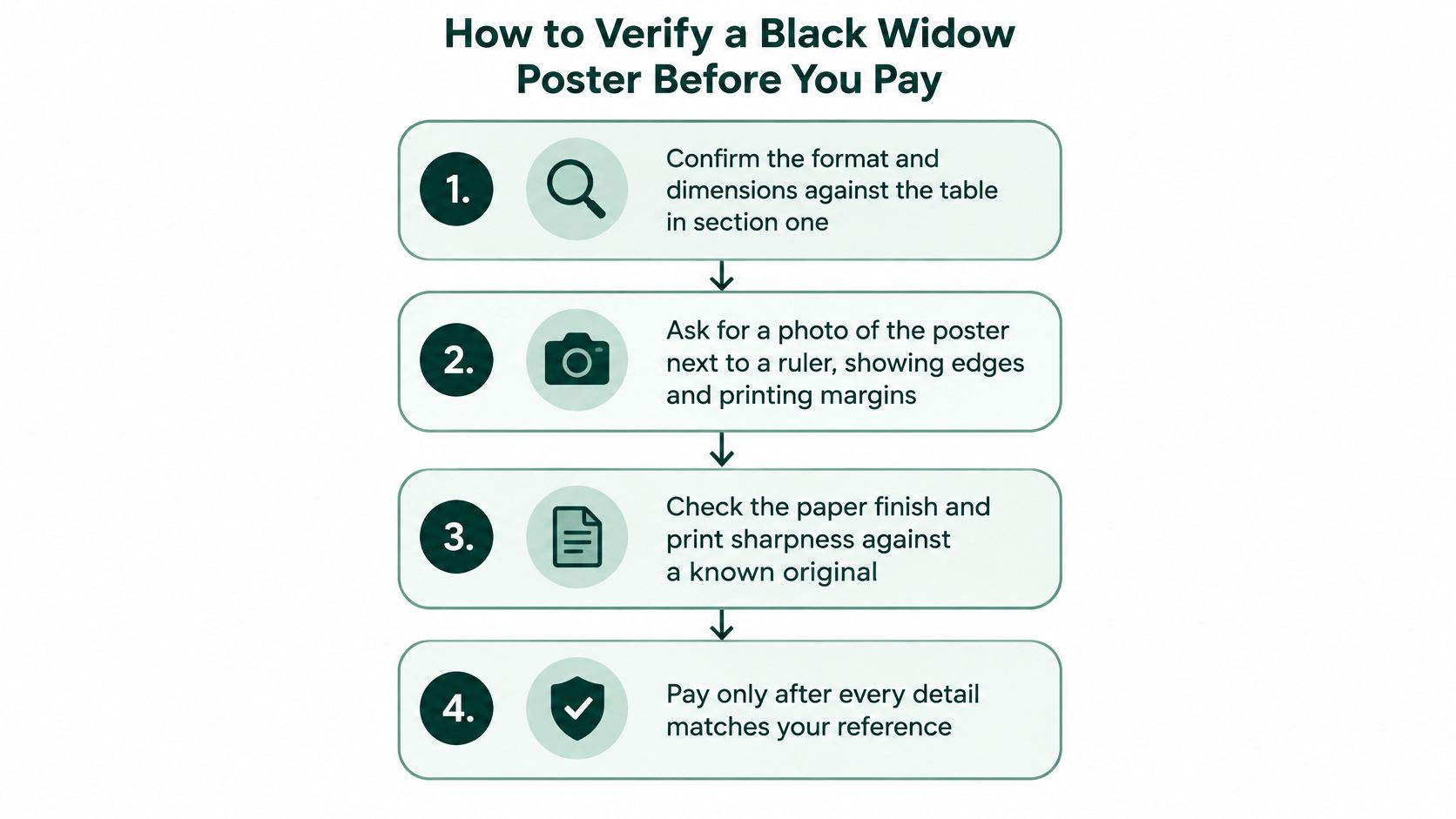
This visual checklist summarises the initial inspection before the fuller buying routine.
Build an evidence trail
- Confirm the format and actual dimensions. Ask for a photograph with a ruler or tape measure alongside the sheet, showing the paper edges rather than just the printed image. A seller who repeats a standard size without measuring hasn't resolved whether the item is trimmed, mislabelled or simply described carelessly.
- Inspect the bottom margin and date wording. Request a sharp, straight-on photograph of the billing block, copyright information and any distributor or printer identification, then assess whether those details fit the claimed campaign. Don't confuse a copied copyright date with proof of manufacture, and don't reject an advance design merely because its wording differs from the final release poster.
- Establish what the printing was intended for. Ask whether the sheet is single-sided or double-sided and whether the seller is describing theatrical advertising, licensed decorative merchandise or a reproduction. If double-sided printing is claimed, request a reverse photograph rather than accepting the phrase as evidence of cinema use.
- Request photographs that reveal the surface. Ask for the corners, edges and paper under raking light, with a lamp shining across the sheet rather than directly at it. This makes creases, surface scuffs, rippling and repairs easier to inspect; repeated refusal to supply close-ups is a reason to stop.
- Read the condition description and returns terms together. Check whether tears, tape, restoration, trimming or fading are acknowledged, and ask whether the photographs show the exact item rather than representative stock. Establish whether the seller also offers reprints, because mixed stock requires particularly clear labelling, although selling reproductions doesn't by itself make a dealer dishonest.
- Ask for provenance in practical terms. Useful answers explain previous ownership, the source of the stock and how the poster was stored, without inventing a cinema history that nobody can document. A vague claim of authenticity carries less weight than a coherent account backed by photographs, purchase records or an identifiable supplier.
- Compare the asking price with a genuinely comparable original. Use the documented asking-price reference in the pricing discussion as an anchor, not an invented market range, and allow for differences in format and condition. An unusually cheap listing deserves scrutiny, but an inflated price offers no protection against a fake.
- Keep the agreement and use buyer protection. Save the listing, item photographs, condition statement and messages confirming originality before paying through a method with applicable buyer protection. Read that payment provider's terms rather than assuming every transaction type receives the same cover, especially if the seller asks you to move away from the advertised checkout.
Decide whether the answers are sufficient
The guide to buying original movie posters in the UK provides further collecting context. Your immediate decision, though, should rest on the evidence for this sheet, not the confidence of the sales language.
For an additional visual reference while assessing a listing, the following video is available.
Don't demand impossible certainty from an inexpensive decorative purchase, but don't accept decorative-poster evidence at an original-poster price. If the seller can't resolve a material discrepancy, leave the purchase unfinished.
What a Black Widow Poster Costs in 2026
In 2026, UK seller Vintage Movie Posters listed an original Black Widow US/International One Sheet at £95. That's a single asking price, not a market average, a completed-sale result or a reliable price range for every version.
There isn't a verified bracket here for British Quads, double-sided Quads or reprints. Treat those formats as unpriced until you find genuinely comparable listings, rather than adjusting the One Sheet figure by guesswork.
What justifies a different price
| Factor | How to judge it |
|---|---|
| Format | Compare the same territory, orientation and campaign edition |
| Printing | Establish whether light-box printing is part of the edition's appeal |
| Condition | Assess tears, fading, folds, repairs and missing paper |
| Provenance | Look for evidence supporting the claimed campaign history |
| Restoration | Ask what was done and whether it's disclosed clearly |
Among comparable originals, damage generally weakens value, although the importance of a fold depends on whether that edition was distributed folded. Restoration may improve appearance without making the poster equivalent to an untouched example.
A documented UK campaign history can justify more interest from a British collector. Double-sided printing alone doesn't guarantee a premium, and a reprint priced close to an authenticated original needs a convincing decorative justification, not vague collectability claims.
Use the guide to original movie poster prices to frame comparisons. If a seller asks a premium, ask which specific feature supports it.
Framing and Storing Your Poster Safely
Acidic materials and poor storage can damage paper, even when the poster remains untouched. Museums Galleries Scotland's storage and display guidance explains that acidic and lignin-containing materials can cause discolouration, brittleness and staining, and recommends acid-free tissue for paper storage and acid-free board for mounting.
Protective materials should be identified by their composition, not merely advertised as premium packaging. If the backing board or sleeve specification is unclear, keep it away from direct contact with the poster until you can confirm its suitability.
Storage and mounting materials for a Black Widow poster
| Item | Use it for | Avoid |
|---|---|---|
| Acid-free tissue | Interleaving, rolling or storing flat | Ordinary tissue, newsprint or unknown paper |
| Acid-free board | Mounting the poster | Standard cardboard or wood-pulp board |
| Acid-free polyester sleeve | Long-term protection in a flat box | Sleeves that trap moisture |
| Glazing with a gap | Framed display | Glass resting directly on the print |
| Backlit light box | Double-sided UK Quad display | Mounting a single-sided poster where light will fade it |
For polyester sleeves, seek conservation-grade, uncoated material. Polyester itself isn't paper, so the important specification is its suitability for photographic or paper collections, rather than an acid-free label alone.
Frame without permanently altering the sheet
Choose the frame around the poster, not the poster around the frame. Ask the framer to allow for the actual sheet and appropriate support without squeezing the edges tightly into the rebate.
Use a window mount or suitable spacers to keep glazing away from the printed surface. Direct contact can become especially troublesome if moisture develops inside the frame, and a poster should never be pressed against glass just to make it appear flatter.
Avoid spray adhesive, dry mounting and ordinary pressure-sensitive tape on a collectible original. These shortcuts can make later removal difficult and turn a reversible display decision into permanent alteration.
Conservation first: A frame should support the poster without requiring cuts, adhesive across the image or forced flattening.
For a double-sided sheet, explain your intentions before the framer adds opaque backing. Conventional framing and a light box need different construction, and a sealed, backed frame can't be illuminated from behind afterwards.
Control light and handling
Keep the display out of direct sunlight and away from radiators, damp external walls and places with condensation. UV-filtering glazing can help reduce exposure, but it doesn't make continuous bright light harmless.
For light-box display, choose equipment intended for posters and assess heat as well as illumination. Don't improvise with a bright lamp behind an ordinary frame or assume that every double-sided poster should remain illuminated continuously.
Prepare a clean, dry surface before unpacking. Remove jewellery that might catch an edge, use clean, dry hands and support the sheet rather than lifting it by a corner.
Let rolled paper relax
Unroll a sound poster gradually, with acid-free tissue protecting its surfaces. If the paper resists, allow it to relax under broad, light, evenly distributed weight between suitable protective boards, checking it periodically rather than forcing it flat.
Flattening can take several weeks, but it isn't a fixed treatment schedule. Don't apply an iron, steam, moisture or aggressive reverse-rolling, and refer brittle, torn or heavily creased material to a paper conservator.
Store flat where practical, in a clean protective enclosure away from floors and leak risks. If you need professional help, ask a specialist seller about framing options and archival guidance before choosing the enclosure, so the display supports the poster's format and condition.
Confirm the Format and Terms Before You Buy
When you buy from a trader, the Consumer Council's guidance on buying goods states that the trader remains responsible until you or a nominated person receives the goods, and that delivery must normally take place within 30 days unless another period was agreed. If the applicable delivery period is missed, you may be entitled to cancel and receive a full refund, depending on whether timing was essential and whether a reasonable alternative can be agreed.
That protection isn't the same as an optional shipping upgrade. A stronger tube, an express service and an agreed arrival deadline describe different parts of the transaction, so ask the seller to put the delivery window in writing.
Agree the purchase in the right order
- Identify the item. Settle the format, originality and condition before discussing payment.
- Confirm the terms. Obtain the delivery commitment, returns conditions and procedure for reporting damage.
- Keep the record. Save the agreed description and order confirmation somewhere you can retrieve them.
If a title isn't listed, a Request a Poster service can seek it through partner suppliers. Ask for the same evidence and terms when a sourced example becomes available; a special search doesn't replace inspection or establish condition.
For a gift, tell the trader before ordering if arrival by a particular occasion is essential. Don't assume that mentioning the occasion after dispatch changes what was agreed.
Format comes first, delivery terms second, payment last. That order gives you a clear description of what you're buying and a written basis for resolving problems if the transaction doesn't go as promised.
Famous Movie Posters offers guaranteed original cinema posters, framing options and a Request a Poster service for titles you can't find in the catalogue. Visit Famous Movie Posters to look for Black Widow campaign material or request your preferred format, and ask for the item's dimensions, condition and provenance before committing.