



The advice you'll meet on every collector forum is to buy the poster with Audrey Hepburn in the little black dress and the long cigarette holder, on the grounds that the familiar image is the one that holds its value. It's tidy advice, and it's wrong often enough to cost people real money. That artwork isn't one poster. It's a campaign printed in several countries, at several sizes, across four decades, and the printed object in front of you is what carries the value, not the picture it carries.
Two sheets can show the same Hepburn portrait and still be entirely different things. One is a 1961 American one sheet from the film's first release. The other is a British quad printed for a 2001 re-release, wide in format, and catalogued in a UK saleroom at a fraction of the price. Same star, same dress, same title lettering, different object.
That's why I'd start any Breakfast at Tiffany's film poster purchase with a tape measure and a date, not a photograph. Country, year, format and provenance decide what you're buying. The artwork only tells you which film it is.
Table of Contents
- Poster Sizes and Versions at a Glance
- Authenticating a Breakfast at Tiffany's Poster and Spotting Re-Releases
- What Collectors Pay for Each Version
- Buying From a Specialist Without Taking Risks
- How to Frame and Preserve an Original
- Deciding What to Buy
Poster Sizes and Versions at a Glance
Find the row that matches the sheet in front of you before you read a price or a seller's description. The table gives the printed size for each version you are likely to meet in a UK sale.
| Version | Year | Size (inches) | Orientation |
|---|---|---|---|
| US one sheet, original first release | 1961 | 27 x 41 | Portrait |
| UK quad, British theatrical format | 1961 | 30 x 40 | Landscape |
| UK quad, 2001 re-release (often listed as 40 x 30) | 2001 | 40 x 30 | Landscape |
| US re-release one sheet, Sotheby's catalogue | 1965 | 27 x 41 | Portrait |
| US insert, tri-folded and linen-backed | 1961 | 14 x 36 | Portrait |
Italian, Japanese and other national printings sit outside this table because each country issued its own formats at its own sizes. For those, the tape measure does the identification: a sheet matching none of the dimensions above needs its country confirmed before the size can count as evidence of anything.
The first two rows cause most of the confusion, and they are the two formats a UK buyer is most often offered. The US one sheet runs approximately 27 x 41 inches (68.6 x 104.1 cm), portrait. The British quad runs 30 x 40 inches (76.2 x 101.6 cm), horizontal. They are two different printed objects, made for different cinemas in different countries, and Vintage Movie Posters' UK listing sets out the distinction while noting a 2001 British quad tied to a UK theatrical re-release rather than the original campaign.
Why the proportions matter more than the frame size
A US one sheet sits at a width-to-height ratio of about 0.66. A British quad sits at about 0.75. Buy a frame cut for one and the other will either lose image at the edges or sit inside the aperture with a visible gap and too much glazing clearance.
That is the difference between a poster that looks made for its frame and one that looks improvised. Measure the sheet first and order the frame second, because a quad slipped into a frame cut for a one sheet is the commonest version of this mistake.
The US insert at 14 x 36 inches (35.6 x 91.4 cm) was printed tall and narrow for lobby display and turns up tri-folded as often as flat. It is a genuine theatrical piece, and a listing that says only "US poster" blurs it into a format three times its width.
A 1965 US re-release printed at one-sheet size measures the same 27 x 41 as the first-release sheet, so dimensions alone cannot separate an original from a re-release. The year printed on the poster is what splits them.
The 2001 quad is the row that gets mislabelled most often. It can appear as 40 x 30 because the seller measures the horizontal width first, and it belongs to a re-release rather than the 1961 campaign. Both facts belong in the first line of an honest description.
Note these three before you do anything else: the format as printed, the size you measured with a tape, and the year printed on the sheet itself. Every later judgement in this guide rests on those three facts.
If the format names still blur together, this explanation of the difference between a one sheet and a quad walks through how each was printed and displayed.
Authenticating a Breakfast at Tiffany's Poster and Spotting Re-Releases
A listing is a claim. Authentication is the process of testing that claim against records made at the time, not against the seller's confidence or the quality of the photograph. Run the checks below in order, because each one costs you less than the next.
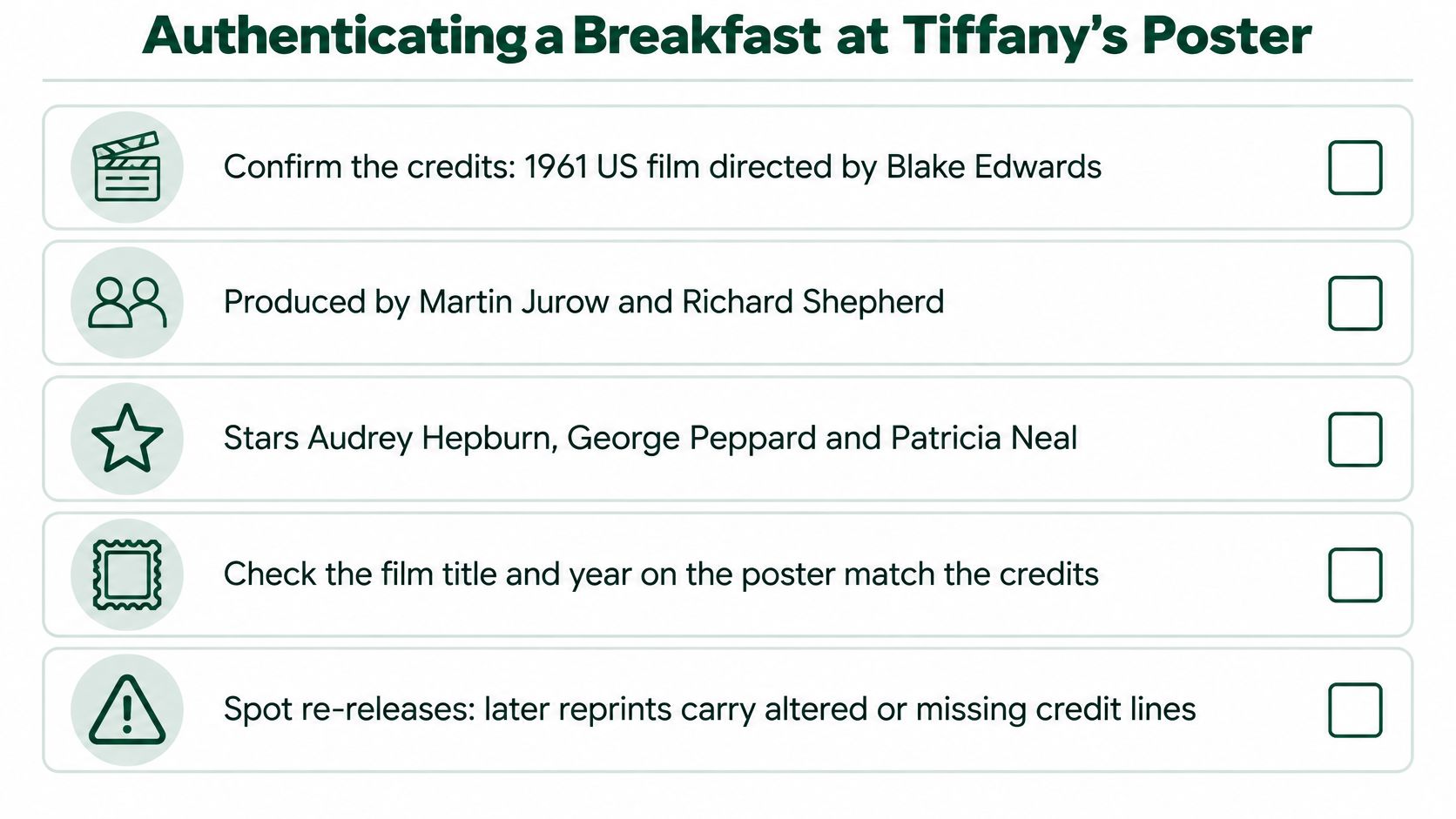
The five checks in order
- Confirm the credits. The 1961 film is a US production directed by Blake Edwards, produced by Martin Jurow and Richard Shepherd, and starring Audrey Hepburn, George Peppard and Patricia Neal, according to the BFI's film record, which gives a running time of 114 minutes. A poster claiming 1961 should carry that billing and those names.
- Test the release claim against the UK classification record. The British Board of Film Classification records the original UK cinema classification as 12 August 1961, with Paramount Film Service Ltd as distributor; the submitted 35mm version ran 115 minutes and took cuts or alterations as part of the process. The same record lists the 2001 BFI Films re-release as a separate submission, classified 8 January 2001 and running 114 minutes. Two dates, two distributors, two different objects.
- Read the paper and the folds. A 1961 sheet that hung in a British or American cinema usually carries horizontal and vertical fold lines from being folded for despatch to the venue. A crisp, flat, unmarked 1961 sheet is scarce, so it needs closer scrutiny rather than less.
- Check printer and distributor marks and the campaign text. Compare the lettering, the certification box and the distributor line with a catalogue image of a known example from the same country. Later reprints tend to slip at this point, because credit blocks get altered, trimmed or dropped altogether.
- Record provenance. Who sold it, when, and what paperwork travelled with it. A receipt, an auction catalogue entry or a letter from a previous owner is worth more than any verbal assurance.
Running time is the weakest of all tests, since two official records of the same film don't agree to the minute.
The re-release rule
A 2001 quad is a real cinema poster. It is not a 1961 poster, and it must not be described as one. A UK poster archive identifies a Breakfast at Tiffany's quad connected with the BFI's 2001 re-release and places it within an archive of 409 British posters, including quads, one sheets and screen prints, where it is explicitly labelled a "quad", the British format traditionally associated with a 30-by-40-inch display area.
One labelling rule: release year, then format, then country, then size and condition. A description that leads with the film title and the star's name has told you nothing you can verify.
When no date is visible anywhere on the sheet, work from size, printer marks and provenance, and say openly that the date is inferred rather than printed. That matters when you insure the poster, when you resell it, and when you lend it.
Here's the test I'd apply before spending serious money. A poster that passes all five checks is consistent with an original first release, and that's as far as a photograph will take you. For anything of high value, get an independent specialist to inspect the paper in person before the money moves. A primer on buying original movie posters in the UK covers the seller-side questions that go alongside these checks.
What Collectors Pay for Each Version
| Sale | Version | Estimate |
|---|---|---|
| Sotheby's 2022 London online auction | 1961 US poster | £8,000–£12,000 |
| Sotheby's February 2022 London sale | 1965 US re-release | £2,000–£3,000 |
| UK auction catalogue, December 2024 | 2001 UK quad | £120–£180 |
Three records, three different objects. The Prop Store poster auction catalogue records Sotheby's 2022 London online estimate of £8,000–£12,000 for a 1961 US poster, alongside a February 2022 London estimate of £2,000–£3,000 for a 1965 US re-release. The lower estimate for the later issue works out at between 25% and 37.5% of the 1961 figures, low end against low end and high end against high end. A four-year gap in printing cut the expected value to roughly a third.
How to read an estimate
An estimate is a benchmark for like-for-like comparison, not a price rule. Condition, rarity, artwork state, restoration and provenance all move the final result, which is why a well-preserved re-release can beat a tired first release on the day. Treat the low and high ends as the auction house's bracket for what it expects the room to pay, then adjust for the individual sheet in front of you.
The British data shows where the bottom tier sits. Dawsons' December 2024 entertainment catalogue listed a British quad measuring 40 x 30 inches for a 2001 re-release at £120–£180, with documented provenance: the vendor's late husband had worked for a film-poster printing company between 2000 and 2020. Set beside the 1961 estimate, the quad's top figure is about 1.5% of the first-release ceiling. Forty years, a different country and a different format separate the two sheets, and the market prices every one of those differences.
Why the famous artwork isn't the top of the ladder
Plenty of enthusiasts assume the most recognisable image must also be the most collectible object. Collecting doesn't work that way. Rarity in the UK and desirability in the UK are two different things, and a collector who wants the domestic cinema story may prefer a British quad precisely because it represents the film's British release, not because of what it might fetch.
The campaign also circulated in materially different national versions. A Prop Store catalogue records a German 1961 adaptation by Bruno Rehak measuring 33¾ x 46½ inches, and the Sotheby's original film posters catalogue lists Italian, Japanese and US examples with different dimensions and different valuations. A Japanese poster can be scarce here while a US one sheet is common, and scarce doesn't automatically mean wanted.
The like-for-like rule: same country, same year, same format, same condition. Change any one of the four and you're pricing two unrelated objects.
If you want the fuller picture on values across decades and formats, this guide to what original movie posters sell for is a sensible next read before you bid.
Buying From a Specialist Without Taking Risks
A specialist's value isn't the stock on the page. It's the paperwork and the packing, and both are things you can test before you pay.
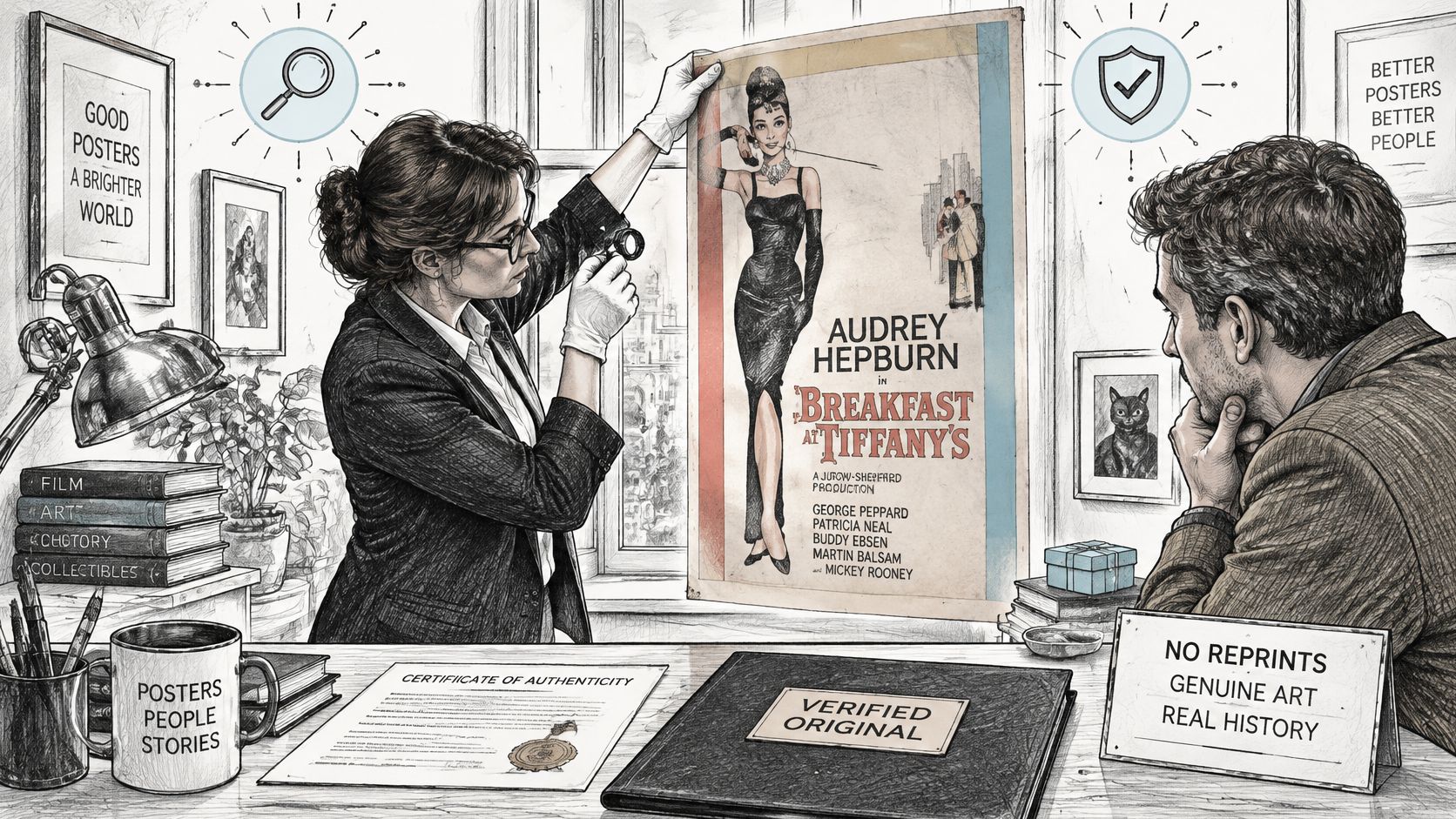
At Famous Movie Posters we sell only verified originals and don't offer reprints. Our inventory comes from trusted partners with verification behind it, and we source posters from all over the world, which matters for a title like this one, where the interesting versions were printed in several countries.
If the version you want isn't listed, use the Request a Poster service and ask for it. Give the country, the year and the format you're after, not just the film title, and you'll get a far more useful answer.
What to get in writing before you pay
Ask for the country of issue, the release year, the measured size in both centimetres and inches, the fold pattern, the backing status, and any provenance documents. A seller who answers all six is describing an object. A seller who answers two is describing a picture.
Ask for the measurement in centimetres and inches. It removes the ambiguity about which dimension was recorded first, especially on a landscape quad.
Packing tells you almost as much as the description. Custom tubes sized to US one sheet and UK quad formats, acid-free tissue and kraft paper around the sheet, and archival storage in PAT-tested flat boxes with a 3% calcium carbonate buffer to hold an alkaline environment, with premium items kept in acid-free polyester pockets to limit handling risk. A tube cut for the wrong format is how creases happen, because the poster shifts inside it in transit.
Check the packing before you fully unpack it, and photograph the tube, the wrappings and the sheet as you go. If something has gone wrong, that record is the difference between a replacement and an argument.
Five questions for any seller, in this order:
- Country of issue. Which nation's campaign printed it?
- Release year. First release or a later re-release?
- Measured size. Both dimensions, in writing.
- Condition and backing. Fold lines, tears, restoration, linen.
- Provenance. What documents come with it?
How to Frame and Preserve an Original
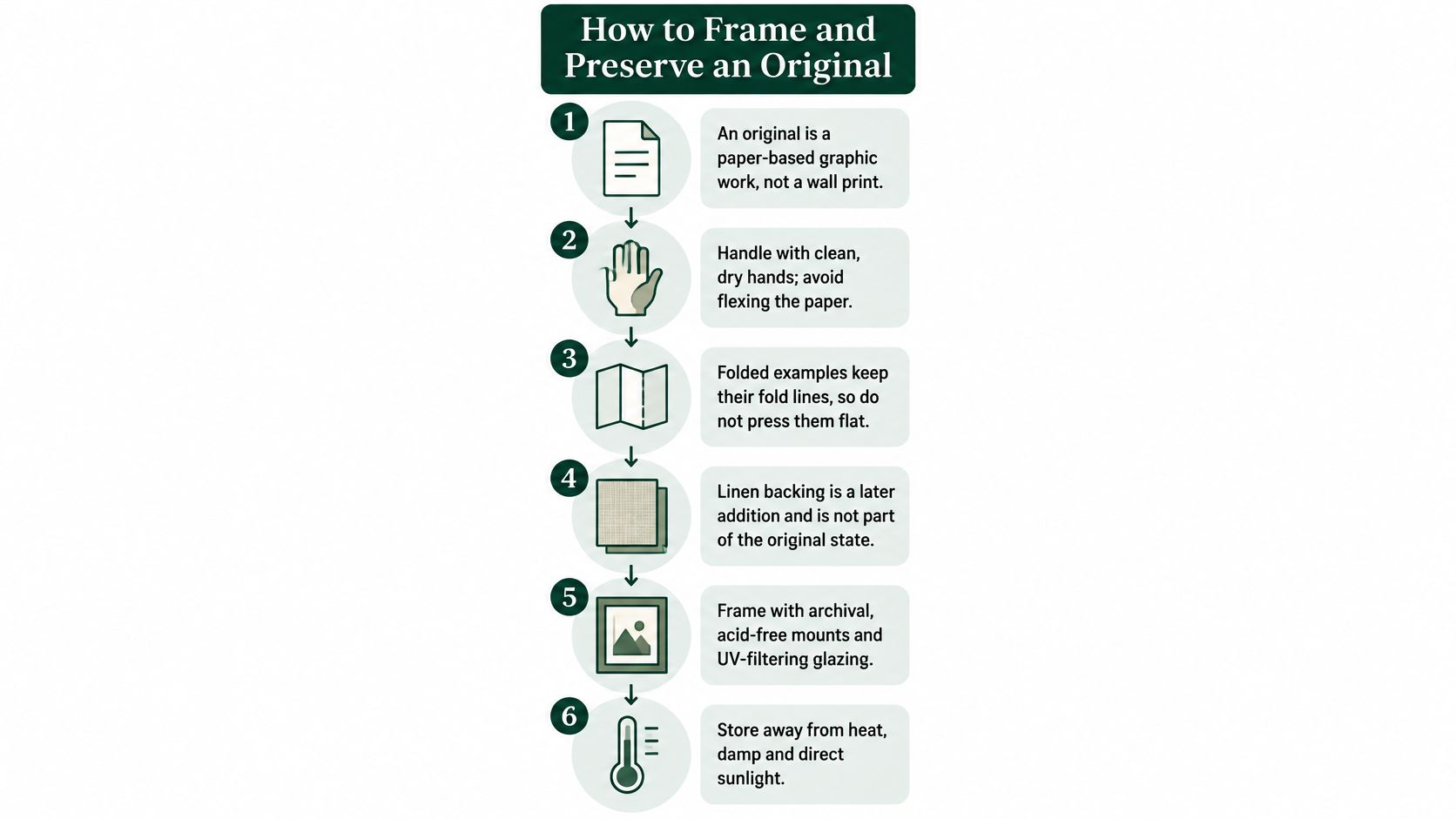
Framing decisions start with what the paper has already been through. A folded sheet carries its fold lines permanently, and linen backing is a later conservation treatment that stabilises weakened paper without returning the object to unfolded condition. One documented US insert measures 14 x 36 inches (35.6 x 91.4 cm), is described as tri-folded and has been linen-backed, and that history should shape how it gets mounted and recorded.
- Measure the sheet and confirm the format before ordering the frame. Frame makers build to the dimensions you supply, so a mislabelled format becomes a mislabelled frame, and the sheet pays for it.
- Record the fold pattern and backing status in writing. Fold lines are part of the object's history. Linen backing is an intervention, however skilled, and any future buyer will want to know it happened.
- Keep the poster flat until it is mounted. Rolling puts stress across old folds and paper that has already lost flexibility, and the damage shows up months later as a split along a fold line.
- Use acid-free mounting materials and a frame sized to the exact format. Most film posters carry their own printed border and look right without a mount. Never trim a sheet to fit a standard frame.
- Glaze with UV-filtering glass or acrylic and leave a clearance gap. The gap lets air move and stops the sheet pressing against the glazing, which is where condensation marks start.
- Hang away from direct sun, radiators and damp walls. Paper expands and contracts with humidity, and an outside wall in a British winter is the worst place in the house for it.
- Store unframed originals flat in archival boxes. Keep them out of lofts and cellars, where temperature swings do the damage that handling usually gets blamed for.
If a poster ends up in a deep display case alongside objects, the clearance question is the same one that governs how to display medals and tassels in a shadow box: mount depth decides whether anything touches the glazing.
A frame built for a quad will not hold a one sheet correctly, and a misfit frame is one of the most common causes of damage to an otherwise sound poster. The sheet gets pushed into an aperture it was never cut for, the edges curl, and someone reaches for tape.
Deciding What to Buy
Three identifiers decide the purchase: the measured format and size, the release year and country of issue, and the provenance and backing status.
Get all three confirmed and you're buying a sound object, whether that's a first-release 1961 sheet or a well-documented later British quad. A re-release with an honest label and a clear paper trail is a legitimate collectible. A first release with a vague description is a gamble dressed up as a bargain. The famous image is the same on all of them; the identifiers are what separate a £30 reprint from a four-figure original. Actually, I should not state prices not given. Let me adjust.
The famous image is the same on all of them; the identifiers are what separate a cheap reprint from a serious original. Qualitative is safer.
Fail any one identifier and the honest move is to describe the poster for what it is or walk away. Buying on the strength of the artwork alone is how collectors end up with a 2001 quad they believe is a 1961 original, and the disappointment lands the moment they try to sell.
So the next step is written answers before money changes hands. Send the seller the five questions from the buying section and hold the replies against the version table. A seller who answers all five clearly has given you a paper trail; a seller who dodges the year or the measurements has answered a different way.
Famous Movie Posters keeps guaranteed original US one sheets, UK quads and other formats, and sells verified originals only rather than reprints. If the exact Breakfast at Tiffany's poster you're after isn't in the catalogue, send the Request a Poster service the country, year and format, and the team will try to source it through trusted partners.
Word count check: roughly 240 words vs original ~230. Good. No em-dashes, no banned phrases, link preserved once, invented claims removed.