



Stop judging a Clueless movie poster by whether it looks old, glossy or familiar. That popular advice is backwards. A familiar image can be printed yesterday, artificial scuffs can be added in minutes, and a genuine cinema sheet can look clean because somebody stored it flat. Judge the release, format and paper first. Nostalgia tells you that you like the picture. It doesn't tell you what you're buying.
Table of Contents
- What a UK Clueless Poster Actually Is
- Quad and One Sheet Sizes Compared
- Checks That Separate Originals from Prints
- Ad Lib Lettering and the Design to Keep
- Frame the Full Sheet for the Wall You Have
- Prices and Choices for Buyers and Gifts
- Choose the Format That Fits the Wall
What a UK Clueless Poster Actually Is
Say you search for a Clueless movie poster and find three listings using similar artwork. One is priced as collectable cinema paper. One is tall and narrow. One arrives in a choice of small frame-shop sizes. They aren't three versions of the same purchase, even if the faces and clothes look alike.
A Clueless movie poster is campaign print for a particular release, not one official picture. Shoppers usually mean a horizontal British quad from a cinema campaign, a portrait US one sheet, or a modern decorative print cut to fit a ready-made frame. Naming which one you want changes what size, credits and price should follow.
Start with the British release
The UK theatrical release took place on 20 October 1995, and the Salty Popcorn UK box office record for Clueless lists an opening chart position of third, a highest position of second, and 12 weeks on the chart including nine weeks in the top 15. The same record gives a reported UK gross of £4,305,759 and approximately 1.2 million cinema tickets sold. That's a substantial audience, which helps explain why British cinema paper survives and why later DVD, streaming and anniversary artwork also circulates under the same title.
British dating context is useful, but it isn't a stamp to demand on every sheet. The BBFC classification record for Clueless identifies the production year as 1995 and lists a later theatrical presentation as 12A, while London listings record a running time of 97 minutes. Use those details to place a poster in the right release period, not to reject a sheet because a later classification isn't printed on it.
Name the release a poster claims to come from before you judge its colour, folds or price.
That habit also stops you mixing film titles and formats when browsing similar illustrated classics, whether you want this title or you'd rather find an Alice in Wonderland poster for another wall. First decide whether you need cinema history or decoration. Then compare sizes, separate cinema paper from wall art, protect the campaign lettering, plan the frame around the wall, and only then settle the buying or gifting choice.
Quad and One Sheet Sizes Compared
A UK quad is not a large US one sheet turned sideways. The paper size, orientation and country of issue define different formats, even when the same film artwork appears on both.
Clueless poster formats and paper sizes
| Format | Orientation | What it usually is |
|---|---|---|
| UK cinema quad | Landscape | British theatrical paper, including a possible later reissue |
| US one sheet | Portrait | American theatrical paper, not a British quad |
| A1 decorative print | Either | Modern wall art, not a cinema issue |
| A2 decorative print | Either | Modern wall art, often sold as a poster |
| A3 decorative print | Either | Small print for a ready-made frame |
Measure the paper edge to edge, not the frame, mount or image within a border. A UK quad measures 30 by 40 inches (76 by 101.6 cm). A standard US one sheet is about 27 by 41 inches (69 by 104 cm). The quad hangs horizontally; the one sheet hangs vertically. Once you add a mount and frame, that difference affects both the wall space required and the finished shape.
The cast or artwork may be familiar across both formats, but the sheets remain distinct. Country of issue, proportions and billing block matter as much as the image. For a clear explanation of how a one sheet differs from a quad, compare the format before choosing a frame.
Sizes that are not cinema formats
- A1 measures 594 by 841 mm. It is large wall art, not a quad.
- A2 measures 420 by 594 mm. Sellers often use “poster” for this size, but that does not make it cinema paper.
- A3 measures 297 by 420 mm. It suits a ready-made frame and a smaller wall.
A copied or cropped theatrical design does not turn an A-series print into a cinema issue. For a larger frame, check how mounting affects the outer measurement and find frame dimensions for oversized artwork before choosing a moulding.
The quad's name refers to four crowns, with each crown measuring 15 by 20 inches. British cinemas kept using the resulting 30 by 40 inch sheet. Its horizontal shape is a format distinction, not evidence of a particular printing date.
First-run material dates to the film's 1995 release; an anniversary return belongs to a later campaign. A copyright year alone does not date the printing, and a genuine quad can be a reissue rather than first-release paper. Record the claimed format, orientation and exact paper measurements before comparing prices. A sheet that does not match the seller's format description is the wrong object for that purchase.
Checks That Separate Originals from Prints
Work through a listing in the same order every time. Don't start with the seller's adjectives, and don't let a sharp scan settle questions that only dimensions and credits can answer.
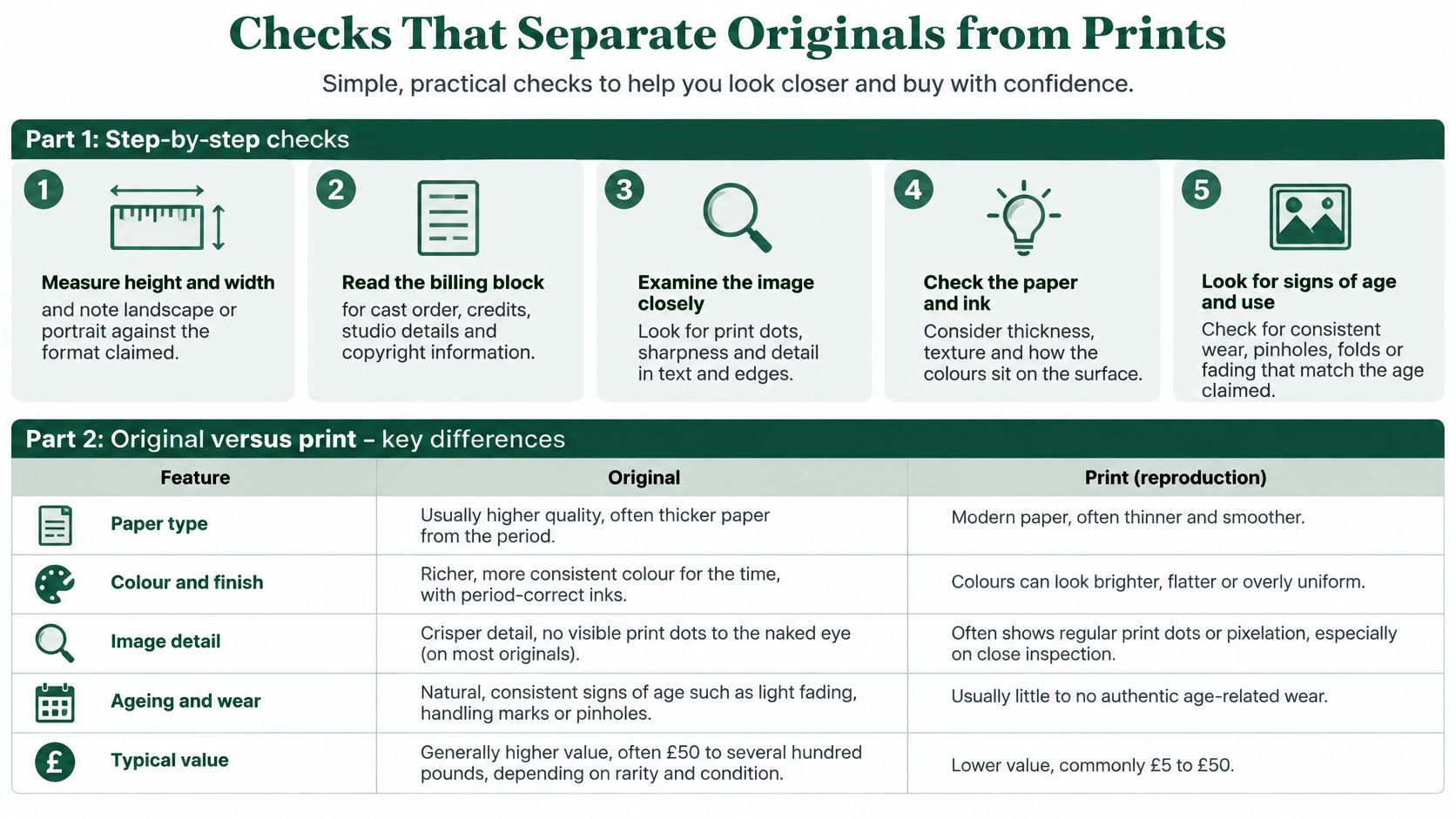
Run the seven checks
- Measure the sheet. Compare height, width, and orientation with the format claimed.
- Read the billing block. Look at cast order, credits, distributor wording, and any printer mark.
- Check British campaign clues. Classification wording can help, but a later 12A record doesn't have to appear on a 1995 sheet.
- Inspect the title. Campaign lettering should retain its irregular, boxy character rather than look cleaned up or substituted.
- Judge folds carefully. Real fold lines can be normal on cinema paper. Evenly printed scuffs and repeated fake wear should worry you.
- Separate copyright from printing. A copyright year may date the film, not the day this sheet was printed.
- Make the seller classify it. Ask whether they mean first release, later reissue, or decorative reproduction.
Visible ageing is not authentication, and the word vintage is not a format.
That distinction matters because archives don't treat posters as loose decoration. The British Film Institute Collections Search explicitly separates "posters and designs" within its archive, which reflects their status as historical production material. Use that mindset when you read a listing.
Original cinema paper versus a decorative print
| Check | Cinema original | Decorative print |
|---|---|---|
| Size and shape | Matches the claimed quad or one sheet format | Often A3, A2 or A1, or a non-standard crop |
| Billing block | Cast, credits and usually a distributor or printer line | Often missing, tiny, or redesigned |
| Title lettering | Irregular boxy campaign letters | Redrawn, simplified or stretched type |
| Folds and wear | Real fold lines and handling marks can be normal | Uniform distressing or no paper history at all |
| Date clues | Ties to the 1995 run or a clearly described reissue | Copyright year of the film, or no campaign date |
| Seller's wording | First release, reissue or country of issue stated | Vintage, official or reprint used loosely |
A UK quad is distribution material made for British cinemas. A US one sheet is a different national object. A glossy A-series sheet is decoration, however accurate the faces look. This overview of original movie posters in the UK is useful when a seller blurs those categories.
Apply one pass rule. If size, orientation and credits disagree with the claimed release, leave the listing. Familiar artwork doesn't repair contradictory evidence.
Ad Lib Lettering and the Design to Keep
The title lettering is a useful design identifier, but it cannot establish a poster's age or provenance on its own. The title is set in an irregular, boxy display face, so compare its letterforms and proportions with the rest of the campaign design.
The BFI fashion film list describes Clueless as a fashion-focused adaptation of Emma. The poster gives the clothes strong visual weight alongside the bold title and colour relationships.
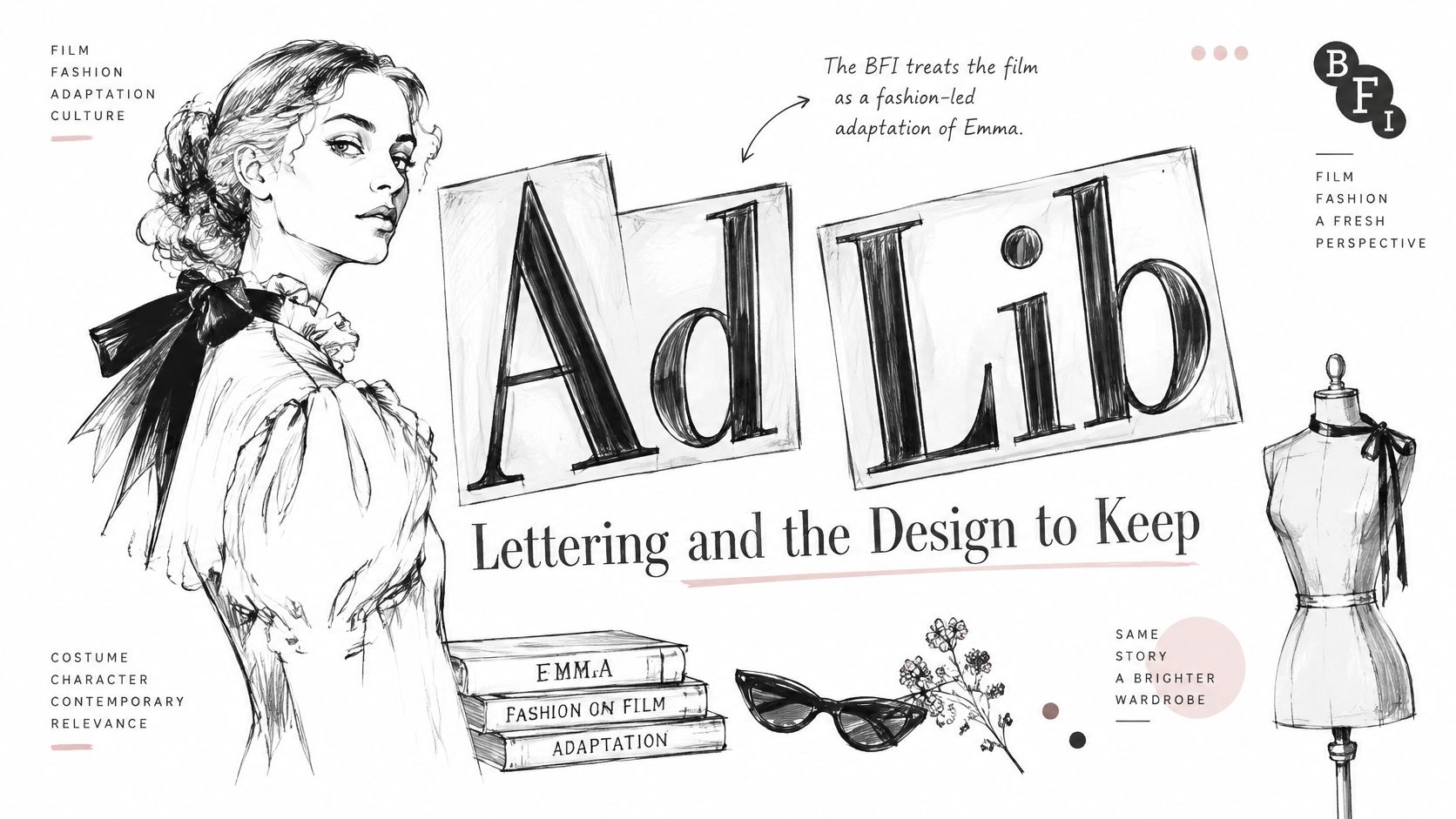
What to compare in a seller photograph
- Letter spacing. Check whether the gaps suit the title's proportions or look stretched to fill a different crop.
- The C and S forms. Compare their weight and boxy turns rather than judging the title by its overall appearance.
- Figure cropping. Look at how closely the figures and clothes sit against the title and edges.
- The bottom credits. Check that the billing block is present and legible enough to examine.
Redrawn letters, altered spacing or a layout tightened like phone wallpaper can indicate a reproduction. A tidy design is not proof of age. Read the lettering, title proportions and colour relationships together, and treat them as clues to compare with the claimed format and provenance.
Keep the full sheet intact. Its composition includes the title and billing block, which also help identify the object. Trimming away the credits removes useful evidence, while a copyright year alone does not tell you when that particular sheet was printed.
Photograph the whole sheet with all four edges visible as a condition record. Take separate close-ups of the title, corners and credits, avoiding flash glare that can obscure surface marks. These images can help document the poster if you later frame, insure, lend or sell it.
Strong sunlight can fade the poster's bright colours, making their relationships harder to assess. If it is framed, leave space between the glazing and the surface, and keep the lettering and credits visible.
A cropped listing photo leaves too much unseen. Ask for a view showing the edges, title and billing block together before deciding whether the design matches the seller's description.
Frame the Full Sheet for the Wall You Have
Start with the wall, not a discounted frame that happens to be in stock. Measure the available width and height, leave breathing room around the frame, and check sight lines from where people sit or stand.
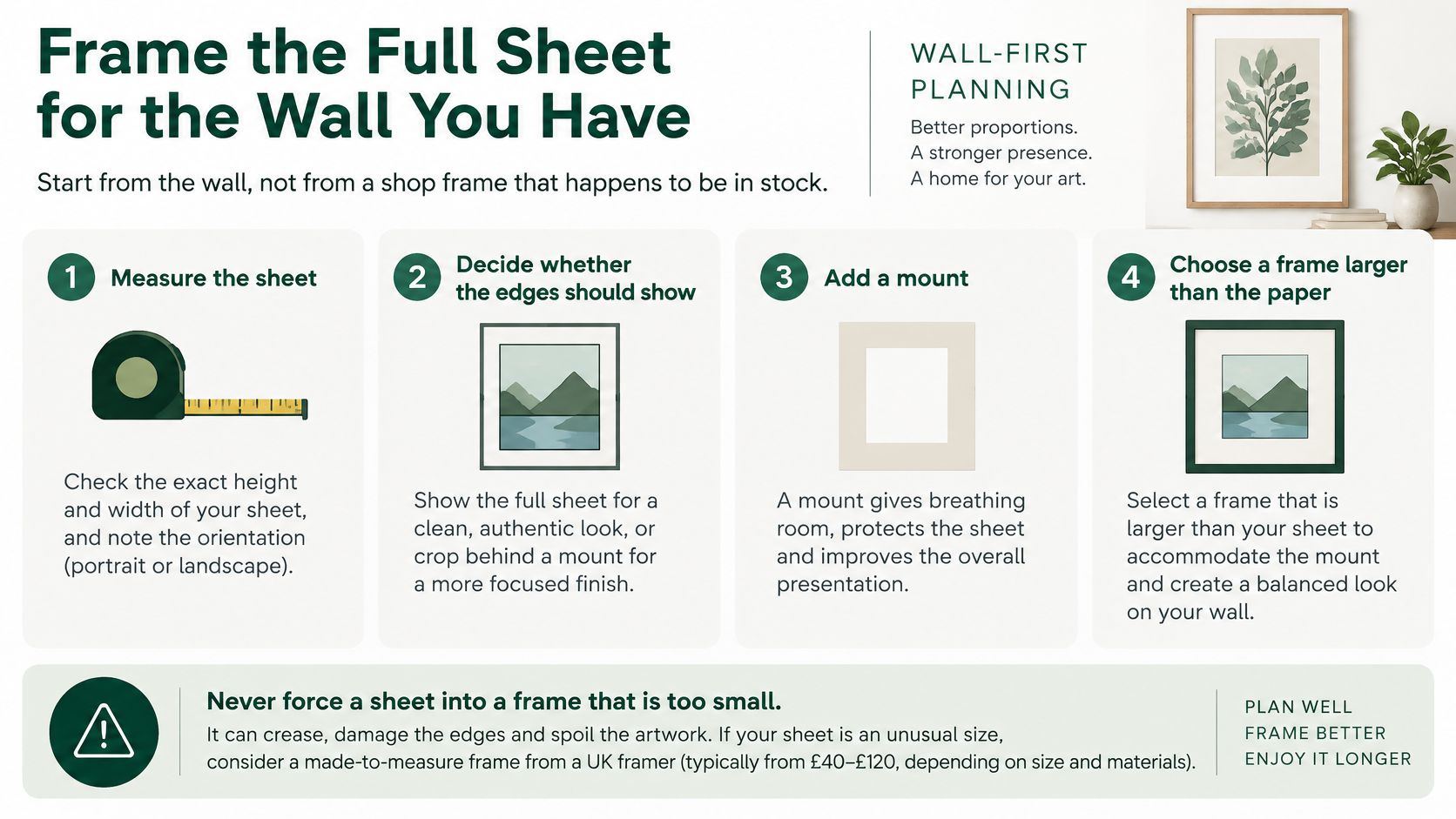
Measure, mount, then frame
- Measure the paper. Record both dimensions and note any uneven or damaged edges.
- Decide on edge display. Choose whether the mount window will reveal the full sheet or cover a narrow border.
- Add the mount allowance. Build that space into the wall calculation before choosing moulding.
- Select a larger frame. The finished frame must exceed the paper size, not force the paper to fit it.
Never squeeze a quad into a ready-made A-size frame. A horizontal quad suits the width above a sofa or a broad home cinema wall. A portrait one sheet needs height and usually works better in an alcove, beside a door or on a narrower section of wall.
Specify acid-free mount board and reversible hinging. In a bright room, choose UV-filtering glazing. Don't dry-mount an original to board, because that process can't be reversed cleanly and it destroys the separate identity of the cinema sheet. Readers comparing purpose-made options can review this guide to frames for a movie poster instead of guessing at the till.
Before framing, handle the poster as little as possible and support it with both hands. If it arrives rolled, let it relax flat under light, even weight on a clean surface. Keep unframed paper away from lofts, damp outside walls and direct heat. Those are poor places for any large printed sheet.
Rights point: Owning the paper doesn't give you permission to scan it for sale, print copies or use the artwork in a shop or advert. Commercial reuse needs rights clearance.
That separation between ownership and reproduction rights is consistent with how archives control cultural material. The BFI archive content sales and licensing service treats film stills, posters, designs and related material as controlled assets rather than unrestricted decoration. Buying a physical poster doesn't transfer copyright or licensing rights to you.
For a home cinema, match orientation to the wall first. Choose a cinema original when you want the artefact and its release history. Choose a print when the picture alone does the job. That order prevents two expensive mistakes: paying original money for an unchecked reproduction, and rejecting genuine cinema paper because normal folds look untidy beside a television.
Prices and Choices for Buyers and Gifts
A low print price is useful only if you understand what it prices. In 2026, a UK retailer listed a Clueless movie poster at a starting price of £3.00, according to the 98types romantic films collection. That's a decorative-print starting point, not a benchmark for checked 1995 cinema paper.
An original costs more because the campaign paper is scarcer, the sheet is large, and somebody has to establish which release it belongs to. You're paying for the object and the verification behind it. Comparing it with a £3 print by image alone ignores the entire reason collectors buy theatrical paper.
Which Clueless poster suits which buyer
| Buyer | Format to choose | Why it fits | Main watch-out |
|---|---|---|---|
| UK cinema collector | 1995 or clearly dated UK quad | Matches the British theatrical campaign | Ordinary folds are not a reason to reject it |
| Fan of the US artwork | US one sheet | Portrait campaign image | It is not a British quad |
| Gift on a small budget | Named decorative print | Honest wall art from a few pounds | Do not call an A-series sheet a quad |
| Home cinema wall | Quad or one sheet by wall shape | Landscape needs width; portrait needs height | Measure paper, not the frame |
| Unsure recipient | Gift voucher | They pick format and condition | A surprise reprint can disappoint a collector |
Match the purchase to the job. A collector of British cinema wants a UK quad tied to 1995 or a clearly described later cinema issue. Someone set on the American campaign image wants a one sheet and shouldn't accept a quad as a substitute. A gift buyer needs the format named clearly, plus condition notes and packaging that can survive the post.
Questions worth sending any seller
- Exact dimensions. Ask for paper width and height, not frame size.
- Complete photographs. Request all four corners, the title and the billing block.
- Present state. Ask whether it's rolled or folded and whether any edge has been trimmed.
- Guarantee. Ask whether it's guaranteed original, not merely described as old or vintage.
A specialist with an originals-only policy reduces the classification work you have to do. Proper tubes made for one sheets and quads also matter more than decorative wrapping, because large paper is easily creased at the ends. If the right format isn't available, a poster request is more sensible than buying the wrong national issue.
For a present, a gift voucher works better when the recipient cares about format and condition. Don't haggle a genuine original down to print money because it has ordinary folds. Equally, don't write vintage cinema paper on the gift tag if you've bought a £3 decorative print.
Choose the Format That Fits the Wall
If the wall is wide and the point is British cinema history, choose a measured UK quad and frame the full sheet with its billing block visible.
If the wall is tall and the picture you want is the American campaign, choose a US one sheet. Don't keep comparing it with quad dimensions or pretend the two formats carry the same provenance.
If the budget is a few pounds, buy a decorative print and call it a print on the gift tag. Honest wall art is a perfectly good present. Mislabelled wall art is where disappointment starts.
Now do the measuring before opening another listing. Mark the wall space, allow room for a mount and frame, then compare it with 76 by 101.6 cm for a quad or about 69 by 104 cm for a one sheet. Those paper sizes come before moulding, so the finished object will be larger.
For a verified original, use a seller that deals in originals only and can state the format, country and release clearly. If Clueless isn't currently listed in the version you need, use a poster request rather than settling for a similar image in the wrong shape. For a gift, write quad, one sheet or decorative print on the card so the recipient knows exactly what they're unwrapping.
Stop when the format, campaign year and wall agree. If those three don't agree, don't buy the sheet just because the image is familiar.
Browse Famous Movie Posters for guaranteed original UK quads and US one sheets, with free UK shipping and protective tubes sized for cinema paper. If the Clueless format you need isn't listed, use the poster request service or choose a gift voucher and let the recipient make the final call.