

You've found a listing for a Donnie Darko movie poster, the price looks keen, and the seller calls it original. Then you notice there's no measurement, no country of issue, and no close photograph of the billing block. That's the point where most UK buyers either gamble or walk away, and neither choice helps much.
A better approach separates two things that listings often blur. The image is famous, and that fame is real. Resale and display value are narrower questions, answered by format, release period, provenance and condition. If you work through those checks in order, you'll know what you're holding before you buy a frame or pay a premium for cult status.
Table of Contents
- Donnie Darko Poster Sizes and Formats Compared
- Original Releases, Variants and Reprints Explained
- How to Tell an Original From a Reprint
- Choosing Artwork Between Frank, the Jet Engine and the Ensemble
- What Drives Value Beyond the Image
- How to Frame, Store and Pack Your Poster
- Confirm Format and Provenance Before You Buy
Donnie Darko Poster Sizes and Formats Compared
A poster can feature the iconic Frank artwork and still require a different frame than the theatrical sheet you anticipated. For display and storage, identify the format first: the UK Quad is wider, while the US One Sheet is portrait. Their dimensions are similar in height but vary in width, so selecting by image alone can result in the wrong frame.
| Format | Dimensions | Orientation | Framing implication |
|---|---|---|---|
| UK Quad | 30 x 40 in (76 x 102 cm) | Landscape | Needs a landscape frame or bespoke mounting |
| US One Sheet | 27 x 40 in (69 x 102 cm) | Portrait | Fits standard portrait frame sizes |
What those dimensions mean on a wall
The UK specialist listing for the Donnie Darko UK Quad gives the British Quad at approximately 30 × 40 inches (76 × 102 cm), compared with the 27 × 40-inch US One Sheet. The difference in width affects both framing and how much wall space the poster occupies. A Quad placed in a portrait frame will not fit correctly, while forcing it into a narrower frame risks pinching the borders and causing creases.
The comparison of One Sheet and Quad movie poster sizes explains how orientation affects frame choice. Measure the flat sheet from edge to edge, record the dimensions in inches and centimetres, then compare them with the table. Seller shorthand is not a substitute for a measurement.
Measure first: Correct dimensions do not establish that a poster is original, but an incorrect fit can lead to damage or an unsuitable frame.
The UK Quad listing describes its sheet as single-sided, originally issued rolled, and attributed to KO Creative. Its dark field and bright blue Frank imagery make surface abrasion and fading particularly noticeable under display lighting. A pale scuff that is hard to see in a listing photograph may stand out once the poster is on the wall.
Reprint sizes
Reprints vary in size by edition, so measure the sheet and compare it with the standard theatrical formats before choosing a frame. A reused image does not guarantee the same dimensions or orientation as a UK Quad or US One Sheet. Keep an unframed sheet flat and untrimmed until you have checked its measurements. That gives you a reliable basis for selecting a frame and storing it without folding it to fit.
Original Releases, Variants and Reprints Explained
The same Frank image can appear on several different objects, printed years apart for different purposes. Sorting them doesn't require memorising every variant. It requires three questions asked every time: what year does it promote, which country was it printed for, and does the listing describe it as theatrical?
| Version | Promotes | Printed for | Listing clue |
|---|---|---|---|
| 2001 UK Quad | 2001 cinema release | United Kingdom | Landscape, 30 x 40 in (76 x 102 cm), UK billing |
| 2001 US One Sheet | 2001 cinema release | United States | Portrait sheet with US billing and legal text |
| 25th-anniversary commemorative | 25th-anniversary event, 2026 | United Kingdom for UK anniversary screenings | Anniversary wording or event date |
| Home-video artwork | Home-video release | Territory named on the packaging or billing | Smaller format and a different design |
| Reprint or fan-made design | No specific release campaign | Commercial sale to fans | Reused Frank or jet engine image with no release detail |
The 2001 theatrical sheets
Ask first whether the poster promotes the original cinema release. A UK Quad and a US One Sheet from that period can carry closely related artwork, yet they're separate printings. Country of issue changes the billing block, layout and legal text, so a sheet printed for American cinemas isn't a British theatrical poster just because a UK seller now holds it.
Neither format is automatically better. A Quad connects directly to British cinema display, while a One Sheet suits portrait wall space and standard framing. What matters is that the description matches the object.
Later campaigns and lookalikes
Ask next whether the poster promotes an anniversary event rather than the first release. The BFI spooky season programme announcement schedules a screening marking Donnie Darko's 25th anniversary for 31 October. Material printed for that kind of presentation belongs to a later campaign. It can be an attractive commemorative piece, but it isn't period cinema advertising from the original release.
Home-video artwork sits in another category again. It often uses a revised design at a smaller size, made to sell a disc or stream rather than fill a cinema lightbox or foyer frame. Sellers sometimes crop photographs tightly, which hides that difference, so look for full-sheet images that include all four edges.
Reprints and fan-made designs complete the picture. They reuse Frank, the jet engine or other familiar motifs because those images sell, and they're frequently listed with vague phrases such as vintage style or classic poster. That language describes appearance, not printing history.
A recognisable image alone doesn't establish which version is in your hands. Year, territory and campaign purpose do.
How to Tell an Original From a Reprint
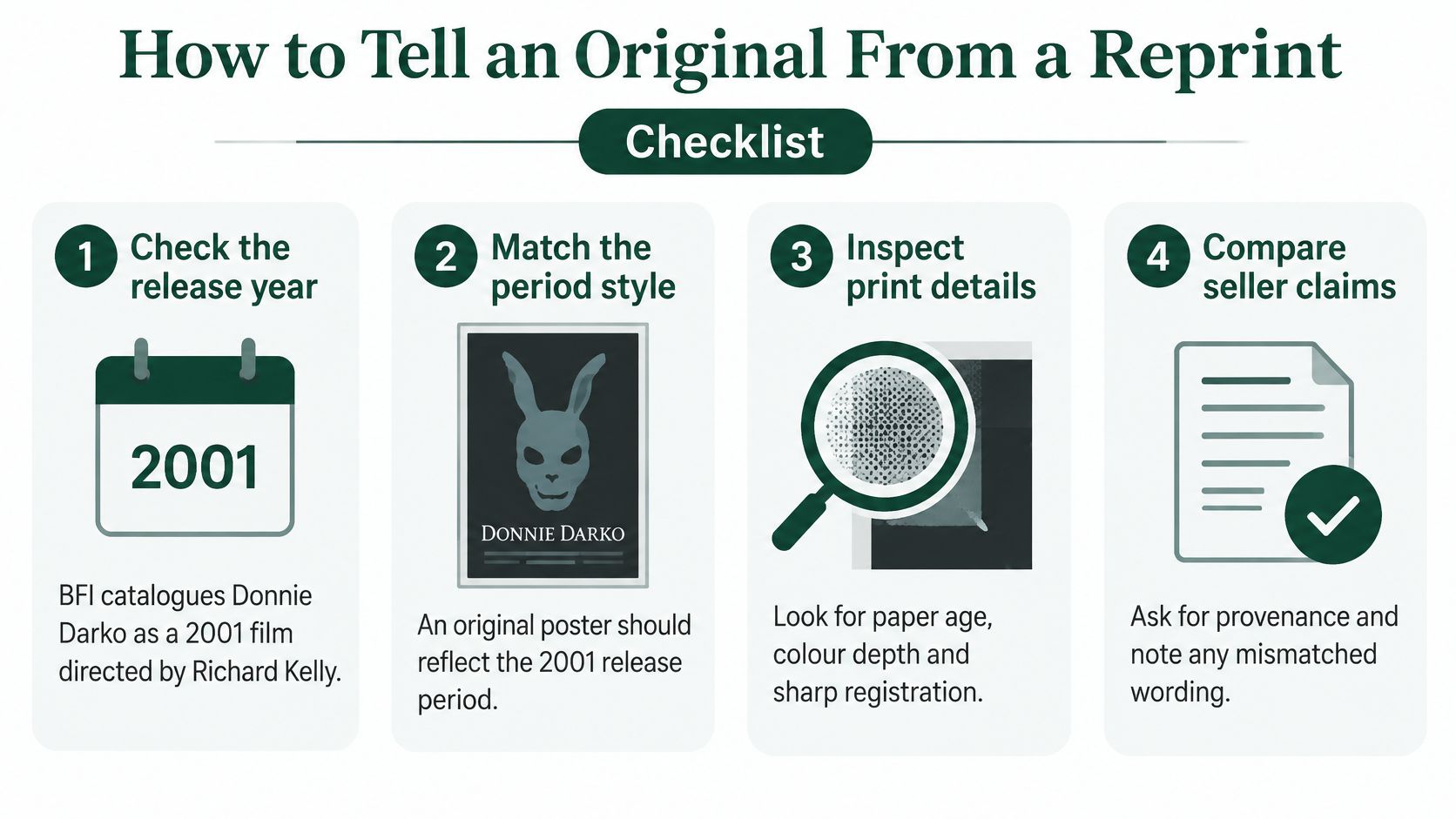
No single test decides authenticity. I would work through these six checks in order and treat a failure at any stage as a reason to pause, not as a detail to explain away.
The six checks
- Confirm the release year. The British Film Institute film record for Donnie Darko records it as a 2001 film directed by Richard Kelly. A poster sold as an original theatrical item should align with that release period, credited director and distribution history, rather than resting on artwork alone.
- Identify the country of issue. Read the billing block and small legal text at the foot of the sheet. UK and US versions differ in layout and wording, so establish territory before you discuss rarity, because scarcity in one market doesn't transfer automatically to another.
- Measure the sheet yourself. Match the result against the Quad and One Sheet dimensions and be wary of any listing that gives no measurements at all. The guide to original movie posters in the UK is useful here if you want the broader format context before you challenge a seller's description.
- Inspect sides, surface and storage wear. Check whether the sheet is single-sided and look for creasing, rolling memory and edge darkening consistent with long storage. Fresh, uniformly bright paper isn't impossible for a well kept original, but it should prompt closer questions about printing history.
- Look for anniversary wording. A 25th-anniversary line, a revival date or commemorative branding points to later material. Sellers sometimes photograph the centre of the artwork and omit the margins where that wording sits, so insist on seeing the whole sheet.
- Treat the certificate as context only. The BFI Player listing for Donnie Darko lists the film as certified 15, with strong language and horror in the content information. That classification helps describe the UK marketing context, but related publicity across several formats can carry it, so it doesn't by itself prove a poster is original.
Combine the evidence. Size, billing, period detail and provenance pointing the same way carry far more weight than any one reassuring feature.
Ask for written measurements and whatever provenance the seller holds before you pay. If the answers arrive as general assurances rather than specific facts about that sheet, you're being asked to buy the story instead of the poster.
Choosing Artwork Between Frank, the Jet Engine and the Ensemble
Different artwork doesn't just change the colour on your wall. It changes which version of the film you're putting on display, and that choice is worth making deliberately.
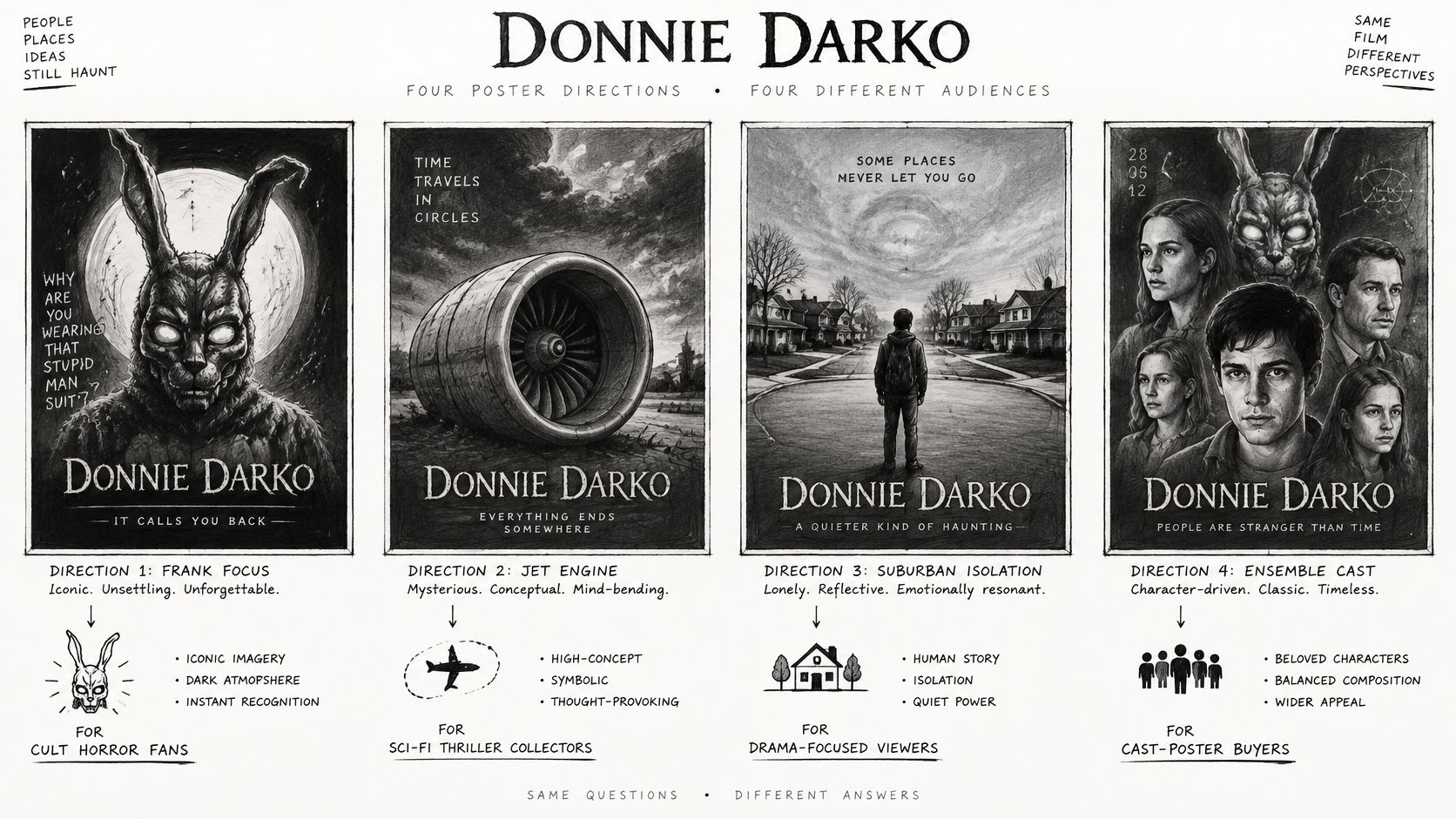
The concepts below show how varied those visual directions can look side by side.
Match the image to your reading of the film
The BFI interview and film description with Richard Kelly describes Donnie Darko as combining high-school drama, science fiction, psychological thriller, black comedy and horror. With that range in one film, no single image covers everything. Each major artwork direction emphasises one strand and drops the others.
- Frank the rabbit: Best for a buyer drawn to horror and mystery. It's the most immediately recognisable option and works in a cinema room or hallway where you want impact at a glance, but it reduces a complicated film to one figure.
- The jet engine: Suits science fiction fans who focus on time, causality and the approaching catastrophe. It tends to feel colder and more conceptual, which can sit well in a study or a pared back room.
- Suburban isolation: Fits anyone who reads the film mainly as a story of adolescent unease. A lone figure against ordinary streets and interiors carries the psychological weight without leaning on a monster image.
- The ensemble cast: Works if you see the film as a group story about family, school and community pressure. It gives a room a broader, less confrontational focal point.
A practical test helps cut through indecision. Choose the artwork that matches the one sentence you'd use to describe the film to a guest standing in front of it. If that sentence is about a teenager who may be unravelling, Frank alone may not be the faithful choice, however iconic he is.
The clip below is worth watching with that test in mind, noticing whether your attention lands on dread, speculation or the suburban setting.
Don't let artwork choice replace the originality checks. A fan-made design can capture the film's mood faithfully and still have no connection to official cinema publicity. Equally, a UK Quad is historically tied to British cinema-going, yet format alone proves neither authenticity nor superior value. Decide what the image says, then verify what the sheet is.
What Drives Value Beyond the Image
A Donnie Darko poster can draw more attention when the film returns to UK cinemas, but renewed interest does not make every version collectible. Reprints and anniversary designs may reach new buyers alongside original theatrical material. That creates a practical distinction: the film's cult image can be widely recognised while an authentic period poster remains scarce.
What buyers actually pay for
Resale value depends on the specific sheet, not on how recognisable Frank is. Check these points:
- Release-era match: Was the poster printed for the original theatrical campaign, or for a later event?
- Format and territory: Does the sheet's format and billing fit the country where it was issued?
- Provenance: Can the seller describe a plausible source or ownership history in writing?
- Condition: Look under good light for rolling memory, folds, fading, edge wear and surface scuffs.
- Rarity in that exact form: Compare like with like, including format and condition. The film's fame alone does not establish rarity.
Current UK programming signals continuing interest, not a guaranteed rise in prices. British Cinematographer's report on BFI Halloween programming covers UK venues promoting a 25th-anniversary 4K presentation. A renewed cinema run can bring the film to fresh audiences and prompt collectors to look again, while also putting modern commemorative designs in front of buyers. Neither response proves that a particular original will appreciate.
For a market reference, a UK specialist listing page for Richard Kelly posters displayed an original Donnie Darko UK Quad at £175 in its 2026 listing data. That is one seller's asking price, not a completed sale or a dependable valuation. Use it as a comparison point, then weigh the exact poster's format, condition and provenance. The guide to original movie poster prices provides further context for separating those factors from cult appeal.
Buy an original when its format, provenance and condition hold up, and the price makes sense to you as a display piece. Treat an anniversary design as a separate purchase, with its own price and purpose. Fresh cinema attention may bring more commemorative stock into view, but it cannot create another period original.
How to Frame, Store and Pack Your Poster
Keep the poster flat in an acid-free sleeve until framing day. Dark artwork shows creases early, and once a fold cracks the printed surface you can't press that damage away.
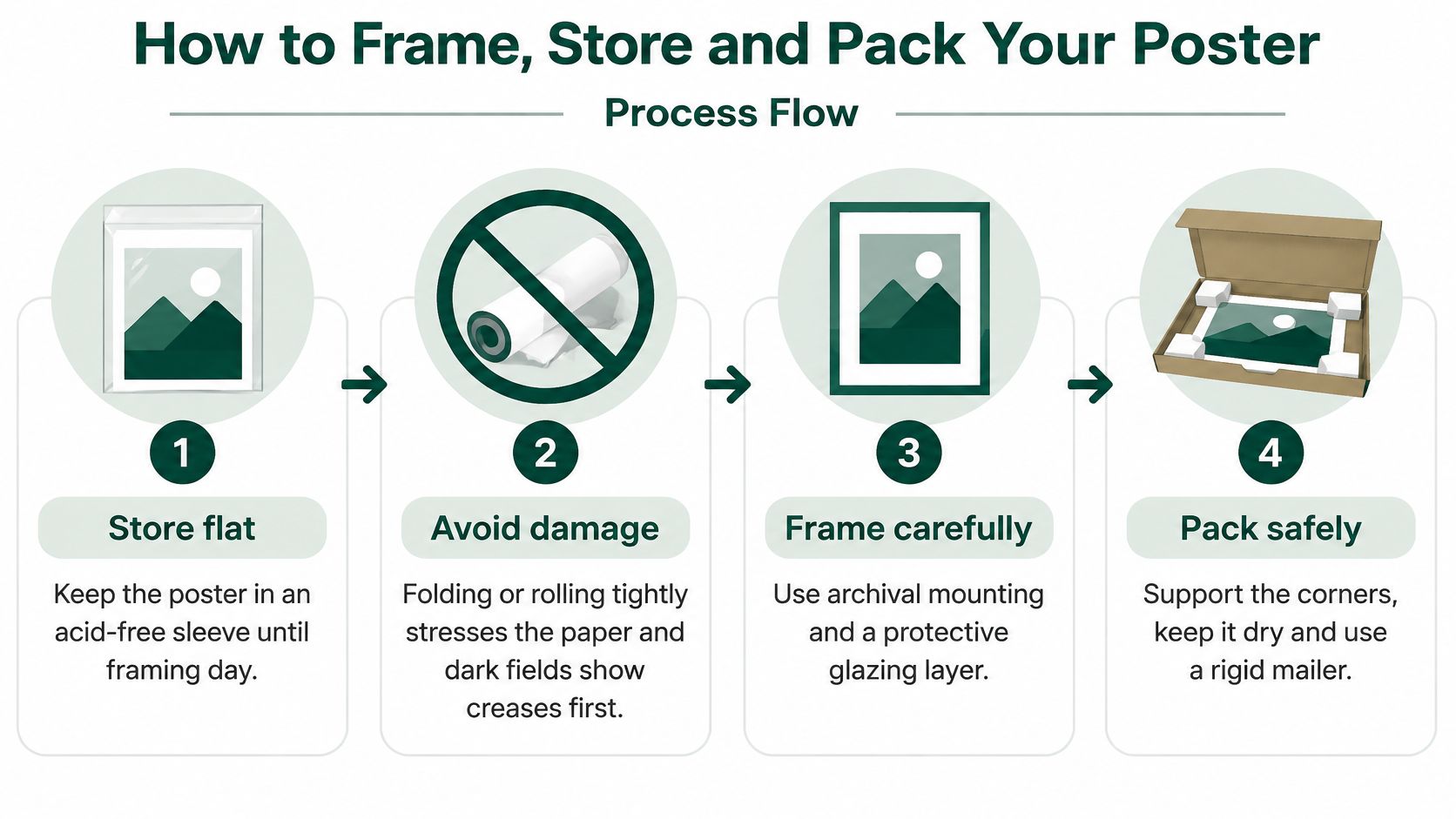
Working in order
- Match the frame to the format. Use a wide frame for a Quad and a portrait frame for a One Sheet. For a reprint, size the frame to the measured sheet rather than the title of the listing, and leave the poster untrimmed even if it's a few millimetres off a standard size.
- Mount without adhesive on the artwork. Use archival hinges or corner mounts on an acid-free backing board. Tape and glue can stain, cockle or tear paper and they aren't reliably reversible, which matters if you later reframe or sell.
- Choose the wall carefully. Hang away from direct sunlight, radiators and damp external walls. Fading shows first where colour is deepest, and moisture can wave the sheet inside the frame long before you notice a mark on the glazing.
- Relax a rolled original slowly. Unroll it face up on a clean flat surface and let it settle over several days under light, even weight protected by clean tissue. Forcing tight rolling memory flat in one session risks edge splits and horizontal stress lines.
- Pack for posting with no room to shift. Roll the sheet loosely in acid-free tissue inside a rigid tube sized to the format, with end protection so it can't slide and dent. A One Sheet can also travel flat in a rigid box if it's supported on both sides and kept dry.
After a month: Open your diary, not necessarily the frame, and inspect for curling, moisture marks or lifting corners while they're still easy to correct.
Good handling won't turn a reprint into an original. It will stop a sound original losing condition, and condition is one of the few value factors fully under your control once the poster is yours.
Confirm Format and Provenance Before You Buy
Before you pay, put your questions in writing and keep the replies with the poster. A seller who knows the stock should answer them directly, and the record you create will help with framing, insurance and any future sale.
Questions worth sending
- Format and exact dimensions: Ask for inches and centimetres measured across the full sheet, not the image area.
- Release year and country of issue: Ask which campaign the sheet was printed for and which territory's billing it carries.
- Physical state: Ask whether it's rolled, folded or flat, single-sided or otherwise, and whether there's fading, edge wear or restoration.
- Period or later printing: Ask plainly whether it's a period theatrical original, an anniversary piece or home-video material.
- Provenance: Ask where the seller obtained it and what documentation, if any, comes with it.
Request close photographs taken under raking light, with the light angled across the surface rather than aimed straight at it. Scuffs, light creases and fading that vanish in flat catalogue shots show up clearly that way, particularly on dark blue fields. Ask for the reverse as well, because tape remains, stamps and paper tone all add context.
Walk away from a listing that can't answer in writing or gives no measurements. That isn't caution for its own sake. Without format and period, you can't price the poster, frame it correctly or compare it with another example.
Apply the same list to every dealer, including us. Famous Movie Posters sells only guaranteed original movie posters, and we hold hundreds of posters in stock, searchable by decade, genre or franchise, but those facts shouldn't replace your questions about the specific sheet you want. Test any claim against dimensions, billing, condition and provenance.
Write down five things for the Donnie Darko movie poster you're considering today: format, year, country, condition and provenance. If you can complete that line from evidence rather than listing language, you're ready to decide. If you can't, the decision is to wait.
Browse guaranteed originals by decade, genre or franchise at Famous Movie Posters and apply the format, year, country, condition and provenance checks above to any Donnie Darko movie poster you find. If the exact Quad or One Sheet you want isn't listed, visit the site to search the current stock and explore framing options sized for the sheet you choose.