



A late-night listing catches your eye. The image looks right, the seller has used the words “original” and “rare”, and the price seems suspiciously low. You have seconds to decide whether to open the listing, ask for more photographs, or walk away.
That hesitation is justified. The Evil Dead has spent decades generating reprints, bootlegs, later editions and unofficial tribute artwork, so a convincing image on a marketplace proves very little. The 1981 UK quad, designed by Graham Humphreys for Palace Pictures, deserves particular attention because it belongs to the British release history of the film, not merely to its international poster catalogue. A UK poster reference for The Evil Dead identifies it as a first-release UK quad and records the British distribution connection.
By the time you finish this guide, you'll know what the UK quad means, how it differs from a US one sheet, which evidence an honest listing should provide, and how condition, framing and provenance affect your decision. My advice is simple. Treat the format as evidence, treat the paper as evidence, and treat any seller who avoids detailed photographs as a risk.
Table of Contents
- Why the Evil Dead Poster Stops Collectors in Their Tracks
- Key Editions and Variants Worth Knowing
- UK Quad Versus US One Sheet and What It Means for Your Collection
- How to Verify an Original Evil Dead Poster
- Reading Condition and Grading on Evil Dead Posters
- Framing, Storing and Preserving Your Poster Long Term
- Where UK Collectors Should Buy Their Evil Dead Poster
Why the Evil Dead Poster Stops Collectors in Their Tracks
A convincing Evil Dead poster can fool an experienced buyer at first glance. The image is grimy, aggressive and unmistakably tied to Sam Raimi's film, with a distressed shrine-like scene that looks as though it has survived the woods. That rough visual language is precisely why modern reproductions can pass casual inspection.
A reproduction can copy the composition, add artificial wear and hide its clean paper under flattering lighting. If you judge only by the image, you risk paying original-poster money for a recent decorative print. Examine the format, paper, reverse and seller photographs before discussing price.
The British format matters
The 1981 UK quad, measuring 30 x 40 inches and printed horizontally, is the British first-release format commissioned from Graham Humphreys by Palace Pictures. It belongs to the film's UK cinema history rather than being another version of an international design. The British release history of The Evil Dead's UK quad provides useful reference material for identifying that context.
That distinction gives the quad its strongest collecting argument. Its appeal comes from the meeting of film, British distribution, period design and a recognisable artist's work. A US one sheet can be an important companion piece, but it should not replace the UK quad when your collection is focused on the film's British cult identity.
Palace (Video) Pictures held the relevant distribution connection and used Humphreys for the quad and related video artwork. The artist's early involvement is part of the poster's story, while collector commentary on the Evil Dead poster offers further background on the artwork and its place in the film's collecting history.
Dealer's rule: A clean front image is an advert, not proof of authenticity.
British cinema posters were commonly produced for short theatrical runs and could be discarded once a booking ended. That helps explain why genuine examples can be difficult to find, particularly when later video designs, reprints and tribute artwork have kept the image in circulation. The film's continuing British following increases demand, but popularity alone proves nothing about a sheet's age.
Separate collectability from decoration
A first-release UK quad is a period artefact connected to the film's initial British theatrical market. A later reprint may still look excellent above a desk or in a home cinema, but it must be described and priced as a reproduction or later issue. Honest terminology protects both buyer and seller.
My recommendation is straightforward. Start with the UK quad if British release history matters to you. Ask for photographs of the edges, reverse, folds and paper surface, then compare those details with the listing description. Buy the object, not the seller's use of the words “original” or “rare”. Consider the US one sheet after you understand how format and release market change the collecting case.
Key Editions and Variants Worth Knowing
Start with the title, country and format before assessing condition. “Evil Dead poster” is a useful search phrase, not a precise collecting description. A reliable listing should identify whether the sheet is a UK quad, a US one sheet, a later theatrical issue, a video-market design or a reproduction.
Put the UK quad first
The defining British item is the 1981 UK quad, associated with Palace (Video) Pictures and designed by Graham Humphreys when he was 20. It was produced for the UK 30 x 40-inch cinema format and belongs to the film's original British theatrical release. The date, market, format and artist work together. That combination gives the poster its place in British cult film history.
The quad also reflects how The Evil Dead was marketed in Britain before VHS-era imagery extended its life. Later video artwork and tribute designs belong to that wider story, but they answer different collecting questions. UK Evil Dead poster listings and reference material provides useful examples of UK-related material and the distinction between theatrical and video designs.
A later piece is not automatically a poor purchase. Buy it for display if you like the artwork. Describe it as a video issue, reprint or tribute poster, and do not present it as the 1981 quad.
Use a release table, not seller language
| Release Year | Format | Title/Film | Designer | Distributor | How to tell |
|---|---|---|---|---|---|
| 1981 | UK quad | The Evil Dead | Graham Humphreys | Palace (Video) Pictures | Horizontal 30 x 40-inch format, with the British credit block and Palace identification |
| 1981 | US one sheet | The Evil Dead | Check the individual listing | Check the individual listing | Portrait format, with an American credit block and distributor details |
| 1983 | UK video poster | The Evil Dead | Graham Humphreys artwork | Palace Video | VHS-era design and video branding, not a 30 x 40 quad |
| 2013 | US one sheet | Evil Dead | Check the individual listing | Check the individual listing | Separate film, modern US credit block and different distributor information |
The 1983 example matters because familiar Humphreys artwork can appear on a video-market poster rather than the original cinema quad. The 2013 sheet matters for the opposite reason. Its title connects it to the franchise, but its release, credit block and distributor identify a separate film.
A seller who writes only “original Evil Dead poster” has left out information that should guide your decision. Ask for dimensions, country of issue, the reverse side, the folds and any documentation. Compare the measurements with the claimed format before discussing price.
What “variant” should mean to you
A meaningful variant has an identifiable reason for being different. Check paper size, title wording, credit block, distributor information, trimming and release purpose. A colour shift caused by fading is condition, not a designed variant. A cropped scan proves nothing about rarity.
For a first serious purchase, ignore dramatic labels such as “unique”, “one of a kind” and “museum quality” unless the seller supplies evidence. A standard original with clear photographs, honest condition notes and a return policy is a better acquisition than a supposedly rare sheet with no reverse image or measurements. Start with the UK quad if British release history is your priority, then compare US and video issues once you can identify what separates them.
UK Quad Versus US One Sheet and What It Means for Your Collection
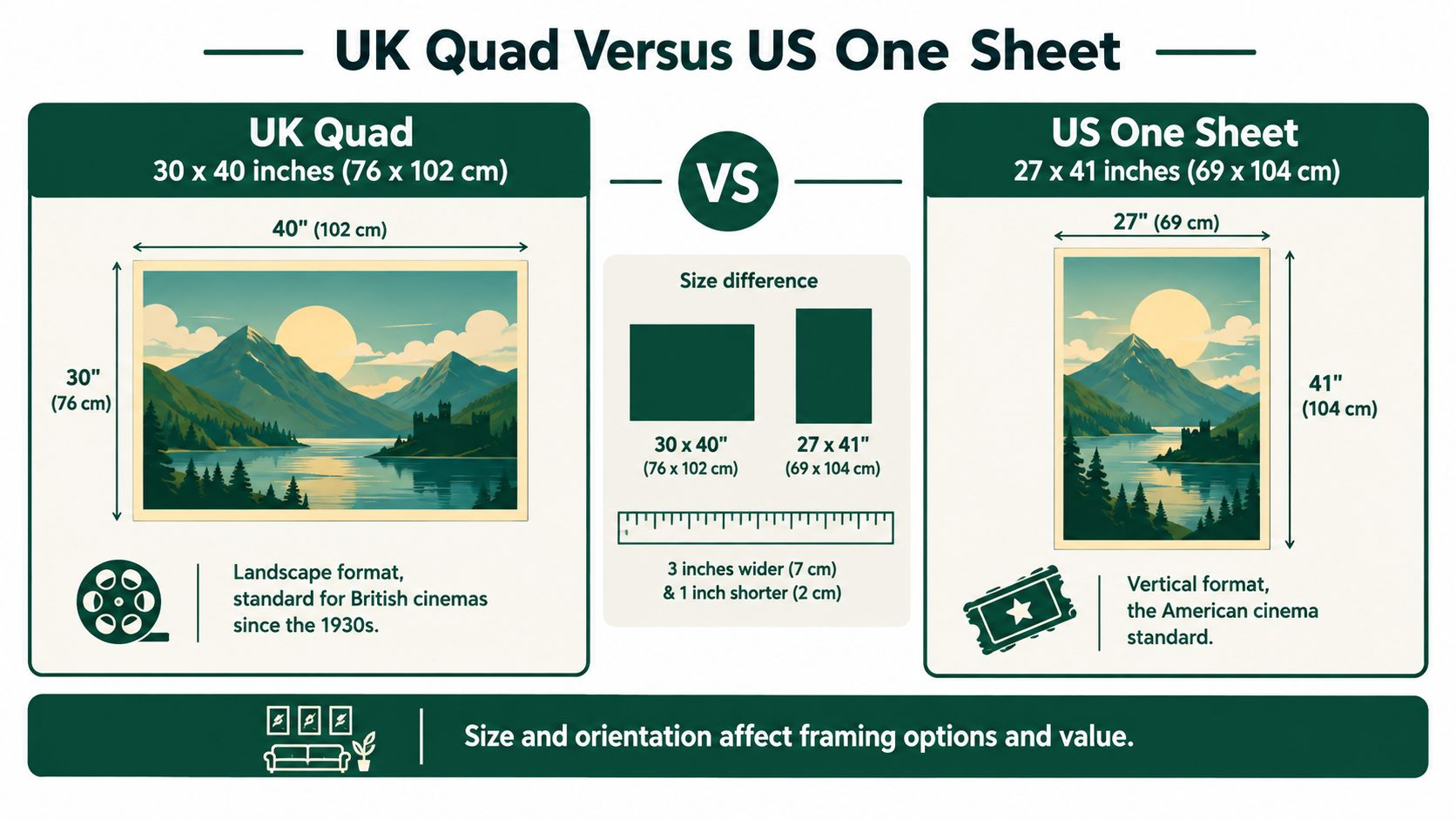
The UK quad is horizontal. The US one sheet is portrait. That sounds basic, but it affects identification, display, storage and the story the poster tells.
A standard UK quad measures 40 x 30 inches, according to UK cinema poster size references. The same reference identifies a UK one sheet as 27 x 40 inches, with the quad oriented horizontally and the one sheet vertically. These are not interchangeable labels, and the difference matters when you're buying a frame or cataloguing a collection.
Format is provenance in visual form
A UK quad normally points you towards British theatrical distribution or a closely related UK issue. A US one sheet points towards American theatrical or video-market origins. The format doesn't authenticate the sheet by itself, but it gives you a starting hypothesis that the rest of the evidence must support.
British specialists have long treated the quad as the standard UK cinema poster format. A guide to common UK movie poster sizes also notes that one sheets became more common in UK cinemas around 2000, which reinforces the need to identify the exact release context rather than relying on the film title alone.
For a new UK collector, the quad is usually the more practical format. UK retailers commonly stock frames close to 30 x 40 inches, while a US one sheet often needs a bespoke frame or a more carefully selected mount. Storage presents the same issue. A collection built around quads can use a consistent flat-file or portfolio system, whereas mixed formats require more planning.
Read the difference between a one sheet and a quad movie poster before you buy a frame, especially if the listing uses “one sheet” loosely.
The US sheet still has a place in a serious collection. It offers a different national release history and may appeal if you collect American cinema material. But don't buy one expecting it to be the British poster. For the UK story of The Evil Dead, the quad is the more direct and satisfying choice.
How to Verify an Original Evil Dead Poster
Authentication begins with the sheet, not the seller's confidence. Start by asking for photographs that show the complete front, all four corners, both crossfolds and the reverse. If the seller refuses or provides only a tightly cropped image, stop there.
The original 1981 UK quad was created as a purpose-built British format. Graham Humphreys has explained that the bottom 3 inches were traditionally left available for a venue strip, a compositional constraint recorded in the interview with Graham Humphreys about The Evil Dead poster. That detail matters because the artwork was designed for the quad rather than resized from an American one sheet.
Follow a fixed inspection order
- Confirm the dimensions. The nominal UK quad is 30 x 40 inches, but surviving examples can vary. Trimmed examples have been recorded at approximately 38.25 x 28.75 inches, so a slightly smaller sheet isn't automatically fake. Ask whether the edges have been trimmed or the borders removed.
- Study the paper. An older original should be assessed for the character of its stock, folds, handling and print surface. Don't accept a seller's claim that a glossy sheet is original just because the image looks sharp.
- Inspect the print. Use a close photograph or a loupe to examine the dot pattern and ink. Modern reproductions can look attractive at normal viewing distance, but the printing method and surface often tell a different story.
- Check the artwork against trusted references. Look at the distressed Humphreys image, the title treatment, the central horror imagery and the layout around the lower strip area. Compare the whole composition, not just one familiar detail.
- Look at the reverse. The back can reveal trimming, paper damage, tape, staining, bleed-through and restoration. It can also expose a sheet that has been mounted, backed or heavily altered.
- Record the provenance. An old purchase receipt, auction record or dealer history can help, but paperwork doesn't excuse a physical inspection. Treat provenance as supporting evidence, never as a substitute for the poster itself.
Understand NSS evidence properly
Older US posters may carry National Screen Service-style markings, including a release year and four-digit film code at the bottom. Auction guidance on identifying valuable movie posters explains why these markings can assist with verification and notes that the NSS ceased to exist in the UK in 2007.
That evidence is more useful for a US sheet than for a British quad, so don't demand an American marking from a UK poster. The country of origin, format and release history must agree.
Post-1990 bootlegs make modern authentication harder because glossy printing is easier to reproduce. The safest approach is to combine paper, dimensions, printing, artwork, reverse-side evidence and provenance. No single visual cue deserves your money on its own.
For a broader reference point, consult this guide to original movie posters in the UK, then ask the seller direct questions rather than relying on marketplace terminology.
Reading Condition and Grading on Evil Dead Posters
Condition descriptions vary between dealers, so translate every grade into visible evidence. “Very good” is not a magic phrase. It should tell you what has happened to the sheet and what you'll see when it arrives.
On a UK quad, ordinary handling can produce edge wear, rounded corners and surface creasing at the crossfolds. Those faults may be acceptable in a scarce first-release poster, but their position matters. A crease across the main face or central demon disrupts the image far more than a small mark in an unprinted margin.
Grade the image, not just the paper
A strong example should retain crisp colour and a clean, readable composition. Pay close attention to the blue sky area and the red and yellow inks. Noticeable fading in those areas changes the character of the poster and should affect the price, even if the sheet has no tears.
US one sheets have their own familiar trouble spots, including damage around the upper-left corner and chipping along the bottom edge. The format changes, but the principle stays the same. Inspect the areas where a cinema poster was most likely handled, pinned or removed.
| Grade | Typical appearance on Evil Dead posters |
|---|---|
| Excellent | Strong colour, clean surface and sharp edges, with only minor signs of handling |
| Fine | Crisp presentation, intact folds and bright printed areas, with no obvious tape marks |
| Very Good | Edge wear, minor corner rounding and some crossfold or surface creasing |
| Good | More visible folds, marks, tears or fading, but the main image remains presentable |
| Restored | Repairs, backing, retouching or other conservation work that must be disclosed clearly |
The table is a working description, not a universal industry standard. One dealer's “fine” may be another dealer's “very good”, which is why photographs matter more than the adjective.
Condition rule: A professionally repaired poster can still be desirable, but restoration must be priced and described as restoration.
Ask for full, edge-to-edge scans or photographs showing all four corners and both crossfolds. Request close-ups of tears, pinholes, tape, stains and repaired areas. If the listing hides the borders, assume the borders contain information the seller doesn't want you to see.
Never treat linen backing as proof of quality. It can stabilise a fragile sheet, but it can also conceal damage, trimming or extensive restoration. Buy the object you can inspect, not the grade printed in the listing title.
Framing, Storing and Preserving Your Poster Long Term
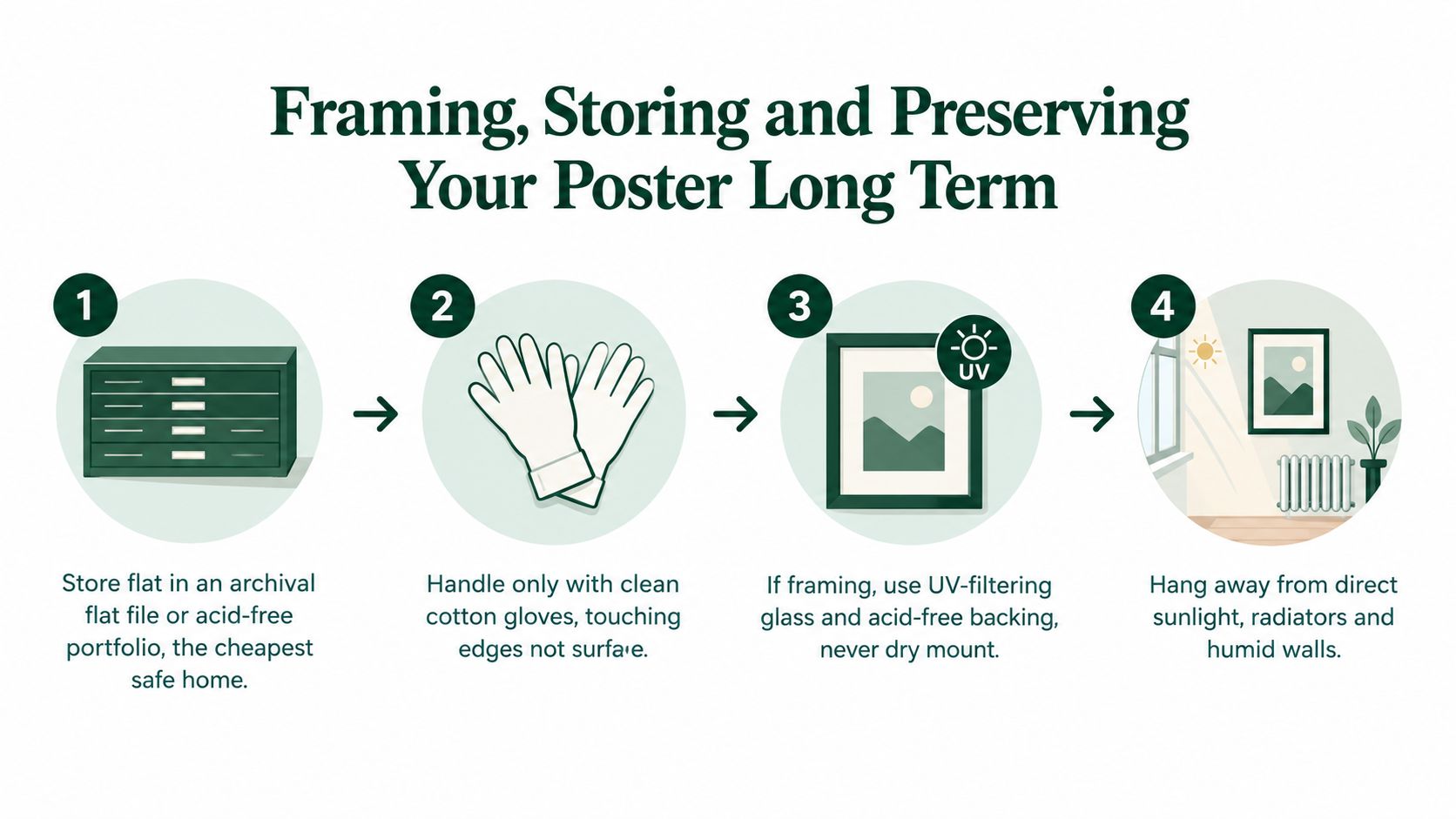
Preservation comes before display. The cheapest safe home for a UK quad is usually an archival flat file or a portfolio with acid-free pockets, with acid-free tissue between sheets. A 40 x 32-inch drawer is the practical minimum for a standard UK quad, allowing room for the poster without forcing the edges against the sides.
Keep the storage flat in a dry room. Avoid radiators, damp external walls and direct sunlight. The red and yellow areas of the Humphreys artwork are especially important to protect because fading changes the visual balance of the design.
Frame only when the display plan is settled
Framing a poster is a conservation decision, not just a decorating decision. If you plan to rotate the sheet between storage and display, leave it unframed until you've chosen a safe routine. Repeated mounting and removal create handling risks that the poster doesn't need.
Use a wooden or aluminium frame with a sealed back, UV-filtering glass or perspex and acid-free mount board behind the artwork. The glazing shouldn't press against the paper. A suitable spacer or deep frame can create the separation required to prevent contact.
Never tape, hinge or attach self-adhesive corners directly to the poster. Adhesive can stain, pull fibres from the paper or make future conservation more difficult. If a framer recommends dry mounting a valuable original, find another framer.
Build a handling routine
Clean hands are essential, and cotton gloves can help when you're moving a sheet, but gloves don't replace care. Hold the poster by its edges, support the full sheet and avoid dragging it across a table. Never force a folded poster flat.
A sensible routine looks like this:
- For storage: Use an archival flat file or acid-free portfolio, with acid-free tissue between sheets.
- For display: Use UV-filtering glazing, acid-free backing and a sealed frame.
- For rotation: Place the poster in a protective polyester or mylar sleeve before returning it to storage.
- For the room: Choose a dry wall away from windows, radiators and humid areas.
The poster framing guide for collectors is useful when comparing frame construction, glazing and backing options. Don't let a low-cost frame dictate the treatment of an original. The frame should protect the poster, not merely make it fit the wall.
Where UK Collectors Should Buy Their Evil Dead Poster
There are three sensible buying routes in Britain. You can use a specialist original-poster dealer, bid through a major auction house such as Bonhams, Prop Store or Dreweatts, or search general marketplaces including eBay and Facebook Groups. For a difficult title, a Request a Poster-style concierge service can add another route through established dealer networks.
Each option has a different balance of stock, price, paperwork and risk. A specialist dealer may cost more than an optimistic marketplace listing, but you're paying for identification, handling, photographs and a clear description. An auction house can offer strong provenance, though you must read the condition report carefully and understand the buyer's premium, collection arrangements and return position.
Choose evidence over excitement
General marketplaces are useful for research and occasional bargains, but they're the least forgiving place for a first serious purchase. Listings can use the right image while omitting the format, dimensions, reverse side and restoration history. Facebook groups can be excellent communities, but community reputation isn't the same as a written guarantee.
A UK-based originals specialist is usually the better starting point. The dealer should be able to explain why the poster is a UK quad or US one sheet, identify trimming, disclose restoration and provide photographs that show the whole sheet. They should also state their return policy before you buy.
Buying advice: The honest seller answers specific questions before taking payment. The risky seller keeps repeating “rare original” without supplying evidence.
Ask these questions in writing:
- Is the poster an original theatrical issue, a reissue, a video-market item or a reproduction?
- What are the exact dimensions, and has the sheet been trimmed?
- Can you send a full front photograph, all four corners and the reverse?
- Are there tears, tape marks, pinholes, staining, retouching or backing?
- Has the poster been linen-backed, paper-backed or otherwise restored?
- How will it be rolled, protected and insured during postage?
- What happens if the sheet differs materially from the description?
If the copy is heavily folded, budget for professional linen-backing only after an experienced conservator has assessed it. Don't assume backing automatically increases value. For many collectors, an unrestored sheet is preferable to a heavily treated one.
The best purchase is rarely the cheapest listing. It's the example with the clearest identity, the most complete photographs, the most transparent condition report and a seller prepared to stand behind the description.
Famous Movie Posters offers guaranteed original film posters, including UK quads and US one sheets, with authenticated sourcing, archival handling and protective UK shipping. Visit Famous Movie Posters to search the catalogue or request a hard-to-find Evil Dead poster through its specialist sourcing service.