



The usual advice is to buy the cleanest poster you can afford. For an extraterrestrial movie poster, that can be the wrong starting point. A spotless sheet may be a reproduction, a later reissue or an unused original, while a folded example with modest wear may have a much stronger connection to the film's British cinema release.
Start with the paperwork and the format, not the shine. The useful question isn't whether the artwork looks right, but whether the dimensions, credits, printing, release history and seller's description tell a consistent story.
Table of Contents
- Poster Formats and Sizes at a Glance
- How to Verify an Original Before You Buy
- Dating a Poster From Its Release Clues
- Why Folds and Wear Can Add Value
- What Actually Drives a Poster's Price
- Buying an Original Poster Online
- How to Store and Display an Original Safely
Poster Formats and Sizes at a Glance
Which format is in front of you, and will it fit your frame and wall? Establish that before comparing prices. Measure the complete sheet, including its borders, rather than the image alone.
The UK Quad is the familiar British cinema format, conventionally 30 x 40 inches, approximately 76 x 101.6 cm. The traditional US One Sheet is portrait and usually 27 x 41 inches, although that label doesn't guarantee that every sheet has those measurements. Our guide to the difference between a one sheet and a quad explains the distinction for collectors choosing between British and imported material.
Common extraterrestrial film poster formats
| Format | Orientation | Typical size | Typical origin |
|---|---|---|---|
| UK Quad | Landscape | 30 x 40 in, approximately 76 x 101.6 cm | British cinemas, most UK releases from the 1940s |
| US One Sheet | Portrait | 27 x 41 in for the traditional format | US theatrical release, often imported |
| US Half Sheet | Landscape, despite occasional portrait descriptions | Request the sheet's measured width and height | US cinema lobby and window display |
| US Insert | Portrait | Request measured dimensions for this tall, narrow format | US cinema, narrow display format |
| UK Quad Crown | Landscape | 15 x 20 in | Pre-war British cinema |
| Cinema advertisement, Quartet, Science Museum Group | Landscape | 758 x 1,014 mm | Documented UK collection sheet, not a size to assume |
| Signed E.T. poster, Propstore London 2024 | Portrait | 27 x 39 in, about 69 x 99 cm | Auctioned sheet matching neither the standard quad nor traditional one sheet |
The 15 x 20-inch Quad Crown helps explain why pre-war British posters can look different from later quads. Similar names don't mean interchangeable frames, and sellers sometimes use format names loosely.
Actual measurements matter more than the label. The Science Museum Group's Quartet record gives its cinema advertisement as 758 x 1,014 mm, close to a quad but not a measurement to assume. Likewise, Propstore's signed E.T. the Extra-Terrestrial listing records 27 x 39 inches, approximately 69 x 99 cm.
Framing rule: Match the format to the release market, then match the frame to the actual sheet. Never buy a frame on the strength of the film title alone.
How to Verify an Original Before You Buy
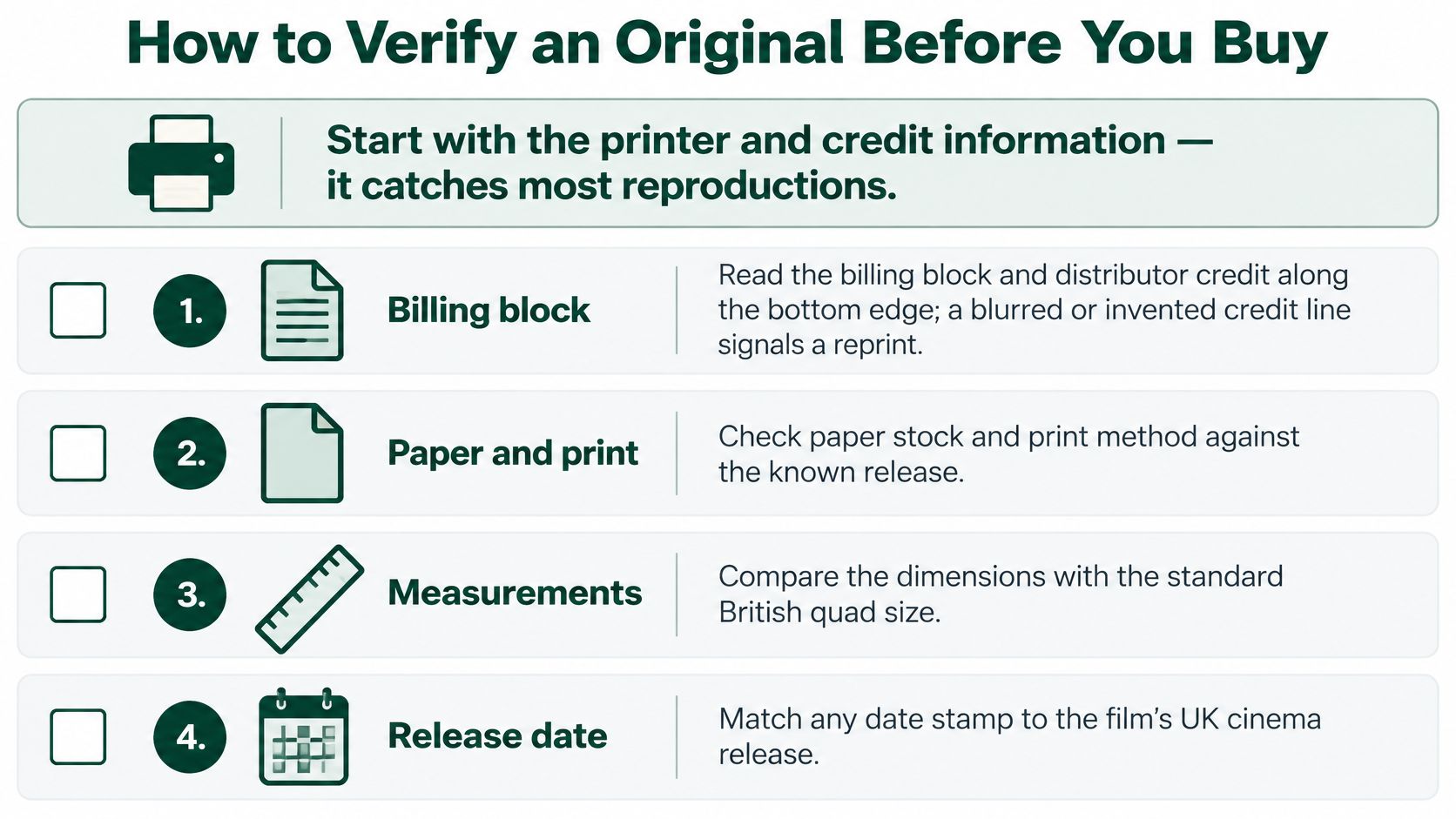
Start with the printer and credit information. Reproductions can reproduce an arresting image convincingly, but small lettering, cropped margins and inappropriate distributor details often expose inconsistencies more quickly than the main artwork.
Use this checklist as a prompt for closer examination, not as a certificate of authenticity.
Read the evidence in order
- Read the billing block and distributor credit. Compare the lettering along the bottom edge with a reliable reference image of the same national release and campaign. Look for missing words, altered spacing and credits that have become blurred while the main picture remains sharp.
- Assess paper weight and tone. Ask whether the stock matches a documented example, rather than assuming that old paper must be thick or yellow. Uneven ageing can be plausible, but storage conditions affect appearance, and bright paper alone doesn't prove a reproduction.
- Examine the print under magnification. A loupe can reveal halftone dots, ink distribution and copied surface damage. Offset dots may support the proposed printing method, but their presence isn't proof: a reproduction can copy an earlier dot pattern, and digital printing isn't always smooth.
- Inspect folds and edge wear. Compare their position with the proposed distribution and storage history. A crease reproduced in the image, without a corresponding physical fold, deserves particular attention.
- Match the campaign artwork and text. Compare the title treatment, tagline, credits and layout with the specific release being claimed. An alternative design can be a legitimate theatrical issue, but attractive fan art isn't cinema-issued merely because a seller calls it alternative.
- Request clear photographs of both sides. Ask for an uncropped full-sheet image, a reverse view and close-ups of margins, credits and defects. The reverse can reveal repairs, backing, staining or annotations that the front conceals.
Authenticity checks and warning signs
| Check | Genuine original | Warning sign |
|---|---|---|
| Printer or litho credit | Where present, consistent with the documented release | Missing, cropped or digitally smoothed information compared with a reference |
| Paper and tone | Stock and ageing consistent with known examples, sometimes thicker with uneven yellowing | Bright white, uniform colour and flimsy stock when the claimed issue should look different |
| Print pattern | Halftone or offset dots where expected for that printing | Smooth digital-looking gradients or copied dots inconsistent with the known process |
| Fold and edge wear | Physical handling marks compatible with the sheet's history | A crisp, unfolded sheet described as vintage without supporting evidence |
| Campaign artwork and text | Matches the documented release campaign | Later reissue artwork sold as the original release |
These are warning signs, not automatic verdicts. Some originals lack printer credits; some survive unfolded; some were printed on relatively light stock. Conversely, wear can be fabricated.
Keep the seller's explanation beside the photographs and reference material. If the explanation changes whenever you identify a mismatch, pause the purchase. No single check settles authenticity: the evidence has to agree.
Dating a Poster From Its Release Clues
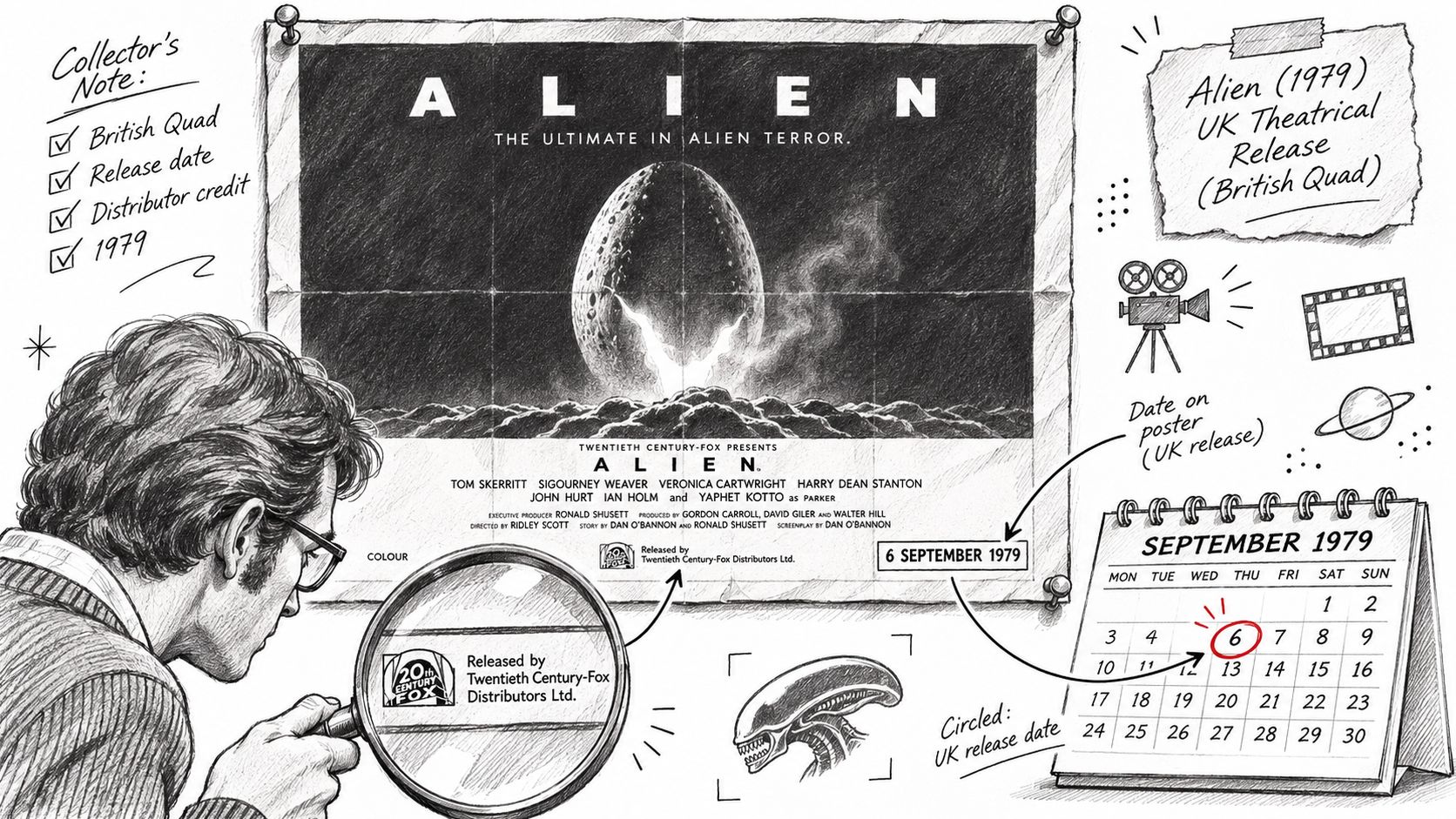
A film's production year isn't necessarily the date of its poster. Alien makes a useful worked example: the BFI's film record places its UK opening on 6 September 1979 and distinguishes the 1 March 2019 40th-anniversary reissue as a separate release.
When examining a claimed original, concentrate on the printed release clues rather than the atmosphere of the image.
Read classification details historically
The film's classification history needs care. The BFI record identifies a 15 certificate, but that shouldn't be read backwards as the certificate expected on its first British campaign. The accompanying classification history describes consideration of the less restrictive AA, the decision to pursue the adult X, and the replacement of X by 18 in 1982.
Those distinctions matter because a modern database entry describes the film as catalogued now, not necessarily the wording printed on its earliest advertising. Concerns surrounding graphic body horror, reproductive imagery and H. R. Giger's creature design also explain why classification was commercially significant.
A poster works rather like a postmark: its wording helps locate it in a particular place and release period. The familiar artwork alone can't supply that context.
Build a release match
- Record the claimed campaign. Separate the film's original release from anniversary screenings and other reissues.
- Transcribe the classification line. Compare the actual wording and symbol with the proposed British release, while allowing for designs that omit them.
- Compare campaign details. Check the title, tagline, distributor and any cinema-opening information together.
- Identify later additions. A handwritten date, dealer sticker or subsequent stamp isn't automatically the poster's printing date.
The film footage offers context for the campaign's imagery, rather than evidence that a particular sheet is original.
A bright modern quad can be a genuine cinema-issued poster yet belong to a later campaign. That isn't a defect if it's accurately described, but it changes what you're buying. A dated match narrows the search; it doesn't replace physical examination.
Why Folds and Wear Can Add Value
A flawless, unfolded poster isn't automatically the better buy. Honest condition and documented originality matter more than an appearance of perfection. If the proposed distribution history involved folding, an unexplained pristine sheet deserves questions rather than an immediate premium.
British quads from the period of Alien were commonly distributed folded. That makes folds compatible with originality, not proof of it. An unused original may also have survived without folds, so don't reject a sheet because it escaped cinema handling.
Separate distribution folds from damage
Regular centre or intersecting folds can fit a plausible distribution history. Random creases, crushed corners and pressure marks tell a different story about later handling. Look especially at intersections, where repeated opening can cause small separations or ink loss.
Tape marks and edge wear need individual judgement. A mounting mark outside the artwork may be less visually intrusive than staining across a face, but neither becomes desirable merely because it looks old.
For conversations with sellers, use a simple vocabulary:
- Excellent: Light handling and minor fold wear, with the image remaining strong.
- Very Good: Light edge wear or small tears that should be identified and photographed.
- Fair: Splits, staining, pinholes or other defects that affect the image or the sheet's stability.
These are working descriptions, not a universal grading standard. Ask what the seller means by the grade and prioritise the condition report over its headline.
A fold can support a credible history. A tear remains damage, even when the poster itself is unquestionably original.
Understand what restoration changes
A folded original with modest, disclosed wear can be a stronger purchase than a cosmetically improved sheet with an unclear treatment history. Restoration isn't necessarily bad: careful conservation can stabilise vulnerable paper and improve display.
The distinction is disclosure. Linen backing, pressing, tear repairs, infilling and retouching change what you can inspect directly, and collectors differ in how they value those interventions.
Before paying, ask whether the poster has been linened, pressed or repaired, and make sure the answer appears in the written description. Don't pay a condition premium for work you weren't told about.
What Actually Drives a Poster's Price
A signed E.T. the Extra-Terrestrial poster sold for £1,008 at Propstore's London collectible-poster auction in 2024, against an estimate of £200–£400, according to Propstore's published auction results. That's a result for a particular signed object, not a price guide for every poster carrying the same image.
A useful valuation separates the factors rather than crediting everything to the film's fame.
Assess the object, not just the title
- Signatures and inscriptions: Establish who signed, what evidence supports the attribution and whether the writing affects the artwork.
- An enduring audience: Recognition can create demand, but doesn't make every printing scarce.
- Scarcity of the actual issue: A less familiar limited-release film may be harder to find than a widely distributed blockbuster. Availability alone doesn't guarantee buyers.
- Format and dimensions: National campaign, composition and practical display appeal all influence which examples collectors pursue.
- Condition and treatment history: Compare like with like rather than treating an unrestored sheet and a heavily retouched example as interchangeable.
- Documented provenance: A traceable auction, studio or collection record can help establish what the object is and where it came from.
There's a useful distinction between a space-themed image and a physical space collectible. If you're comparing those interests, Astro West's Campo del Cielo guide offers a separate reference point for meteorite collecting; a film poster's appeal instead rests on its printing, campaign and cultural history.
Compare completed transactions
Our guide to original movie poster prices provides further context for comparing formats and condition. Keep a record of sold examples with their descriptions, rather than collecting asking prices without knowing whether anyone paid them.
Buy for display when the evidence doesn't support an investment case. If you'd still enjoy the poster without a resale gain, you've made a clearer decision than someone relying on age or a famous alien to guarantee appreciation.
Buying an Original Poster Online
Once you're satisfied with the object, check the transaction. The following consumer checklist concerns online purchases from a business; don't assume that a private sale offers the same cancellation rights.
Keep a copy of the listing and the terms available when you ordered. A saved document is more useful than relying on a page that may later change.
Before checkout
Under the GOV.UK distance-selling guidance, sellers must provide the total price including taxes, payment method, delivery arrangements, delivery costs and expected delivery time, explain cancellation rights and supply a contract copy you can save no later than delivery; unless otherwise agreed, delivery must take place within 30 days.
Use that as a practical checklist:
- Confirm the payable total. Separate the poster price from delivery and check that applicable taxes are clear before authorising payment.
- Read the cancellation terms. Find out how to notify the seller and where a return must go. Don't infer a specific listing's arrangements from a general impression of the website.
- Save the contract. Keep the confirmation email with the listing images and any written answers that influenced your purchase.
- Check the delivery commitment. If you've agreed a different timescale, retain that agreement, especially when buying a gift.
At Famous Movie Posters, we sell only guaranteed original movie posters, and we ship to nearly every country. For an international order, check the destination-specific costs and terms rather than assuming the UK arrangements apply unchanged.
After the parcel arrives
The GOV.UK returns and refunds guidance gives online customers 14 days after receipt to notify cancellation without giving a reason, followed by a further 14 days to return the goods. It also states that the seller must refund within 14 days of receiving the returned item, normally including the original standard-delivery charge; an express upgrade need only be refunded up to the standard-delivery cost.
Open the parcel carefully and retain its packaging while you assess the purchase. If you decide to cancel, send an unambiguous written notice and keep evidence of dispatch when returning it.
Buying safeguard: Pay only when the total price, delivery arrangements and cancellation process are clear enough to save with your order.
Don't let a seller's friendly manner substitute for written terms. Those records become especially useful when the delivered sheet differs from the description or its condition couldn't be fully judged from photographs.
How to Store and Display an Original Safely
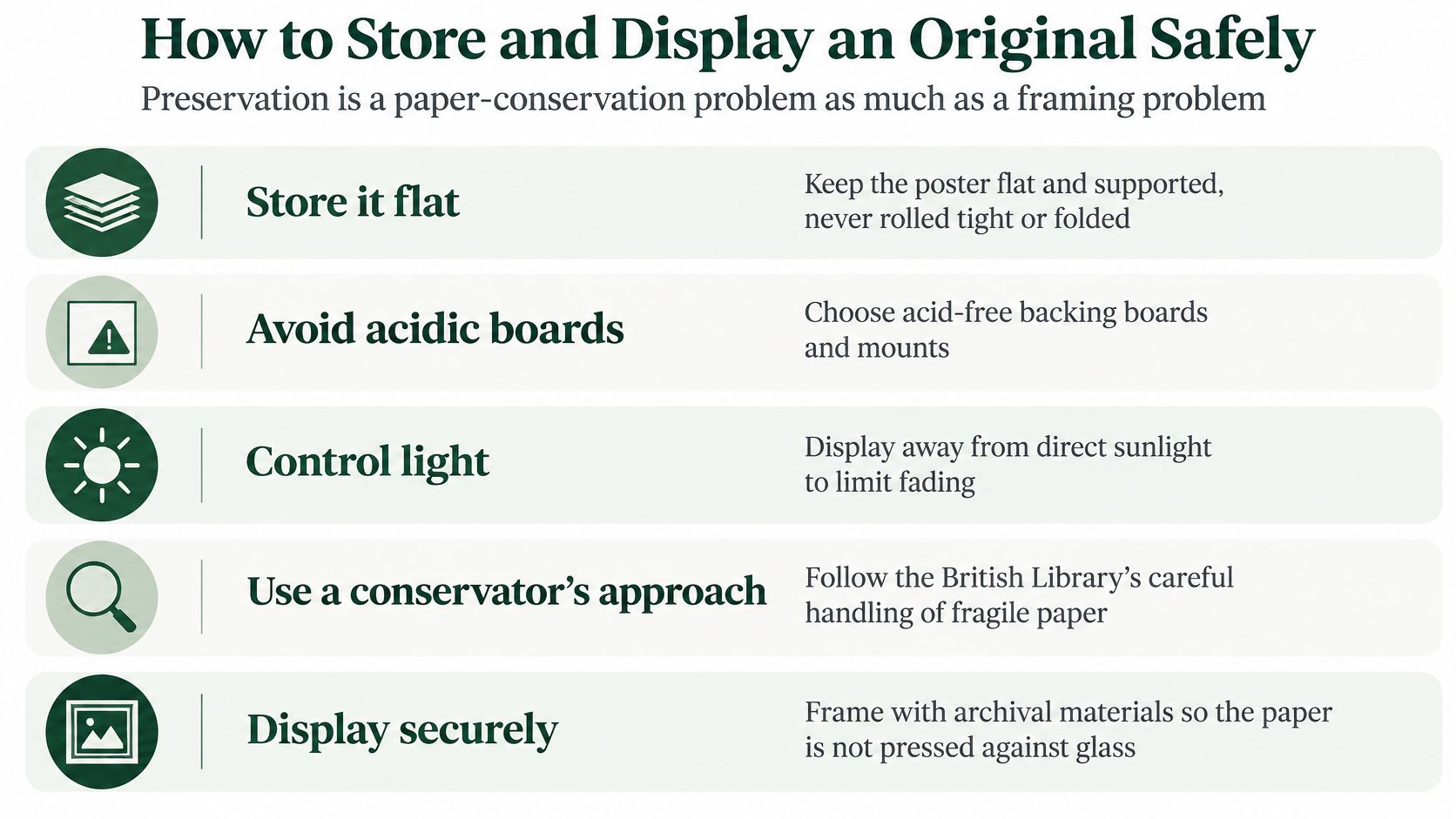
Preserving an extraterrestrial movie poster is a paper-conservation problem, not just a framing purchase. The British Library's conservation guidance treats fragile paper and other organic materials as objects requiring appropriate care, handling and conservation.
For a collector, that means supporting the sheet, avoiding acidic materials and keeping the environment reasonably stable. Handle the edges with clean, dry hands, on a clean surface large enough to support the whole poster.
Use these preservation principles when planning storage and display.
A practical care routine
- Store it flat and supported. Use a clean, dry archival box or suitable flat storage, keep heavy objects off it and don't roll it for routine storage; seek conservation advice before trying to flatten a resistant sheet.
- Make a condition record. Photograph the entire sheet at high resolution, then capture credits, printer marks, folds and defects, keeping an untouched master file separate from edited copies.
- Frame with conservation materials. Specify archival mounting and UV-filtering glazing, with a spacer or mount that keeps the paper away from the glazing, and position the frame out of direct sunlight.
- Rotate the display periodically. Give originals time away from light rather than assuming UV-filtering glazing prevents all fading, particularly where dark space backgrounds make colour changes conspicuous.
- Inspect at seasonal intervals. Look for fresh tears, cockling, staining or changes around mounts, and address the storage conditions rather than concealing the symptoms.
The British Library's digitisation guidance explains that viewing digital images instead of handling originals helps protect them from physical damage. A carefully made reference image lets you examine small details without repeatedly lifting and turning the sheet.
Avoid irreversible shortcuts
Don't attach the poster with ordinary adhesive tape, glue it to a board or force it into an undersized frame. If an old repair is lifting, resist peeling it away: you may remove original paper or ink with it.
Our movie poster storage FAQ offers further guidance for organising a collection before framing. Keep the condition photographs alongside purchase records and treatment notes.
That digital record provides a baseline for later comparisons and supports insurance or resale documentation. It also preserves the small evidential details that make the sheet worth collecting, without requiring constant physical access.
At Famous Movie Posters, we offer guaranteed original film posters across British quads, US one sheets and other formats. Visit Famous Movie Posters to explore extraterrestrial cinema titles, compare the listed formats and condition, and choose an original you'll enjoy displaying and preserving.