



Most UK homes already have the foundation for a home cinema setup, with smart TVs in 76% of households and 4K OLED televisions now available for under £900. You don't need a dedicated room or thousands of pounds of equipment to create a convincing film-watching space.
You may already be watching films from the sofa, but the room probably wasn't designed around the experience. The television sits where the furniture allowed, the sound reflects from bare walls, glare appears during daytime scenes, and the collection of original posters remains stored in a tube or portfolio. A good home cinema setup brings those elements together without turning the house into a building site.
The practical target isn't maximum equipment. It's a room where the screen is comfortable to watch, dialogue remains clear, bass doesn't annoy the neighbours, and the posters on the wall look intentional rather than incidental. That might mean improving an existing television and soundbar, or it might justify a projector, acoustic treatment and carefully planned display.
Table of Contents
- Starting Your Home Cinema Journey
- Choosing the Right Room and Layout
- Projector or Television for Your Space
- Speaker Placement and Room Acoustics
- Displaying Your Movie Poster Collection
- Purchasing Equipment and Finalising Your Setup
Starting Your Home Cinema Journey
A typical UK living room already functions as an entertainment zone. It has a television, broadband connection, one or more streaming subscriptions and seating positioned towards the screen. The opportunity is to make those pieces work together more deliberately, rather than assuming a cinema requires a separate room and a rack of specialist equipment.
The scale of home viewing supports that approach. The UK home entertainment market reached a record £5.1bn in 2024, up 10.6% year on year, across streaming, digital purchases, discs and rentals, according to reporting on the UK screen industry and home entertainment market. Netflix was present in 17.3 million UK homes, Amazon Prime Video in 13.4 million, and Disney+ in 7.5 million, while ad-supported tiers contributed about £400m in consumer value during that year, as the same source reports.
That doesn't mean you need every service. It means your home cinema setup should prioritise connected viewing, reliable access and simple control. Physical media still matters to collectors, but the everyday system usually begins with the display and the network.
Start with the experience
Before buying anything, decide what bothers you most. A weak picture, muffled dialogue, distracting reflections and uncomfortable seating each require a different remedy.
- If the picture is the problem: check screen size, viewing distance, brightness and room lighting before replacing the television.
- If dialogue disappears: improve the centre-channel performance or choose a soundbar with a speech-enhancement mode.
- If the room feels flat: add controlled lighting, better seating and a visual focal point such as framed original posters.
- If neighbours hear the bass: reduce vibration at the source and treat the room, rather than just turning the subwoofer down after every film.
The UK has also moved decisively away from disc-first viewing. About 76% of households had a smart TV in 2024, while only about 27% had a DVD player, down nearly 5 percentage points from the previous year, according to UK home entertainment technology data. That makes a smart TV, streamer or games console the natural source component for many homes.
Practical rule: Upgrade the part of the room that limits viewing most often. A carefully positioned television with clear sound will outperform an expensive projector installed in the wrong space.
If the project involves concealed wiring, a media wall, integrated lighting or a larger dedicated room, review the options described in this home cinema installation guide. The important decision is not whether the system looks impressive on a specification sheet. It's whether the room makes you want to watch a complete film without fiddling with settings first.
Choosing the Right Room and Layout
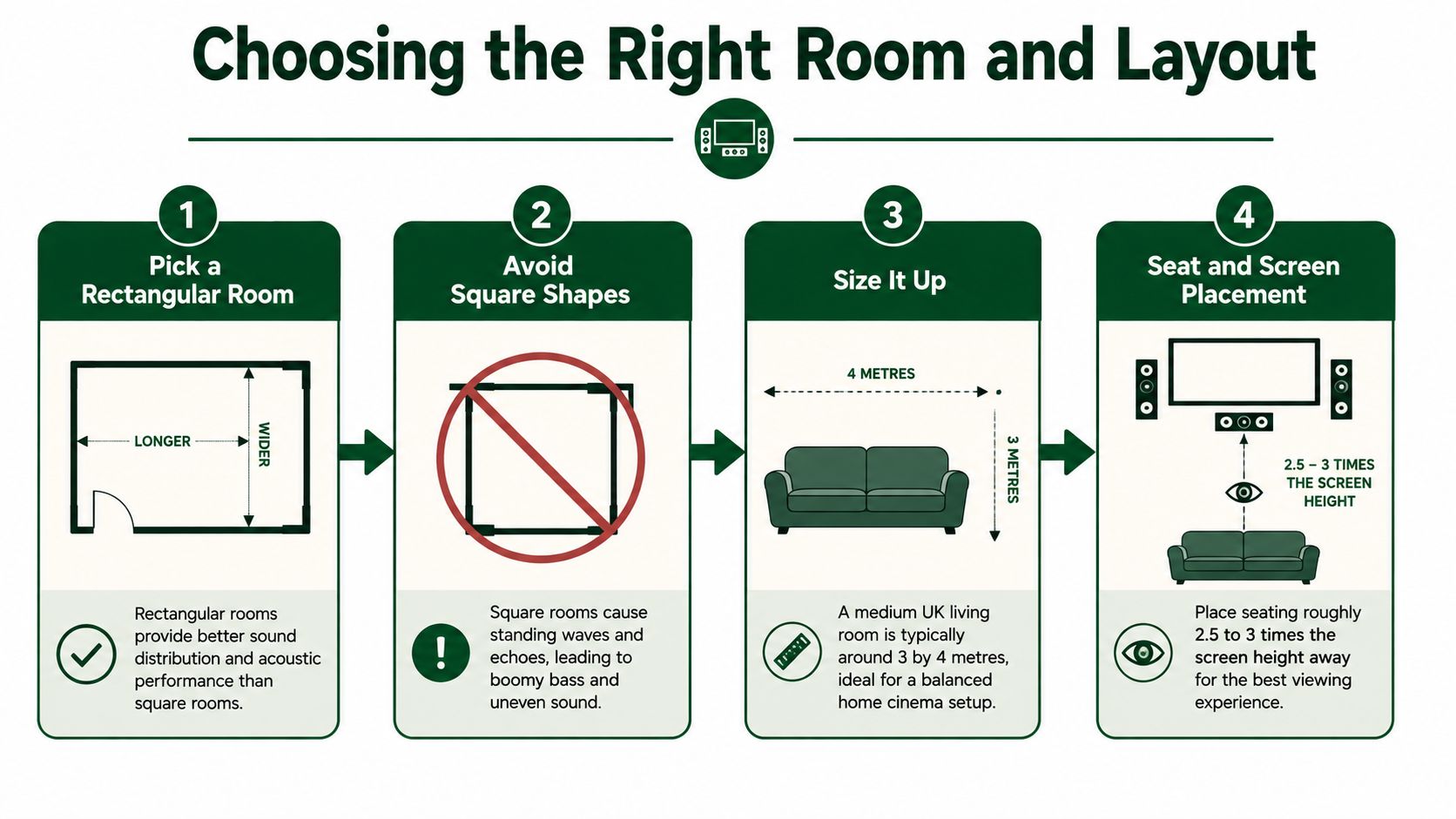
Room choice determines more than the furniture arrangement. It affects reflections, screen geometry, speaker placement, cable routes and how much control you have over daylight. Start with the most rectangular room available, preferably one where the longer dimension runs from the screen wall towards the seating.
Square rooms are difficult because sound reflections and standing waves reinforce each other in unhelpful ways. One UK installer uses 4.8 × 3.6 metres as a medium-room reference, 6 × 4.5 metres for a large room and 7.5 × 5.5 metres for an extra-large room, while custom dedicated rooms commonly start at 9 × 6 metres or more, as outlined in this UK home cinema room guide.
Measure before you mount
Use a tape measure before ordering a screen, television bracket or projector mount. Record wall width, ceiling height, window positions, door swings and the likely eye position from the main seat.
A small dedicated room doesn't automatically rule out a projector. A UK buying guide places small-room projector viewing around 50 to 100 inches at 1.5 to 3 metres, medium rooms around 100 to 150 inches at 3 to 5 metres, and large rooms around 150 to 300 inches at 5 to 10 metres. The same guide recommends an image occupying roughly 30% to 50% of the viewer's field of view, which is a useful check against both an undersized and an exhausting screen.
For a television, use the screen's diagonal as a starting point. Samsung's UK placement guidance estimates minimum viewing distance by multiplying a 4K television's diagonal in inches by 1.2. It places a 75-inch television at around 2.3 metres and an 85-inch television at around 2.6 metres, with the final position adjusted for comfort and room layout.
Check the room in use
Sit in the intended position at different times of day. Look for windows behind or beside the screen, glossy furniture that reflects light, and wall surfaces that will bounce sound towards the sofa. A room that works at night may be frustrating for daytime sport or family viewing.
Keep the main seating symmetrical where possible, but don't sacrifice walking routes or access to doors. A medium room can work well with one principal sofa and occasional seating, while a larger space gives you more freedom to separate display, poster wall and listening positions.
Before drilling: Project a grid or test pattern, confirm the image is square, check focus across the frame and measure throw distance from the final lens position. A fixed mount installed too early often leaves you relying on keystone correction, which trades installation convenience for image quality.
Projector or Television for Your Space
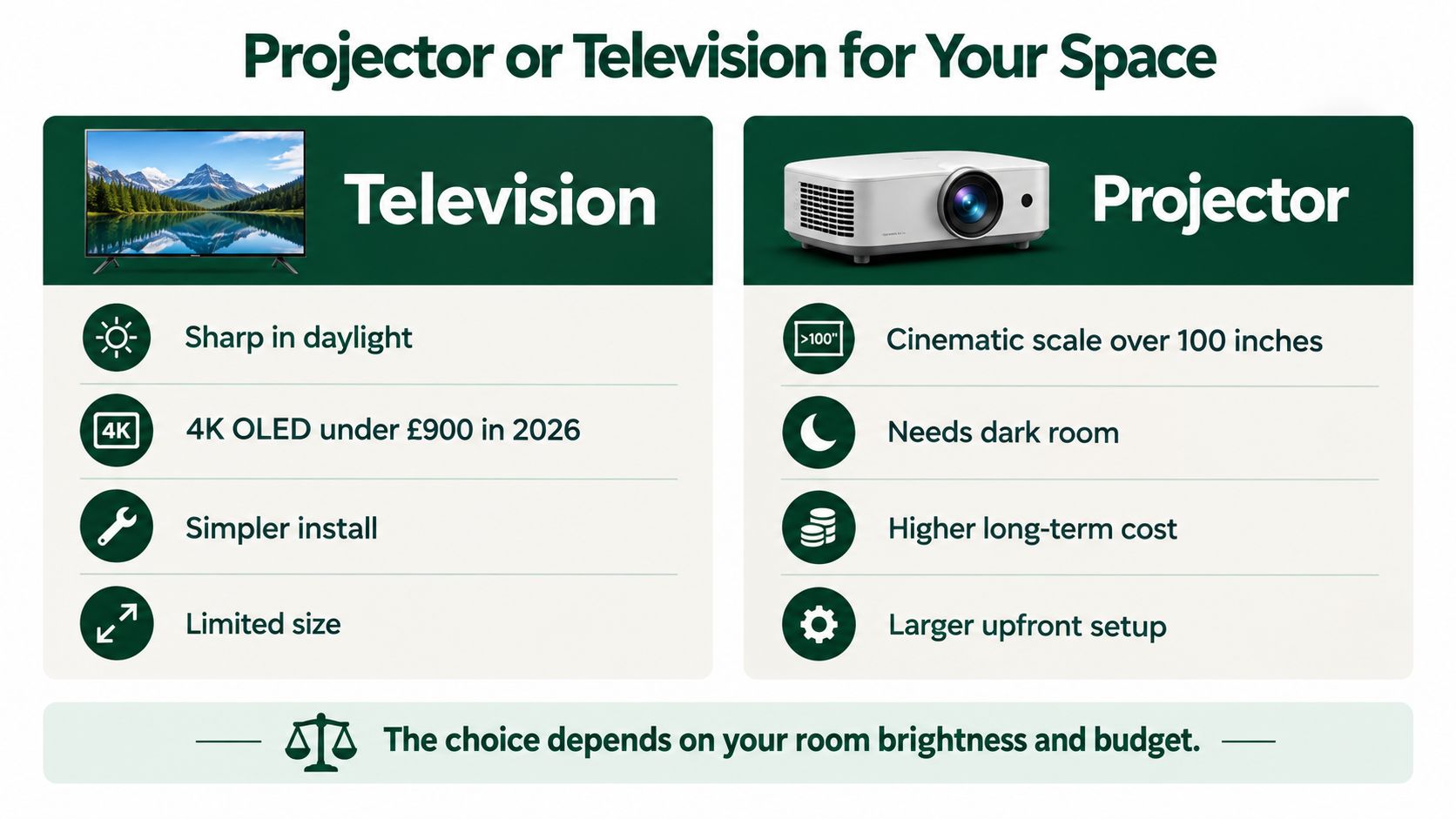
The television and projector routes solve different problems. A television provides dependable brightness, sharp detail in daylight and a straightforward installation. A projector delivers scale and a more traditional cinema feel, but only if the room, screen, throw distance and lighting are under control.
A recent UK shopping guide says 4K OLED televisions that cost about £2,000 three years earlier can now sit under £900, while Dolby Atmos soundbars have also moved into affordable territory. That changes the value calculation for a living room. A television, soundbar and streamer can create a strong home cinema setup for a few hundred pounds, rather than automatically leading you towards a projector-led system.
Choose a television when convenience matters
A large OLED makes sense when the room has windows, the television will also serve everyday viewing, or you want consistent HDR performance without blackout blinds. It starts quickly, needs little calibration for enjoyable use and doesn't require a separate screen.
The compromise is scale. Even a large television occupies a fixed physical area, and the screen can dominate a living room in a way that some households don't want. It also gives you fewer opportunities to conceal the display when the film ends.
A soundbar with HDMI eARC is a sensible first audio upgrade. It reduces cable clutter and improves dialogue over most built-in television speakers. A subwoofer can add impact, but in a flat or terraced house it may introduce vibration that travels through floors and adjoining walls.
Choose a projector when scale is the priority
A projector becomes persuasive when you want an image over 100 inches, can control ambient light and are prepared to measure the installation carefully. The screen can disappear visually when not in use, leaving the wall available for framed posters or a clean living-room finish.
The costs aren't limited to the projector. Allow for the screen, ceiling or wall mounting, cable routing, blackout treatment and possibly a receiver or speaker package. A cheaper projector placed too far from the screen, or aimed at a wall with poor geometry, won't deliver the cinematic result its size suggests.
For installation, confirm the manufacturer's throw-distance range before committing to screen size. The practical sequence is to measure the wall, calculate the throw, position the projector temporarily, project a test grid and only then drill. This guide to the best TV and sofa placement is also useful when the screen and seating need to coexist with normal living-room furniture.
A television usually wins for mixed household use. A projector wins for dedicated film sessions where scale, darkness and atmosphere matter more than instant convenience. Don't buy the bigger format merely because it appears more cinematic in a showroom. Buy the format your room can support without constant compromise.
Speaker Placement and Room Acoustics
Sound is where many attractive home cinema setups fall apart. People invest in screen resolution, then place small speakers inside a cabinet, push the sofa against the rear wall and expect automatic calibration to correct the room. It can't remove every reflection, bass null or vibration path.
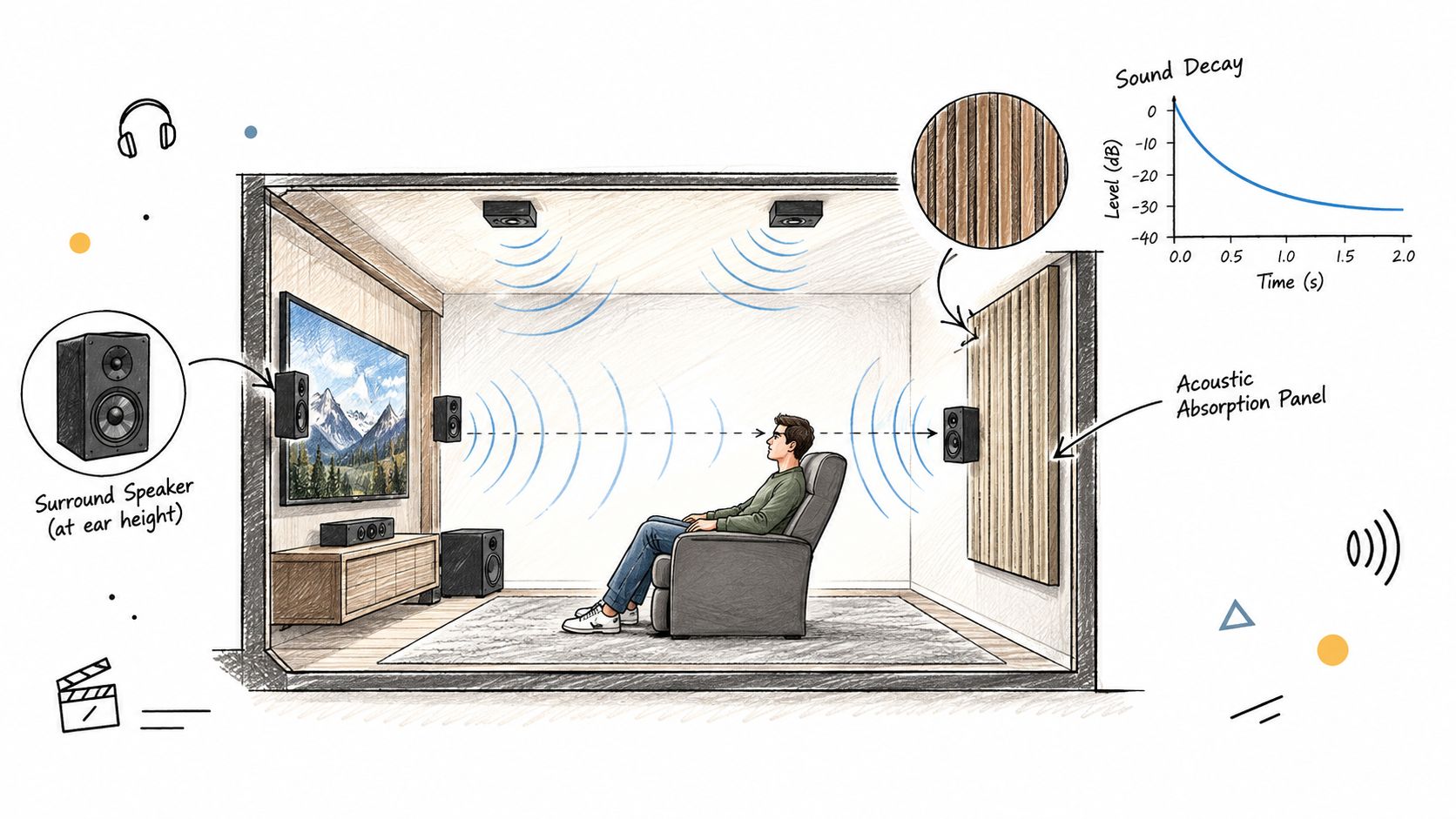
For a dedicated residential cinema, independent guidance suggests an RT60 of about 0.3 to 0.4 seconds, with tighter control near 0.2 seconds for dialogue-focused screening rooms, according to this home cinema installation pricing and acoustics guide. These figures are room targets, not reasons to turn an ordinary living room into a deadened studio.
Put speakers in the right relationship
The centre speaker should align closely with the screen so dialogue appears to come from the actors, not from below the picture. Left and right speakers need enough separation to create a stable front stage, while surround speakers should sit beside or slightly behind the main listening area without firing directly into one person's ear.
Keep the tweeters near seated ear height where practical. Avoid burying the front speakers behind doors or placing a soundbar so low that the television cabinet blocks it. If a full surround system isn't realistic, a good soundbar positioned clearly below the screen is preferable to a poorly integrated collection of mismatched speakers.
The small-room speaker placement guide is useful for working through compromises in flats, bedrooms and compact living rooms. It focuses attention on speaker distance from walls, listening symmetry and the effect of furniture, all of which matter before electronic calibration.
Treat reflections before chasing bass
Start at the first-reflection points on the side walls, where sound from the front speakers reaches the listener after bouncing once. Rugs, heavy curtains and upholstered furniture can control excessive brightness without making the room feel like a recording booth.
Low frequencies need a different response. Guidance recommends corner bass trapping for buildup below roughly 250 Hz. In a normal UK home, that might mean broadband traps in the front corners, a substantial rug over a hard floor and careful subwoofer placement rather than a room full of thin decorative foam.
The common mistake: Subwoofer EQ can smooth the response at the listening position, but it can't make room modes disappear. Treat the room first, then calibrate the subwoofer and main speakers.
Bass leakage also travels through structure, not only through the air. Keep the subwoofer away from shared walls where possible, use isolation beneath it, lower the level during late viewing and choose a night mode that limits sudden dynamic peaks. Soft furnishings help with reflections, but they won't provide full soundproofing. For a shared-wall property, the most effective affordable approach is usually a combination of sensible subwoofer placement, isolation, moderate playback levels and controlled bass rather than an expensive speaker upgrade.
Displaying Your Movie Poster Collection
A home cinema should show what you love about film, not only what you spent on equipment. Original posters give the room an identity before the screen comes on, but they need to be displayed with the same care given to the projector, speakers and lighting.
Two formats create different visual rhythms. A UK Quad measures 30 by 40 inches in landscape orientation, while a US One Sheet uses portrait orientation. Treating them as interchangeable creates awkward framing, inconsistent spacing and unnecessary cropping. Choose the format first, then select the frame.
Build the wall around the film
A single UK Quad above a sofa can work as a wide statement piece, especially when the room has a screen on an adjacent wall. A portrait One Sheet can sit beside a doorway, in a narrow vertical recess or within a symmetrical pair of wall-mounted pieces. A gallery wall can combine formats, but align the frames rather than forcing the paper itself into a rigid grid.
Keep the poster away from direct sunlight and strong heat sources. Dimmable, warm display lighting usually supports the cinema mood better than bright overhead illumination, while low-glare glazing helps preserve visibility when the screen is active. If you use a backlit display, control its brightness so it doesn't compete with the film.
Display principle: The poster wall should reinforce the room's focal points, not compete with the screen during viewing.
A collector might choose a favourite UK Quad as the room's visual anchor, then use smaller framed pieces or lobby cards around the entrance. Another approach is to rotate posters according to the current film programme, using interchangeable frames or a light box for a stronger marquee effect. Guidance on a light box for displaying a movie poster is helpful when the memorabilia needs to remain visible without taking over the entire room.
Frame depth matters when the poster has been backed, mounted or protected with conservation materials. Leave enough clearance for the artwork, avoid pressure on the paper and make sure the hanging hardware can support the finished frame. Don't place valuable originals directly above a radiator or beneath a projector exhaust path.
The best result usually comes from restraint. One authentic poster with thoughtful lighting can give a modest television room more character than a wall covered in unrelated prints. The technology creates the image and sound. The memorabilia tells visitors why this room exists.
Purchasing Equipment and Finalising Your Setup
Buy the system in an order that protects the room plan. Confirm the display size and seating position first, then choose audio, source devices, mounting hardware, cables, lighting and poster frames around those decisions. This avoids the common cycle of buying a television that dictates the furniture, then adding equipment that has nowhere sensible to go.
Delivery needs attention when you're ordering original memorabilia. Purpose-designed poster tubes matched to US One Sheet and UK Quad formats, with acid-free tissue and kraft paper, help protect items during transit. Inspect the packaging before removing the poster, keep the artwork flat when required and don't rush framing before the room's humidity, lighting and layout are settled.
The guide to poster framing costs can help you compare framing choices before you commit to a format. For equipment, check return policies, warranty coverage and whether the installer will calibrate the finished system rather than just attach the brackets.
DIY works well for a television, soundbar and carefully placed streamer. Professional support becomes more valuable when the project includes concealed wiring, a projector ceiling mount, a media wall, acoustic treatment or multiple seating rows. A dedicated room can also require planning around ventilation, access panels and safe cable routes.
The final budget should follow the constraint that matters most. Spend first on the display or projector that suits the room, then on clear audio and seating, followed by light control, acoustic improvements and poster presentation. A coherent modest system will give you more usable enjoyment than expensive components installed without regard for geometry, sound or the artwork on the walls.
Famous Movie Posters offers guaranteed original film posters, framing options and poster-sourcing support for collectors building a cinema room around authentic memorabilia. Browse the Famous Movie Posters catalogue to find a format and title that suits your screen wall, seating area or display plan.