



A 27 x 40 inch US one sheet measures 685.8 x 1,016 mm, about 68.6 x 101.6 cm, in portrait, and vintage sheets are often 27 x 41 inches. You've found the title you want, the listing looks straightforward, and then the frame arrives a fraction too short, or the poster you thought was British turns out to need a completely different mount.
That's the trap with movie posters 27 x 40. The name sounds precise, but in the UK it's trade shorthand imported from the US, not a promise about the sheet in front of you. Measure the paper, check the orientation, and budget for framing and storage before you pay, and you'll avoid most of the expensive surprises.
Table of Contents
- 27 x 40 Poster Dimensions at a Glance
- Where the One Sheet Size Came From
- How to Measure an Original Before You Frame It
- Framing Options and What They Really Cost
- Storing an Unframed Poster Flat and Safe
- Originals, Reprints and Authentication
- Buying, Shipping and a Pre-Order Check
27 x 40 Poster Dimensions at a Glance
A standard 27 x 40 inch movie poster is the US One Sheet, a tall portrait format designed to fill a cinema lobby case. It's big enough to dominate a hallway wall, and that's the first thing UK buyers underestimate. A sheet that looks manageable in a listing photograph needs clear wall space, a frame with real presence, and storage that won't fit in a standard portfolio.
The British Film Institute's retail listings identify A2 posters as 420 x 594 millimetres and A3 posters as 297 x 420 millimetres, while a 27 x 40 sheet is approximately 686 x 1,016 millimetres. Its area is 1,080 square inches, or roughly 0.697 square metres, compared with about 0.249 square metres for A2, so it has approximately 2.8 times the display area of A2. That gap explains why UK metric prints and US one sheets don't share frames, mounts, or even storage boxes.
Common Movie Poster Formats Compared
| Format | Dimensions (inches) | Dimensions (mm) | Area (m2) |
|---|---|---|---|
| US One Sheet (standard) | 27 x 40 | 685.8 x 1,016 | 0.697 |
| US One Sheet (vintage) | 27 x 41 | 685.8 x 1,041 | 0.714 |
| UK Quad | 30 x 40 | 762 x 1,016 | 0.774 |
| A2 (UK print) | 16.5 x 23.4 | 420 x 594 | 0.249 |
| A3 (UK print) | 11.7 x 16.5 | 297 x 420 | 0.125 |
Read the table by orientation as well as by numbers. The one sheet and the A sizes are portrait, the Quad is wider, and that difference matters as much as the measurements. Two posters can share a 40 inch side and still need entirely different wall space.
Practical rule: Read the listing's dimensions in millimetres and confirm portrait or landscape before you buy any frame. The nominal name doesn't guarantee the real size.
I would treat every 27 x 40 label as a starting point, not a specification. If a seller only gives inches and no millimetre measurement, ask for one. A seller who can't measure the sheet probably hasn't checked its condition closely either, and that's useful information before money changes hands.
Where the One Sheet Size Came From
The one sheet began as a working tool, not a collectable. Studios printed a single large sheet for cinema lobbies and window displays, folded it, and shipped it to exhibitors who pasted, pinned, or framed it for a week or two. Nobody designed it for a collector's living room.
Early sizes followed printers' paper stock and local habit rather than a formal rule. US one sheets were commonly catalogued at the taller vintage size in the mid-century decades, and dealers later settled on 27 x 40 as a convenient trade label. Catalogue dates for the change disagree, so treat any single year you see quoted as approximate. The label stuck because it was easy to say, not because printers suddenly standardised.
Britain went a different way. The UK Quad developed as a cinema poster in a horizontal format, shaped by British printers and British display cases, and it became the format most UK cinemas used. If you want the fuller picture, this guide to the difference between a one sheet and a quad movie poster sets the two traditions side by side.
Say a thriller opens on both sides of the Atlantic. The American campaign uses a tall portrait image, a face looming over a title block. The British campaign needs a wide composition, so the artist reworks the layout, moves the credits, and crops differently. Same film, same week, two posters that share almost nothing except the name of the film.
That's why 27 x 40 is a trade label, not a legal standard. History produced overlapping names for sheets that vary by an inch here and a trim there, and you'll meet that variation every time you measure a real poster.
How to Measure an Original Before You Frame It
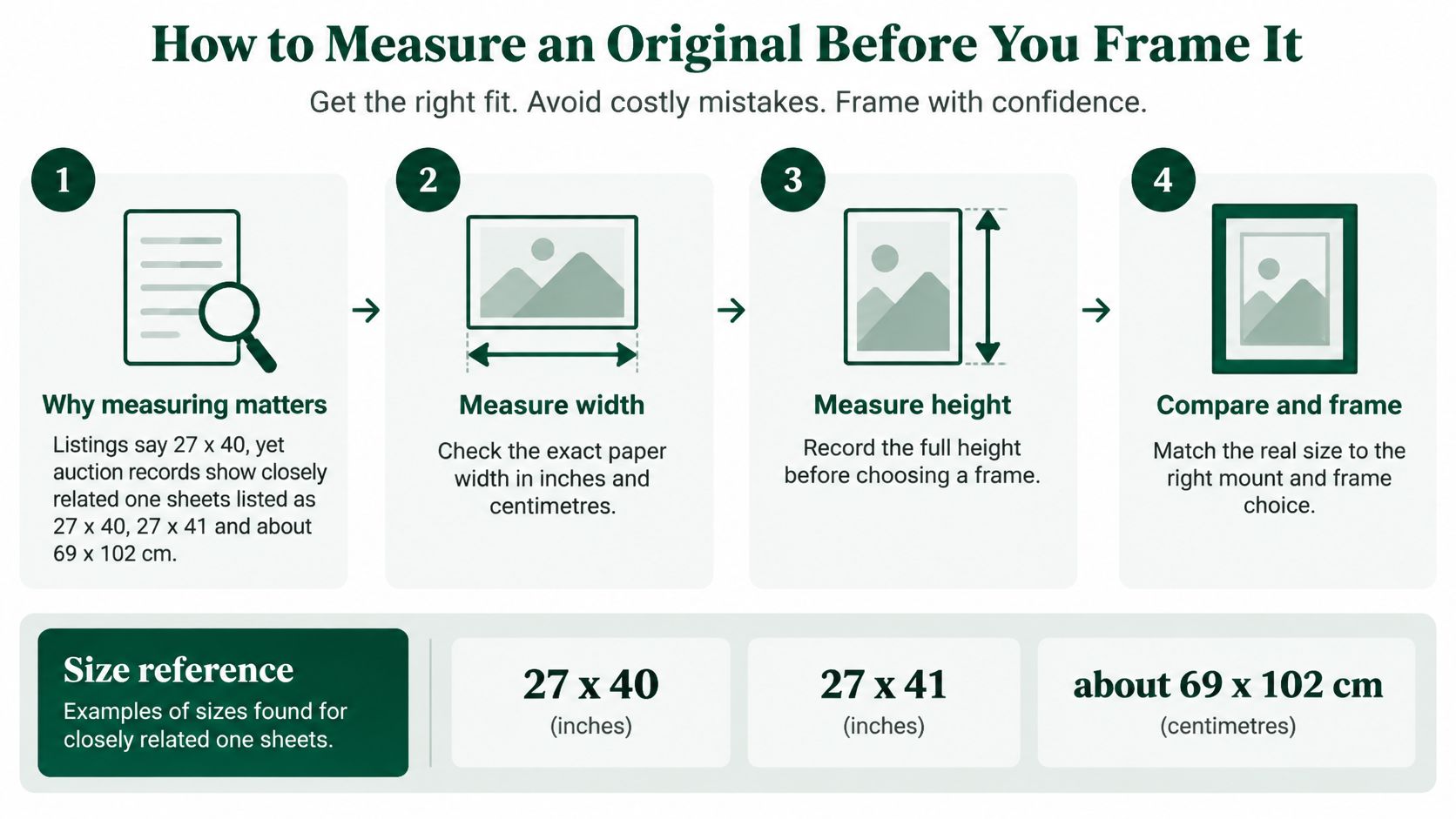
Measuring matters because the label lies politely. A Propstore one sheet listing sits in a market where closely related one sheets are listed as 27 x 40, 27 x 41, or approximately 69 x 102 cm, and a one inch discrepancy can make a supposedly standard frame unsuitable. The British quad at 30 x 40 inches isn't interchangeable either, so catalogue terminology alone won't tell you what frame to order.
The Measuring Routine
- Lay it flat first: Put the poster face up on a clean, flat table. A rolled sheet may need days or weeks under gentle weight before it lies flat enough to measure accurately, and forcing it risks cracked ink along the curl.
- Measure the width three times: Use a steel rule at the top, middle, and bottom, reading to the nearest millimetre. Vintage sheets aren't always perfectly square, and one reading can hide a tapered trim.
- Measure the height three times: Check the left, centre, and right edges. The vintage extra inch often shows up here, and a trimmed border subtly shortens one side.
- Note the condition as you go: Record trimming, border loss, fold lines, old tape, and mounting residue. These change the usable area and tell your framer where the mount can and can't sit.
- Compare against the two benchmarks: Set your readings against the standard sheet and the taller vintage sheet. If your poster matches neither, you're looking at a trim, a reprint size, or a different format entirely.
- Order to the measured size: Ask for a few millimetres of clearance, not a tight match. Paper moves, and a frame that grips the edges will eventually show it.
- Confirm the rebate: Check the frame's rebate depth and whether the framer can cut a bespoke opening. A shallow rebate leaves no room for the spacer and backing a valuable sheet needs.
Standard size doesn't mean standard fit. A poster advertised as 27 x 40 may still need custom framing, and finding that out with a steel rule costs nothing.
Write the measurements down and keep them with the poster. You'll use the same figures for storage sleeves, shipping tubes, and any future sale listing, and you'll only have to flatten the sheet once.
Framing Options and What They Really Cost
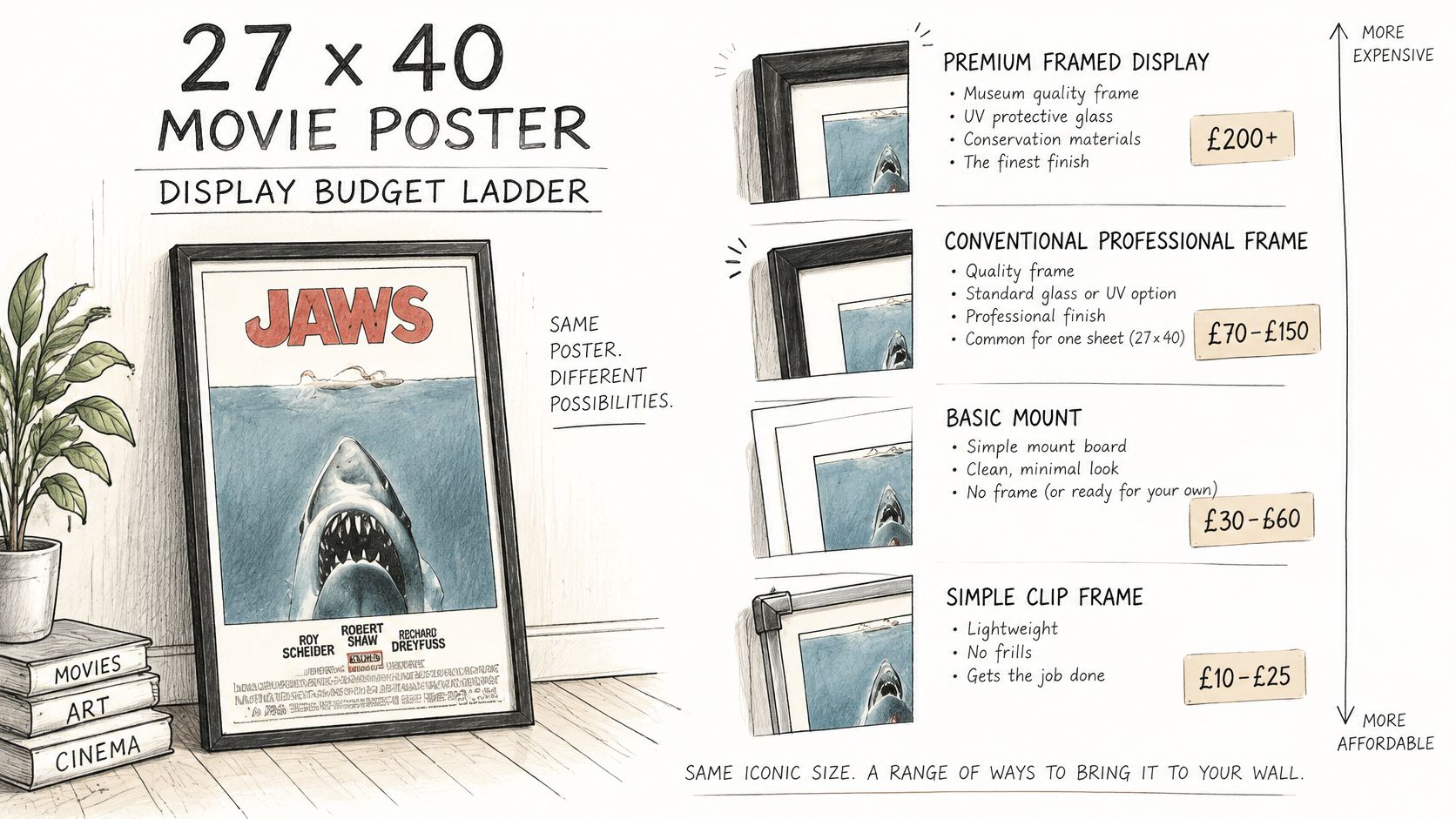
The poster price is only part of what you'll spend. Across UK framers, a conventional professional one sheet frame commonly lands around £70 to £150, bespoke work often starts around £150, and museum-grade specifications can pass £250. Treat those as market bands rather than a quote, because glass choice, mount cutting, condition and size move the figure fast. A sheet sold as 27 x 40 may still measure off the label, so frame to the actual sheet, not the trade shorthand.
Display Options and Typical Costs
| Display option | Typical cost (GBP) | Best for | Trade-off |
|---|---|---|---|
| Conventional professional frame | £70-£150 | Display prints for a few years | Standard glazing, limited UV control |
| Bespoke frame for trimmed or 27 x 41 sheets | £150+ | Non-standard or measured sheets | Cost rises with materials and condition |
| Museum-grade with UV glazing and reversible mounts | £250+ | Rare or high-value originals on sunlit walls | Highest outlay, strongest protection |
| Unframed in an acid-free sleeve, stored flat | Sleeve and box cost only | Collectors who rotate posters | Needs storage space and a hanging plan |
Match the tier to four things: the poster's value, how long it'll hang, how much daylight the wall gets, and whether it's folded, restored, or scarce. UV-filtering glazing earns its cost on a sunlit wall or under a rare original, and it's wasted money in a windowless cinema room. An air gap from a spacer or mount stops the printed surface touching the glazing, which matters most for glossy and heavily inked sheets. Reversible hinges let a framer remove the poster later without tearing fibres, so insist on them for anything you'd resell.
The cheaper frame can become the expensive mistake. If a fixed 27 x 40 frame pinches a taller vintage sheet or leaves a trimmed edge exposed, you pay twice: once for the frame, again to correct the fit. For a replaceable reprint or a poster you'll rotate seasonally, a plain conventional frame is honest value. Don't spend museum money protecting a sheet you can replace for the price of a pizza.
The lowest-cost display that doesn't undermine an original's value is often no frame at all, the print resting in an acid-free sleeve, stored flat, and hung only when you rotate it into a frame you already own.
Storing an Unframed Poster Flat and Safe
Start with the enclosure, because a good sleeve in a bad box still fails. The Archives and Records Association UK storage guidance recommends paper and board that are calcium-carbonate buffered, with a pH between 6 and 9, free from lignin and sulphur, and packaging that fits without documents being folded or adapted. For a one sheet that means a buffered flat-file box sized to the sheet, never a smaller box and a hopeful fold.
Inside the box, give each poster its own acid-free polyester pocket. Polyester is chemically stable, it lets you read the poster without touching it, and one item per sleeve stops sheets abrading each other. Choose a pocket that's neither too small nor excessively large, because a loose sheet slides and catches its corners. Handle the poster in the sleeve rather than repeatedly removing and reinserting it, since frequent handling is where edge wear accumulates.
The Room Matters as Much as the Box
Keep paper in a cool, dry, stable space with little light, and avoid damp lofts, hot airing cupboards, and walls that bake in afternoon sun. If your collection outgrows a spare room, it's worth taking time to compare climate-controlled storage for artwork rather than defaulting to the nearest self-storage unit. Stable conditions beat expensive materials in an unstable room every time.
For day-to-day handling, work with clean, dry hands, support the sheet flat with both hands, and keep glossy modern prints clear of shelf edges and sharp corners. Our own guide to storing your movie posters covers the questions collectors ask most often, including what to do with folded sheets.
Originals, Reprints and Authentication
Ask the question most buyers skip, is this sheet an original, a reprint, or a fan-made copy? Reprints are common and often listed at the same nominal size, so the physical evidence matters more than the label in the listing title. A confident seller expects these questions. A vague one hopes you won't ask.
Physical Checks You Can Run Yourself
- Read the credit block: Check the printer's credit, edge markings, and any studio or NSS-style information along the borders. Missing or blurred credits on a supposedly original sheet need an explanation.
- Measure in millimetres: A sheet much smaller than either benchmark size may have been trimmed, which lowers value and changes the frame you'll need. Trimming also removes exactly the edge evidence that proves origin.
- Inspect the printing: Use a magnifier on a detailed area. Modern reproductions often show a regular dot pattern that differs from period printing, and colours can look flat where an original has depth.
- Ask about restoration plainly: Folds, touched-in fold lines, and paper fills aren't disqualifying, but the seller should describe restored areas without being cornered.
Ask for clear photographs of the front, back, and corners in daylight, and ask whether the seller guarantees originality in writing. It helps to spend a few minutes understanding art certificates of authenticity so you know what a useful guarantee states, and what a decorative one avoids saying. Our background on original movie posters in the UK explains how the UK market distinguishes originals from later printings.
Treat a very low price for a title with a known original run as a warning sign, not a bargain. A seller who explains condition grades and provenance clearly is giving you the good sign instead.
Buying, Shipping and a Pre-Order Check
Mixed formats turn into real money at the buying stage. A 1stDibs listing for a British Quad illustrates the format at 30 x 40 inches, approximately 76.2 x 101.6 cm, traditionally wider, while a 27 x 40 poster measures approximately 68.6 x 101.6 cm, so a Quad frame or mount won't fit correctly without gaps or a custom solution. British Quad artwork can also differ from the US One Sheet design for the same film, so you're choosing an image, not just a size.
Ask every seller four things before you pay, the measured size in millimetres, the orientation, the condition grade, and exactly how the poster will be packed. For transit, a sheet is safer rolled in a tube matched to its format than folded, wrapped in acid-free tissue and kraft paper. Our poster tubes are made with a poster tube manufacturer and sized to fit US one sheet and UK Quad posters, because an undersized tube bends corners and a loose one lets the roll telescope and crease.
Watch the total cost, not the headline price. International delivery, a bespoke frame, and a storage box can outweigh a low listing price, while we offer free shipping on all UK orders and sell only guaranteed original movie posters, which removes two uncertainties at once. As a concrete example of checking the actual sheet, our Luca poster is the US One Sheet size, 27 x 40 inches, stated plainly so you can plan the frame before it arrives.
Your Pre-Order Checklist
- Confirm the millimetres: Get width and height in writing, not just the format name.
- Check orientation: Portrait one sheet or Quad, and confirm the artwork matches the image shown.
- Decide display or storage: Frame it straight away, or order the sleeve and box with the poster.
- Set a framing budget: Match it to the tiers above so the frame isn't an afterthought.
- Note folds and restoration: Record them now, while the listing photographs are still available.
Measure the wall and the poster first, so the size you buy is the size you can frame, store, and ship safely. If a title you want isn't listed, you can request a specific poster through our request form, and we'll do our very best to get it.
Browse guaranteed original one sheets and UK Quads with their real sizes stated up front, and plan your frame before your poster even ships. Visit Famous Movie Posters to search hundreds of originals by decade, genre, or franchise, with free UK shipping on every order.