



A Back to the Future US one sheet carried an auction estimate of £300–£500 in the Farnham Herald's specialist auction coverage. That's a useful starting point for collecting movie posters by Drew Struzan, but only if you keep the description attached to the price. It was an estimate for a particular issue and format, not a valuation of every print carrying the same artwork.
For a UK buyer, the important question isn't whether Struzan painted the image. It's which physical poster you're buying, where it was issued, and what its condition and history justify paying.
Table of Contents
- Notable Drew Struzan Movie Posters at a Glance
- How Drew Struzan Painted His Movie Posters
- Original Poster Sizes From the US One Sheet to the UK Quad
- What Original Struzan Posters Sell For Today
- How to Store and Handle a Struzan Poster Safely
- Confirm Originality Before You Buy a Struzan Poster
Notable Drew Struzan Movie Posters at a Glance
Key Drew Struzan movie posters
| Film | Year | Collector note |
|---|---|---|
| The Thing | 1982 | Strong auction benchmark; see the value section |
| Back to the Future | 1985 | US one sheet and UK quad both circulate in the UK market |
| Indiana Jones and the Last Crusade | 1989 | Artwork used for both the US one sheet and the UK quad |
| Star Wars Trilogy Special Edition | 1997 | Re-release material; check the issue date and country |
| Hellboy | 2004 | Modern theatrical one sheet; confirm printing status before buying |
Struzan's name carries weight because collectors recognise his painted imagery independently of the film title. His compositions combine convincing likenesses with atmosphere, action and carefully controlled lighting. That makes the artist a sensible starting point for a collection, but a poor substitute for identifying an individual sheet.
The clearest British example is Indiana Jones and the Last Crusade: Cinema Poster Gallery's account of Struzan's cinema posters identifies his artwork on both the US one sheet and UK quad for the 1989 release. Those are distinct collecting objects, even when the central painting is familiar.
The film title isn't the issue
With Back to the Future, start by deciding whether you want British exhibition history or the internationally familiar portrait presentation. Neither choice is automatically better. A collector building a UK cinema collection may prefer the quad, while someone arranging portrait posters along a hallway may choose the one sheet.
The Thing needs equally precise identification before an auction result becomes useful. A famous image doesn't turn every copy into a valuable theatrical original. For Hellboy, the practical question is whether the seller is describing cinema advertising material or a later print made for collectors.
Star Wars requires particular care because a re-release campaign has its own identity. Later theatrical material can be original to that campaign without being an original-release poster for the film.
Catalogue the object, not just the picture. An attractive image is what draws you in; the issue description tells you what you own.
A year beside a film title usually identifies its theatrical release, not when Struzan completed the painting or when the particular sheet was printed. Re-releases, licensed editions and reproductions can all retain his artist credit.
Record the film, release year and country of issue before anything else. Add the campaign or edition wherever you can establish it. Those details give you a workable foundation for checking authenticity, choosing comparable sales and deciding whether the poster belongs in your collection.
How Drew Struzan Painted His Movie Posters
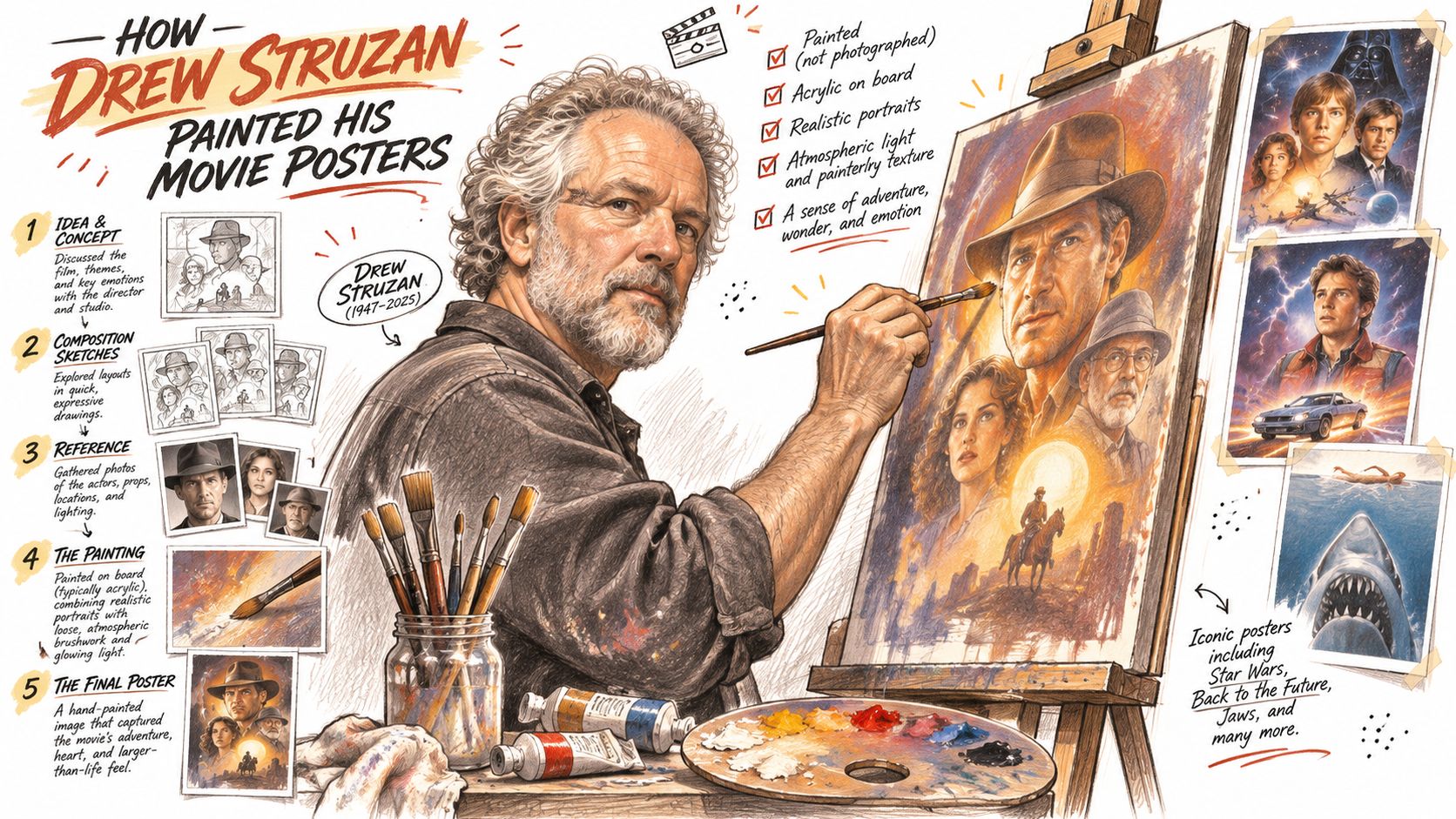
Struzan's working scale helps explain why his posters reward close inspection as well as distant viewing. The overview of his working methods describes a preference for working at approximately 1:1 scale, around 27 × 40 inches, rather than relying on substantial enlargement from a small illustration.
Think of a stage set built at full size rather than a model. Relationships between faces, lighting and background shapes can be judged at the scale at which viewers will encounter them. Fine pencil marks and transitions between painted areas don't have to survive the same degree of enlargement.
The illustration below shows the relationship between the working surface, the composition and the finishing stages.
Building a readable composition
A useful way to understand the process is to follow a typical ensemble poster from layout to finish. This is a practical explanation of the build-up, not a claim that every commission followed an identical sequence.
- Establish the composition. Sketch the main figures and reserve space for the title, billing block and other campaign text.
- Combine the references. Use photographs to develop recognisable faces, then bring separate poses into a coherent composite.
- Block in colour and light. Establish the dominant palette, the darkest passages and the light source before concentrating on small details.
- Refine the finish. Develop features and textures, using airbrush transitions to soften atmospheric gradients and glows where appropriate.
The difficult part isn't making each face convincing. It's making the whole arrangement readable without the figures competing with the title or disappearing into the background. Look for the contrast between sharply described features and softer surrounding atmosphere.
What the technique means on the wall
For display, judge the composition from your normal viewing position, not only with your nose close to the paper. Faces should remain legible, the title should have breathing room, and reflections shouldn't obscure the darker passages.
If you're planning a small film-viewing room, DigiDevice's guide to a compact theatre in a box setup offers useful context for thinking about equipment and available space. Decide where the screen, speakers and lighting will go before committing a valuable poster to the remaining wall.
Keep the distinction between original artwork and printed poster clear. An airbrushed painting has its own vulnerable surface; a cinema poster reproduces that work in print. Neither benefits from rubbing, careless mounting or repeated handling, but their conservation needs aren't interchangeable.
Original Poster Sizes From the US One Sheet to the UK Quad
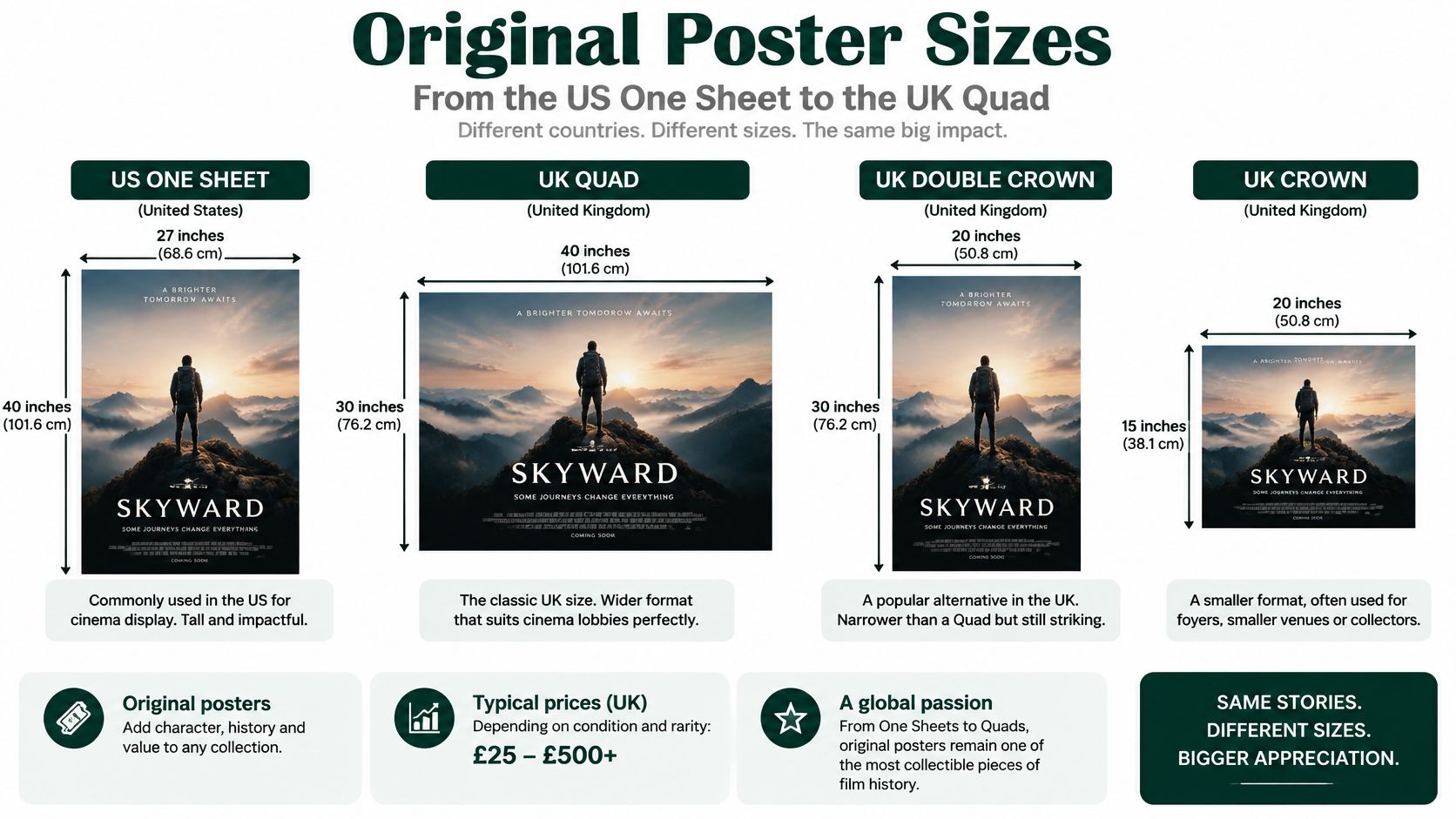
The familiar formats aren't interchangeable frame sizes. The Paradiso collector's guide identifies the standard British quad as 30 × 40 inches, or 762 × 1,016 millimetres, in horizontal orientation. Its shape belongs to British cinema exhibition, not to a resized American layout.
For comparison, Vice Press's Struzan-related one-sheet listing specifies 27 × 40 inches, approximately 69 × 102 cm, and documents modern archival pigment printing specifications including 200gsm premium silk paper and 270gsm archival paper across the described editions. Those production details belong in the catalogue record alongside the artwork credit.
Common Drew Struzan poster formats
| Format | Size | Orientation | Typical use |
|---|---|---|---|
| US one sheet | Standard one-sheet dimensions stated above | Portrait | Licensed Struzan-related one-sheet releases |
| UK quad | Standard quad dimensions stated above | Landscape | Traditional UK cinema poster |
| Later reissue | Measure the particular issue | Confirm from the actual sheet | Later theatrical release |
| Video poster | Use the release-specific sheet dimensions | Confirm from the actual sheet | Home video release |
| Modern archival reproduction | Use the publisher's edition specification | Follow the licensed layout | Licensed pigment print on the paper stocks described above |
The comparison below is useful for visualising the difference in proportions. Actual measurements and edition information should always take priority over a diagram.
Measure before choosing the frame
A portrait one-sheet frame won't accommodate a horizontally oriented quad without a different arrangement. Turning the frame doesn't solve the mismatch in proportions, and trimming an original poster to fit existing furniture is a poor economy.
Our guide to the difference between a one sheet and a quad movie poster helps distinguish the formats before you select display materials.
Use a clean work surface and a ruler or tape that won't scrape the print:
- Measure the image area. Record the printed design separately from any surrounding border.
- Measure the full sheet. Include margins rather than assuming the image reaches every edge.
- Note physical changes. Record trimming, folds, curled edges or a sheet that won't lie flat without restraint.
- Label the measurements. Keep image and sheet dimensions together with the issue and country.
A later reissue or video poster is a release category, not a dependable measurement. Likewise, archival pigment describes a printing process, not a universal format.
Buy the frame for the full sheet, not for the image you can see in the seller's photograph.
Check dimensions before ordering mounts, frames or display cases. If the sheet needs a custom mount, include that expense in the buying decision rather than treating it as an unwelcome extra afterwards.
What Original Struzan Posters Sell For Today
In 2024, a Drew Struzan The Thing poster sold for £3,780 at Propstore's London Entertainment Memorabilia Auction; Propstore's published lot result records the winning bid and five bids. That's a meaningful transaction, but it isn't a price guide for every poster bearing the image.
The useful lesson is the level of identification a comparison needs. Without the same issue, format and a credible condition comparison, an auction result can encourage either overpayment or an unrealistic selling expectation.
Put the price drivers in order
Start with the issue. An original theatrical advertisement, a later cinema reissue and a modern reproduction serve different collecting purposes. An authorised print may be an excellent display purchase, but its legitimacy doesn't make it original theatrical material.
Then weigh the remaining factors:
- Format and collecting market. A British quad may suit a UK cinema-history collection better than a more familiar US one sheet.
- Condition. Tears, paper loss, surface wear, folds and restoration affect how the poster presents and what work it may need.
- Provenance. A documented history is more useful than a confident but unsupported description.
- Genuine scarcity. Establish which issue is difficult to find, rather than accepting that the film itself is famous.
The largest poster isn't automatically the most desirable. Nor is the cleanest-looking sheet necessarily the strongest purchase if its appearance depends on substantial restoration that the seller hasn't explained.
For broader context, our guide to original movie poster prices helps separate the different reasons collectors pay more for particular examples.
Compare transactions, not ambitions
Asking prices tell you what sellers hope to receive. Sold results tell you that a transaction occurred, although you still need to establish what the recorded amount includes and whether the description matches your candidate.
Keep a simple comparison record with the sale venue, result, issue, format and disclosed defects. Save the listing description and photographs when possible, because a title and price alone won't help much later.
This video provides additional visual context for the artwork and collecting interest surrounding Struzan's posters.
Set your maximum price from comparable objects, then allow for framing and any conservation advice needed. Don't stretch the budget solely because the artist's name appears in the listing title.
How to Store and Handle a Struzan Poster Safely
Choose storage that's cool, dry and seasonally stable, with limited light and protection from dust and pests. The National Archives' introduction to archive care warns against keeping paper below 40% relative humidity for long periods, because it can become dry and brittle.
Dry storage doesn't mean the driest room available. Consistency matters, and a poster kept beside a radiator can face very different conditions from one stored in a suitable enclosure elsewhere in the same house.
The care sequence below is a practical starting point for a sound, unmounted paper poster.
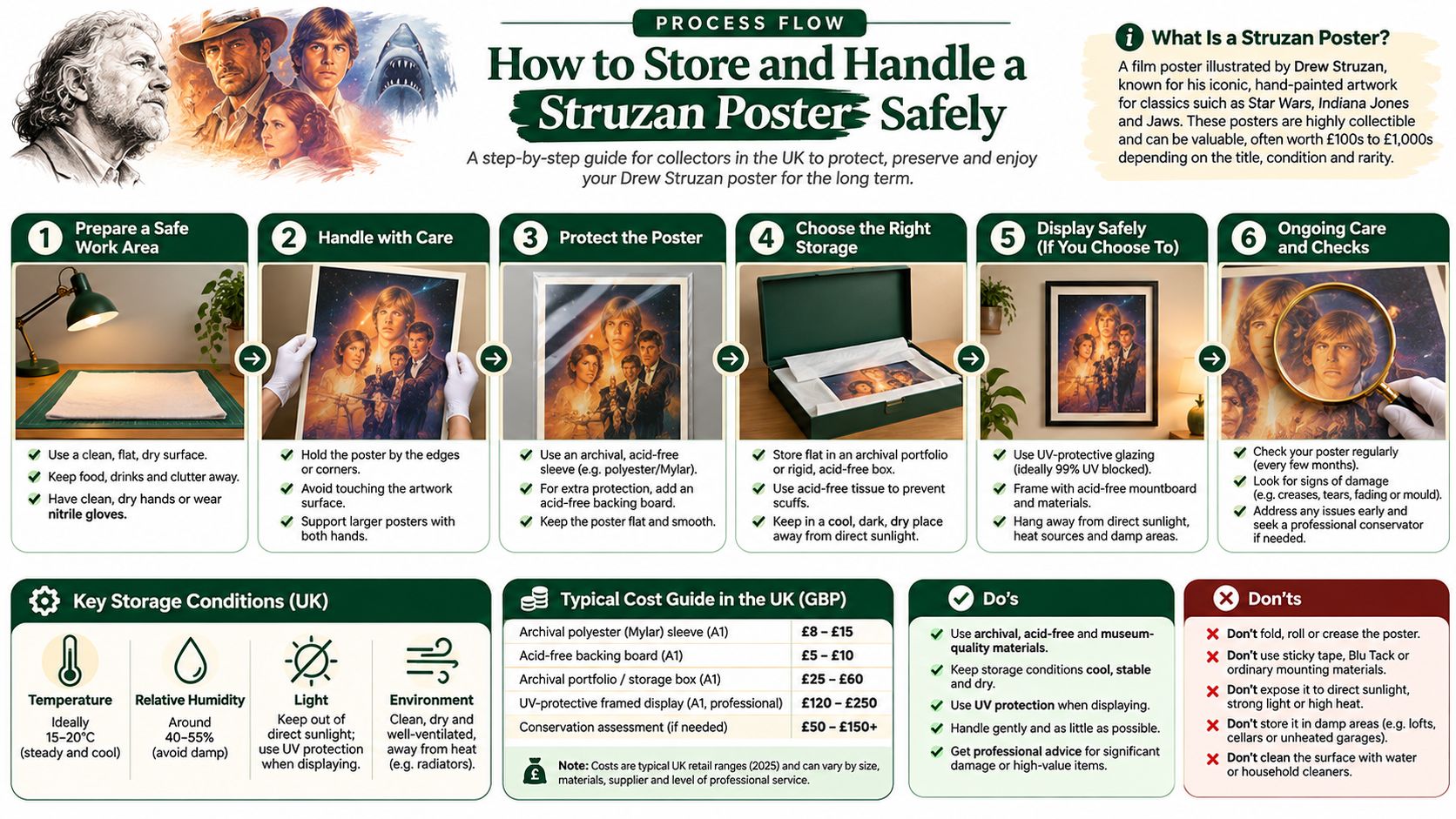
A safe handling routine
- Choose the room carefully. Avoid lofts, garages, damp external walls and positions beside radiators; use a stable internal storage space.
- Monitor humidity. A simple digital hygrometer helps identify fluctuations that you won't reliably detect by touch.
- Support the sheet. Store suitable posters flat in an appropriately sized archival box, without forcing open brittle folds or crushing curled edges.
- Separate surfaces. The National Archives' guidance for prints supports conservation-quality mounting and acid-free folders or tissue; keep posters away from newspaper, untreated wrapping and acidic board.
- Match the enclosure to condition. The National Archives' paper preparation guidance warns that polyester can create static and catch fragile or damaged paper, so it isn't the right sleeve for every sheet.
- Handle with clean, dry hands. Support the poster across its area and avoid dragging fingertips over the printed surface.
- Keep glazing clear of the print. Use a conservation mount or suitable spacers, and keep adhesives off the original sheet.
Don't flatten stubborn rolls with books, steam or household heat. If paper resists gentle handling, stop rather than turning a storage problem into a tear.
Moving and inspecting the collection
Transport needs its own plan. If you're relocating to or within the US, AMB Moving & Storage Inc.’s checklist for hiring movers for out-of-state moves can help organise the wider move, but a valuable poster still needs appropriate conservation packing rather than an ordinary removals carton.
Our movie poster storage FAQ offers further guidance for choosing between storage approaches. Keep an identifying label on the enclosure so you don't have to unpack the poster repeatedly.
Inspect the collection yearly for fading, foxing, new curl or changes around old repairs. Photograph anything concerning and seek a paper conservator's advice before attempting cleaning, tape removal or flattening.
Confirm Originality Before You Buy a Struzan Poster
No single feature proves originality. Correct dimensions, plausible paper and convincing print quality are useful checks, but a convincing identification requires those details to agree with the release campaign.
A seller's description should identify the object precisely enough that you could distinguish it from another poster using the same artwork. “Original” shouldn't be left to mean old-looking, officially licensed or not downloaded at home.
Read the sheet before accepting the description
Begin with size and orientation. Ask whether the claimed format matches the actual sheet, allowing for any disclosed trimming, backing or missing borders. A label in a listing title is a claim to test, not a conclusion.
Next, request readable photographs of the bottom margin, billing block, distributor information and printer details, where present. Compare the wording and layout with a documented example of the same campaign, rather than a general image search result. Different territories can use different credits, typography and release language without either sheet being wrong.
Folds and rolls need interpretation, not a simple authenticity rule. Some theatrical posters were folded for distribution, while other originals were supplied rolled; reproductions can also acquire folds. Look for whether the physical history is consistent with the claimed issue.
A fold is evidence of handling, not a certificate of authenticity. Assess it alongside the printing, wording, format and provenance.
Ask about paper and printing process. A seller who describes a sheet as an archival pigment edition may be giving an entirely accurate account of a modern licensed print. The error occurs when that description becomes blurred into an original cinema-issued poster.
Put the candidate in the right category
Use clear categories before discussing value:
- Original theatrical issue. A poster produced for the identified cinema campaign, with the territory and release established.
- Later reissue or video poster. Advertising associated with a subsequent theatrical campaign or home-video release, described accordingly.
- Modern reproduction. A later print, licensed or unofficial, that reproduces the artwork rather than belonging to the claimed cinema campaign.
An original theatrical reissue can be a legitimate collectible in its own right. The point is to identify it accurately, not dismiss everything that wasn't printed for the film's first release.
Artist attribution is a separate question. A Struzan credit tells you whose artwork appears on the object; it doesn't establish when the paper was printed, which distributor issued it or whether the edition was intended for cinemas.
Follow a buying sequence you can document
Before paying, work through the purchase in a fixed order. It prevents an appealing image or an urgent sales message from replacing the checks that matter.
- Confirm the identity. Get the film, campaign year, country and stated issue in writing.
- Check display compatibility. Match the actual sheet to your planned frame, including borders and any backing.
- Request close photographs. Ask for margins, credit lines, folds, corners and areas of restoration, not just a flattering overall photograph.
- Establish production details. Clarify printing process and paper where known, and ask the seller to distinguish confirmed facts from assumptions.
- Test the price. Use sold comparisons that match the issue and format, adjusting your judgement for disclosed condition.
- Obtain a condition report. It should explain defects and restoration plainly enough that you understand what will arrive.
A condition report should distinguish a tear from a repaired tear, and an intact border from a reconstructed one. Ask whether photographs were taken before or after restoration, and whether the reverse can be shown. Those questions are particularly useful when mounting conceals evidence.
Our policy at Famous Movie Posters is to sell only guaranteed original movie posters. That policy doesn't remove the collector's need to choose the right issue for their interests; it establishes the category of material we offer.
Keep the invoice, description, condition report and photographs with your catalogue record. If an important answer is missing, pause the purchase and ask again. A seller's inability to explain an issue is a reason to slow down, not a reason to fill the gaps with optimism.
At Famous Movie Posters, we offer guaranteed original movie posters for collectors who want the cinema-issued object, not a copy of the artwork. Visit to explore the collection, or use our request form to specify the Struzan title, country and format you're seeking, and we'll do our very best to get it.