


You've found a poster that seems to contain everything noir promises: a hard stare, a dangerous woman, deep shadow and lettering that looks made for a rain-soaked cinema entrance. Then the questions begin. Is it an original or a modern print? Is it American, British or a later international version? Will it fit the frame you already own?
Those questions matter because noir movie posters aren't one uniform category. They belong to different national markets, theatrical formats and production periods. A British quad can have a different composition from the American one-sheet for the same film, while a reprint may copy the image without preserving the paper, printing method or physical history of the original. The most rewarding way to collect them is to understand those differences before you buy.
Table of Contents
- Why Noir Movie Posters Stand Apart
- The Golden Age of Noir Poster Art
- Original Formats and Sizes Worth Knowing
- How the Same Noir Title Exists in Many Versions
- Spotting an Original and Avoiding Reprints
- Storing, Framing and Preserving Noir Paper
- Where Collectors Find Originals Today
Why Noir Movie Posters Stand Apart
A good noir poster can make you feel that something has already gone wrong. You may see a detective standing apart from the main action, a face emerging from shadow or a couple trapped in a composition that offers no comfortable escape. The film's plot has been reduced to a single visual decision, and the image asks you to supply the danger.
Classic noir poster design often used strong contrast, angular layouts, limited colour combinations and oversized lettering. That approach suited stories about suspicion, divided loyalties and compromised characters. The poster didn't need to explain every twist. It needed to create an atmosphere quickly, often from across a cinema lobby.
Collector's instinct: If the image communicates tension before you know the story, you're probably responding to noir's visual grammar.
Colour against a black-and-white reputation
Many classic noir films are associated with black-and-white cinematography, yet the posters could be vivid, theatrical and aggressively colourful. A 2014 feature discussed a book containing more than 350 classic noir poster examples, describing the artwork from the Forties and Fifties as vivid colour pieces even when the films themselves were black-and-white. You can read that context in the Telegraph's history of film-noir posters.
That contrast is part of the category's appeal. The poster isn't a literal still from the film. It's a sales image designed to make menace visible, using colour, gesture and typography to promise an experience.
Why originals feel different
Collectors often respond to more than the design. An original has the physical qualities of its period, including the paper stock, printing surface, fold pattern and evidence of theatrical use. Even when a poster has been restored, it remains connected to the campaign that first promoted the film.
The BFI National Archive holds posters and design materials alongside film, television, still images, recordings, books, journals and personal papers. That breadth gives British collectors and researchers a primary-source foundation for investigating artwork changes, release formats and period marketing. In practical terms, noir paper belongs to a documented archival history, not just a decorative marketplace.
A reproduction can reproduce the picture. It can't reproduce that chain of use, production and survival. That distinction is the foundation of informed collecting.
The Golden Age of Noir Poster Art
The period most collectors call classic noir poster art is linked to the 1940s and 1950s, when Hollywood studios used illustrated advertising to establish a film's identity before the audience entered the cinema. The design had to be immediate. A viewer might notice the star, the threat or the title first, but every element worked towards the same promise of uncertainty.
American studios produced several formats for different theatrical purposes. One-sheets generally carried the principal campaign image, while smaller pieces adapted the same design for particular display spaces. Lobby cards could show scenes or characters in sequence, allowing the campaign to tell a more extended visual story through a group of printed cards.
Read the design before the title
Start with the image rather than the filmography. Look for the choices that recur across noir advertising:
- A dominant figure: A face, gun, hat or silhouette often controls the composition.
- Directional lighting: Bright highlights and dense shadow divide characters morally as well as visually.
- Compressed space: Figures may appear boxed in by architecture, blinds, doorways or typography.
- Uneasy relationships: A couple can be posed together while the design suggests mistrust or entrapment.
- Aggressive lettering: The title may occupy a large area, creating a graphic block that balances the artwork.
These choices explain why the category attracts people who collect design as much as cinema. The poster often works as an illustration in its own right.
Titles that give a collection shape
Films such as Double Indemnity, The Big Sleep, Out of the Past, Gilda, The Third Man and Touch of Evil provide useful reference points because their campaigns are widely discussed and exist in multiple market versions. They also show how broad the noir field can be. One title may emphasise seduction, another urban corruption, another fatalism or pursuit.
A beginner doesn't need to chase every famous title. It's more useful to choose a theme, perhaps private detectives, femme-fatale imagery, British exhibition history or a particular illustrator, and then compare designs within it. That method teaches you what changes between campaigns and helps you recognise when a listing uses a familiar image in an unfamiliar format.
Classic noir poster art is therefore both a film category and a design history. The best purchases usually come after you've learned to see both.
Original Formats and Sizes Worth Knowing
The phrase “movie poster” covers several objects. A US one-sheet, a British quad and a lobby card may advertise the same film, but they were made for different markets and display conditions. Their proportions affect rarity, framing, storage and price, so identifying the format should come before judging the artwork.
The British quad is especially important in UK collecting. It's a horizontal poster commonly sized at 30 x 40 inches, unlike the portrait-oriented US one-sheet. British quads can also use artwork that differs from the American campaign, which means the format is not a resized version of a US design. For a useful visual explanation of the distinction, compare this guide to the difference between a one-sheet and a quad movie poster.
A practical format map
| Format | Dimensions (inches) | Market |
|---|---|---|
| British quad | 30 x 40 | United Kingdom |
| US one-sheet | Commonly encountered in American collecting | United States |
| Half-sheet | Smaller than a one-sheet | United States |
| Insert | Narrower portrait format | United States |
| Lobby card | Small card format, commonly issued as a set | United States |
| Window card | Compact display format | United States |
| Double crown | British smaller format | United Kingdom |
The British quad's horizontal layout changes how you display it. A frame designed for a portrait one-sheet won't solve the problem, and rolling a large original without understanding its condition can introduce additional stress. UK collectors and sellers commonly treat size-matched archival storage and conservation framing as essential practical decisions because the long edges are vulnerable to handling and fold wear. Guidance from At The Movies on British poster formats explains the standard quad dimensions and their relevance to UK buyers.
Don't compare unlike formats
A smaller piece may be more affordable or easier to display, but that doesn't make it an inferior object. Lobby cards, inserts and window cards can offer excellent artwork in a manageable size. Their appeal comes from the format's intended use, not from pretending they are smaller versions of a quad.
Before you compare two listings, record the market, orientation, dimensions, title wording, distributor information and artwork. A British re-release quad and an American first-release one-sheet may look related while representing different campaigns. Format knowledge prevents you from paying for an assumption.
How the Same Noir Title Exists in Many Versions
A single noir release can produce a small family of paper rather than one definitive poster. The studio may prepare an advance design, a final one-sheet and several smaller formats for American theatres. A British distributor may then commission a quad with a new layout, altered credits or entirely different artwork.
That's why a title can appear repeatedly in catalogues without every listing being interchangeable. The collector isn't only choosing the film. They're choosing a campaign, a country, a format and a point in the film's release history.
Follow one campaign through the market
For an American release, the principal group might include:
- An advance or teaser design, intended to build interest before the full campaign.
- A final one-sheet, usually the main theatrical poster.
- A half-sheet, made for a different display proportion.
- An insert, with a tall, narrow layout.
- Lobby cards, which may present scenes, portraits or supporting characters.
- A window card, designed for exterior or local display.
These pieces can share typography or imagery, but they don't necessarily have identical printing details. A collector who wants the central campaign image may prefer the one-sheet. Someone studying the film's publicity history may value the lobby-card set or a scarce advance design more highly for its specific role.
British campaigns add another layer
In the UK, the same title may appear as a 30 x 40 inch quad, a double crown, a pressbook-related still or a later re-release quad. The British distributor could adapt the campaign to local exhibition practice rather than importing the American design.
| Variant | Typical size | Market | Collector note |
|---|---|---|---|
| Advance design | Varies | US or UK | Indicates early publicity |
| Final one-sheet | Varies | United States | Main US theatrical campaign |
| British quad | 30 x 40 | United Kingdom | Horizontal format, often distinctive artwork |
| Double crown | 20 x 30 | United Kingdom | Smaller British display format |
| Lobby card | Varies | United States | Scene-led or character-led campaign material |
| Re-release quad | 30 x 40 | United Kingdom | Later campaign, not necessarily first release |
The key question is not “Which version is the real poster?” Several may be original. Ask instead which version fits your collecting purpose. If you care about British cinema history, provenance and distributor context may matter more than owning the most familiar American image.
Spotting an Original and Avoiding Reprints
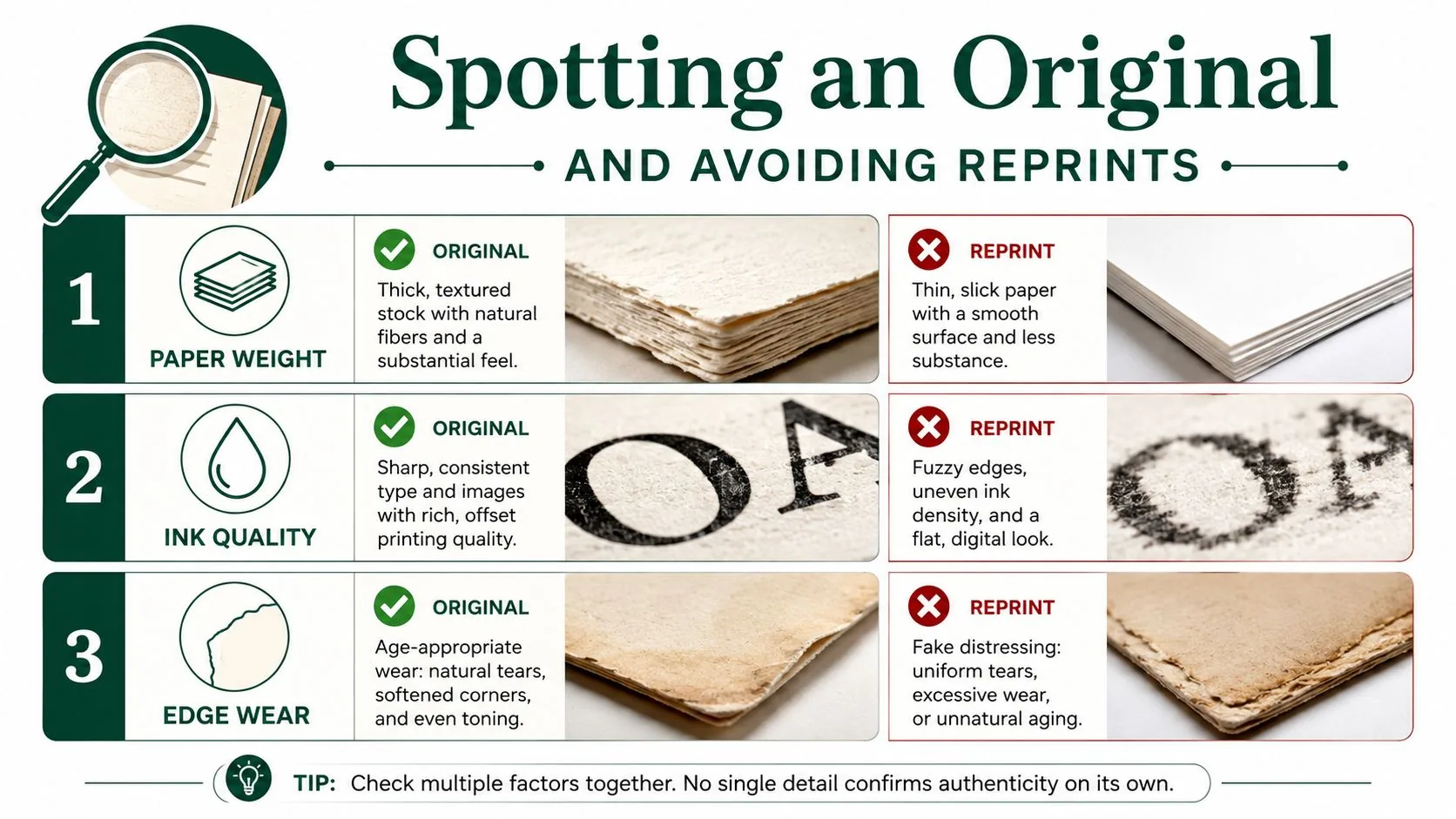
Authentication works best as a sequence of checks, not a single visual impression. A sharp scan can make a modern print look convincing, while an original may show folds, edge wear or restoration that distracts from its identity. Inspect the object, the seller and the paperwork together.
Start with the physical paper
Original paper usually has a period-appropriate feel. Look closely at weight, surface and ink behaviour. A modern digital reproduction may appear too slick, too clean or unnaturally uniform, while older printing can show registration variation, texture and gentle age-related toning.
Fold analysis is useful, but it isn't a verdict on its own. Original US paper was often folded for distribution, whereas British quads may have been shipped flat or rolled depending on the campaign and handling history. Examine whether the folds make sense for the format and whether wear along them looks consistent with ordinary use rather than artificially distressed.
Check the details that reproductions often flatten
Look for copyright lines, distributor information, printer marks and credit blocks. American material may include National Screen Service information, while British material can carry local distributor or printer details. These markings help place a piece within a campaign, although their presence or absence should be assessed alongside the entire design and paper.
Restoration needs equal care. Professional conservation may reduce the appearance of folds and minor defects without pretending the paper was never used. UK restoration specialists explain that linen-backing can make folds and minor defects virtually undetectable at normal viewing distance, so a clean-looking poster isn't automatically unrestored. Read the treatment description and ask whether the work stabilised the paper or concealed damage.
Use the guide to buying original movie posters in the UK as a checklist, then ask the seller for:
- High-resolution images: Request close views of the front, reverse, edges, folds and markings.
- Condition reporting: Ask for specific details about tears, paper loss, staining, trimming and restoration.
- Provenance: Find out where the poster came from and whether earlier ownership is documented.
- Return terms: Make sure you understand the policy before paying.
- Independent advice: For an expensive or unusual piece, consider a third-party opinion before committing.
Buying rule: A confident seller should be able to explain what the poster is, where it came from and what has happened to it.
Storing, Framing and Preserving Noir Paper
Preservation begins before framing. A poster that spends years in an attic, damp basement or poorly sealed tube can deteriorate even if nobody touches it. Treat storage, display and handling as one continuous process, because each decision affects the next.
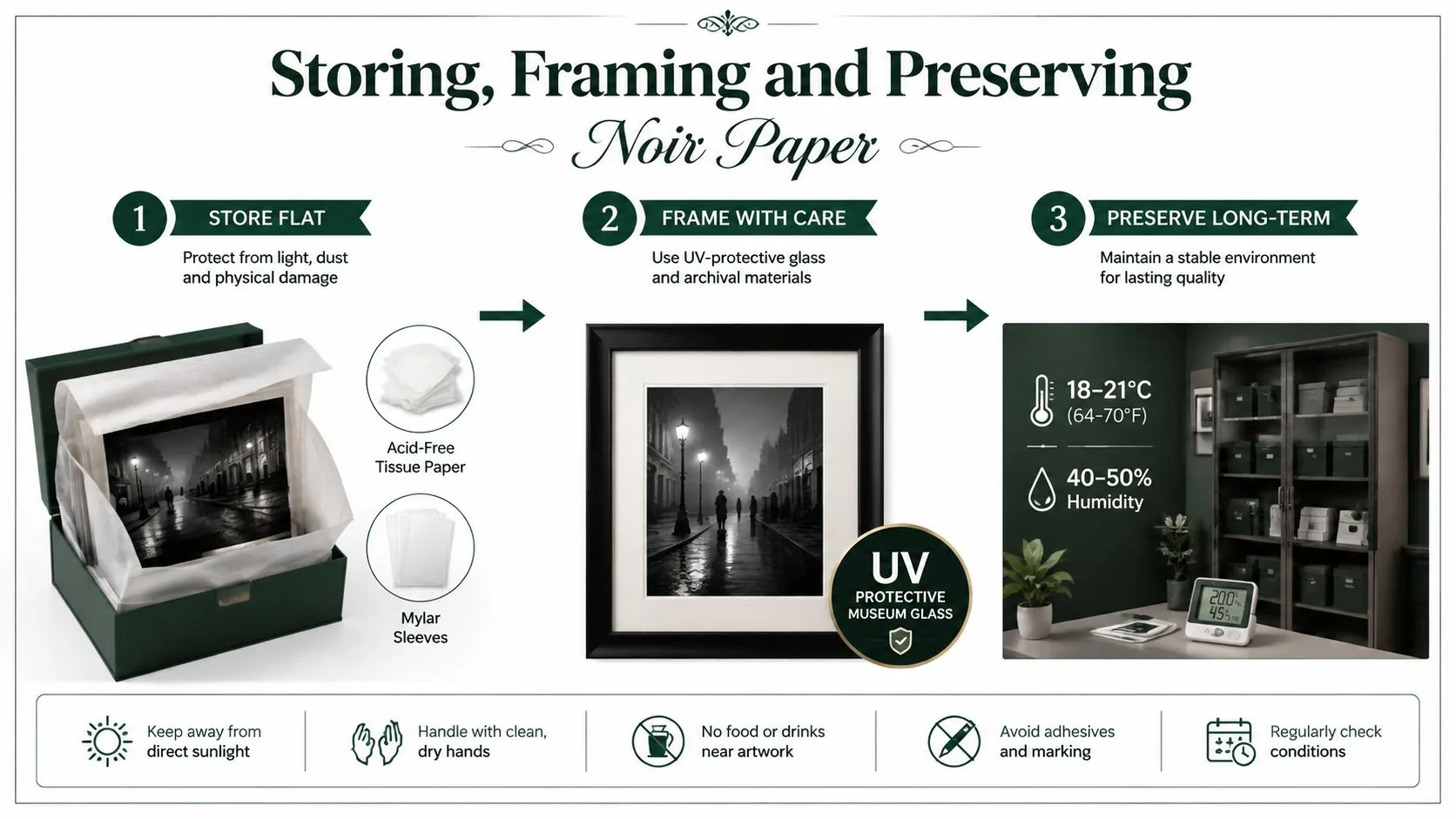
For long-term storage, collectors generally favour a flat, dark and stable environment. Use acid-free tissue and suitable polyester protection, and avoid pressing paper against untreated cardboard, wood or adhesive. UK specialists describe using archival flat-file storage, acid-free polyester pockets and custom poster tubes to reduce handling and environmental risks. The right method depends on the poster's condition and whether it has already been backed.
Build a conservation frame
A conservation frame should protect the image without trapping it against the glazing. UV-filtering glass or acrylic helps reduce light exposure, while an acid-free mount separates the poster from damaging materials. Spacers are useful because they prevent the paper from touching the glazing, reducing the chance of moisture-related contact marks.
Don't dry-mount a valuable original casually. Adhesive mounting can prevent future treatment and may permanently alter the paper. Reversible corner mounts or carefully prepared Japanese tissue hinges are generally more appropriate for collectors who want the option of future conservation.
Handle it as a fragile sheet
Clean, dry hands are often safer than cotton gloves, which can reduce tactile feedback and catch on rough edges. Lift a large quad with support from both sides, never by one corner, and clear the work surface before unfolding it. Keep food, drinks and direct sunlight away from the area.
A simple care routine helps:
- Inspect the frame: Look for condensation, loose backing or signs of insect activity.
- Check the room: Avoid sharp fluctuations in temperature and moisture.
- Limit light exposure: Display valuable paper away from strong daylight.
- Use the right tube: A tube should suit the poster's format and include protective interleaving.
- Ask before treating: A paper conservator should assess serious tears, stains or brittle folds.
For more detailed guidance, consult this UK-focused explanation of how to store movie posters safely. Preservation isn't about making an original look untouched. It's about keeping the paper stable while respecting its history.
Where Collectors Find Originals Today
The safest place to begin is usually a specialist poster dealer who can explain format, condition and restoration in plain language. A good dealer won't just show you an attractive image. They'll tell you whether it's a British quad, a US one-sheet, a re-release or a reproduction, and they should be willing to discuss defects that aren't obvious in a photograph.
Specialist dealers, dedicated poster auctions and film-memorabilia houses all serve different purposes. Dealers can provide education and a more controlled buying experience. Auctions offer discovery and competition, but require comfort with condition reports, buyer terms and limited inspection time. Poster fairs can be rewarding because you can examine paper in person, although availability is unpredictable.
Test the source, not just the poster
Before buying, check the seller's history and ask for evidence that matches the listing. Trade-body membership can be useful, but it shouldn't replace your own questions. Look for previous sales of comparable material, clear condition descriptions and high-resolution photographs that include the reverse and edges.
At an auction viewing, inspect the poster under ordinary light and ask whether backing, trimming or restoration has been recorded. Online buyers should request a written condition report and confirm whether the lot can be returned if it differs materially from its description. A low price doesn't compensate for uncertainty if you can't establish what you're buying.
The UK market also has an active in-person dimension. A London vintage poster market event held in May 2026 points to continuing interest in rare and authenticated paper, while specialist UK inventories distinguish film noir from neo-noir rather than treating every dark crime film as one category. You can also expect broad online search results, including 1,000+ relevant Etsy UK results and 2,600+ eBay UK results for film-noir posters, as recorded in the market comparison at Vintage Movie Posters. Those listings include mixed material, so volume shouldn't be mistaken for authenticity.
Start with a reputable specialist who will answer basic questions. Then move into auctions and fairs once you can read format, condition and provenance without relying on the photograph alone.
If you're looking for an authentic noir-related original, browse the verified collection at Famous Movie Posters, where UK quads, US one-sheets and other formats are clearly presented for collectors. You can also use the site's poster-request service to pursue a specific title or campaign variant that isn't currently listed.