



You've found an original film poster you want on the wall, searched for poster frames 70 x 100, and discovered that the listings aren't as interchangeable as they first appear. One frame may have a nominally correct face size, while another has better glazing, a deeper rebate, safer backing and hardware capable of supporting a large sheet without twisting.
That difference matters more with original cinema paper than with a modern decorative print. A frame can fit the dimensions and still encourage fading, create contact with the glass, or compress a backed poster. The right decision balances paper size, aperture, mounting depth, glazing, wall support and future care.
Table of Contents
- Why 70 x 100 cm Frames Need More Thought Than the Size Suggests
- What 70 x 100 cm Means in UK Paper Sizes
- Aperture, Rebate and Orientation
- Frame Styles and Materials for Original Film Posters
- Measuring, Flattening and Mounting the Poster
- Glazing, UV Protection and the Case for Conservation Spec
- Delivery Checks, Display Conditions and Long-Term Care
Why 70 x 100 cm Frames Need More Thought Than the Size Suggests
A 70 x 100 cm frame sounds like a straightforward purchase. Measure the poster, find the matching listing and hang it. In practice, the headline measurement can describe the artwork size, the visible opening, the glazing or even the outside of the frame, depending on the retailer.
That ambiguity creates problems for original movie posters. A vintage sheet may have slightly uneven edges, folds, linen backing or a border that you want to preserve. A cheap frame might accept the paper but leave no room for a spacer, mount and protective backing. If the poster sits against ordinary glass in direct daylight, the image can gradually lose colour and the paper can deteriorate.
Practical rule: Buy the framing specification, not just the number in the product title.
The useful questions are simple. What are the internal dimensions? How deep is the rebate? Does the frame accept a mount or spacer? Is the backing neutral-pH or acid-free? Does the glazing offer UV filtering, and is the frame strong enough to hang safely in portrait or horizontal orientation?
For a general overview of positioning and fixings, these picture hanging tips for homeowners are useful alongside the poster-specific checks here. A large frame needs careful support, particularly when its weight is unevenly distributed by glazing, backing and mounted paper.
The same principle applies to the cost decision. A guide to how much it costs to frame a poster can help establish the difference between a basic decorative solution and a more protective specification, but the cheapest option isn't automatically the most sensible one for an original.
This guide focuses on the decisions that affect the poster after it leaves the dealer's flat file: choosing the right size context, checking the aperture, selecting a suitable frame, preparing the paper, separating it from the glazing and caring for it once installed.
What 70 x 100 cm Means in UK Paper Sizes
A 70 x 100 cm format sits close to ISO B1, but close does not mean interchangeable. B1 measures 707 × 1,000 mm, making it 7 mm wider than a nominal 700 × 1,000 mm poster, as shown in this ISO B paper-size reference. Its approximate aspect ratio is 1:1.414, the √2 proportion used across the ISO paper system.
That explains its regular appearance in print shops, art suppliers and frame listings. B1 was developed as a large paper format for printing and publication work. Its area is about 0.707 m², or 7,070 cm², compared with approximately 0.500 m² for A1, which measures 594 × 841 mm. For a framer, B1 provides a useful large-format reference even when a retailer describes the frame in centimetres.
Original film posters add another complication. A UK Quad measures 76 × 101.6 cm and is normally horizontal. A US One Sheet is roughly 68.6 × 103.5 cm and is normally portrait. A 70 x 100 cm frame is therefore a near-fit for B1, not a universal cinema-poster frame. The paper's actual dimensions and condition should guide the purchase, especially where the poster has valuable borders or has not been trimmed.
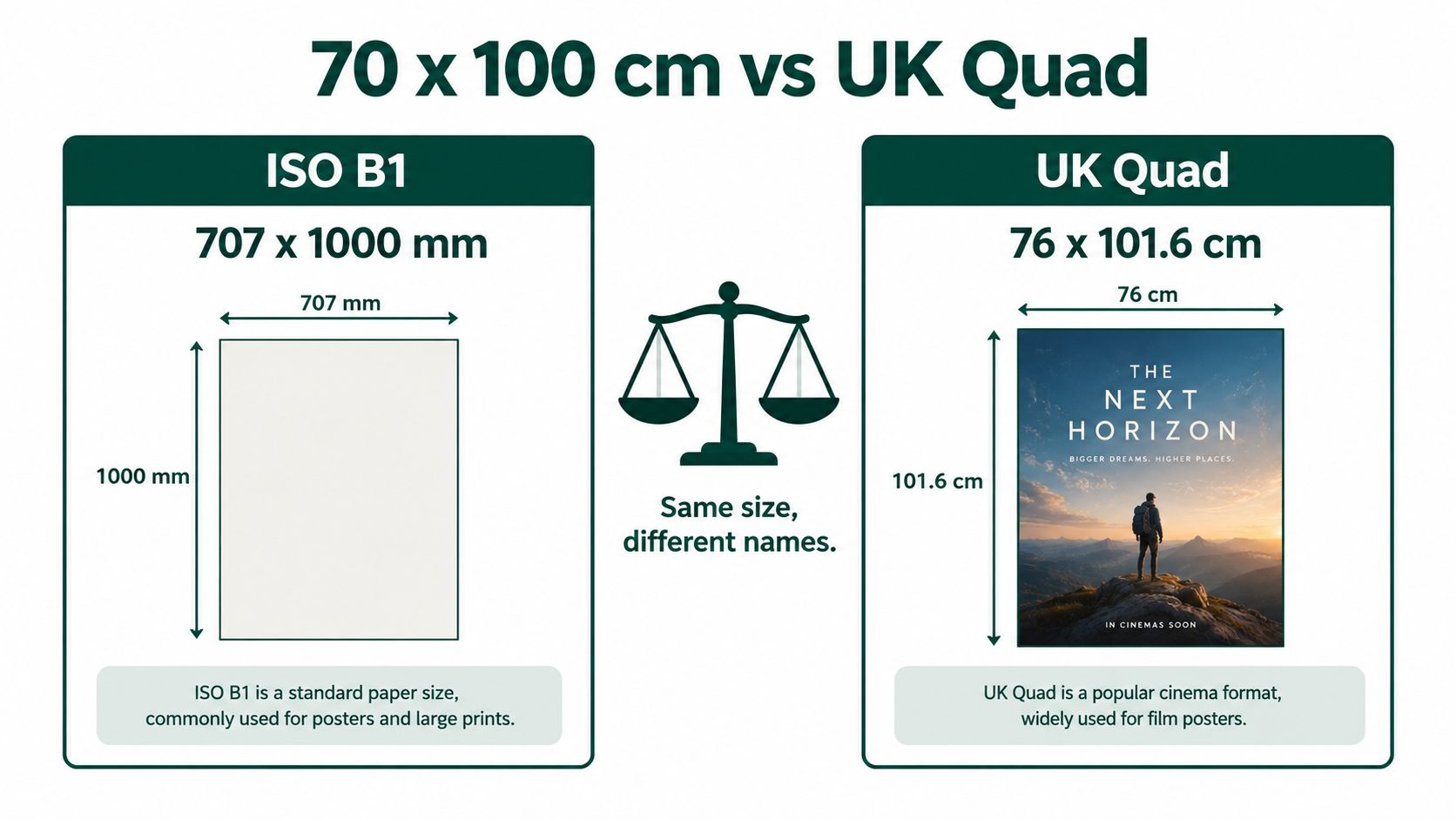
70 x 100 cm in context
| Format | Dimensions (cm) | Orientation | Notes |
|---|---|---|---|
| Nominal 70 x 100 poster | 70 × 100 | Portrait or horizontal | Common large-format frame description |
| ISO B1 | 70.7 × 100 | Portrait or horizontal | Close to 70 x 100 cm, with the additional width |
| UK Quad | 76 × 101.6 | Usually horizontal | Larger cinema format that may need a larger frame or a carefully planned mount |
| US One Sheet | Approximately 68.6 × 103.5 | Usually portrait | Similar in overall area, but not a direct 70 x 100 cm match |
Some collectors place a UK Quad into a smaller-looking presentation with a mount or a deliberately cropped visual arrangement. That requires care. Trimming an original is not an acceptable shortcut. If the sheet exceeds the frame, choose a larger frame or ask a professional framer to design a reversible presentation.
When comparing poster proportions with fine-art and print photography portfolios, keep three measurements separate: the visible image, the paper boundary and the frame opening. Check each one before ordering. A nominal size can identify the right starting point, but it cannot replace measuring the individual poster.
Aperture, Rebate and Orientation
A frame advertised at 70 × 100 cm commonly relates to an artwork aperture of approximately 700 × 1,000 mm, or 27.6 × 39.4 inches, as outlined in this poster-frame size guide. That doesn't mean the entire sheet will remain visible. The rebate is the channel that holds the glazing, artwork, mount and backing, and it usually conceals several millimetres at each edge.
This is normal. It becomes important when the poster has printed material close to its border, a signature, registration marks or an unusually generous white margin. A sheet measuring exactly 700 × 1,000 mm may need a frame marketed for that artwork dimension, but the manufacturer's internal aperture still needs checking.
Read the listing like a framer
Before buying, ask for these details:
- Artwork dimensions: Confirm whether the listed 70 × 100 cm refers to the paper or the outside of the frame.
- Visible aperture: Check how much of the image remains visible after the rebate or mount overlaps the edges.
- Rebate depth: Make sure it can accept the glazing, spacer, poster, backing and any linen treatment.
- Glazing size: A large pane can add considerable weight, so confirm the hanging hardware and wall suitability.
- Mount opening: If a mount is included, ask whether its window is smaller than the paper and whether the overlap is intentional.
A frame with a 700 × 1,000 mm internal opening may be suitable for an unbacked poster that measures slightly less than that. A frame with a 700 × 1,000 mm external artwork size may not be. Retail descriptions are inconsistent enough that a written measurement from the supplier is worth obtaining before you risk bending an original.
Portrait and landscape hanging
The format can be displayed either way, but orientation changes the load on the wall fixings and the tendency of the frame to twist. At this size, use two-point hanging rather than one central fixing. Two secure points help reduce twisting and frame-racking, especially when the frame contains heavy glazing.
Fit the hardware to the wall rather than relying on a generic hook. Masonry, plasterboard and stud walls need different fixings, and a large framed poster should sit level without pulling one upper corner away from the wall. Keep the frame supported by its structural sides, not by the glazing or a thin backing board.
Frame Styles and Materials for Original Film Posters
A slim aluminium profile gives a crisp, modern appearance and works well for contemporary reprints or posters where the visual priority is a clean edge. It can also suit a minimalist interior, particularly when the frame is used without a bulky mount. The limitation is depth. Some slim profiles leave little room for a spacer, conservation board or a poster that has already received linen backing.
Natural wood offers a warmer presentation. Oak, ash and stained hardwood can complement illustrated cinema art, while black wood creates the familiar gallery effect around a bold title or monochrome design. Buyers comparing finishes can also look at these wooden frame options for decorators, although decorative examples still need to be assessed for rebate depth and conservation suitability.
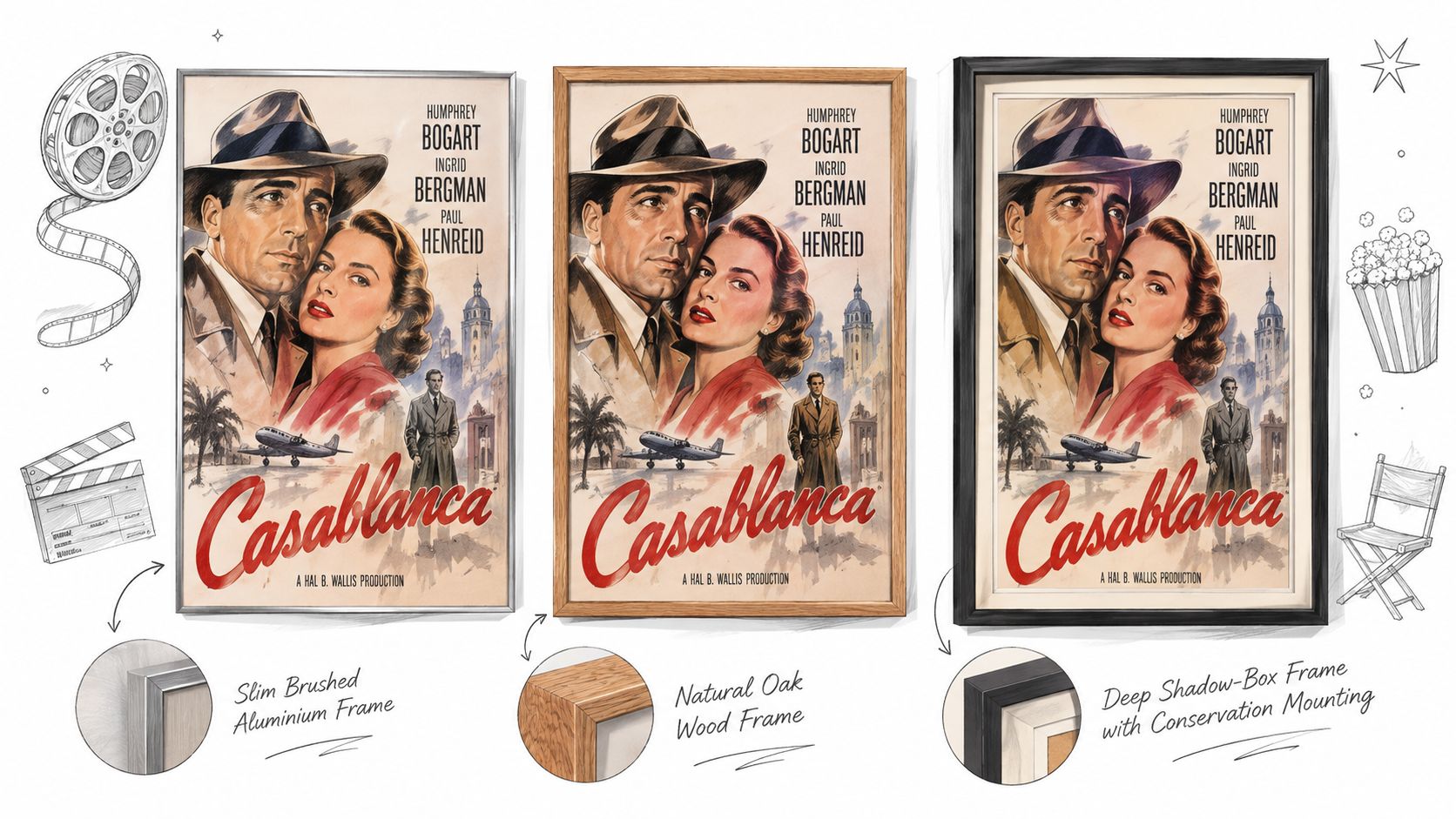
Decorative framing versus protective framing
A decorative frame usually prioritises profile, finish and price. That can be entirely reasonable for a modern print that will be changed periodically. It becomes less convincing for a valuable original that you expect to keep displayed for years.
A conservation-oriented frame needs enough internal depth for the complete assembly. That may include glazing, a spacer or window mount, the poster, an isolating layer and a rigid backboard. If the frame is too shallow, the framer may be forced to compress the contents or allow the paper to touch the glass.
| Frame approach | Strength | Limitation |
|---|---|---|
| Slim aluminium | Light visual profile and contemporary appearance | Often limited rebate depth |
| Natural wood | Warm finish and broad decorative choice | Quality and depth vary considerably |
| Black wood | Neutral gallery presentation that suits many posters | A narrow moulding may not accept conservation layers |
| Deep box frame | Space for spacer, mount and backing | Projects further from the wall and may cost more |
For an original film poster, I normally treat the moulding as the outer envelope, not the main protection. A beautiful profile can't compensate for unsuitable glazing or an acidic backing board. If the poster has linen backing, folds that need support or a mount that creates extra thickness, choose the frame around the complete package.
The dedicated movie poster framing guide is useful for comparing those choices before you commit to a profile. The right frame is the one that accommodates the treatment the paper needs, rather than the one that merely looks correct in a product photograph.
Measuring, Flattening and Mounting the Poster
Start with the poster flat on a clean, clear surface. Measure the paper in more than one place, because older sheets may have slight distortion from storage, folds or previous handling. Record the full paper dimensions, the printed image area and any border you want visible.
Don't pull a curled poster tight by force. Gentle flattening under an even, clean weight can help a sheet relax, but an original with brittle paper, deep folds, tears or flaking ink should go to a paper conservator. Excessive pressure can create new creases or transfer texture from an unsuitable surface.
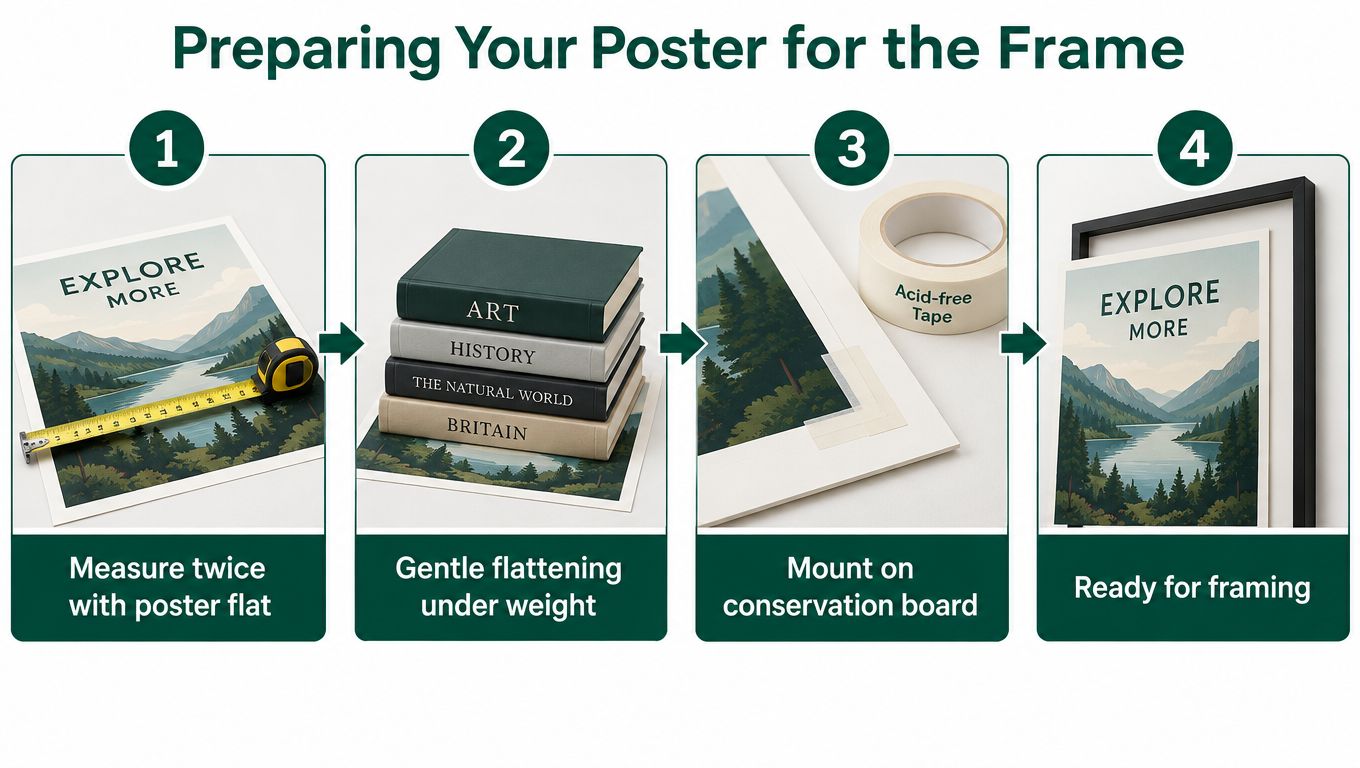
Choose the mounting method carefully
A flush mount places the sheet close to the glazing and gives a clean, borderless appearance. It can work for a stable decorative print, but it offers little tolerance for movement, condensation or surface contact. Original paper deserves more separation.
A window mount creates a visible border and keeps the artwork away from the glazing. Use conservation-quality, acid-free or neutral-pH board, and make sure the aperture is planned around the image rather than cutting through important lettering or credits. The mount also changes the depth required inside the frame.
For a fragile or valuable original, linen backing may provide structural support, but it isn't a cosmetic layer that can be ignored in the measurements. A backed poster is thicker and may need a deeper rebate. Mounting should also remain as reversible and non-invasive as the material allows.
Run through this checklist before assembly:
- Measure the flat sheet: Record width, height and any irregularity.
- Inspect the surface: Look for tears, loose ink, stains, old tape and brittle folds.
- Plan the presentation: Decide which borders, credits and edges must remain visible.
- Select the board: Use acid-free or neutral-pH materials suitable for long-term contact.
- Add separation: Specify a mount or spacer so the paper won't touch the glazing.
- Confirm the rebate: Check that every layer fits without compression.
- Secure the back: Use a rigid, well-fitting board that doesn't bow inside the frame.
A practical guide to how to frame a poster can help with the sequence, but valuable originals should be assessed individually. A sheet that has been folded, backed or repaired isn't equivalent to a fresh commercial print.
Glazing, UV Protection and the Case for Conservation Spec
For an original film poster, glazing and backing usually matter more than the colour or profile of the moulding. Ordinary glass may look perfectly clear on the wall, yet it does little to address ultraviolet exposure or the risk of the paper sitting directly against the pane.
UK conservation specialists describe UV-filtering glazing options that reduce ultraviolet transmission by roughly 70 to 99 per cent, as set out in this specialist UV-protective framing guidance. That range depends on the product, so ask for the glazing specification rather than accepting a general claim that it is “UV safe”.
UV filtering slows photochemical damage. It doesn't make the poster immune to visible light, and it doesn't justify hanging valuable paper in prolonged direct sunlight. In practice, daylight exposure, heat and poor backing can still create problems even when the glazing is better specified.
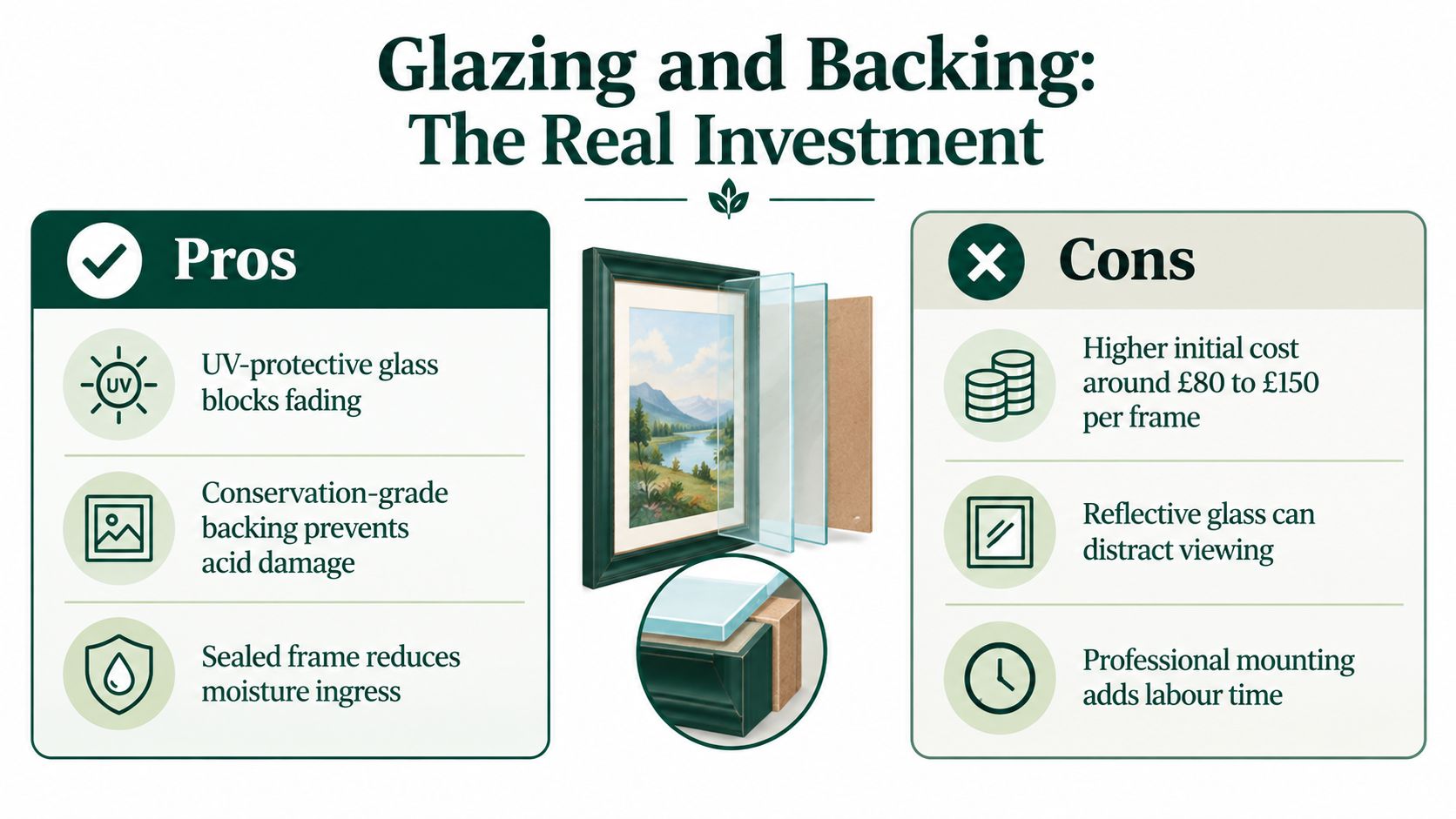
Glass, acrylic and backing
Standard glass is rigid, familiar and often visually crisp, but it is heavy and can break. UV-filtering glass improves the protective specification while retaining that solid surface, although reflections may remain distracting depending on the room.
Acrylic is lighter and avoids the sharp breakage risk associated with glass. It can be practical for a large frame or a room where impact is a concern, but it may scratch more readily and needs careful cleaning with suitable materials. The choice is a balance between weight, clarity, handling and safety.
The backing deserves equal attention. Use acid-free or neutral-pH mounting materials, and don't allow the poster to touch the glazing. A spacer or mount reduces the risk of condensation-related adhesion, abrasion and blocking, while a suitable backing helps limit contact with damaging materials.
Tate's guidance on caring for art on paper also supports checking transmission data for UV protection periodically and recognises acrylic as a practical option for many works on paper. That is a better approach than treating a glazing label as a permanent guarantee.
The following video provides a visual introduction to the framing decision. Use it as a supplement to the material specification, not as a substitute for checking the exact rebate and conservation layers.
A flush poster against glass may look sleek in a shop photograph, but it fails the basic separation test for a valuable original. Spend the budget first on safe distance from the glazing, suitable backing and reliable UV data, then choose the finish that suits the room.
Delivery Checks, Display Conditions and Long-Term Care
A 70 × 100 cm frame deserves an arrival inspection before its packaging is discarded. Check the glazing, corners, frame joints, backing and visible poster surface. Photograph any damage while the box and protective materials are still available.
For UK online purchases, the retailer remains responsible for the goods until they reach you or a nominated recipient. Delivery should generally take place within 30 days, unless another period was agreed, as explained in this UK consumer-rights guidance. Report transit damage to the retailer, not just the courier, and keep the packaging until collection or return arrangements are confirmed.
Conservation bodies generally advise a cool, stable room with moderate humidity. Keep the frame away from radiators, direct heat, damp rooms, condensation and prolonged direct sunlight. If the poster comes off display, store it flat or properly supported, covered with acid-free tissue or another suitable protective material, and never directly on the floor.
Lift a 70 × 100 cm frame by its structural sides. Two people are safer than one, particularly with glass. Never carry it by the glazing or a single corner. Check the glazing and surrounding conditions periodically. UV protection slows fading and paper deterioration, but sensible light control still matters.
Famous Movie Posters offers original film posters, framing options and guidance on formats such as UK Quads and US One Sheets. Visit Famous Movie Posters to browse originals, review framing support or request a specific title before planning your display.