



The most popular advice about poster frames black starts with appearance. That's the wrong place to start if you're framing an original film poster. Black moulding can give a Quad or One Sheet a clean, authoritative edge, but the colour itself does nothing to slow fading, prevent condensation or stop paper from touching the glazing.
The serious decisions are hidden inside the frame. Glazing, mounting board, spacers, frame depth, wall fixings and the room's light levels will determine whether your poster remains stable and readable. A modest black frame with proper conservation materials can be a far better choice than an expensive design frame that leaves an original exposed to ultraviolet light and damaging contact.
Table of Contents
- Why Frame Colour Is Not Your First Concern
- Understanding Poster Formats Before You Buy
- Choosing the Right Glazing for Your Display
- The Importance of Spacers and Acid-Free Mounts
- Optimal Placement and Lighting Conditions
- Final Steps for Safe Framing and Display
Why Frame Colour Is Not Your First Concern
A collector once brought in a striking original film poster in a beautifully finished black frame. From across the room, it looked exactly right. The moulding created strong contrast around the artwork, the proportions felt balanced and the dark finish suited the graphic design.
The problem appeared when the frame was opened. The glazing sat directly against the paper, the backing board was ordinary mountboard and the display location received strong daylight. The black frame had made the poster look finished, but it hadn't created a safe display environment. In practical terms, the frame's most visible feature was the least important part of its protection.
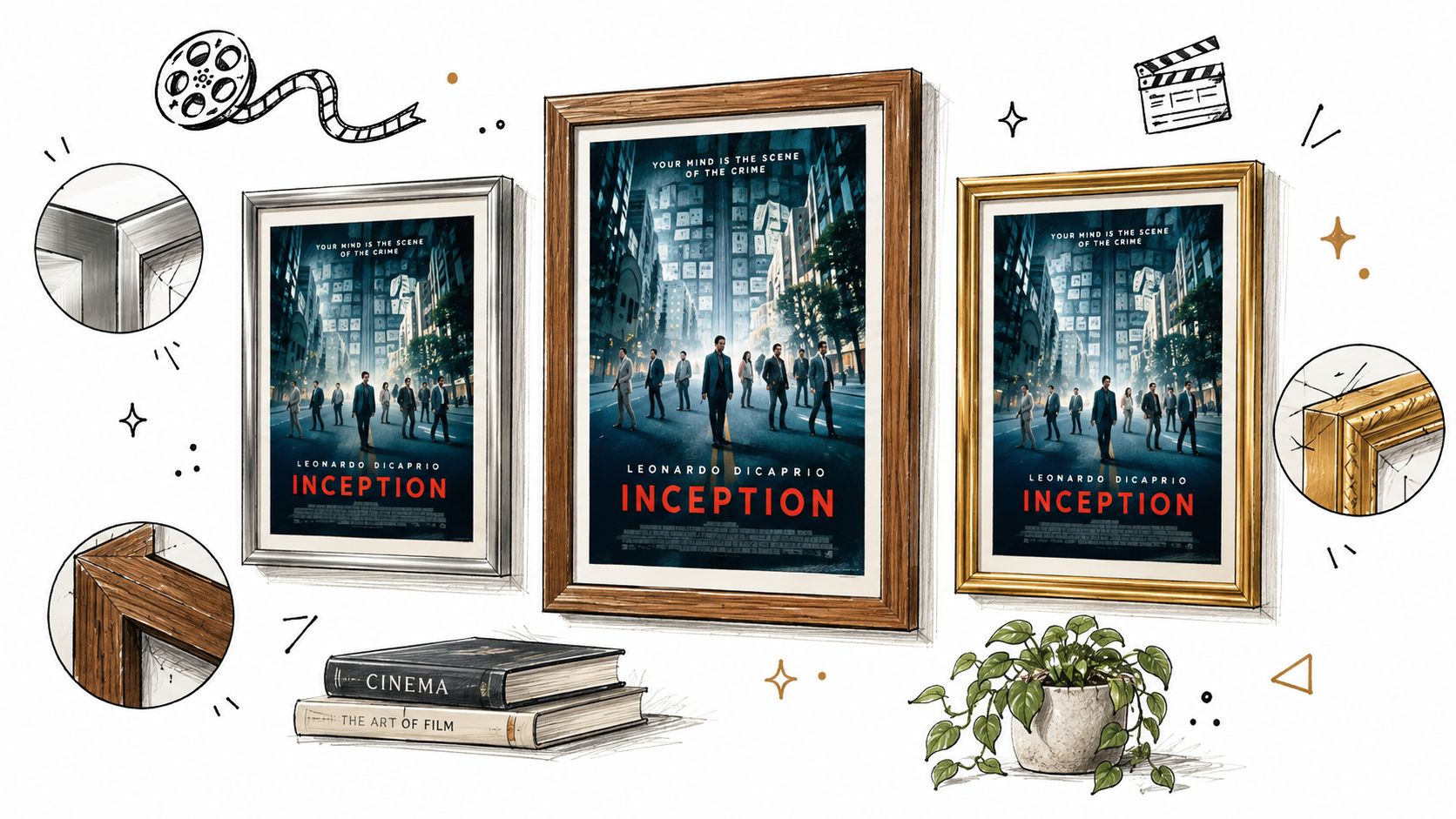
What black moulding does well
Black is popular for good reasons. It gives vivid artwork a defined boundary, works with both contemporary and historic designs and usually sits comfortably in a cinema room, study or living room. A narrow black profile can make a large poster feel crisp, while a deeper, broader profile gives a substantial Quad more visual weight.
That's an aesthetic decision, and it matters. Framing should respect the artwork rather than distract from it. Black can also echo architectural details elsewhere in a room, much as black cladding can create a strong, understated surface around a wider interior scheme.
What black cannot do is filter light. It cannot improve the chemistry of the backing board. It cannot create an air gap around the poster or compensate for an unsuitable wall. A black finish is neutral in relation to preservation, so judge it as a visual component only after the protective specification is right.
Practical rule: Choose the conservation package first, then select the black moulding that can house it safely.
The protection is inside the rebate
For an original poster, the frame should accommodate UV-filtering glazing, an archival mount and a spacer or window mount. The National Archives recommends UV-protected glass, conservation-quality or acid-free mounting materials and separation between glazing and artwork in its guidance on caring for prints (National Archives guidance on caring for prints).
That separation matters because paper can suffer from abrasion, sticking, trapped moisture and chemical migration when it rests directly against the glazing or unsuitable board. A black frame with the wrong internal construction can therefore present a greater long-term risk than a less fashionable frame fitted with proper conservation glazing.
Original cinema art deserves the same disciplined approach whether it's a delicate early poster, a folded modern release or a large-format British Quad. The visual finish should support the object, not become a substitute for protecting it.
Understanding Poster Formats Before You Buy
A frame labelled “large poster” isn't a specification. Before ordering black poster frames, identify the format and measure the actual sheet. Cinema posters have been produced in proportions that don't always correspond with the paper sizes used in British frame shops.
The British Quad is the key UK format. It traditionally measures 30 × 40 inches, approximately 762 × 1,016 millimetres, and is normally displayed horizontally (Soho Frames' poster-framing guidance). Its broad horizontal layout is associated with British cinema promotion across much of the twentieth century. Earlier examples could appear in portrait orientation before the Second World War, while post-war “broadside quads” became the familiar horizontal format handled by collectors today.
A US One Sheet is generally recognised by its portrait orientation, but the exact dimensions of a particular poster should be confirmed before framing. The format name alone doesn't tell you whether a sheet has been trimmed, folded, backed or altered during its history. That's why the table below gives the Quad's established measurement and treats the One Sheet as a format requiring verification rather than assigning it an unsupported figure.
Common Poster Format Dimensions
| Format | Dimensions (Inches) | Dimensions (mm) | Orientation |
|---|---|---|---|
| British Quad | 30 × 40 | Approximately 762 × 1,016 | Usually landscape |
| US One Sheet | Measure the individual poster | Measure the individual poster | Usually portrait |
The distinction between imperial cinema formats and ISO paper sizes causes many avoidable mistakes. UK framing commonly uses A-series dimensions, from A4 at 210 × 297 mm through A3 at 297 × 420 mm, A2 at 420 × 594 mm, A1 at 594 × 841 mm and A0 at 841 × 1,189 mm (UK poster frame size guidance from Picture Frames Express). A0 has an area of approximately one square metre, but it still doesn't match the traditional British Quad.
That mismatch affects more than the outer appearance. A frame can have an aperture that's too tight, a rebate that lacks clearance or a mount that leaves an awkward border. Trying to force a Quad into an A-series frame can mean bending, trimming or concealing part of the original paper.
Measure the paper, not the label
Lay the poster flat on a clean surface and measure its width and height. Record the visible sheet, not just the printed image area, and check each edge for irregular trimming. If the poster is folded, backed or fragile, ask a professional framer to assess it rather than flattening it aggressively at home.
Also confirm the intended orientation. A wide Quad needs a frame and hanging system designed to support its width. If you're buying a frame for a reproduction or a newly printed piece, suppliers of printed indoor posters may work to different production sizes, so the finished sheet still needs to be measured before you choose the frame.
A useful specialist reference is this guide to a 27 x 40 poster frame, but don't treat a related size as proof that your original will fit. Trimming, fold lines and production variation can change the required aperture.
Choosing the Right Glazing for Your Display
Glazing is usually the most consequential part of the framing specification. It controls the poster's exposure to light, affects reflections, adds weight and determines how safely the package can be handled. The black moulding may dominate the view, but the glazing determines much of the risk.
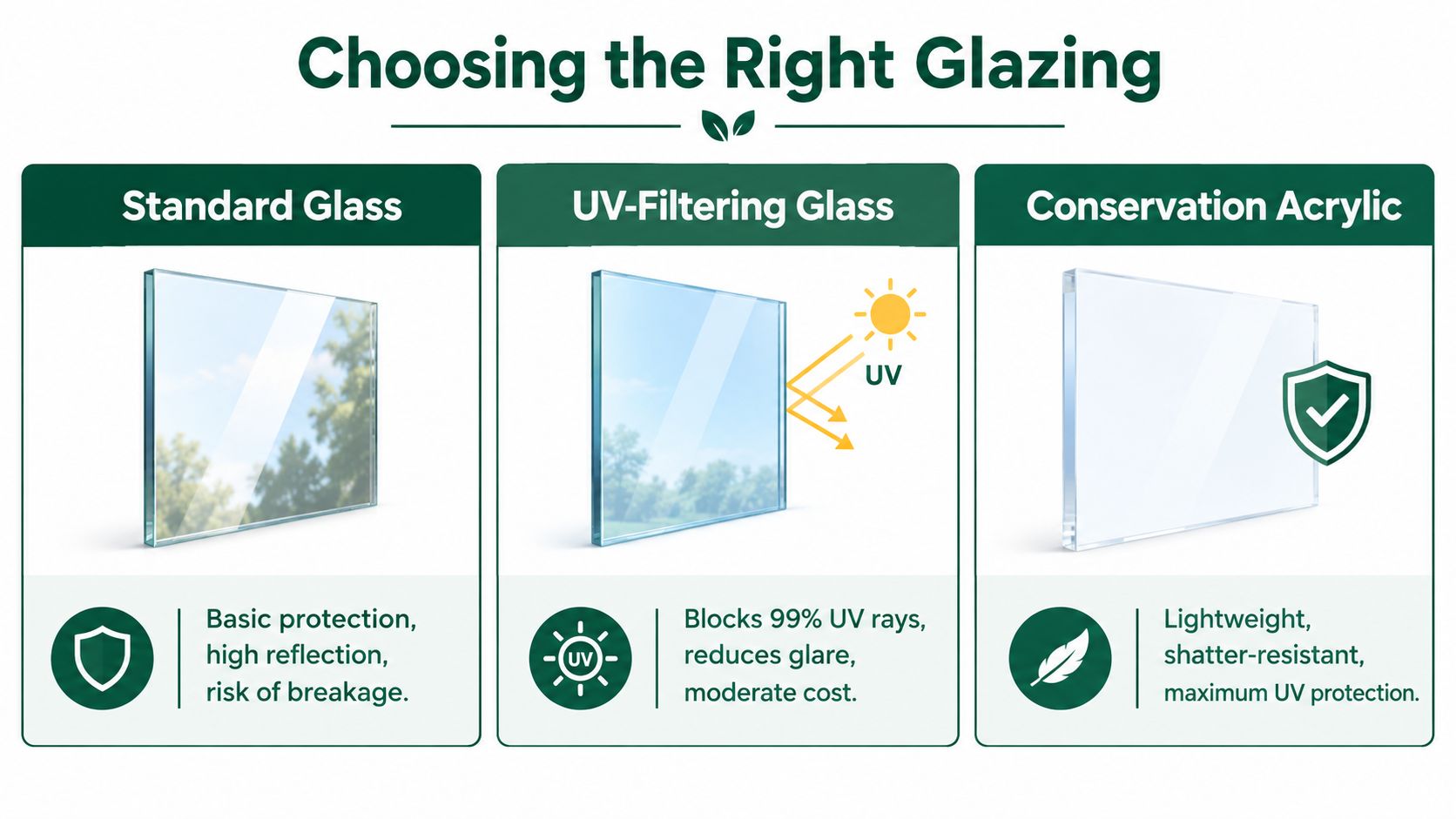
Standard glass
Ordinary glass can provide a clear, familiar presentation and may be suitable for a low-value reproduction displayed away from strong light. It's rigid and generally resists scratching better than acrylic, but it reflects room lighting and daylight. Unless the product is specifically described as UV-filtering, don't assume it offers the protection required for an original poster.
Glass also adds substantial weight to a large frame. That affects the frame's corner strength, the backing, the hanging hardware and the wall fixing. A wide British Quad in a black frame can become a serious load, particularly when the frame includes a mount and substantial backing.
UV-filtering glass
UV-filtering glass is the sensible starting point for an original paper poster. It addresses the part of the display system that colour alone can't address, namely exposure to ultraviolet-rich light. The National Archives specifically advises UV-protected glazing as part of a conservation approach, rather than relying on the frame finish for protection.
It's still not a licence to hang the poster in direct sun. UV-filtering glazing reduces risk, but it doesn't make daylight harmless, and it won't prevent damage caused by heat, poor humidity control or unsuitable mounting materials. Ask the framer to specify the glazing on the order and confirm how it will be separated from the paper.
Low-reflective options can improve visibility in rooms with lamps or windows opposite the artwork. They're useful when glare would otherwise obscure the image, although the final choice must also suit the frame's size and strength.
Conservation acrylic
Acrylic is lighter and shatter-resistant, which can make it a practical choice for a large poster or a frame hung where impact is possible. UK museum guidance recommends considering acrylic where glazing weight is a concern, while also stressing the importance of spacing it away from the artwork (Museums Galleries Scotland guidance on caring for paintings and frames).
The trade-off is handling. Acrylic scratches more easily than glass and can generate static, so it needs careful cleaning and isn't automatically suitable for every medium. Static-sensitive materials such as pastels and charcoal need particular caution, even though that concern may be less central with a typical printed film poster.
| Glazing choice | Main advantage | Main limitation |
|---|---|---|
| Standard glass | Familiar clarity and a hard surface | Reflection, breakage risk and no assumed UV specification |
| UV-filtering glass | Better protection for original paper | Greater weight and possible reflection |
| Conservation acrylic | Lower weight and impact resistance | Scratches more easily and may create static |
For more display-focused comparisons, consult this guide to the best frames for movie posters, then ask a framer to match the glazing to the poster, room and fixing method. The right answer isn't always the lightest or most expensive option. It's the one that provides suitable protection without creating a structural problem.
The Importance of Spacers and Acid-Free Mounts
A black frame can only protect a poster if the internal layers have been specified correctly. The paper shouldn't be pressed against the glazing, and it shouldn't sit against an ordinary acidic board that may transfer damaging chemicals over time.
The first component to specify is the mount or backing. For a valuable film poster, use acid-free, conservation-grade material. Museum Galleries Scotland recommends acid-free board for mounting prints and drawings because suitable buffered boards can help prevent acid migration (guidance on storage and display materials).
Build the package in the right order
A professional framer will normally consider the frame, glazing, spacer, mount, artwork support and backing as one system. Each layer has a job:
- Glazing: Filters light where a UV specification has been selected and shields the surface from dust and handling.
- Spacer: Creates physical separation between the glazing and the paper.
- Window mount: Holds the artwork visually and can provide the necessary clearance when designed correctly.
- Acid-free backing: Supports the sheet without introducing unsuitable materials.
- Secure backboard: Keeps the package stable inside the rebate and protects the rear of the poster.
A spacer is not decorative filler. It prevents the glazing from touching the paper, reducing the chance of abrasion, sticking and moisture being held against the artwork. A window mount can perform a similar separation function, but the framer must ensure the opening, board thickness and artwork position are appropriate.
Avoid permanent damage during mounting
Original posters shouldn't be permanently altered just to make them fit a frame. Aggressive trimming removes history and can reduce the value of the sheet. Strong pressure-sensitive tapes, unsuitable adhesives and casual dry mounting can also make future conservation more difficult.
Ask how the poster will be held in place before approving the work. A conservator or experienced poster framer should be able to explain whether the sheet will be hinged, supported or otherwise secured in a reversible way. The answer will depend on the paper, condition, backing and whether the poster has already been treated.
The mount should support the poster without becoming part of its history.
Frame depth deserves attention too. UV-filtering glass, a spacer, mountboard and backing need enough room inside the rebate without being compressed. If the package is forced into a shallow black frame, the back may bow, the glazing may press forward or the poster may become difficult to remove safely.
For an ordinary decorative print, these details can seem excessive. For an original cinema poster, they're the difference between a display that merely looks complete and one designed for long-term care.
Optimal Placement and Lighting Conditions
The safest black frame can't compensate for a poor wall. Light damage is cumulative and irreversible, and blue and ultraviolet-rich light can accelerate fading, yellowing and embrittlement in paper and boards, according to the Archives and Records Association's paper conservation guidance.
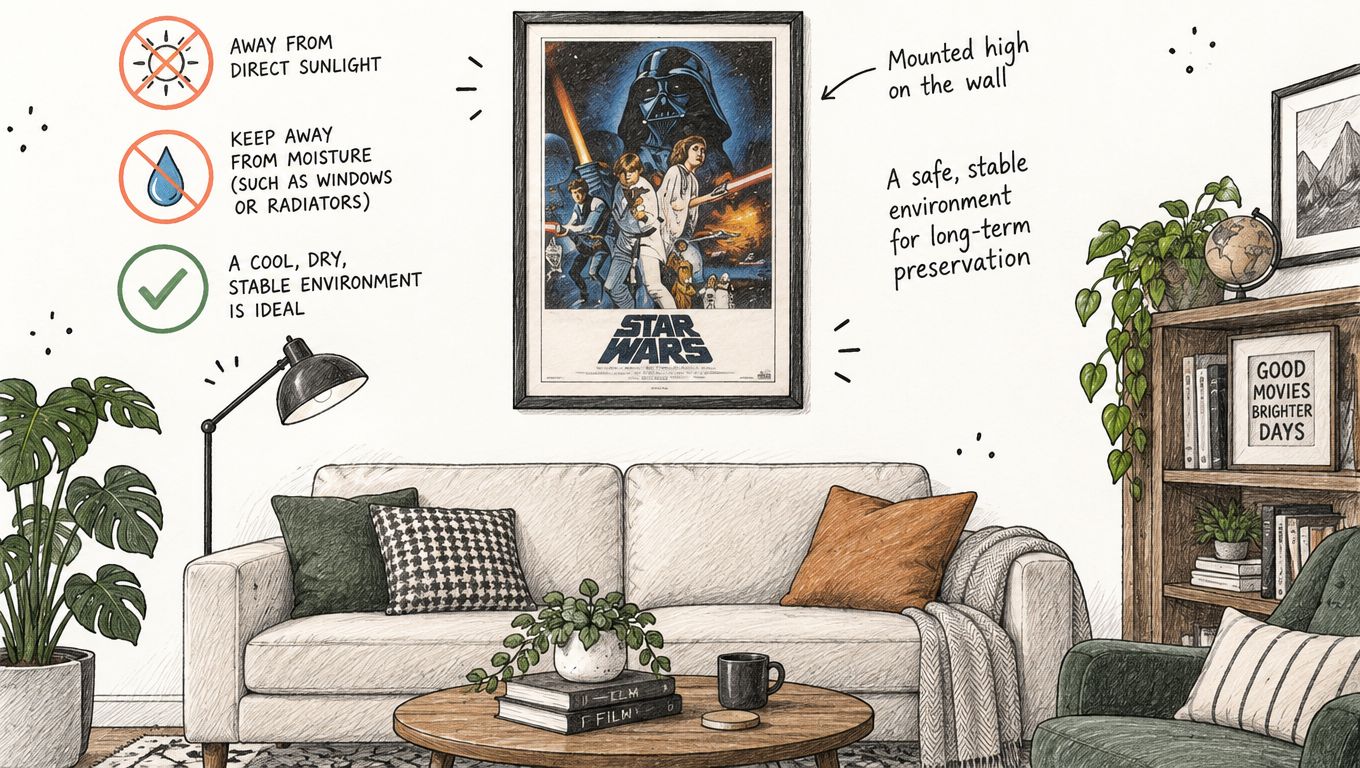
South-facing rooms deserve particular caution because strong daylight can fall on the frame for extended periods. A poster may look fine during the first part of its display, while the ink and paper gradually respond to the light. Closing blinds at certain times helps, but it's better to position the artwork away from direct exposure in the first place.
Read the room before choosing the wall
The best location is usually one with controlled, indirect light and a stable temperature. Avoid placing an original poster directly opposite a bright window, beneath a strong skylight or beside a lamp that produces significant heat. If the room changes function throughout the day, check it at different times before committing to the hanging position.
Exterior walls create a separate risk. A comparatively cold outside wall can encourage condensation and mould inside the frame, especially where the frame sits tightly against the surface. Leave an air gap behind the frame and monitor the display area for condensation or signs of humidity.
Stable conditions matter as much as the absence of direct sun. Archival guidance for framed paper artworks gives an ideal relative humidity range of approximately 45–60%, with mould risk increasing above approximately 60–65% (preventative conservation advice from Art UK). You don't need to turn a living room into a museum store, but a small room monitor can reveal whether a damp or poorly ventilated space is suitable.
Large frames need a structural plan
A wide Quad in a black frame may be visually light but physically demanding. Glass is heavy and requires secure fixings, while acrylic reduces the load but still needs a properly constructed frame and reliable backing. Plasterboard and solid masonry require different fixing methods, so select the hanging hardware after confirming the wall type and the finished weight.
Use two people to position a large framed poster and avoid relying on a single small picture hook where the frame has considerable width or depth. Check that the hanging points are level, the frame sits securely and the lower edge can't catch against furniture or a door.
A display can be visually minimal without being physically casual. For further ideas about controlled presentation, see this discussion of a light box for a movie poster, but don't use any illuminated solution close to an original unless the heat and light exposure have been properly assessed. The aim is to make the artwork readable while limiting the conditions that accelerate deterioration.
Final Steps for Safe Framing and Display
Treat the purchase of poster frames black as a measured conservation decision, not an impulse based on colour. A reliable workflow looks like this:
- Identify the format. Decide whether the poster is a British Quad, US One Sheet or another format. Note the intended orientation.
- Measure the actual sheet. Record width and height, inspect the edges and allow for trimming, folds, backing or manufacturing variation.
- Specify the internal package. Request UV-filtering glazing, an acid-free or conservation-grade mount and a spacer or window mount that keeps the glazing off the paper.
- Check the rebate depth. Make sure the frame can hold every layer without compression or movement.
- Choose glass or acrylic deliberately. Consider clarity, reflection, impact risk, scratching, static and the total weight of the finished frame.
- Plan the fixings. Match the hardware to the frame weight and wall construction. Large glazed frames need more than a casual hanging arrangement.
- Select the wall carefully. Avoid direct daylight, particularly strong south-facing exposure, and don't hang the frame directly against an exterior wall.
- Inspect the display periodically. Look for condensation, movement, dust ingress or changes in the paper, and address problems before removing the poster becomes urgent.
A black moulding can be the perfect final touch, but it should be the final decision. The successful frame is the one that combines a suitable visual profile with adequate depth, stable support, appropriate glazing and a sensible display environment.
Famous Movie Posters offers guaranteed original UK Quads, US One Sheets and other cinema formats, with framing guidance to help collectors match the artwork to the right display solution. Browse the collection at Famous Movie Posters, or use its Request a Poster service to find a specific original before arranging safe, properly measured framing.