



An original film poster deserves more thought than a standard art print. Before choosing a frame, you need to know whether you're working with a US One Sheet or UK Quad, how the paper has survived, where the poster will hang, how much sunlight reaches the wall, what your budget allows and whether the collection is likely to grow.
The right display can make a folded vintage poster feel like a gallery object. The wrong one can trap it against unsuitable materials, exaggerate creases or expose sensitive inks to light. These poster framing ideas move from conservation-led solutions to flexible multi-poster displays, so you can match the presentation to the poster rather than forcing every title into the same frame.
Authenticated originals from Famous Movie Posters can be selected by decade, genre or franchise, with format guidance that helps you give a framer accurate information before work begins.
Table of Contents
- 1. Museum-quality UV-protective framing
- 2. Minimalist edge-to-edge floating frames
- 3. Matched-size custom tube framing coordination
- 4. Sector-specific thematic framing galleries
- 5. Vintage period-appropriate frame styling
- 6. Interactive multi-poster rotating display frames
- 7. DIY frame assembly with professional conservation guidance
- 8. Statement wall and salon-style asymmetrical arrangements
- 8 Poster Framing Ideas, Quick Comparison
- Choose the display that protects the story
1. Museum-quality UV-protective framing
A rare original deserves a conservation-led frame, especially if its condition or value makes replacement difficult. Museum-quality framing combines UV-filtering glazing, conservation board, archival backing and careful mounting, so the display protects the poster rather than enclosing it.
UV-resistant glazing can block up to about 99% of UV light, helping limit fading in vulnerable inks and paper. UK conservation guidance for poster display recommends conservation or museum-level board of at least 1,100 microns, with the poster attached using conservation-grade gummed paper or linen tape. Keep the artwork away from the glazing with an air gap of at least 5mm.
This specification suits a scarce film noir title, a Hammer Horror original or a high-value James Bond poster where preserving the paper's character matters more than minimising cost. It also gives the framer an opportunity to assess tears, old repairs, fold lines and staining before the poster is enclosed.
Build the frame around reversibility
Ask how the poster can be removed without damage. Direct adhesive mounting onto backing board may produce a flat finish, but it is a poor choice for a collectible original. Hinges and suitable archival supports let the paper respond naturally to environmental changes and make later conservation work more manageable.
For step-by-step mounting and glazing choices, read this guide on how to frame a poster.
Keep the finished frame away from direct sunlight, radiators and other heat sources. During shipping, use protective packaging suited to the format instead of folding the poster into a smaller parcel.
Collector rule: If a poster has financial or sentimental importance, pay for condition assessment and suitable materials before decorative moulding.
A specialist familiar with archival practice should explain the board, hinge, glazing and backing choices clearly. For wider context on museum-quality standards and provenance-led presentation, see this guide to Buddhist statue provenance standards.
2. Minimalist edge-to-edge floating frames
A floating frame makes the poster appear suspended between panes of glass or acrylic. Instead of hiding the edges beneath a conventional mount, it allows viewers to see the full sheet, including its margins, fold history and the character of the original stock.
This works especially well when the poster's design is the main attraction. A bold Star Wars composition, a contemporary Marvel design or a clean modern release can sit comfortably in a restrained frame with minimal visual interference. The effect is also useful in a home cinema where several posters need to feel modern rather than traditionally framed.
The trade-off is precision. A floating presentation leaves less room to disguise uneven edges, handling marks or small losses. It also needs careful support, spacers and sealing. The poster shouldn't be pressed directly against the glazing, and the framer must prevent dust from entering the cavity.
Keep the minimal look technically sound
Choose a framing specialist with experience in floating construction, not just standard poster frames. Ask for acid-free spacers, UV-protective glazing and sealed edges. The minimalist appearance should come from the frame profile, not from removing the protective elements that keep the poster stable.
A floating frame can reveal the reverse of a poster, which may appeal to collectors interested in paper quality and printing evidence. It can also expose unfinished edges or old repairs, so inspect the whole sheet before committing to an edge-to-edge design.
The cleanest frame is not necessarily the safest frame. A narrow visible border still needs proper clearance, support and protection behind it.
For practical guidance on selecting a suitable frame profile and construction, use this advice on the best frames for movie posters. In a bright room, floating style should never mean ordinary glazing. Reflection control and UV filtering remain more important than achieving a frameless appearance.
3. Matched-size custom tube framing coordination
The frame is only part of the journey. A poster that arrives with new creases, crushed edges or uncontrolled moisture already presents a harder conservation problem before it reaches the framer.
Coordinating delivery packaging with the eventual frame is a practical approach for collectors buying several titles. Custom-designed tubes matched to US One Sheet and UK Quad formats can help the poster travel in an appropriate shape, with acid-free tissue and kraft paper used to separate and protect the sheet. Famous Movie Posters' poster tube packaging guidance explains the purpose of this format-led approach.
Give the framer useful information
Ask for the poster's dimensions and format when ordering. A framer can then prepare a quotation and decide whether the sheet needs flattening, a condition check or conservation treatment before mounting. This is particularly useful when assembling a consistent Lord of the Rings or James Bond wall, where mismatched outer dimensions can make the finished display look accidental.
When the tube arrives, don't rush straight to framing. Unroll the poster carefully and allow it to rest flat for 24 to 48 hours before taking final measurements or placing it into a frame. Keep it in a cool, dry environment, and don't use heavy objects to flatten it.
Practical rule: Measure the actual poster, not just the advertised format. Borders, trimming and previous handling can change the sheet you receive.
Photograph the poster as it arrives and retain the packaging and documentation. If the paper shows fresh damage or unexpected movement, tell the framer before attempting to flatten it yourself. A coordinated approach is also useful for gift purchases, because the recipient can take the poster to a professional with its format and handling information intact.
4. Sector-specific thematic framing galleries
A collection becomes more compelling when the frames support a clear subject. Group posters by genre, decade or franchise, then use consistent spacing and related materials to make separate titles read as one visual statement.
A James Bond wall might move from Sean Connery through Daniel Craig, with the frame finish changing subtly to reflect the eras while the mount widths remain consistent. A science-fiction gallery could bring together Star Wars, Blade Runner, 2001: A Space Odyssey and Close Encounters of the Third Kind. A horror display might combine Hammer Horror, 1980s slashers and contemporary titles without making the wall feel like a random stack of purchases.
The strongest gallery walls have a hierarchy. One poster acts as the anchor, while supporting titles fill out the theme. Similar frame depths and repeated mount colours create rhythm, even when the artwork itself varies dramatically.
Design for the next acquisition
Lay the proposed arrangement on paper or use design software before ordering frames. Record each artwork's measurements, frame specification and wall position. This makes it easier to add a newly found title without dismantling the entire display.
Famous Movie Posters' catalogue can be searched by genre, decade and franchise, which helps collectors identify complementary titles before they commit to a layout. A vintage gold finish may suit classic Hollywood, while a dark wood or restrained black profile may work better for a modern science-fiction wall.
Lighting needs planning too. Strong spotlights can create reflections and make glazing look uneven, while carefully positioned gallery lighting can improve legibility without directing unnecessary heat or light at the paper.
Build the collection wall around a visual relationship, not simply around the order in which you bought the posters.
Use the same mat width where possible, but don't force identical frames onto posters with very different condition or proportions. A conservation-grade frame for one rare original can sit beside a simpler display for a less valuable title, provided the overall spacing and colour palette remain deliberate.
5. Vintage period-appropriate frame styling
A poster can look more convincing when its frame recognises the period in which it was made. The aim isn't to create a theatrical imitation. It's to select a moulding, mount and wall colour that support the artwork's historical language.
A 1950s Hitchcock thriller may suit a slim wood moulding and cream mount, creating a mid-century presentation without competing with the typography. A 1970s disaster film or science-fiction blockbuster can carry a stronger, chunkier frame that reflects the decade's bolder interiors. An 1980s action poster may work with a chrome or bevelled finish, while pre-1970s film noir can sit naturally within traditional wood or gilded detailing.
Let the release era guide the room
Start by confirming the poster's release year, then consider the design trends associated with that period. The frame doesn't need to be a perfect historical replica. It needs to make the poster feel intentional rather than paired with a generic moulding.
The same principle applies to groupings. Several 1970s releases can form a coherent room feature when their frames share a visual weight, even if the posters use different colours. A collection spanning multiple decades may benefit from one unifying element, such as a repeated mount colour, while each era receives its own frame finish.
Avoid over-decoration. An ornate frame can overpower a delicate noir design, just as an ultra-modern aluminium profile can flatten the atmosphere of a classic theatrical poster. Show the framer the full poster, not only a cropped image, because margins and paper condition affect the balance.
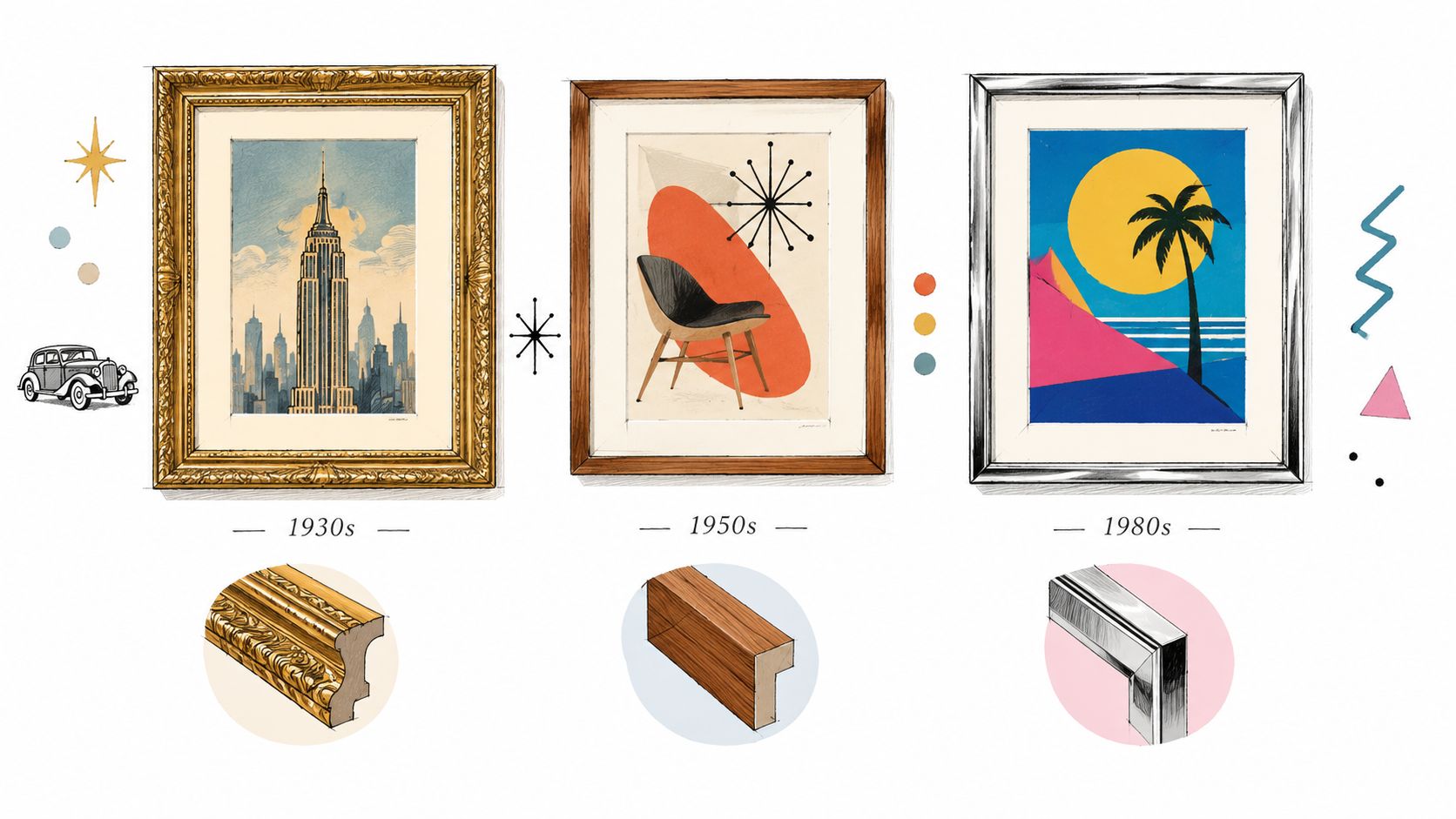
Researching decade categories before buying can also stop a common mistake, choosing a frame that reflects the collector's current interior rather than the poster's own character. The best period styling gives the artwork context while remaining practical to live with.
6. Interactive multi-poster rotating display frames
A rotating display frame is useful when wall space is limited but the collection isn't. Several glass or acrylic panels pivot so that different posters can be shown in sequence, making one installation work harder than a row of permanently fixed frames.
This approach suits a home cinema with changing themes, a collector who wants to display recent acquisitions or a commercial space that refreshes its film material regularly. A tabletop version can sit near a projector or record player, while a securely anchored wall model can become part of the room's permanent architecture.
The principal compromise is handling. Every rotation creates another opportunity for a corner to catch, a panel to shift or a poster to rub against an unsuitable surface. The mechanism must be stable, the glazing must be properly supported and every poster must fit the frame's internal dimensions without pressure.
Plan the rotation before buying
Measure the available wall, shelf or table space carefully. Check the frame's weight, opening method and supported poster formats. Don't assume that a frame designed for one standard sheet will safely accommodate a different format because the outer dimensions appear close.
A monthly, seasonal or quarterly rotation can keep the display engaging, but the schedule should suit how often you interact with the collection. Photograph each displayed title and keep a simple inventory so that posters in storage don't disappear from view.
This method works particularly well for a themed selection from the latest arrivals at Famous Movie Posters. A collector might rotate Marvel titles for one period, move to Star Wars designs later and then feature newly sourced originals without buying another wall full of frames.
A rotating frame saves wall space, but it doesn't remove the need for careful handling. Treat every changeover as a conservation task.
Anchor the unit securely, especially in a home with children or pets. Keep the display away from direct sun and heat, and use protective glazing rather than treating the mechanism as a substitute for preservation.
7. DIY frame assembly with professional conservation guidance
DIY framing can work for a collector who has patience, a clean workspace and a willingness to follow conservation principles. The sensible version isn't a cheap frame, ordinary board and improvised tape. It uses professionally sourced archival materials while allowing the collector to assemble a ready-made or modular system.
Start with an acid-free mount, conservation-grade backing and suitable glazing. UK framing guidance commonly treats 1,400 microns as the minimum mountboard thickness for a conservation-standard frame, with a border of about 5cm around the artwork. Those specifications give the poster breathing room and create a more substantial barrier between the paper and its surroundings.
Know when not to do it yourself
A DIY approach may suit a modern, lower-risk poster or a planned collection where several frames need the same finish. It's less suitable for a rare original with tears, brittle folds, staining, old adhesive or uncertain previous treatment. A framer can identify problems that aren't obvious when the poster is lying flat on a table.
If you proceed, use a flat work surface and practise on a less valuable poster first. A mat cutter, corner clamps and suitable joining tools can improve accuracy, but tools don't replace knowledge of hinging or paper behaviour. Never press an original directly against the glazing because it looks flatter.
The video below can help with general assembly concepts, but it shouldn't replace advice from a conservator when the poster is valuable.
Established conservation suppliers such as Gaylord Archival, University Products and Talas can provide suitable materials, but check every specification rather than assuming that “archival” on a product label guarantees compatibility. Keep photographs of the assembly and record the materials used, so future conservation work doesn't have to begin with guesswork.
8. Statement wall and salon-style asymmetrical arrangements
A salon wall rejects the rigid grid. It uses different frame sizes, finishes and mount widths in an arrangement that feels collected over time, while still relying on careful planning underneath the apparent informality.
This is a strong option for a collector whose posters arrive in different formats and who doesn't want to hide those differences. A large UK Quad can provide the focal point, with smaller sheets and differently proportioned artworks grouped around it. A home cinema might combine 1970s horror, contemporary science fiction and classic westerns, creating a personal film history rather than a single franchise display.
The arrangement should look organic, not careless. Start with the poster that matters most, then place supporting frames around it. Vary wood, metallic and painted finishes, but repeat one or two colours so the wall has a visual thread.
Leave room for the collection to grow
Sketch the arrangement on paper or create paper templates in the actual frame sizes. Test sight lines from the main seating position, and mark the position of radiators, doors and strong sources of light before drilling. Use a level and measuring tape even when the finished pattern is deliberately uneven.
Asymmetry gives you flexibility, but a wall covered too densely leaves no space for future purchases. Keep a gap for the title you haven't found yet, particularly if you're building a franchise collection or using a Request a Poster service.
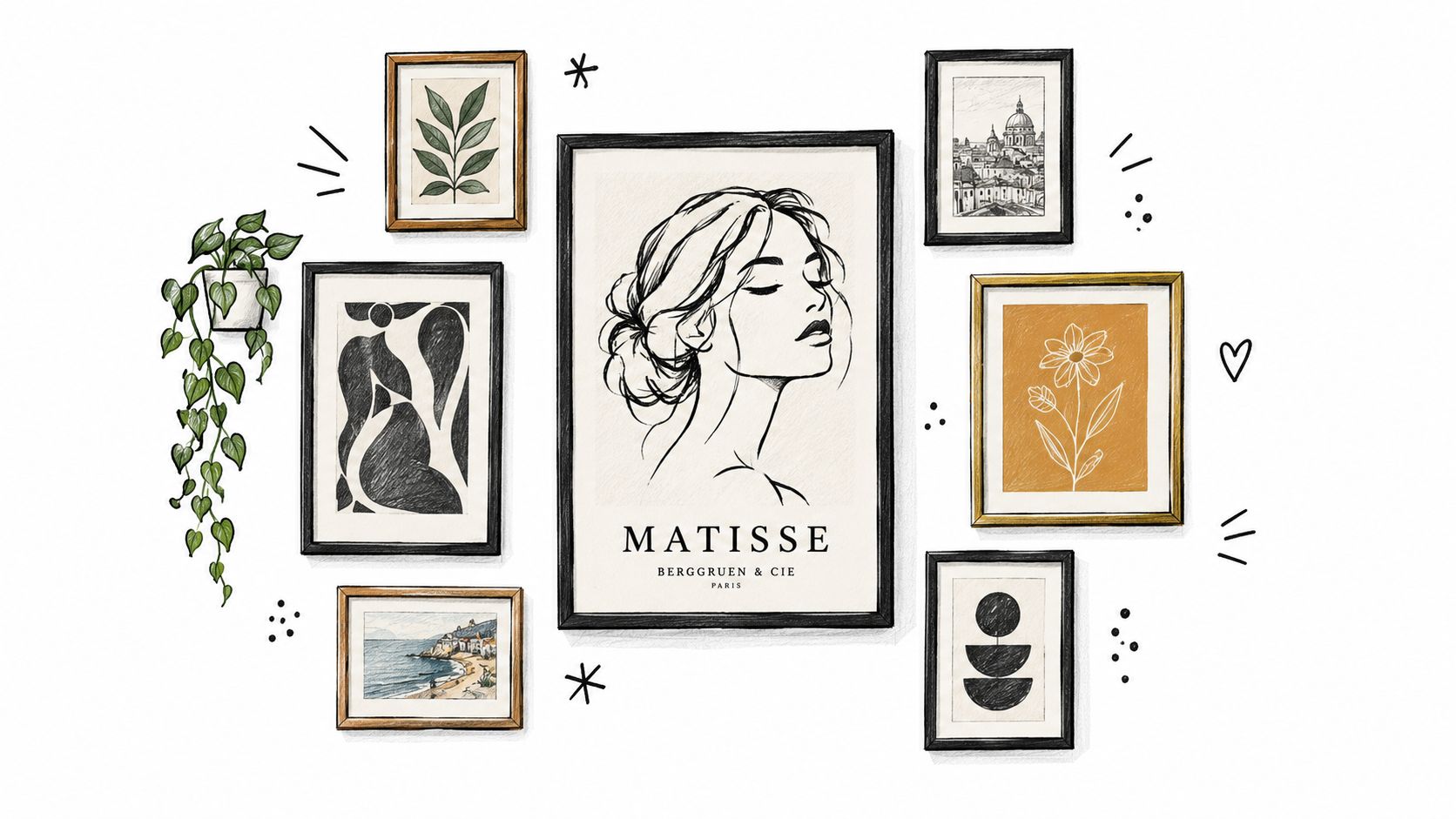
The strongest salon walls balance variety with protection. A statement frame shouldn't justify ordinary glazing, direct sunlight or unsuitable backing. Let the poster sizes create movement, then use professional mounting wherever the paper's condition or value demands it.
8 Poster Framing Ideas, Quick Comparison
| Framing Style | Complexity 🔄 | Resources 💡 | Outcomes ⭐📊 | Ideal use cases | Key advantages ⚡ |
|---|---|---|---|---|---|
| Museum-Quality UV-Protective Framing | High 🔄🔄🔄, specialist conservation methods | Museum-grade glass/acrylic, acid-free mats, certified framers (high cost) | Highest preservation ⭐⭐⭐ · Prevents fading and degradation 📊 | Rare vintage originals & high-value authenticated posters | ⚡Maximises longevity and preserves investment value |
| Minimalist Edge-to-Edge Floating Frames | Medium-High 🔄🔄, precision mounting required | Double-pane glass/acrylic, precision mounts, often UV-protective glass | Strong visual authenticity ⭐⭐ · High display impact 📊 | Iconic modern releases and graphic-focused posters | ⚡Highlights full artwork and original edges |
| Matched-Size Custom Tube Framing Coordination | Low-Medium 🔄, logistical coordination | Custom tubes, acid-free tissue/kraft, documentation for framers | Ready-to-frame arrivals ⭐⭐ · Fewer transit damages 📊 | Collectors ordering multiple titles or Request-a-Poster service | ⚡Reduces handling and speeds framing prep |
| Sector-Specific Thematic Framing Galleries | Medium-High 🔄🔄, planning and consistency needed | Multiple coordinated frames/mats, design planning, wall space | Cohesive gallery impact ⭐⭐ · Thematic storytelling 📊 | Genre, decade, or franchise collections for gallery walls | ⚡Creates unified visual narrative and professional display |
| Vintage Period-Appropriate Frame Styling | Medium 🔄, research and sourcing required | Era-authentic mouldings/finishes, possible bespoke work | Enhanced historical authenticity ⭐⭐ · Contextual display 📊 | Collectors focused on film history and period accuracy | ⚡Reinforces era-specific aesthetics and authenticity |
| Interactive Multi-Poster Rotating Display Frames | High 🔄🔄🔄, mechanical design and secure mounting | Multi-panel mechanisms, sturdy construction, specialised sourcing | Flexible rotating exhibitions ⭐⭐ · Space-efficient display 📊 | Active collectors with limited wall space; commercial use | ⚡Enables frequent rotation and maximises visible titles |
| DIY Frame Assembly with Professional Conservation Guidance | Medium 🔄, skilled, patient DIY work | Archival materials, basic tools, expert guidance (lower cost) | Archive-standard if done correctly ⭐ · Risk if errors occur 📊 | Budget-conscious, detail-oriented collectors | ⚡Significant cost savings and educational experience |
| Statement Wall and Salon-Style Asymmetrical Arrangements | Medium-High 🔄🔄, design sensibility and planning | Varied frames/mats, layout planning, ample wall space | Distinctive artistic presence ⭐⭐ · Evolving display 📊 | Creative collectors, eclectic interiors, home cinemas | ⚡Flexible growth and strong visual personality |
Choose the display that protects the story
The right frame depends on what you're trying to preserve and what you want the wall to say. For a rare original, start with UV protection, suitable board and reversible mounting. A decorative frame can follow, but it shouldn't come first. Valuable or sentimentally important posters may need condition assessment, flattening or paper restoration before they're framed at all.
Choose a floating frame when the poster's edges and printing character deserve attention. Choose period styling when the frame should reinforce the artwork's historical atmosphere. If the collection itself is the feature, a coordinated genre wall, franchise gallery, rotating display or salon arrangement can create more impact than treating every poster as an isolated object.
Confirm whether each sheet is a US One Sheet or UK Quad before ordering. UK Quads measure 30 x 40 inches, or 76.2 x 101.6cm, and became the dominant British cinema poster format after the Second World War. Historical references also distinguish the earlier portrait-oriented “quad crown” from the later **broadside quad” layout. This UK poster-size guide also records the 20 x 30 inch Double Crown, the 80 x 120 inch Six Sheet and the later British One Sheet at 27 x 40 inches.
Those distinctions affect orientation, mount proportions and the amount of wall space you need. Older quads were factory folded until the 1980s, while more recent releases are often rolled, so don't assume that two posters of similar visual size have the same handling history. UK cinema poster format guidance explains why custom sizing is often more practical than forcing an original into an off-the-shelf frame.
Measure the actual artwork, not just the nominal format. Keep the finished piece away from direct sunlight, bright artificial light, radiators and cold, poorly insulated walls. Standard float glass provides basic protection, but UK framing materials guidance notes that it can allow as much as 50% of harmful UV rays through, which is why preservation framing should use suitable UV-filtering glazing for valuable posters.
Budget matters, but the cheapest visible frame can be the most expensive mistake if it damages an original. Bespoke framing for a standard 27 x 41 inch poster is cited as starting at around £150 in the UK market, with size and specification affecting the final choice and cost. This professional UK framing guide provides useful context for planning that conversation with a framer.
Use Famous Movie Posters' format guidance, framing collection and authenticated catalogue as your starting point. Check the poster's condition, decide whether the wall is suitable and brief the framer with the exact measurements before buying materials. When the poster is rare, fragile or valuable, professional conservation is a sensible part of the display rather than an optional extra.
Famous Movie Posters offers guaranteed original film posters across US One Sheet, UK Quad and other formats, alongside framing guidance, purpose-designed packaging and a Request a Poster service. Browse the Famous Movie Posters catalogue by decade, genre or franchise, then choose a display approach that protects the poster and gives your collection room to grow.