



You've finally found the original film poster you wanted. It arrives carefully rolled or stored flat, you inspect the colours and edges, and then the practical question appears: should you put it in a standard shop-bought frame, or hand it to a specialist? With an original, the frame isn't just a border. It becomes part of the poster's storage environment.
A good poster framing service should continue the same careful handling used before purchase, during storage and in transit. The aim is to keep the artwork stable, separated from harmful materials and protected from avoidable light, dust, moisture and physical pressure. The finished piece should look right on the wall, but appearance is only one part of the job.
Table of Contents
- Why Framing an Original Poster Deserves More Thought Than a Standard Print
- What a Poster Framing Service Actually Covers
- How the Process Works From Submitting to Handover
- Archival Materials and Protective Layers Used in Quality Framing
- Turnaround Times and What Drives the Price
- Choosing the Right Level of UV Protection for Your Poster
- How Famous Movie Posters Handles Framing for Originals
- Practical Next Steps for Getting Your Poster Framed
Why Framing an Original Poster Deserves More Thought Than a Standard Print
A 1970s British Quad can arrive with a crease along the fold, softened corners and colour loss at the edges. Its value comes from being an original, not from being flawless. Put it straight into a generic frame with ordinary backing and little separation from the glazing, and you may turn existing weaknesses into permanent damage.
Some problems take time to appear. Acidic board can contribute to paper browning, while light can accelerate fading in inks that have already spent decades exposed to cinema displays, storage conditions and handling. Adhesive tape, unsuitable mounts and pressure against the glass can also leave marks that were not present when the poster was framed.
An original film poster is a historical document as well as a display piece. A reproduction can be replaced if its surface is damaged. An original may have no practical substitute, and restoration can be costly, limited or impossible without changing the character of the item.
The market context matters
The UK picture frame market is projected to generate roughly £400–500 million in retail sales in 2026, with annual unit consumption likely between 60–80 million frames, more than 80% of units manufactured abroad, and e-commerce and social commerce accounting for around 35–40% of UK photo frame sales, according to UK picture frame market analysis. That scale supports a wide range of inexpensive standard frames, but availability does not make every frame suitable for a collectible poster.
Online ordering and made-to-size services make framing easier to arrange without visiting a workshop. They also place more responsibility on the buyer. Before approving a remote order, confirm the board specification, mount design, glazing, mounting method and how the poster will be protected during delivery.
The framing choice should continue the archival handling already used by a reputable seller. If the poster was stored away from damaging materials and packed to limit movement, its frame should provide the same level of care as the final stage of that preservation chain. A low-cost frame can be reasonable for a sturdy decorative print. An original with fragile folds, previous repairs or sensitive inks deserves more careful materials and construction.
Practical rule: Treat framing as the final stage of preservation, not as a decorative purchase made after preservation has finished.
The UK industry is mature and highly competitive. That helps explain the spread of low-cost offers, but price alone does not show what has been omitted. Compare the specification, not just the moulding or finished appearance. Savings may be sensible on a simple frame profile, while backing, separation from the glazing and a suitable mounting method deserve closer attention.
What a Poster Framing Service Actually Covers
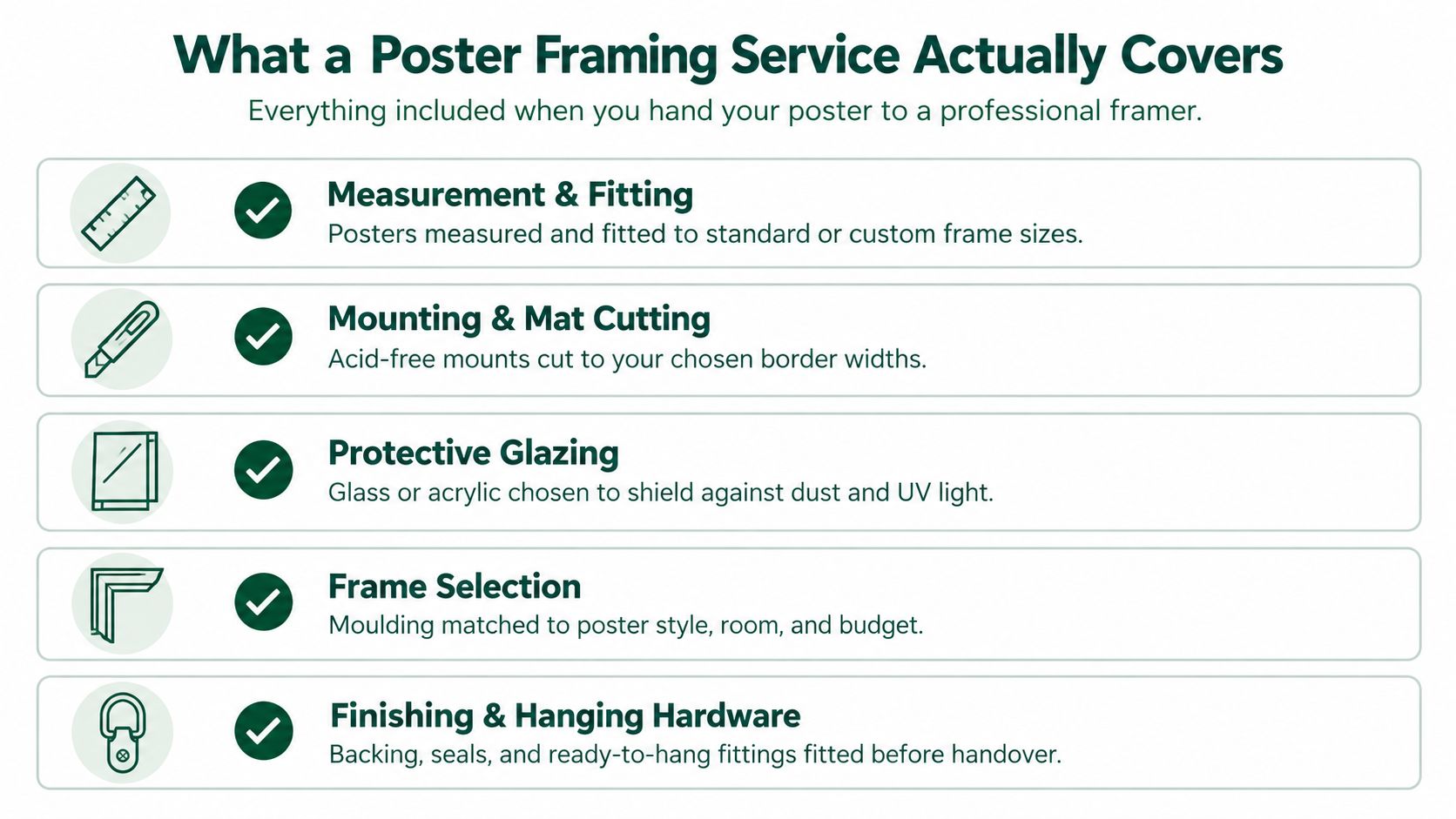
A professional service starts by examining the poster rather than assuming that its advertised format tells the whole story. The framer checks the actual height, width, border condition, fold position, paper tension and any previous repairs. A British Quad, a US One Sheet and a modern custom print may all be called posters, but they don't necessarily need the same frame depth, orientation or mount treatment.
The service should then give you choices that connect directly to the poster's condition and intended location. Those choices usually include the moulding profile, mount colour and width, glazing, backing board, mounting technique and hanging hardware. You're not just selecting a frame from a shelf. You're agreeing how the artwork will sit inside a protective enclosure.
The decisions that matter most
A specialist should explain the difference between dry-mounting and a reversible method such as archival hinging or corner mounting. Dry-mounting fixes the poster to a substrate, which can flatten some items but may permanently alter an original. For a collectible whose future resale or conservation matters, a reversible approach is usually the safer discussion to have.
The mount also does more than create a visual border. It can keep the poster away from the glazing, accommodate slight irregularities and give the paper room to sit without being crushed. A narrow mount may suit a clean contemporary display, while a deeper border can provide more breathing space around a folded or fragile original.
A full service may include:
- Assessment and measurement: The poster is checked in person or against accurate supplied measurements before the frame is ordered.
- Specification advice: The framer matches board, glazing and mounting choices to the poster, room and budget.
- Workshop assembly: The frame is cut, joined, glazed, backed, sealed and fitted with suitable hanging hardware.
- Collection or delivery: The finished piece is handed over securely or returned using a service appropriate to its size and value.
That is a different experience from buying a ready-made frame and forcing a poster into it. A shop frame may be perfectly adequate for a replaceable print in a dim room. It doesn't automatically provide the space, materials or mounting control an original requires.
How the Process Works From Submitting to Handover
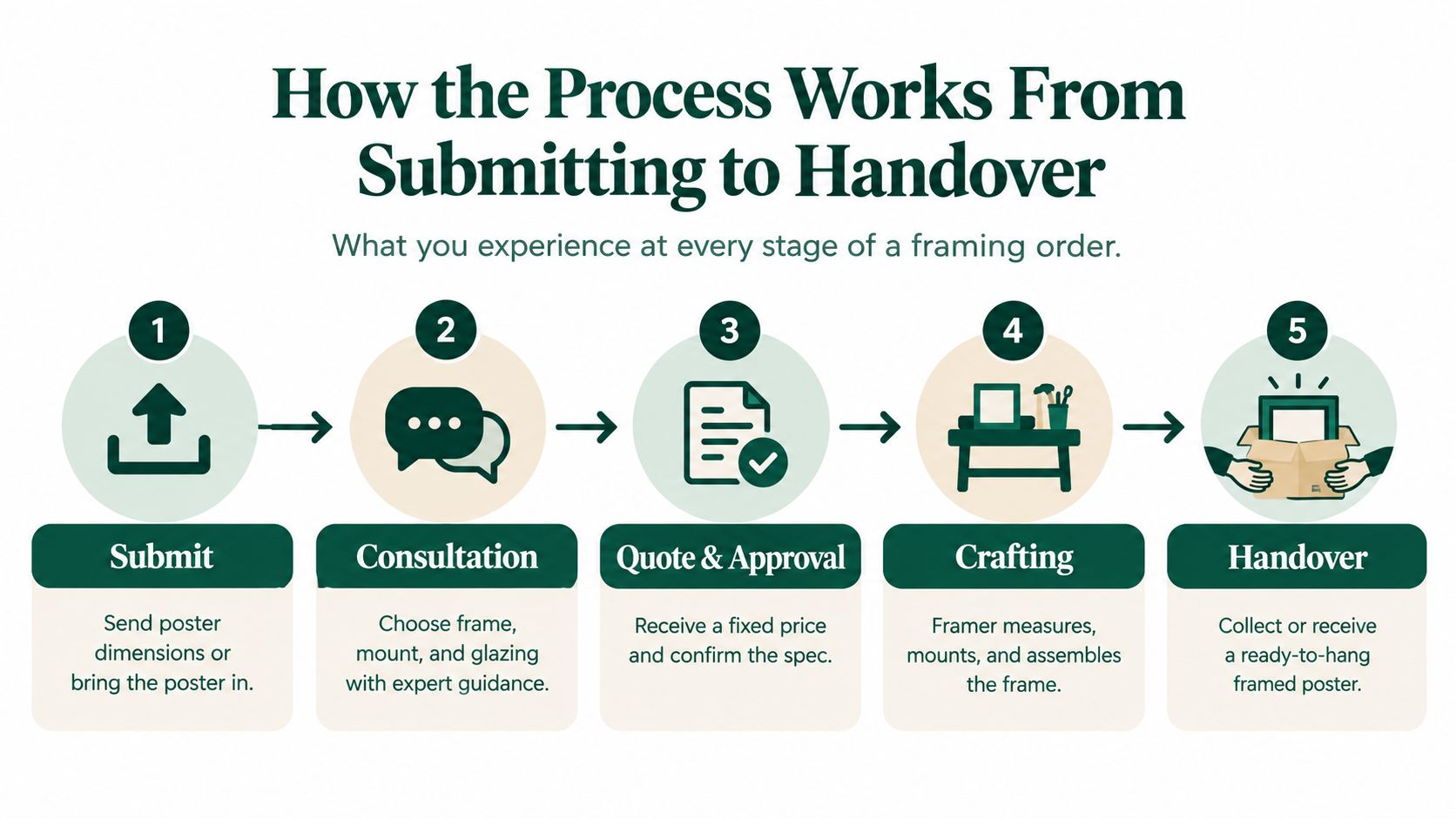
The first contact should be straightforward. You can normally submit the poster's dimensions, photographs and condition details, or bring the artwork to a workshop for inspection. Include images of the front, back, corners, fold lines and any writing or tape. A framer can make better recommendations when the condition is visible before the quote is prepared.
The consultation is where format confusion gets resolved. A British Quad measures 30 x 40 inches, or 762 x 1016 mm, and is typically horizontal, while a UK or US One Sheet measures 27 x 40 inches, or 685.8 x 1016 mm, and is portrait, as shown in this poster size reference. These proportions are different enough that a generic 30 x 40 frame may be unsuitable for a One Sheet, even if the names sound interchangeable.
What happens after approval
Once the dimensions and intended presentation are confirmed, you'll choose the moulding, mount, glazing and backing specification. This is also the point to agree whether the poster will be hinged, held with corners or treated in another way. If the item needs flattening, cleaning or minor conservation work, that should be identified and priced before assembly begins.
The quote should describe the actual specification rather than say “framed”. Check whether it includes UV-filtering glazing, an acid-free mount, a backing board, spacers, sealing and hanging fittings. If you're using a courier, confirm who arranges collection, how the poster is protected before workshop handling and whether return delivery is insured.
During construction, a careful workshop checks the cut dimensions, mount alignment, glazing cleanliness and poster position before sealing the frame. Some services send a photograph or progress message at the approval stage, particularly where the mount width or frame profile is a matter of taste.
At handover, inspect the front and back. Look for dust trapped beneath the glazing, movement inside the frame, a mount that sits squarely and secure fittings appropriate to the finished weight. If the poster is being returned by courier, keep the packaging until you've inspected the item fully. Guidance on handling a damaged delivery recommends photographing the outer packaging, item, tracking details and courier notes, while retaining the box, labels and damaged components during an investigation.
Archival Materials and Protective Layers Used in Quality Framing
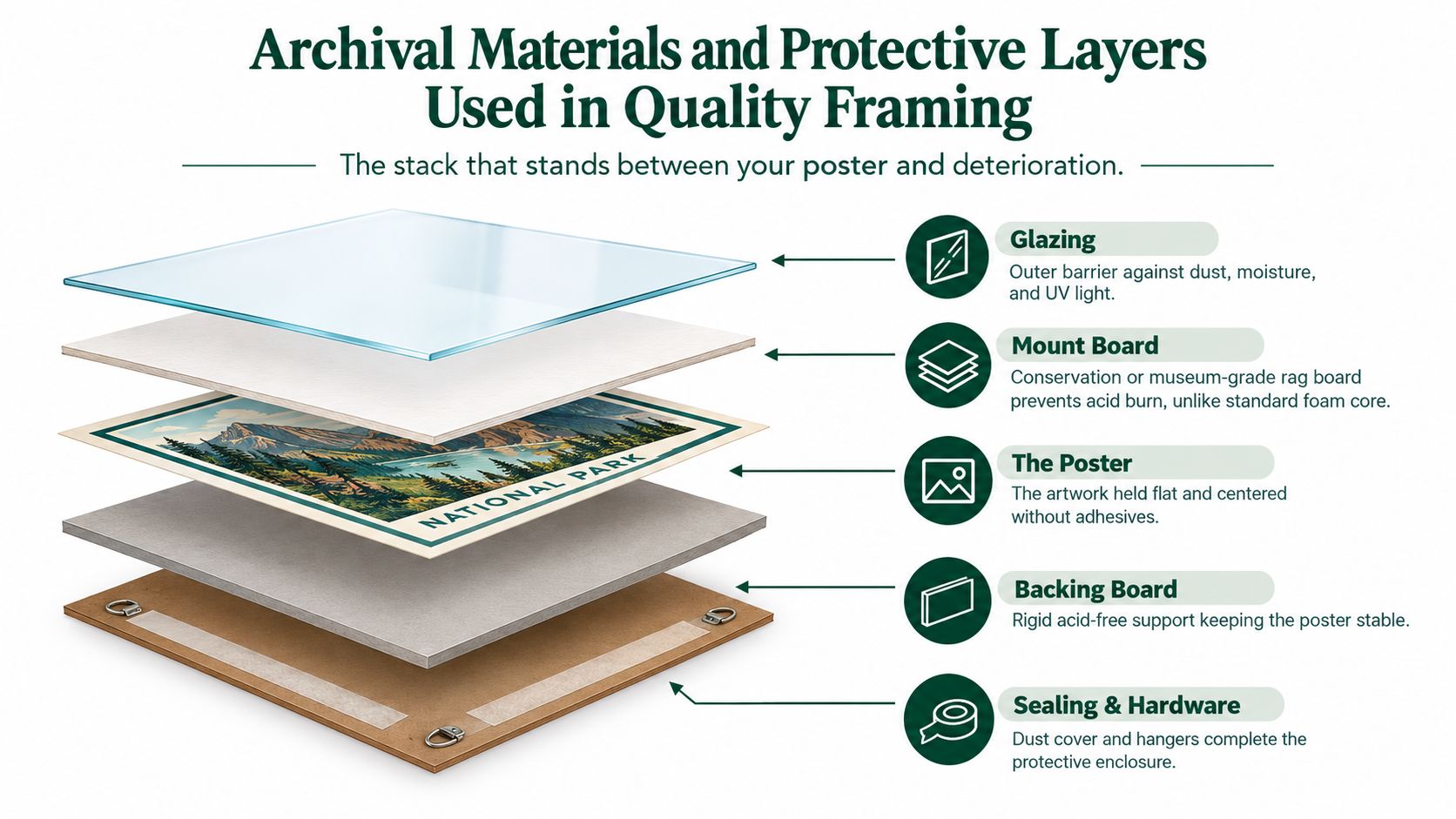
Quality framing works as a layered system. Each component has a different job, and upgrading one layer doesn't compensate for neglecting another. Museum glazing cannot correct an acidic board touching the poster, and an excellent mount cannot protect colours from strong ultraviolet exposure if the glazing offers little filtering.
The first question is what touches the artwork. Conservation framing uses acid-free, lignin-free mount boards, conservation backing and reversible methods intended to reduce acid migration. Cotton or rag-based museum boards are commonly alkaline-buffered with calcium carbonate, helping maintain a more stable pH inside the enclosed frame.
What each layer is protecting against
Mount board creates a stable, clean surface and provides visual separation. Standard foam core may be acceptable for temporary display, but original paper deserves a board designed to reduce chemical transfer.
Hinges or corner mounts hold the poster without spreading adhesive across its surface. The method should allow the paper to respond naturally to changes in the room rather than trapping it under tension.
Spacers prevent the artwork from touching the glazing. That gap reduces the risk of direct contact, condensation transfer and pressure marks, particularly when the poster has a slightly uneven surface.
Backing board adds rigidity and helps limit dust and environmental movement from the rear. A sealed dust cover and properly closed joins complete the enclosure, although a frame is not a substitute for sensible room placement.
The conservation specification should be written down before approval. Ask whether the board is acid-free and buffered, whether the mounting method is reversible, whether spacers are included and whether the glazing is standard, UV-filtering or museum-grade.
For a useful overview of how framed pieces are handled during transport, see this guide for framers and movers. It's particularly relevant to large Quads, where the completed frame needs protection from flexing, impact and poorly supported handling.
Collectors who want to compare the mounting principles in more detail can also read this poster framing guide. The important point is that the visible frame is only the outermost part of a controlled stack.
Turnaround Times and What Drives the Price
A framing quote reflects more than the timber or moulding. Workshop availability, the poster's dimensions, the selected glazing and the time needed to check and mount a fragile original all affect the final schedule. A straightforward standard-size order may move quickly, while a large format with conservation materials, special glazing or a non-standard moulding needs more planning.
The most reliable way to avoid surprises is to approve a written specification. Confirm the mount colour, border width, moulding, backing, glazing type, mounting technique, collection arrangements and return delivery before work starts. If the quoted price changes later, you should be able to identify which choice caused it.
| Specification | Effect on Turnaround | Effect on Price |
|---|---|---|
| Standard moulding in stock | Usually keeps workshop preparation simple | Often the more economical option |
| Custom or scarce moulding | May require ordering before assembly | Adds material and ordering cost |
| Large-format poster | Requires more space, handling and checking | Uses more framing and glazing material |
| Conservation mount and reversible mounting | Needs careful preparation and alignment | Costs more than basic board and adhesive mounting |
| Standard glazing | Usually easy to source and fit | Lower-cost option |
| UV-filtering or museum-grade glazing | May require specialist stock and careful handling | The premium reflects protection, clarity and material performance |
| Courier collection and return | Adds packing and scheduling requirements | Delivery, insurance and protective packaging may be charged separately |
Budget for the specification, not the label
A frame described as “conservation” should come with details. UK guidance places conservation framing at roughly £45 for a small item to more than £300 for large or complex pieces, and notes that visible fading can occur in as little as 24 months in bright rooms, as discussed in this collector's framing guide. Those figures are useful context, not a universal price list.
The cost of a large Quad can rise because of glazing area, frame depth, transport risk and the need for stronger hanging hardware. Acrylic may reduce weight compared with glass, but museum-grade acrylic costs more than basic acrylic. A custom mount with generous borders also uses more board and takes longer to cut.
If you're comparing quotes, use the poster framing cost guide as a starting point, then ask each framer to quote the same specification. That gives you a meaningful comparison instead of choosing between incomplete descriptions.
Choosing the Right Level of UV Protection for Your Poster
A poster displayed in a dim study has different glazing needs from one facing a bright hallway. The right choice depends on the room, the artwork's value and condition, and how much weight the finished frame can carry. Glazing is the main material decision because it affects both protection and viewing comfort.
Standard glass may suit a low-light room where the poster sits well away from windows. Clear glass should not be treated as conservation protection just because it looks clean. UK framing guidance states that standard float glass blocks only about 45% of UV, while museum-grade glazing blocks about 99%, as detailed in this conservation framing guidance. Conservation glazing can also reduce reflections, which helps when the frame faces a window or sits beneath strong room lighting.
Four practical choices
Standard glass provides familiar clarity and a substantial feel, but it is heavy and offers limited UV filtering. It can work for a lower-value reproduction or an original displayed in controlled, subdued light.
Standard acrylic weighs less and resists shattering. That can matter with a large frame, a busy household or delivery over a long distance. Basic acrylic scratches more readily and may provide limited UV protection, so check the exact product specification rather than relying on the word acrylic alone.
UV-filtering acrylic balances lighter glazing with improved protection. It suits a valuable poster where weight or breakage risk matters. Ask whether the chosen product also has anti-reflective and scratch-resistant properties, since those features are not automatic.
Museum-grade acrylic or conservation glass suits irreplaceable originals, bright rooms and collectors who want strong protection with clear viewing. Harten's guidance describes Tru Vue Museum Glass as blocking 99% of UV, transmitting 97% of visible light and keeping reflectance below 1%, as detailed in its linked conservation guidance.
Choose the specification according to the display conditions:
- Dim study: Standard glazing may be reasonable when exposure is low and the budget is tight.
- Bright hallway: UV-filtering glazing is easier to justify where indirect daylight reaches the wall.
- Large or difficult-to-handle frame: Acrylic reduces breakage risk and can be easier to move.
- Rare or irreplaceable original: Museum-grade glazing makes sense because replacing the artwork is not a realistic fallback.
If the chosen wall receives more than two hours of direct daylight a day, treat UV-filtering or museum-grade glazing as the minimum specification. Anti-reflective glazing can also justify its extra cost without direct sunlight. It reduces room reflections across dark areas of a film design, making the poster easier to view from different angles.
For oversized pieces, allow enough clearance around the frame and specify hanging hardware that supports the actual finished weight. The glazing choice should form the final stage of the same careful preservation chain used for storage and shipping, not an isolated decorative upgrade.
How Famous Movie Posters Handles Framing for Originals
The retailer's framing approach follows a useful principle: the poster should not move from careful storage into careless display. Originals are stored in PAT-tested flat file boxes with a calcium carbonate buffer, and premium items are protected in acid-free polyester pockets. That preparation reduces unnecessary handling before the artwork reaches a buyer or workshop.
Posters are also shipped in purpose-designed tubes matched to US One Sheet and UK Quad formats, with acid-free tissue and kraft paper. A poster can be protected properly in storage and still be damaged by a poor shipping method. The tube, internal wrapping and handling process form part of the same preservation chain as the mount and glazing.
What happens at the framing stage
Before framing, the poster should be surfaced for inspection so the framer can check folds, edge wear, old repairs, stains and any signs of previous adhesive. The correct treatment depends on condition. A stable poster may be held with archival hinges or corner supports, while a more delicate or already treated item may need a fully considered sealed package.
The framing options described by the retailer's framing service allow buyers to arrange presentation alongside the poster purchase. The frame is handmade in the UK, with the final specification determined by the selected frame, mount, glazing and any conservation upgrades. Buyers should still confirm exactly what is included, particularly the glazing type and mounting method.
The important distinction is that framing isn't treated as a separate decorative add-on. Storage, inspection, packing and display all need to work together. If an original has been kept flat, protected from unnecessary contact and shipped in suitable materials, the frame should preserve that care rather than introduce an acidic board, adhesive or poorly controlled pressure.
A framed poster still needs sensible placement after handover. Avoid direct sunlight, external-wall damp and radiators, and leave enough clearance for the frame to sit securely without being knocked. The best materials can slow deterioration, but they can't make an unsuitable wall location harmless.
Practical Next Steps for Getting Your Poster Framed
Start with the artwork, not the frame. Before requesting a quote, work through these decisions in order:
- Confirm authenticity: Establish whether you own an original or a reproduction. An original deserves a more careful conversation about reversibility, board quality and glazing.
- Measure accurately: Record the height and width, including the visible paper border. Don't rely only on terms such as Quad or One Sheet.
- Check the condition: Photograph fold lines, corners, stains, writing, tape and previous repairs. Tell the framer what you know about storage and handling.
- Choose the mount purposefully: Use the mount to create separation, improve presentation and accommodate the poster's condition. Don't choose a narrow border solely to reduce the frame size.
- Decide on glazing: Match the protection to room light, poster value, handling risk, weight and budget. Ask for the actual UV specification rather than accepting “protective glass” as a description.
- Agree the timing: Confirm whether the moulding is available, whether conservation work is included and when collection or delivery will take place.
- Read the final specification: Make sure the quote names the frame, mount board, glazing, backing, mounting method, sealing and hanging hardware.
At handover, inspect the poster before disposing of its packaging. UK consumer guidance says removing packaging to inspect goods isn't normally the same as using them, while visible scuffing, bending or other handling damage can affect refund outcomes under the Consumer Contracts guidance.
Finally, photograph the completed frame from the front and record its condition, specification and purchase details for your insurance records and future resale file.
Famous Movie Posters offers guaranteed original film posters, protective storage and framing options that carry the same preservation thinking through to display. Visit Famous Movie Posters to explore original UK Quads and One Sheets, review framing support and choose a poster that can be handled carefully from purchase to wall.