



You've found a Wall-E poster you like, the price looks fair, and the seller calls it an original. Then it arrives, you unroll it on the kitchen table, and you're not sure what you're holding. The paper feels glossy, the size doesn't match the frame you bought, and the small print at the bottom could mean anything. That uncertainty is normal with Wall-E posters, and it's exactly where new collectors lose money. Treat format, authenticity and condition as your starting point, rather than artwork or auction-room talk, and this becomes a straightforward, enjoyable category to collect.
Table of Contents
- Why Wall-E Posters Catch Collectors Out
- The Main Wall-E Poster Formats Explained
- Spotting Originals Versus Reprints
- Displaying Originals Safely at Home
- How Rare Wall-E Posters Actually Are
- Where UK Collectors Source Wall-E Posters
- A Short Checklist Before You Buy
Why Wall-E Posters Catch Collectors Out
A buyer messages a dealer with a photo of a rolled Wall-E poster bought online. The image is right, Wall-E looking up, colours bright, size roughly poster shaped. The question is always the same, is this theatrical? Sometimes the answer is yes. Often it's a later retail reprint sold for bedroom walls, a home video promo, or a reissue piece that a listing described too loosely.
That confusion isn't carelessness. Wall-E looks like a modern blockbuster, so people expect modern distribution, identical prints everywhere and plenty of stock. In practice, its 2008 theatrical campaign still used traditional paper formats that varied by country, and those formats weren't produced for the public to buy. A cinema received what its distributor sent for display, used it, and then returned, stored or discarded it.
The Same Image, Different Objects
Two posters can carry identical artwork and be completely different collectables. A US One Sheet printed for North American cinemas, a UK Quad printed for British cinemas, and a retail print produced years later for shops don't share paper, purpose or value, even if a phone photo makes them look alike. Size, credits and printing separate them, not the picture.
New buyers also trip over condition language. Rolled sounds better than folded, and mint sounds best of all, but neither word proves originality. I've seen crisp, rolled reprints described with more confidence than honest theatrical pieces that carry light edge wear from actual display. Wear can support a story. It doesn't tell the whole story.
Practical rule: Name the format before you judge the price. If you can't name it, you can't value it.
Character posters and teasers add another layer. A seller may list a Wall-E and Eve character piece alongside the final theatrical design as if they're interchangeable, when they served different stages of the campaign and attracted different buyers. Without that context, rarity claims become guesswork.
Why It Matters Beyond Price
Getting this wrong affects more than resale. Buy the wrong format and your frame won't fit. Buy a reprint expecting an original and you've paid for scarcity that doesn't exist. Buy an original framed badly and you'll damage the very thing you paid extra to own.
Wall-E rewards a calmer approach. It's a well loved Pixar title with strong, graphic artwork that works on a wall, and original material remains accessible compared with older classics. You don't need speculation to justify a purchase. You need to know which country's release you want, how to verify it, and whether its condition matches how you plan to display it. Answer those three points and most listings sort themselves quickly.
The Main Wall-E Poster Formats Explained
Format tells you where a poster was meant to be used. Start there, and nationality, size and framing fall into place. If you're comparing listings, this guide to the difference between a One Sheet and a Quad movie poster sets out the two formats UK buyers meet most often.
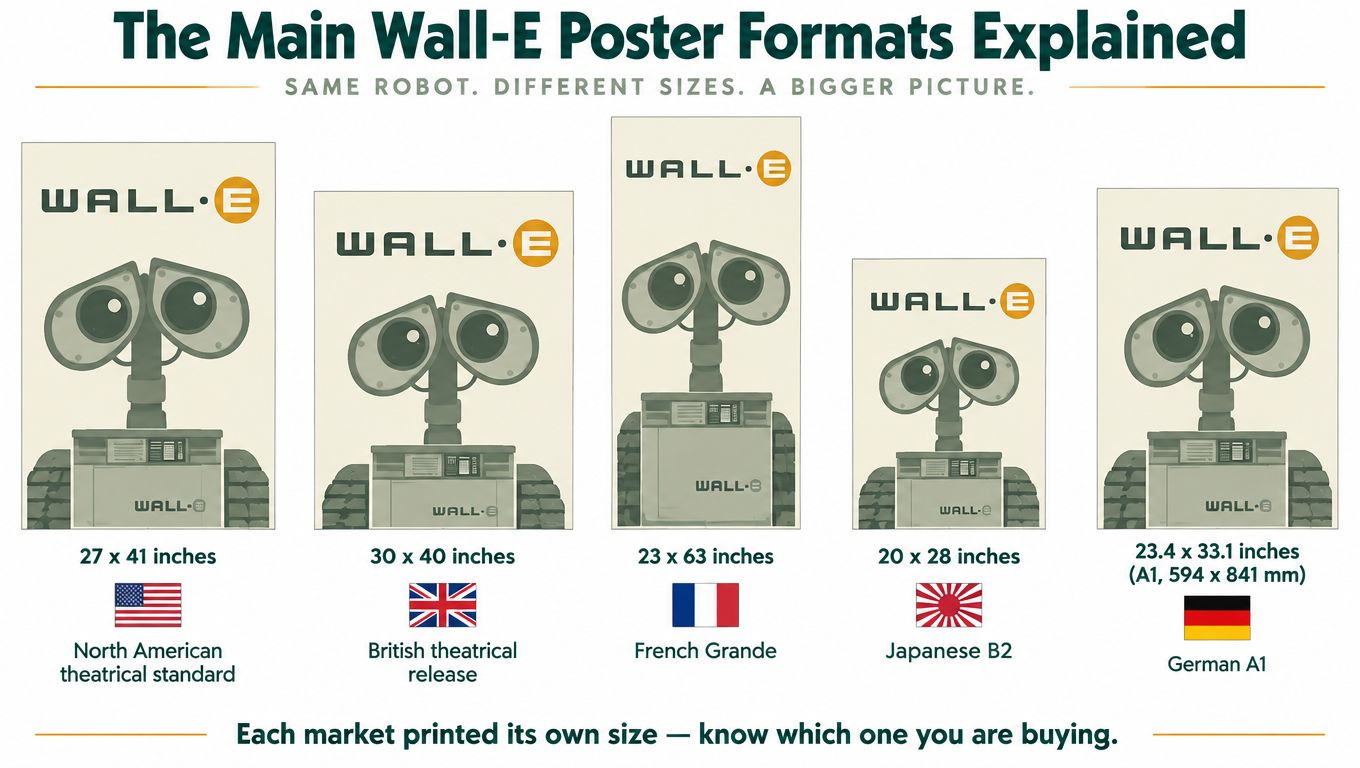
US One Sheet
The US One Sheet measures 27x41 inches and stands vertical. It's the North American theatrical standard, also used widely for international and video campaigns. For Wall-E, this is the format many overseas listings default to, and it's the one that pairs naturally with US framing sizes.
Teaser and advance One Sheets came before the final design. A teaser sells a mood, a character or a date, often with minimal billing, because its job was early awareness. The final theatrical version carries fuller credits and release information. That sequence matters, since collectors often prefer the cleaner teaser image even though the final sheet represents the release itself.
UK Quad
The UK Quad measures 30x40 inches and sits horizontally. It's been the British cinema standard since the Second World War, so a UK release of Wall-E exists primarily as a Quad rather than a domestic One Sheet. Rotating a One Sheet design into horizontal orientation often meant recomposing artwork, which is why Quads sometimes crop or rebalance an image differently.
For a UK buyer, that local connection counts. A Quad is what British audiences saw in cinema cases, and its proportions work well above a sofa or sideboard. A One Sheet, by contrast, suits a hallway or a narrower wall where height helps. Neither is automatically better. They're artefacts of different markets.
- Character posters: Individual designs for figures such as Wall-E and Eve, produced to build recognition and often collected as a set.
- Advance banners and larger display material: Made for foyer impact rather than standard cases, so storage and framing costs rise quickly.
- Retail prints: Commercial reproductions sold to the public, useful decoration but not theatrical originals.
International Variants You'll Meet
Other markets printed to their own traditions. French, Japanese and German Wall-E posters use different sizes, paper and language, and sometimes different artwork choices. That variety appeals if you collect by design rather than by country of release, but it can also disguise a mislabelled listing if a seller converts measurements loosely.
Measure the sheet itself, edge to edge, and compare it with the claimed format. Don't rely on a seller's rounded description or a frame size. A small discrepancy may be trimming, a different country's issue, or a reproduction printed to fit a standard shop frame. Once you know which format suits your wall and your collecting aim, you can ignore the rest without missing anything important.
Spotting Originals Versus Reprints
Appearance alone won't settle authenticity. Reproductions copy artwork well, especially Pixar artwork that's already clean and digital in feel. You need to read the physical object, starting at the bottom and working outwards, and compare like with like.
Read the Bottom of the Sheet
The credits block should make sense for a 2008 theatrical release. Studio and distributor names, billing, copyright lines and rating information should match the market the seller claims. Text that's blurred, cropped or oddly spaced often points to a copy made from another copy.
Look for printer or distributor information in the margins, including NSS information on relevant US material and local distributor imprints elsewhere. Presence alone isn't proof, because reprints can copy text, but missing or incorrect details are a warning. Check alignment too. On theatrical offset litho printing, small type stays sharp under a magnifier. Many digital reproductions soften, pixelate or turn fine lines muddy.
- Credits and copyright: Do names, dates and ratings fit the claimed release and country?
- Printer marks: Are edge markings, colour bars or distributor details present and crisp?
- Image quality: Does magnification show clean litho dots, or digital fuzz and banding?
Paper, Finish and Handling Clues
Original theatrical paper has a specific weight and finish intended for short term display, not heavy retail gloss designed to look premium in a shop. That doesn't mean every original feels flimsy, or every glossy poster is fake. It means you compare the stock with a known example of the same format, instead of trusting a general impression.
Fold lines can support a theatrical history on formats that were shipped folded, while rolled examples also exist. Don't treat either state as a verdict. Sellers sometimes present folds as automatic proof, which overstates the evidence. Look instead for consistency, folds that match how that format travelled, handling wear that matches the claimed storage, and edges that haven't been trimmed to hide reproduction margins.
A poster shouldn't need a colourful story when its measurements, credits and printing already agree.
Age cues are subtler on a 2008 title than on a poster from the 1960s. You won't get the same smell or toning you'd expect from much older paper, and artificially aged reprints exist anyway. Slight plate misalignment can appear on litho printing, but spotless registration doesn't condemn a modern poster either. Use each clue as one vote, not a deciding ballot.
When to Ask for More
Ask for full sheet photographs, front and back, plus close ups of all four corners and the credits. A serious seller expects those requests. If photos cut off margins, measurements are vague, or the listing swaps between original, replica and style language, walk away. Wall-E material isn't so scarce that you need to gamble on a reluctant seller. A clear no is better than an hopeful maybe that you later have to explain to the next buyer.
Displaying Originals Safely at Home
Most damage to Wall-E posters happens slowly at home, not in transit. Light fades, damp cockles paper, and cheap framing traps both against the sheet. You don't need museum conditions, but you do need a sensible baseline and a wall that suits it.
For works on paper on domestic display, Art UK preventative conservation guidance recommends light levels at no more than 50 to 80 lux because light bleaches pigments and discolours paper over time. In plain terms, avoid direct sunlight, don't spotlight an original like a shop display, and use UV filtering glazing or acrylic where a room is bright.
A Workable Home Baseline
Home display baseline for original paper posters
| Factor | Target range | Why it matters |
|---|---|---|
| Light | 50 to 80 lux maximum | Limits bleaching and paper discolouration |
| Relative humidity | Roughly 40 to 60 percent | Reduces mould risk and drying or cockling |
| Wall choice | Dry internal wall | Damp external walls trap moisture behind frames |
Humidity deserves the same attention as light. Keep a simple hygrometer in the room and aim for roughly 40 to 60 percent relative humidity, with stability mattering more than chasing a perfect number. Avoid bathrooms, kitchens and damp external walls, and leave a small air gap behind the frame so moisture isn't held against the backing.
Framing Choices That Protect Paper
Use acid free mounts and backing, and don't let the poster touch glazing directly. A mount or spacer creates separation and gives the paper room to respond to normal room changes. Never use adhesive tape, Blu Tack or dry mounting on an original. Those shortcuts may keep a retail print flat, but they'll stain, tear or permanently alter a collectable sheet.
If you need to rotate pieces or move house, the logic in these safe artwork moving tips from Sydney removalists is useful, keep framed work upright, protected at the corners, and separate from anything that can press into the surface. Back at home, rotation helps because light damage builds up over total exposure, not just brightness on one day. Rest a valuable piece in proper storage for part of the year rather than leaving it under constant light.
For pieces off the wall, this FAQ on how to store your movie posters covers flat storage and protective sleeves in practical terms. Store flat where you can, handle by the edges with clean hands, and keep tubes for transport rather than long term storage. A poster that's been rolled tightly for years will fight a framer and stress its own fibres.
Choose the room before you choose the frame. A dim hallway with a modest frame will preserve an original better than a sunlit living room with expensive glazing. That's the trade off collectors sometimes miss. Display is the point of owning the thing, but the right wall lets you enjoy it without shortening its life.
How Rare Wall-E Posters Actually Are
Wall-E sits in a middle ground that's often misread. The 2008 worldwide theatrical push was major, so common formats aren't scarce in absolute terms. At the same time, not every Wall-E poster for sale is a theatrical original, and clean originals are less plentiful than general listings suggest.
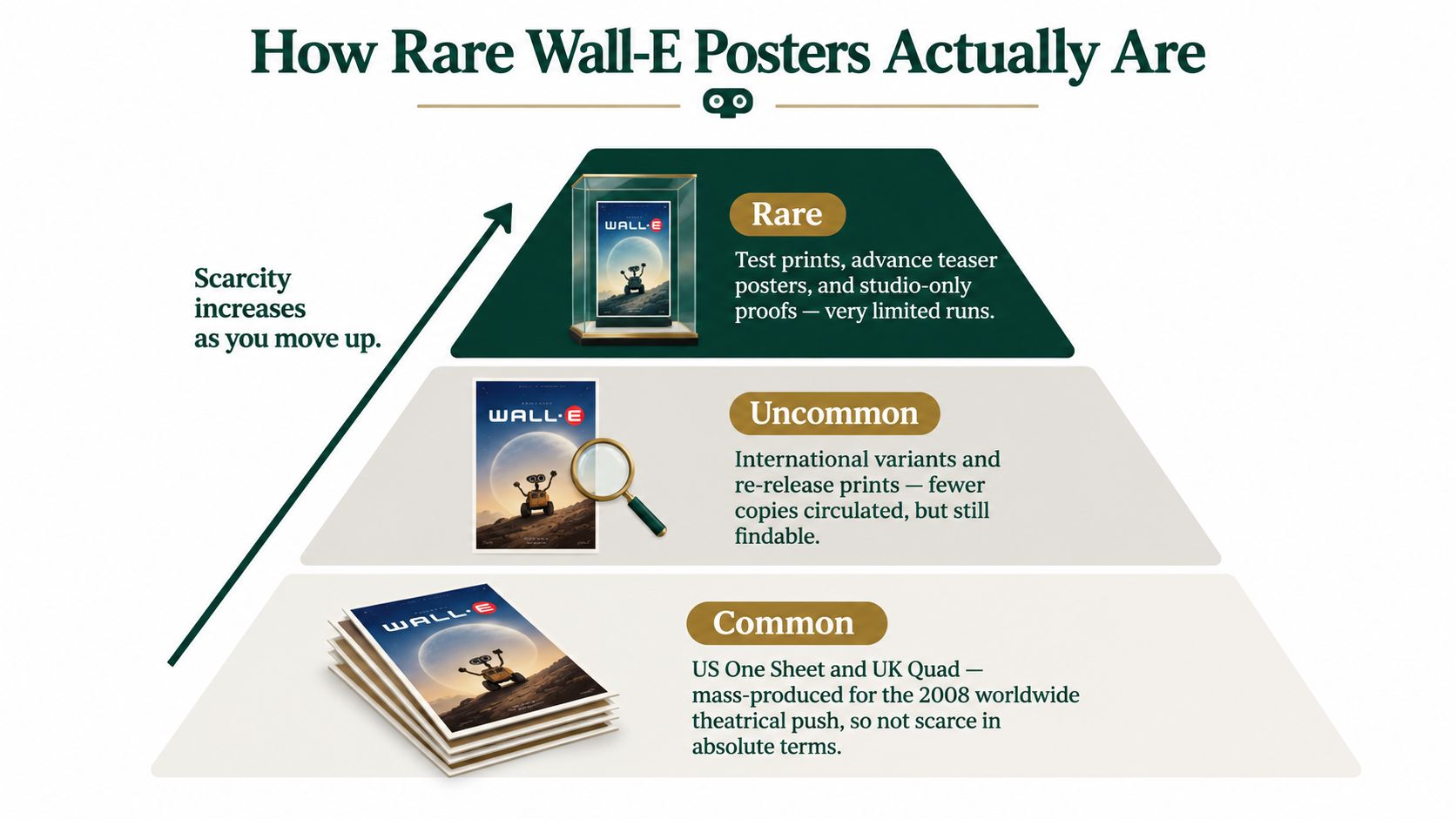
Common, Uncommon and Genuinely Hard to Find
At the broad base sit the US One Sheet and UK Quad in their final theatrical designs. A patient UK buyer should expect to find these without heroic effort, although condition will vary. Rolled, unfolded examples with sharp corners attract more interest than sheets with pinholes, tape marks or fading from cinema light boxes, and that condition gap matters more than a seller's rarity language.
International variants and later re-release prints sit above that base. Fewer copies circulated in the UK, and language or artwork differences narrow the buyer pool, which can make sourcing slower without making a piece automatically valuable. Rarity and demand aren't the same thing. A hard to find variant nobody's looking for can sit unsold, while a familiar final design in excellent condition moves quickly.
At the top are advance teasers, test prints and studio only proofs, plus any material distributed in small numbers before the main campaign settled. Teasers interest committed collectors because they capture the first public image of the film, often with a simpler, bolder graphic idea. Their appeal is design and timing, not just scarcity.
Honest view: Wall-E is a satisfying collecting category, not a dependable investment vehicle.
Why Sellers Overstate Scarcity
Listings blur categories to create urgency. A retail reprint becomes hard to find because that particular shop stopped selling it. A standard One Sheet becomes rare because the seller only has one. Neither claim says anything useful about theatrical supply. Ask instead, rare in what format, from which country, in what condition, and compared with what?
Anniversary attention and renewed Pixar interest can lift enquiries, but they don't rewrite how much material the original campaign produced. Buy because you want that artwork, in that format, on your wall. If it holds its value, that's welcome. If your case for buying needs a dramatic future rise, you're speculating, and Wall-E posters don't need that burden to justify a sensible purchase. A fairly bought Quad you enjoy for years is a better outcome than an overpriced teaser bought in panic.
Where UK Collectors Source Wall-E Posters
Channel choice should match your experience. The less confident you are at authentication, the more value you get from a seller who's already done that work and will stand behind it.
Specialist Dealers
A specialist dealer such as Famous Movie Posters sells guaranteed originals across formats, which removes much of the verification burden for a first purchase. You pay for sourcing, checking, storage and proper packing, and you should expect clear dimensions and condition notes in return. For broader context, this overview of original movie posters in the UK explains how the UK market is normally structured.
Shipping is part of authenticity in practice, because a genuine poster bent in a weak tube is still a bad purchase. For domestic services, Royal Mail Tracked 48 terms for tubes and rolls accept tubes up to 90 cm long with a maximum weight of 2 kg, which is why purpose designed poster tubes are used for One Sheet and Quad shipping. Ask how a seller packs, not just which courier they choose.
Auctions, Marketplaces and Requests
Auction houses and online marketplaces offer reach and occasional bargains. They also put verification on you. Bid only when photographs show the full sheet, margins and credits, measurements are exact, and restoration is disclosed. Factor buyer's fees, framing and return difficulty into what looks like a low hammer price.
- Marketplaces: Best for experienced buyers who can spot inconsistencies quickly and tolerate returns.
- Auctions: Useful for unusual variants, provided condition reports are specific rather than boilerplate.
- Request a Poster services: Helpful when you want a defined Wall-E variant sourced through trusted partner networks instead of waiting for a listing.
Start with the safest route for your first original. Once you've handled a verified Quad or One Sheet, your eye for paper, printing and credits improves quickly, and riskier channels become easier to judge. Experience is cheaper when your first lesson isn't an expensive reprint.
A Short Checklist Before You Buy
Run through these points in order before you pay. They take minutes and they stop most mistakes.
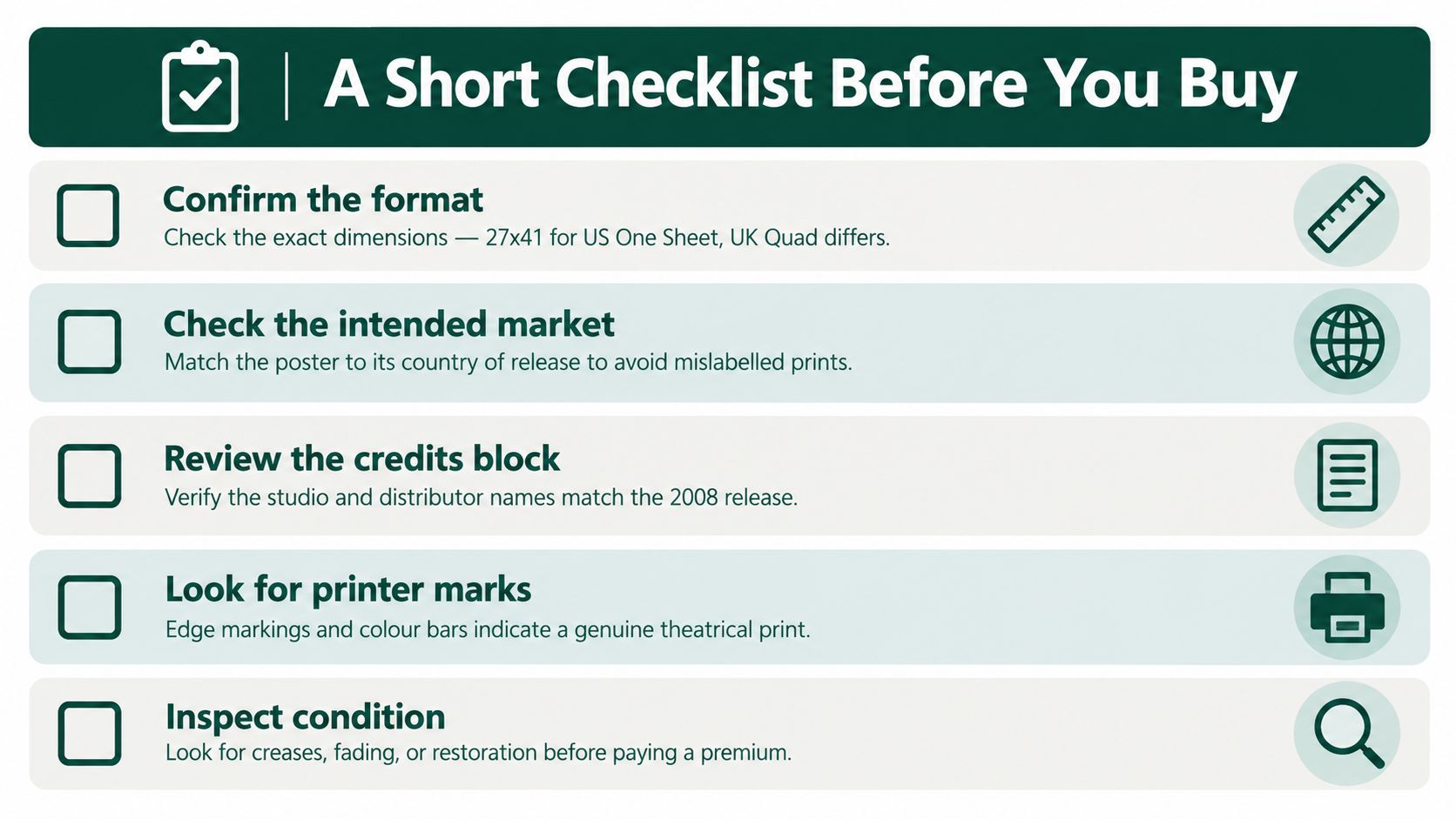
- Confirm the format: Exact dimensions, orientation and country of release agree.
- Read the credits: Studio, distributor, copyright and printer details fit the 2008 campaign.
- Inspect condition: Creases, fading, pinholes, trimming and restoration are shown and priced in.
- Ask about provenance: Where did the seller get it, and how has it been stored?
- Decide its destination: Framing now, or flat storage and rotation later?
Format, authenticity and condition matter more than urgency. A careful, modest purchase at the right size will give you more pleasure than a hurried bet on rarity, and it'll still look right on the wall in ten years.
Browse guaranteed originals by format, check dimensions before you frame, or use the Request a Poster service for a specific Wall-E variant at Famous Movie Posters. You'll find US One Sheets, UK Quads and other original cinema posters packed for safe UK delivery, so your first Wall-E purchase arrives as a collectable, not a creased disappointment.