



You've found a Princess Mononoke movie poster online. The image looks familiar, the artwork is unmistakable, and the listing calls it “original”. But is it a UK cinema poster, a Japanese promotional sheet, a North American import, a later revival design, or just a reproduction made to look the part?
That distinction matters. For a UK collector, the most attractive image isn't automatically the most historically important item. Country of issue, campaign date, format, printer information, distributor credits, folds and condition all help establish what you're buying.
Table of Contents
- Why Princess Mononoke Poster Collecting Matters Now
- Understanding Princess Mononoke Movie Poster Formats
- How to Identify an Original UK Princess Mononoke Poster
- Framing and Preserving Original Cinema Posters
- The 1997 Release and the 2025 BFI IMAX Revival
- Why Verified Originals Reduce Collecting Risk
- Where to Find and Source Princess Mononoke Posters
Why Princess Mononoke Poster Collecting Matters Now
A Princess Mononoke poster sits at the meeting point of animation, cinema history and graphic design. Hayao Miyazaki's film has a strong international following, but collectors aren't dealing with one universal poster. The same title can appear as Japanese promotional material, North American cinema paper, UK theatrical advertising or a later restoration poster, with each item telling a different exhibition story.
The UK has a documented theatrical market for the film. Box Office Mojo's UK record for Princess Mononoke records one United Kingdom release and a lifetime UK gross of $249,391, placing the film at rank 4,844 among the database's listed UK titles. That figure isn't a worldwide result, and it doesn't tell us admissions, ticket prices or the number of cinemas. It does, however, confirm that UK theatrical distribution created a domestic market for promotional artwork.

The image is only the starting point
A listing can use the correct film artwork while misidentifying the paper. Sellers sometimes describe an imported Japanese B2, a US one sheet or a modern reproduction just as a “Princess Mononoke original”. That wording leaves out the information a serious buyer needs.
The useful questions are practical:
- Where was it issued? UK, Japan, North America or another territory?
- Which campaign does it belong to? Original theatrical release, repertory screening, home video or restoration?
- What format is it? A British Quad, one sheet, B2 or another size?
- What physical evidence survives? Printer marks, folds, paper stock and distributor credits can all help.
- Can the seller document its history? A clear provenance trail is more useful than confident listing language.
The film's UK presence also continued into a later exhibition cycle. The British Film Institute scheduled a remastered 4K IMAX presentation at BFI IMAX, with subtitled and dubbed versions opening on 15 August 2025. That makes the title especially interesting now because collectors can compare original-era UK material with a clearly dateable modern revival campaign.
The key is to collect the object, not just the picture. A 1990s UK theatrical sheet represents one exhibition moment. A 2025 IMAX poster represents another. Both may be desirable, but they answer different collecting aims.
Understanding Princess Mononoke Movie Poster Formats
Format identification should come before framing or valuation. UK buyers often see “one sheet” and “Quad” used loosely, although the two formats have different proportions and were designed for different cinema-display contexts.
A US one sheet is generally a portrait-oriented cinema poster. A British Quad is a horizontal format associated with British cinema advertising. The BBC describes the conventional British Quad as 30 by 40 inches, approximately 76 by 102 centimetres, and explains that cinemas used these large sheets for outdoor display. The BBC's guide to British Quad posters provides a useful reference for the format's physical specification.
| Format | Approximate Dimensions | Typical Use |
|---|---|---|
| British Quad | 30 × 40 inches, approximately 76 × 102 cm | UK cinema advertising, usually landscape |
| US one sheet | Territory and campaign dependent | North American cinema display, commonly portrait |
| Japanese B2 | Approximately 51 × 73 cm | Japanese theatrical or promotional use |
| UK revival or event poster | Campaign dependent | Repertory, restoration or special-format screenings |
The Japanese B2 measurement comes from a documented comparison of Princess Mononoke material at Japan Poster's Hayao Miyazaki collection. It should be treated as a useful identification reference, not as a universal specification for every Japanese item.
Why proportions reveal mistakes
A listing photograph can make a smaller B2 look substantial, particularly when the poster is shown against a wall without a scale reference. Ask for unfolded measurements and compare them with the seller's stated format. A sheet advertised as a UK Quad should be checked against the 30-by-40-inch proportion, rather than assumed to be one because it carries English text.
The difference affects more than appearance. A Quad needs a wider frame, different storage support and suitable shipping protection. A one sheet may fit a standard portrait frame, but forcing a Quad into that format can lead to trimming, edge pressure or an inaccurate description.
The format also offers an early clue about market origin. A Japanese B2 isn't made less interesting by being Japanese, and a North American one sheet isn't inferior because it wasn't UK-issued. The issue is accurate labelling. Collectors can then decide whether they want a UK theatrical artefact, an imported design, or a particular visual composition.
For a concise explanation of how the two principal cinema formats differ, see this guide to one sheet and Quad movie posters. The practical rule is simple: measure first, identify second, buy third.
How to Identify an Original UK Princess Mononoke Poster
Authenticating a Princess Mononoke poster requires more than recognising the artwork. Start with the edges, reverse and physical construction, then compare those observations with the claimed territory and campaign.
A useful listing should show the full sheet, not only the central image. Ask for photographs of borders, corners, folds, printer information and any small credits near the bottom edge. A cropped image can hide the very evidence that separates original cinema paper from a later reproduction.
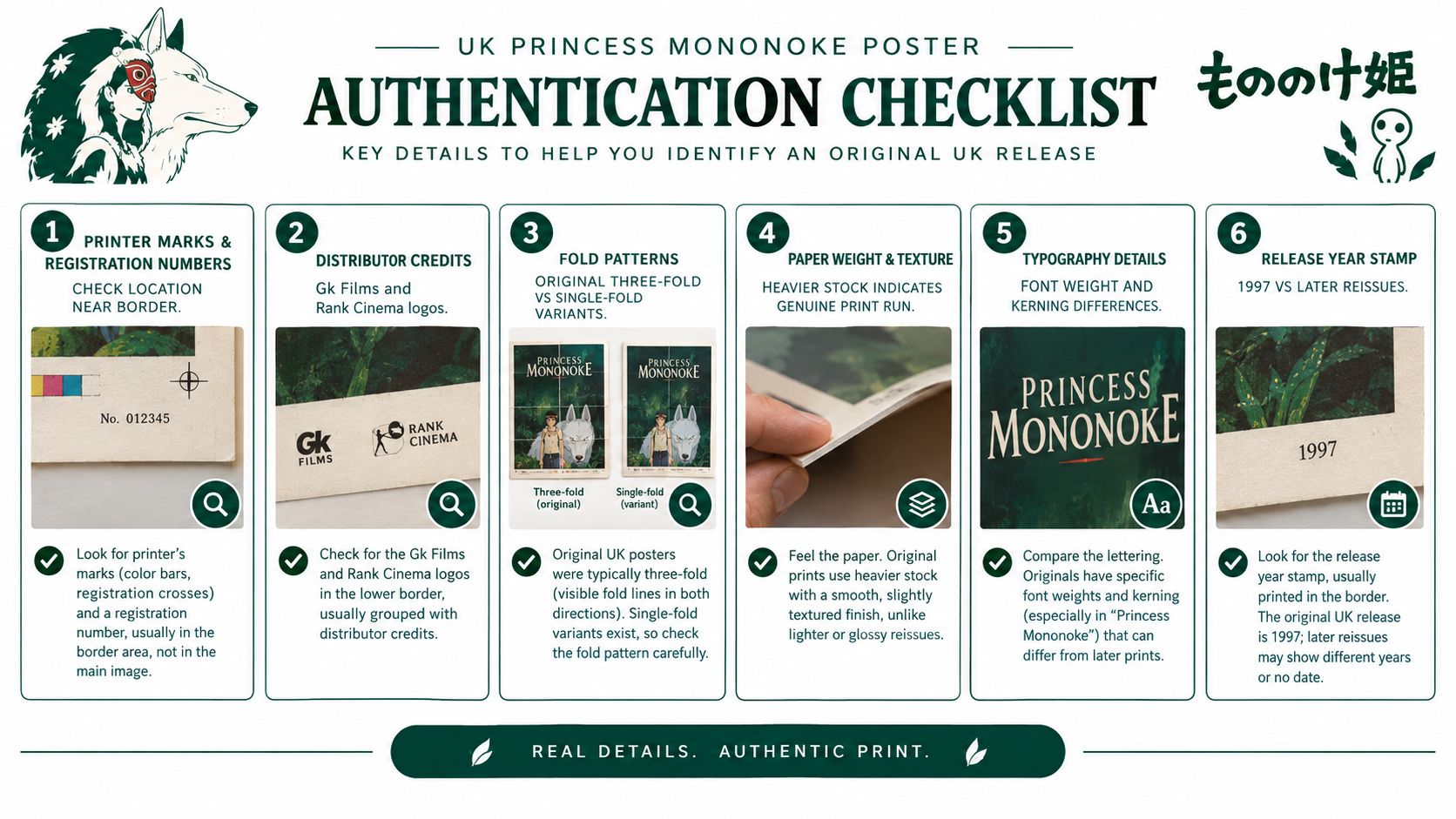
Six checks worth making
- Printer marks and registration numbers: Inspect the border area for small printer details or registration information. These marks can support the claimed campaign, although their absence isn't conclusive on its own.
- Distributor credits: Look for the stated Gk Films and Rank Cinema logos where the item is being presented as UK theatrical material. The credit line should sit naturally within the design rather than appearing as a digitally added element.
- Fold patterns: Compare the folds with the seller's description. Original examples may show a three-fold pattern or a single fold, and an unfolded sheet should be photographed clearly enough to assess whether the creases belong to the printing and distribution history.
- Paper weight and texture: Genuine print runs can feel different from lightweight reproduction stock. Hold the sheet by its edges, never the image area, and ask whether the paper has been backed, linen-mounted or repaired.
- Typography details: Examine font weight, spacing and kerning around titles and credits. Small differences can reveal that an image has been rebuilt from a scan rather than printed during the claimed campaign.
- Release year stamp: Treat a 1997 reference differently from a later reissue date. A release-year marking is useful evidence, but it still needs to agree with format, distributor and provenance.
The UK original movie poster guide is useful background for buyers who are still learning the distinction between original cinema paper and reproduction material. In practice, no single marker should carry the whole authentication decision.
Provenance should agree with the paper
A seller who says “UK original” should be able to explain where the poster came from, whether it was folded, and how its dimensions were measured. If the description says British Quad but the dimensions match a Japanese B2, the inconsistency needs resolving before payment.
Ask for the campaign wording as well. A poster mentioning IMAX, 4K restoration or a specific 2025 event cannot be treated as original 1990s UK paper just because the artwork resembles an older design. The safest purchase is one where the physical evidence, seller description and exhibition history point in the same direction.
Framing and Preserving Original Cinema Posters
Good framing starts with measurement and ends with controlled exposure. A valuable Princess Mononoke poster can be damaged by an attractive display if the frame traps moisture, presses against the sheet or admits excessive ultraviolet light.
UK collections-care guidance recommends a stable environment around 16–19°C and 45–60% relative humidity. The Institute of Conservation's advice for art on paper explains that fluctuations can distort paper fibres, causing shrinkage, loss of flexibility and other physical stress.
Build the display around the poster
Before ordering a frame, record the poster's unfolded dimensions and folded state. Don't trim a sheet to fit a readily available frame. The margins and fold evidence may help establish authenticity later, and cutting them away reduces both historical information and resale flexibility.
Use conservation-grade mounting rather than permanent adhesive. Acid-free support materials, suitable hinges and a frame that doesn't force the corners flat will reduce unnecessary strain. If the poster has severe folds, tears or brittle edges, consult a paper conservator before attempting to flatten it at home.
Lighting deserves equal attention. Collections-care guidance generally places display lighting at 50 lux, with ultraviolet radiation filtered or eliminated. Direct UK daylight is particularly difficult to control because exposure changes through the day and across seasons.
Practical rule: A darker wall position with controlled, UV-filtering glazing is safer than a bright window display, even when the glass is marketed as protective.
Light-driven chemical reactions can yellow paper, weaken cellulose, fade inks and make the sheet brittle. UV-filtering glazing helps, but it doesn't make unlimited exposure safe. Rotate the poster out of display when cumulative exposure becomes excessive, and keep a record of where and how it has been shown.
Storage and handling
Store the poster flat where possible, supported by archival materials and protected from dust, damp and repeated handling. If rolling is unavoidable for transport, use an appropriately sized tube and avoid tight rolls that put pressure on old folds and fragile corners.
Handle the sheet with clean, dry hands or suitable gloves when a conservator recommends them. Lift from a broad support, don't drag it across a table, and never place books or frames on top of it. These habits matter because conservation damage often begins during routine handling rather than dramatic accidents.
The 1997 Release and the 2025 BFI IMAX Revival
For provenance, the most useful distinction is between the film's original exhibition history and later campaigns that reuse or reinterpret its imagery. The BBFC records the production year as 1997 and separately records a UK release date of 15 August 2025 for the documented restoration presentation, creating a 28-year interval between those two milestones. The BBFC record for the 2025 UK presentation identifies the distributor as Elysian Film Group and records separate English-language, subtitled and IMAX classifications.
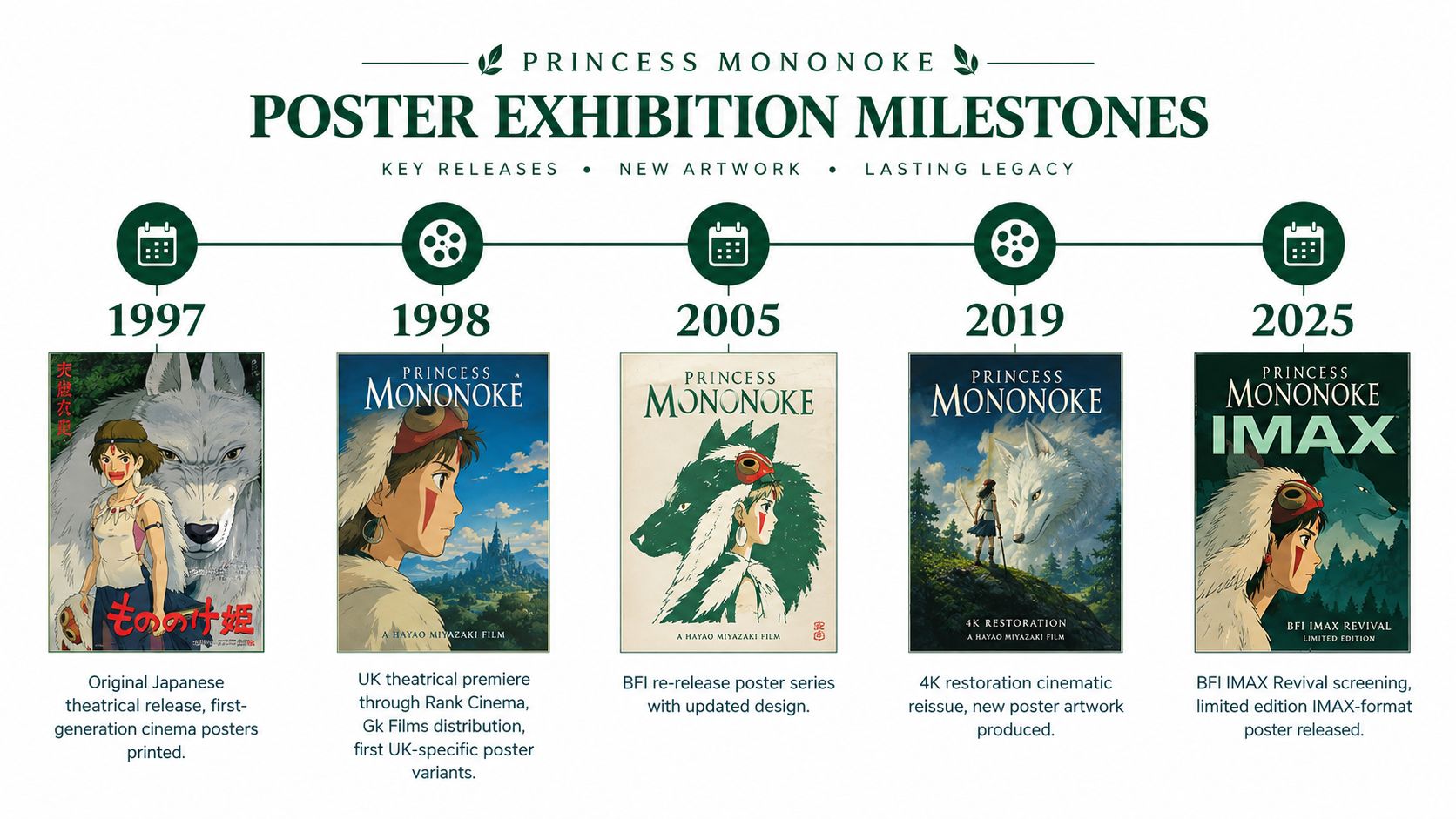
Two campaigns, two collecting contexts
The original production year anchors the film's first historical period, but it doesn't prove that every poster described as “1997 UK” was printed in that year. Collectors should separate the film's production date from the date and territory of a particular poster campaign.
The later UK revival is much easier to date. The remastered 4K IMAX presentation opened at London's BFI IMAX on 15 August 2025, in both subtitled and English-dubbed versions. Anime News Network's report on the London IMAX screening notes that the poster shown in connection with the event was North American promotional material. That point is important. A poster displayed during a UK event isn't automatically a UK-issued poster.
The BFI IMAX listing for the 4K subtitled presentation provides the event context, while the BBFC record helps distinguish the relevant classifications and release documentation. Together, they give collectors a dateable revival benchmark without turning every 2025 image into domestic UK paper.
How to catalogue the difference
For an original-era item, record its country, approximate campaign period, format, printer, distributor and folds. For a 2025 item, add the cinema event, IMAX or 4K wording, language version and whether the poster was UK-issued or imported for display.
That separation protects against a common mistake: assuming that newer means less collectible. A 2025 poster can be valuable as event-cinema memorabilia, while an earlier UK sheet may matter more to a collector focused on theatrical history. The right choice depends on the story you want the object to preserve.
Why Verified Originals Reduce Collecting Risk
Unverified listings transfer the research burden to the buyer. The photograph may be accurate, but the description can still confuse a reproduction with an original, an imported poster with UK paper, or a restoration campaign with an earlier release.
The financial risk isn't the only concern. A wrongly described sheet can arrive in unsuitable packaging, be folded again, trimmed to fit an incorrect frame or stored in materials that accelerate deterioration. Once damage occurs, proving the original condition becomes difficult.
What verification should include
A reliable seller should provide more than a title and a familiar image. Look for:
- Clear format information: The listing should state whether the item is a Quad, one sheet, B2 or another format, with measurements that support the description.
- Condition reporting: Folds, pinholes, edge wear, tears, restoration, backing and paper loss should be disclosed plainly.
- Market and campaign details: The seller should distinguish UK theatrical material from Japanese, North American, home-video and revival paper.
- Handling and dispatch information: Posters need protection against creasing, moisture and impact while in transit.
- A coherent provenance account: The history doesn't need to be elaborate, but it should make sense alongside the physical evidence.
A confident description cannot replace photographs of the paper, measurements and a consistent account of where the poster belongs in the release history.
Certified or professionally verified originals reduce uncertainty because the buyer can assess the object as cinema memorabilia rather than gamble on an image file. That doesn't mean every verified poster will suit every collector. It means the decision is based on the right question, namely which authentic campaign and format you want.
Where to Find and Source Princess Mononoke Posters
The search usually starts with a broad image query and becomes more useful once you narrow the brief. Decide whether you want a UK theatrical item, a Japanese B2, a North American one sheet, or a 2025 restoration poster before contacting sellers. “A Princess Mononoke poster” is too vague for a serious sourcing request.
Established UK specialists are one route, particularly when their catalogues separate formats and provide condition notes. Monitor the latest arrivals from Famous Movie Posters alongside established auction houses, specialist dealers and trusted collector networks. A title may not be listed when you first look, especially if you want a specific UK campaign rather than a popular image.
Ask questions that produce evidence
A useful enquiry should be specific enough for the seller to search accurately:
- State the market: Ask for UK-issued material, or say clearly if Japanese and North American imports are acceptable.
- Name the format: Request a British Quad, one sheet or B2 rather than asking for a poster of any size.
- Define the campaign: Specify original theatrical material, a repertory release, or the 2025 IMAX restoration cycle.
- Request measurements: Ask for unfolded dimensions, not just the advertised format name.
- Ask about condition: Confirm folds, backing, repairs, pinholes, paper loss and edge wear.
- Clarify provenance: Find out whether the poster came from a cinema, distributor, private collection or another source.
- Check dispatch protection: Confirm that the seller uses suitable packaging and won't fold an item that has previously been stored flat.
When a listing uses the phrase “UK Quad”, compare the stated measurements with the conventional 30-by-40-inch British specification. When it uses “original”, ask what evidence supports that description. These questions don't make the purchase awkward. They show that you understand the difference between a decorative reproduction and a piece of exhibition history.
Shipping deserves the same attention as authentication. A correctly identified poster can still arrive with new creases if the tube is too narrow, the sheet is rolled tightly or the internal protection is inadequate. For higher-grade material, agree the dispatch method before paying and keep photographs of the package if its condition on arrival is poor.
The most satisfying purchase is the one you can catalogue confidently. Record the title, territory, format, campaign, dimensions, condition and source as soon as it arrives. That information will help with future framing, insurance discussions, conservation decisions and resale.
Famous Movie Posters offers verified original cinema posters, format guidance, archival handling and a request service for hard-to-find titles, including animation material relevant to Princess Mononoke collectors. Visit Famous Movie Posters to check current stock or submit a focused sourcing request for UK, Japanese or revival-era paper.