



You find a Psycho movie poster described as original, but another seller has a different design with the same description. Before comparing prices, establish whether you're looking at a first-release British quad, a later cinema reissue or an American sheet.
Table of Contents
- Why the 1960 British Campaign Still Matters
- Original Psycho Poster Editions at a Glance
- How the Saul Bass Artwork Creates Unease
- Checks That Separate an Original from a Reprint
- What Recent Auctions Actually Paid
- Choosing and Buying a Verified Psycho Poster
Why the 1960 British Campaign Still Matters
A British Psycho poster is tied to a particular cinema release, not to the year printed in a film guide. Alfred Hitchcock's film opened in London on 4 August 1960, after its 16 June New York premiere, and received an adults-only X certificate in Great Britain, according to the American Film Institute catalogue. The BBFC first received the film for classification that June, and members of the public later wrote letters of complaint following its British cinema release.
Hitchcock's controlled presentation strategy included restricting admission once a screening had started. Arriving on time became part of the cinema experience, while controversy gave audiences another reason to discuss the film. These details help explain why a first-release British poster has a different historical connection from a later campaign poster, even when both relate to the same title.
The illustration evokes the British cinema setting in which the campaign appeared.
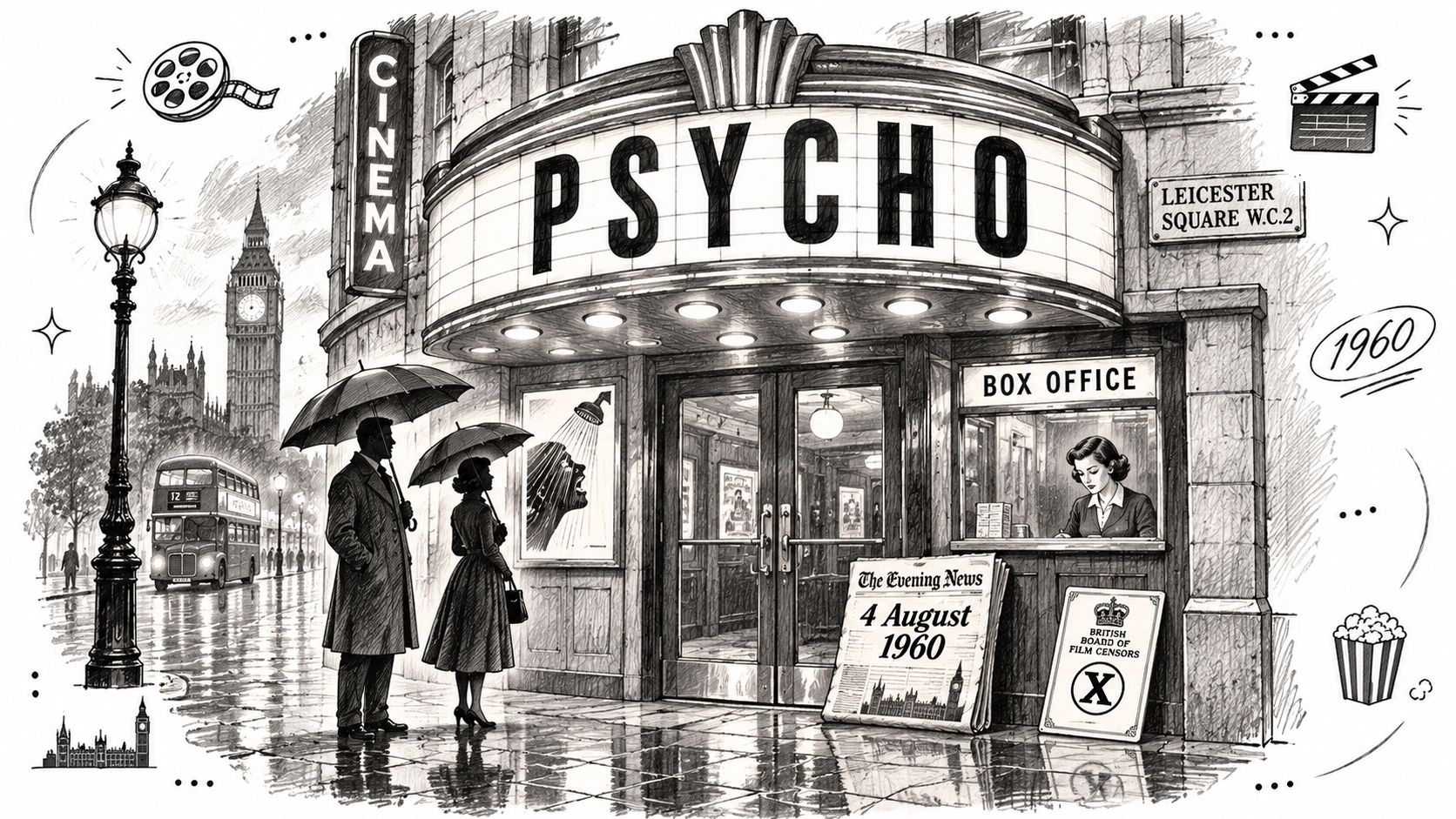
A cinema artefact rather than a film date
Audiences reportedly queued around the block when Psycho reached British cinemas. A first-release British poster belongs to that moment of controlled admission, public argument and intense interest in Hitchcock's film.
For a buyer, the distinction is between an object made for the original British theatrical campaign and one that belongs to a later showing. A modern print may reproduce the artwork, but it was not part of the period campaign. A later cinema poster may be authentic and collectable, while still not documenting the film's first British appearance.
The guide to collecting cinema posters from the sixties offers context for placing Psycho alongside other releases of the period.
Buying principle: The film's release date alone does not establish when a particular poster was issued.
Keep the descriptions distinct:
- Original theatrical campaign: Material produced for the film's initial cinema release in the relevant country.
- Later authorised reissue: Genuine cinema advertising for a subsequent theatrical engagement.
- Modern decorative print: A wall piece produced outside the period cinema campaign.
A seller's use of original should make clear which kind of object is being offered. Once the issue is established, size, condition and price can be compared on a sound basis.
Original Psycho Poster Editions at a Glance
Notable Psycho poster editions
| Edition | Format and size | Orientation | What distinguishes it | Collector note |
|---|---|---|---|---|
| 1960 first-release British quad | 30 x 40 in, about 76.2 x 101.6 cm | Landscape | UK campaign layout in the Bass visual language, with period printer or distributor evidence | Often folded from cinema use; the strongest British historical claim |
| British Quad Style B | 30 x 40 in | Landscape | An alternate British quad design, not the US composition | A named style, so the listing should identify Style B explicitly |
| US one-sheet | Standard American one-sheet size for its issue, confirmed by measurement | Portrait | Bass broken title lettering and relatively few actor photographs | Requires different framing, storage and postage from a British quad |
| US 40 x 60 | 40 x 60 in | Portrait | Larger American theatrical sheet | Scarcer display format; don't describe it as a one-sheet |
| Later reissue quad | Commonly British quad size | Landscape | Later artwork, printer or campaign, without first-release evidence | Can be genuine and collectable without belonging to the first UK release |
| Licensed decorative print | Publisher's stated print dimensions | Either | Modern paper and printing, without period cinema-use evidence | A wall print, not an original cinema poster |
The British Quad, also called the Quadruple Crown, has nominal dimensions of 30 by 40 inches, approximately 76.2 by 101.6 centimetres, and normally uses horizontal orientation, as documented by the Science Museum Group's format record. Those dimensions describe the intended format, not a guarantee that every surviving example remains untrimmed.
Read the edition name before the description
The first-release British quad is the natural starting point for someone collecting the film's British exhibition history. Its appeal lies in the combination of campaign, country and issue, rather than the presence of the familiar title.
British Quad Style B is a more specific identification. It names an alternate British design, not a general category covering every Psycho poster. A seller using that description should show artwork and printing evidence that supports it.
American material needs equally careful naming. A US one-sheet is a portrait format, whereas the larger American sheet in the table is a separate theatrical format. They shouldn't share a vague description merely because both were printed for American cinemas.
Genuine doesn't always mean first release
A later reissue quad may carry a recognisable title treatment alongside different imagery, credits or campaign wording. Its cinema origin can be genuine even though its historical relationship to the film is different.
A licensed decorative print answers another need altogether. It can offer the image in a convenient size without claiming period cinema use. Licensing and historical originality are separate questions: permission to reproduce an image doesn't turn a new print into an old theatrical poster.
Match the offer to a named edition before discussing whether its condition or asking price is attractive.
A listing headed only original Psycho movie poster leaves too much unresolved. Ask for country, format, issue and design identification, then make sure the photographs show the same object the description promises.
How the Saul Bass Artwork Creates Unease
The title's lettering is interrupted and divided, yet remains readable. That tension gives the Psycho campaign an unsettled quality before the viewer has taken in the rest of the image. The diagram highlights the main visual devices.
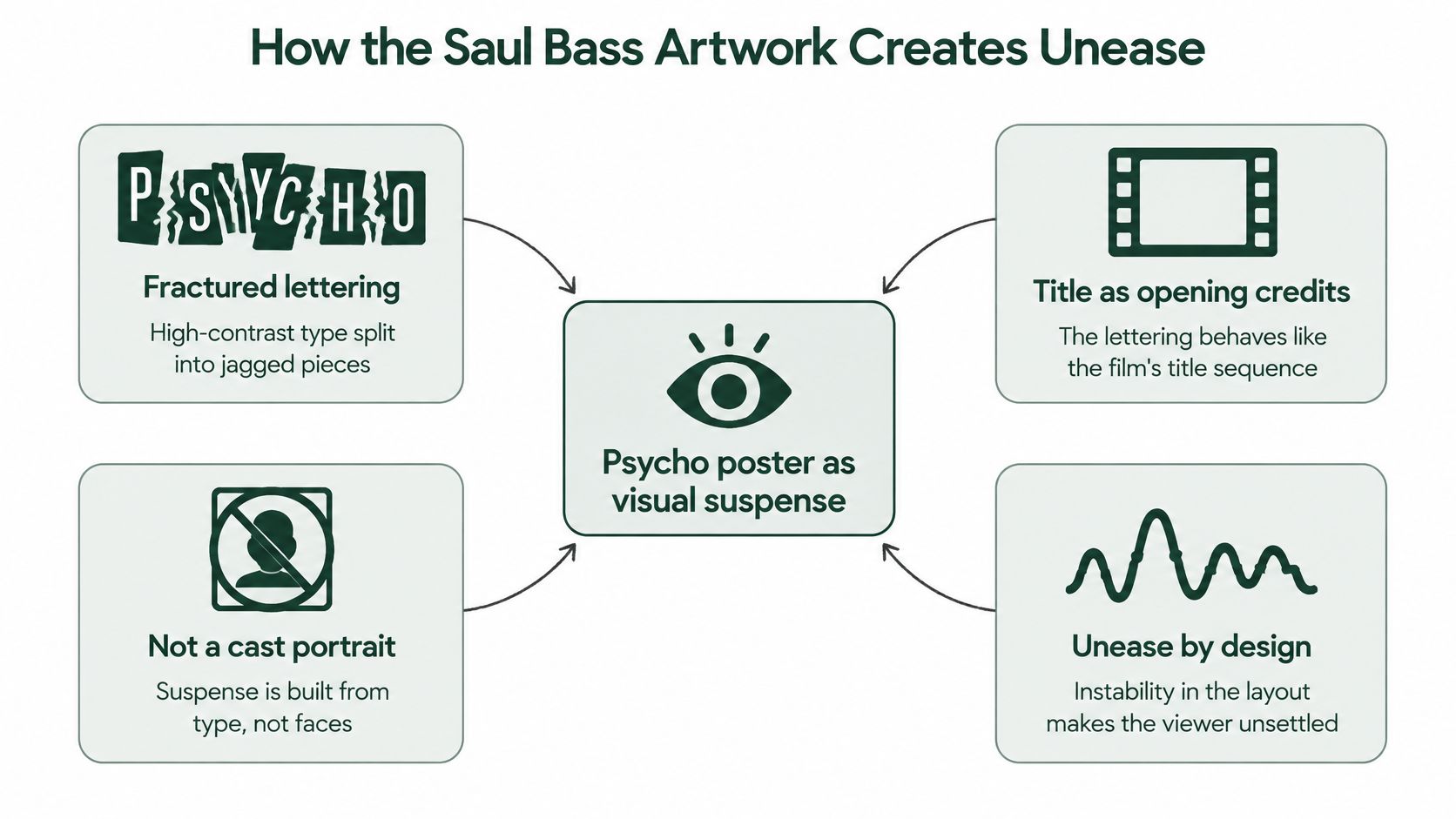
Saul Bass's broken, high-contrast typography links the advertising to the opening-credit design and the film's themes of disruption and violence. The Film Art Gallery's Psycho poster collection illustrates the campaign's focus on dominant lettering rather than a crowd of actor portraits.
Angular divisions make the title less comfortable to read. The eye follows a letter, meets a break, then has to resume. Directional bars and interrupted forms can suggest slicing, rain or information that refuses to settle. These are visual cues, not a literal summary of the plot.
Contrast without a comfortable centre
Strong areas of dark and light make the breaks stand out. Continuous lettering would let the eye move smoothly across the title; Bass's fractured treatment interrupts that movement. The result is graphic suspense, built into the way the words are seen.
The starkness also fits the film's presentation. Psycho was shot in black and white, unlike the Technicolor presentation of Vertigo and North by Northwest. Its graphic language therefore suits the film rather than borrowing from a more colourful spectacle.
For comparison, the Vertigo film poster guide discusses another approach to Hitchcock's visual identity. Consider how each poster's title and image guide attention, rather than judging either design only by the number of familiar faces it shows.
The moving-image treatment offers another way to see how lettering can contribute to suspense.
What a British adaptation can change
A British quad and an American one-sheet have different shapes. Adapting the campaign to another format can change the crop, the placement of the type and how photographs sit alongside the graphic bars. A design difference, by itself, does not show that a poster is inauthentic.
For a buyer, keep three checks in view:
- Compare the correct national format: A British layout need not match the better-known American image.
- Examine the whole composition: Letter shapes, line geometry and credit placement should work together.
- Separate design recognition from authentication: A reproduction can repeat the visual language without being a period cinema sheet.
Recognising Bass's style helps explain the design, but it cannot establish who printed a particular poster. For a UK purchase, the 1960 British quad, a later reissue and a US format are distinct choices. Let the claimed issue and the evidence for that sheet guide the decision, not familiarity with the artwork alone.
Checks That Separate an Original from a Reprint
A Psycho poster can look convincing and still belong to the wrong edition. For a UK buyer, the first question is whether the sheet is a 1960 British quad, a later reissue, a US format or a decorative print. The Film on Paper collecting resource offers a starting point for examining original poster material, but each listing still needs to be checked against its claimed issue.
- Name the claimed edition. Ask for the country, theatrical issue, format and any named style. “Psycho poster” identifies the film, not the particular sheet.
- Check measurements and orientation. Measure the paper, not the frame, and compare the result with the claimed format. Ask whether trimming, backing or missing margins affect the dimensions.
- Inspect paper and printing evidence. Request clear photographs of the stock, small lettering, and printer or distributor information. The details should support the claimed release rather than make the paper appear old.
- Read the folds. Cinema-use folds are not automatically a problem. Look at folding, wear and paper condition together; none of these features alone proves when a poster was printed.
- Check campaign and censorship markings. Wording and markings should fit the claimed country and issue. One familiar symbol is weaker evidence than several details that agree.
- Request the reverse. A frame can conceal tape, lining, repairs or mounting. Ask for photographs of the back, or a clear reason it cannot be inspected.
- Ask about restoration. Request details of closed tears, added colour, replaced paper, lining and backing. Restoration does not automatically rule out a purchase, but undisclosed work makes condition difficult to judge.
- Resolve the release status. Separate first-release material from an authorised reissue and a decorative reproduction. Price alone cannot identify the edition.
The checklist image below provides a reminder of the evidence to gather before paying.
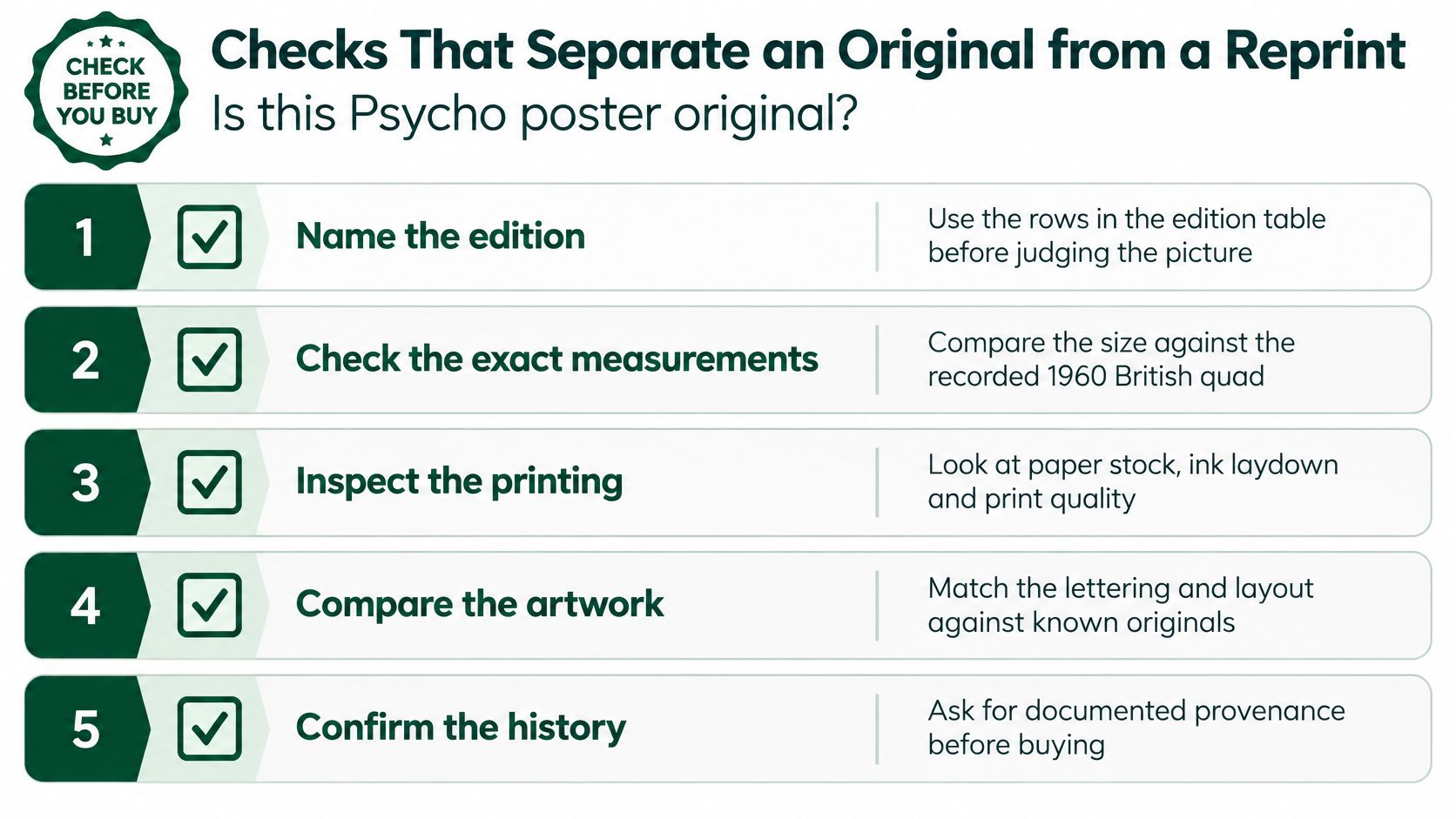
Evidence to request by edition
| Edition | Dimensions to confirm | Evidence to request | Red flag |
|---|---|---|---|
| 1960 first-release British quad | 30 x 40 in / about 76.2 x 101.6 cm | Printer or distributor credit, paper stock, censorship or campaign markings | Portrait sheet or no supporting period credits |
| British Quad Style B | 30 x 40 in / about 76.2 x 101.6 cm | Named Style B design, printer evidence, reverse photograph | Listed only as a generic Psycho quad |
| US one-sheet | Standard US one-sheet, 27 x 41 in | Reverse photograph, printer or exchange credit, fold pattern | Landscape listing or no reverse image |
| US 40 x 60 | 40 x 60 in | Measurements, reverse photograph, paper stock | Described as a one-sheet |
| Later reissue quad | 30 x 40 in / about 76.2 x 101.6 cm | Reissue date, artwork, printer credit, restoration notes | Claimed as a first release without evidence |
| Licensed decorative print | Publisher's stated print size | Publisher details and print edition information | Sold as an original cinema poster |
A red flag means pause and ask for clarification, not assume dishonesty. Trimming, for example, could explain missing credits, but the explanation should be supported by evidence.
The pass rule is consistency: measurements, credits, fold notes, restoration disclosure and reverse photographs should all support one named edition. If details conflict, ask for clarification before treating the listing as verified.
What Recent Auctions Actually Paid
A British quad, a later reissue and a large US-format sheet are not interchangeable, even when each carries the Psycho title. Published auction results help establish what a particular edition achieved, but only when the poster offered is comparable in format and condition.
Recent published Psycho poster auction results
| Sale | Poster identified | Result | Outcome |
|---|---|---|---|
| Propstore, London, February 2024 | Psycho (1960), US 40 x 60 inch | £11,875 | Sold |
| Heritage Auctions, July 2024, reported by Rare Book Hub | Psycho (1960), British Quad Style B | US$17,500 | Sold |
These are two separate sale outcomes, in different currencies and at different auction venues. One concerns a large American theatrical sheet; the other names a specific British quad design. Neither result sets a general value for every Psycho poster.
Read beyond the headline result
Begin with the catalogue description and photographs. Check the edition identified, the condition and whether restoration is disclosed. Also establish whether the reported figure is a hammer price or includes charges, since those amounts describe different costs.
A headline result leaves several practical questions unanswered:
- The buyer's full cost: Premium, applicable charges, delivery and framing may be additional.
- The conservation position: Repairs, lining or future treatment affect the cost of owning the poster.
- The availability of alternatives: A public auction result does not show the full range of private sales or how often comparable examples appear.
- The precision of the attribution: A named edition gives a firmer basis for comparison than a broad description.
The guide to original movie poster prices explains why format and condition belong alongside any price discussion.
A sale result is evidence about the poster sold, not a price label for every poster bearing the same film title.
Compare like with like
If you are offered a British quad attributed to Style B, the British auction result is the more relevant starting point. Compare the issue identification, completeness, restoration and provenance before treating it as a close match. The US 40 x 60 sale shows that a different format also achieved a published result, but it is not a substitute valuation for a British quad.
That distinction matters when weighing the 1960 British campaign, a later reissue and a US-format poster. A later reissue may be visually appealing, but its sale should not be compared directly with a confirmed first-release quad as though the editions were identical.
An asking price remains difficult to assess until the seller identifies the edition and its condition. Once those details are clear, auction evidence can help you judge the asking price without implying a guaranteed resale value.
Choosing and Buying a Verified Psycho Poster
Choose the poster for the job you want it to do. A collector documenting British cinema history and someone furnishing a home cinema can reasonably favour different editions.
The buying decision starts with that distinction.
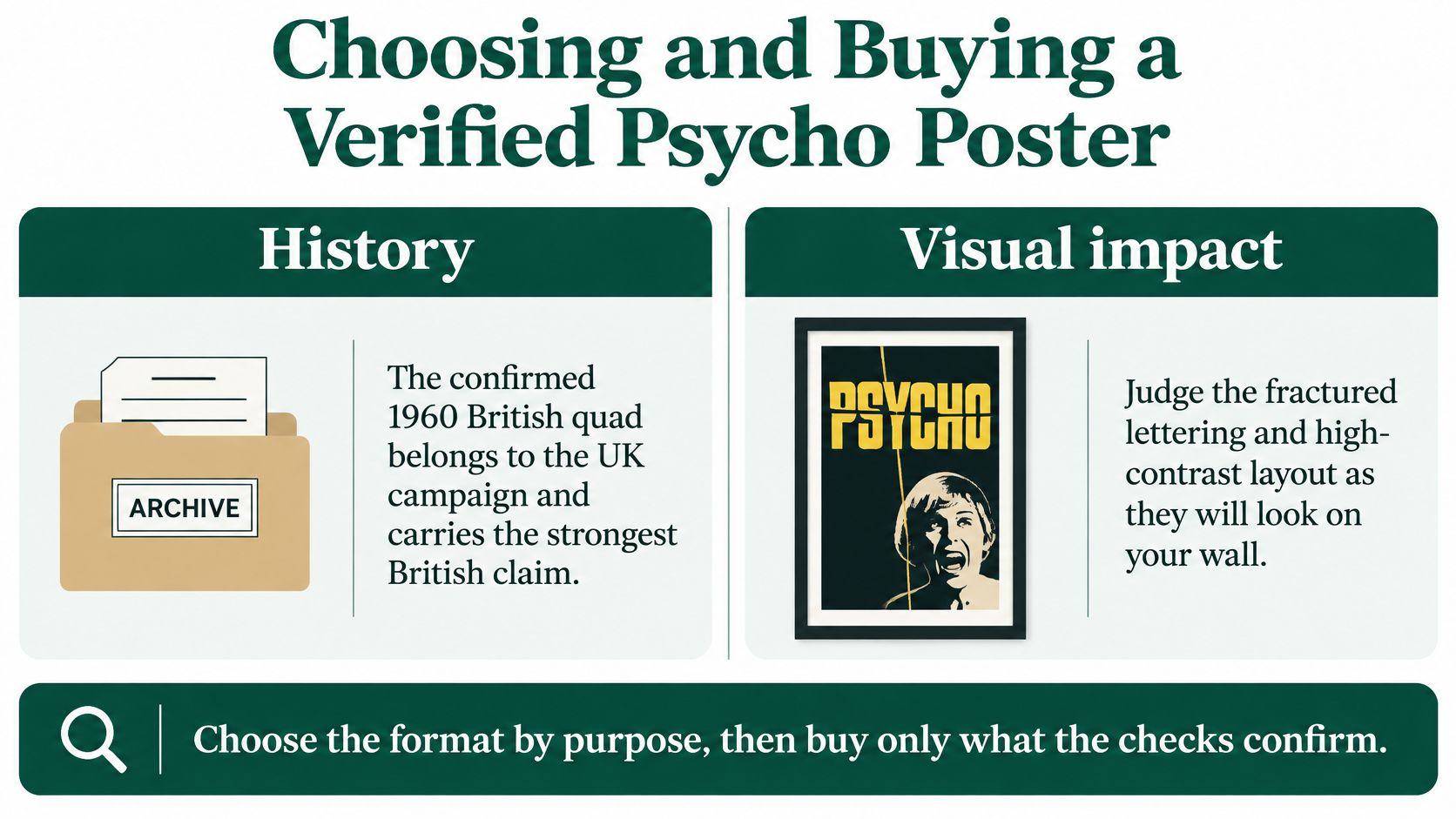
History or visual impact
For British historical significance, favour a confirmed first-release quad with a convincing issue identification. You're choosing its relationship to the original UK campaign, so documentary confidence matters more than whether the sheet looks immaculate.
For visual impact, assess the actual artwork from across a room. A clean later reissue or a strong American design might suit your wall better than a more historically important example with distracting repairs. The Vintage Movie Posters buyer's guide supports considering format, artwork, condition and provenance together rather than assuming the oldest or most expensive choice is automatically best.
Later authorised artwork isn't worthless because it's later. Nor should a history-led collector feel obliged to choose the cleanest sheet if a well-documented cinema-used example better suits the collection.
Describe condition precisely
Keep ordinary handling evidence separate from structural problems. A visible fold and a separating fold aren't the same condition issue: one records handling, while the other needs closer assessment of paper stability.
Ask for distinct notes on colour loss, staining, edge wear, fold separation, restoration and paper acidity. A generic description such as good for its age doesn't tell you which defects will remain visible behind glass.
For preservation, use flat archival storage where practical, avoid pressure mounting and direct window sunlight, and choose a reversible conservation-compatible mount. The discussion of Bass's graphic contrast and paper care at Envato's Saul Bass design guide highlights why fading, staining and stressed folds deserve separate attention.
Budget for the object and its care
Set a purchase budget alongside a framing and handling budget. A wide British sheet and a tall American format require different wall space, mounts and packing arrangements; check the available space before committing.
Use an auction comparable as context, not permission to ignore uncertainty. Better provenance can justify preferring one example, while extensive restoration may make another unsuitable for your priorities even if its front looks cleaner.
Before payment, make the decision explicit:
- Identity: Can you name exactly what you're buying?
- Evidence: Do the photographs and printing details support that identification?
- Condition tolerance: Are you comfortable with the disclosed repairs and visible wear?
- Display plan: Can you frame and store it without introducing avoidable stress?
We sell only guaranteed original movie posters, and we've collected hundreds of the rarest and most iconic designs. If the right Psycho edition isn't available, you can submit a specific sourcing request through our request form, and we'll do our very best to get it.
Visit Famous Movie Posters to look for a guaranteed original Psycho movie poster or request a particular edition. Tell us whether you're seeking a first-release British quad, a later theatrical reissue or a US sheet, along with your budget and condition preferences, so the search starts with the right object.