



You've found a Pulp Fiction poster online. The artwork looks right, the seller says it's original, and the price sits in that awkward middle ground where it's too much for a throwaway buy but not high enough to feel automatically credible. That's exactly where most mistakes happen.
Pulp Fiction is one of those titles that attracts every kind of poster buyer. Long-time collectors want a proper first-release cinema piece. Gift buyers want the image they remember from bedrooms, student flats and video shop walls. Newer collectors often want something frameable and iconic without yet knowing the difference between a 1994 UK Quad, a later authorised reissue, and a mass-produced print that was never near a cinema.
The trouble is that the market now contains all three. Some pieces are genuine period originals. Some are legitimate later issues, including anniversary releases. Some are poor reproductions, and some are made just well enough to catch anyone who relies on a quick glance and a seller's headline. With Pulp Fiction, one extra wrinkle makes the subject more confusing than usual. The early Lucky Strike design was recalled, so buyers often hear that a poster is “the rare version” without being given the practical detail needed to judge whether that claim stands up.
That's where a UK-focused approach matters. In Britain, format tells you a great deal before you even begin to assess condition. A proper UK collector should first ask what size the poster is, whether the layout fits the format claimed, and whether the handling makes sense for a period cinema issue. A buyer who skips those steps usually ends up judging the wrong thing.
A good Pulp Fiction original movie poster should be bought the same way you'd buy any serious piece of film paper: identify the format, confirm the release period, study the print characteristics, then weigh condition against price. Hype doesn't help. Clean measurements, honest photos and sensible provenance do.
Table of Contents
- Introduction
- What Makes a Pulp Fiction Poster an Original
- UK Quad Versus One Sheet and US One Sheet Explained
- How to Authenticate an Original and Spot Reprints
- Condition Grading and What Fold Lines Really Mean
- Typical UK Price Ranges and What Drives Value
- Framing Shipping and Long Term Care for Collectors
Introduction
A common buying scenario goes like this. Someone starts out wanting “the original Pulp Fiction poster” and quickly discovers several versions that all appear close enough on a phone screen. One listing says UK original. Another says vintage cinema poster. A third says anniversary quad. By then, the buyer is comparing prices before they've established whether the items belong in the same category at all.
That's a costly way to shop.
In the UK, the key historical starting point is clear. The original British theatrical poster was issued in 1994 as a UK Quad, the standard British cinema poster format, with a layout measuring about 30 x 40 inches. One catalogue record gives the size more precisely as 30 1/16 x 39 15/16 inches. That places the true British first-release poster firmly in the 1994 UK rollout and gives collectors the right baseline for identification (UK Quad listing for the 1994 release).
If a seller can't tell you the format and approximate size before talking about rarity, they're starting in the wrong place.
That baseline matters because many buyers are now tripping over later lookalikes. There are anniversary reissues in the market. There are UK listings for genuine originals. There are recalled-design stories circulating without enough explanation. There are also bootlegs, especially around the withdrawn cigarette-pack version, where a dramatic backstory often does the selling.
Here, the practical questions matter more than the romantic ones. Is it a 1994 UK Quad, a later UK issue, a US format, or a reprint? Does the fold pattern fit the period? Does the artwork crop correctly for the format? If it's the Lucky Strike design, does the printing hold up under close inspection?
What buyers usually get wrong
Most mistakes come from treating all Pulp Fiction posters as one market.
- Original isn't the same as old-looking. Artificial wear, muted colour and even folds can be added or faked.
- Authorised isn't the same as first-release. A legitimate anniversary poster can still be wrong for a buyer seeking a period original.
- Scarce story doesn't equal scarce object. The recalled design exists, but so do many reproductions.
- Price doesn't prove authenticity. Expensive mistakes are still mistakes.
That's why careful collectors work backwards from format and provenance, then move on to condition and value.
What Makes a Pulp Fiction Poster an Original
A buyer in the UK sees Pulp Fiction artwork, hears “original”, and assumes the hard part is done. It isn't. With this title, the first job is separating a true 1994 cinema poster from later anniversary issues, US material sold into the UK market, and the many bootlegs built around the recalled Lucky Strike design.
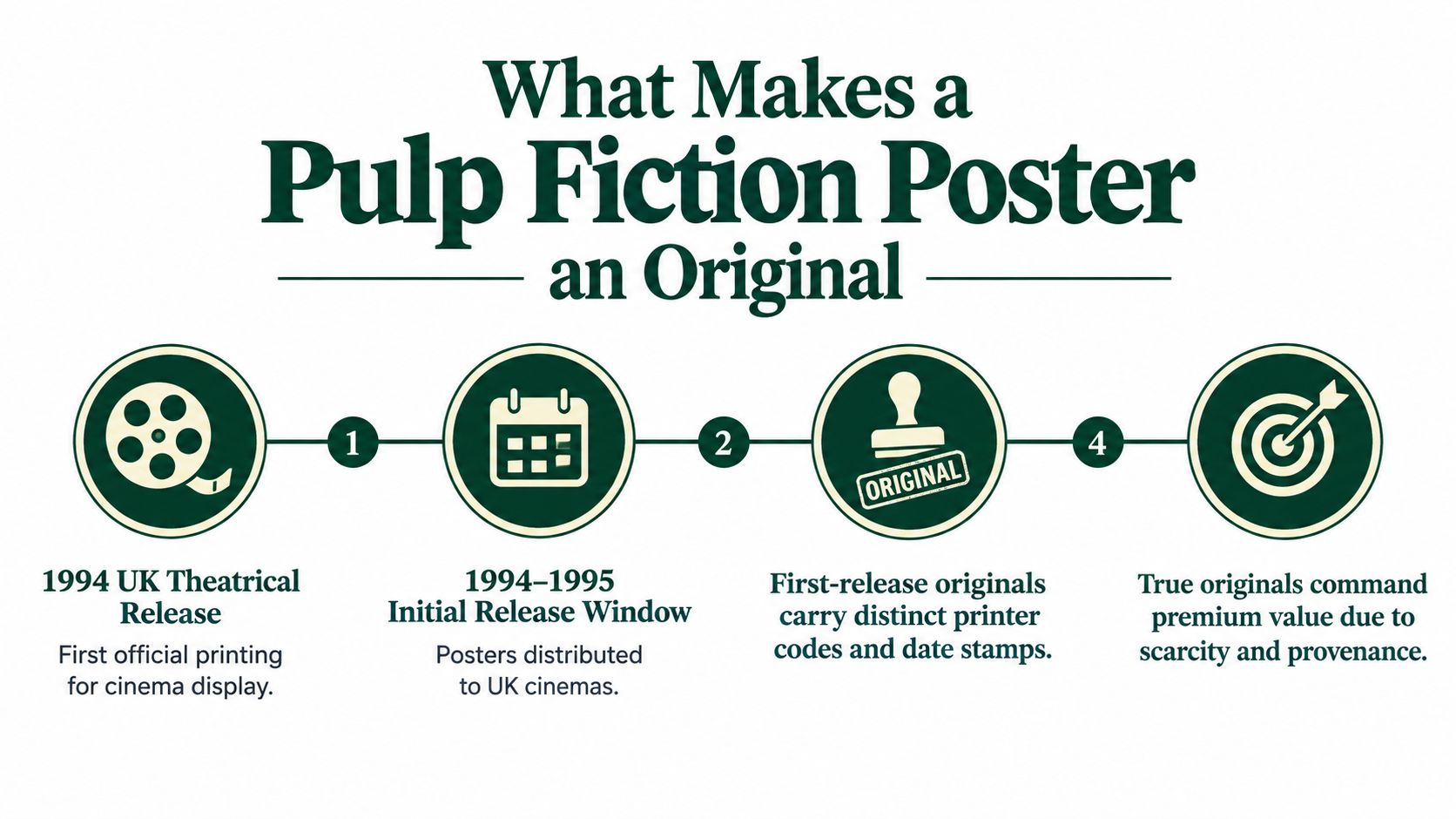
An original Pulp Fiction poster was printed for actual cinema use during the relevant release campaign. For a UK collector, the benchmark is the 1994 British theatrical issue, especially the UK Quad. That means period paper, period printing, and a format that matches British distribution practice at the time. A later authorised poster can still be perfectly legitimate. It is not the same object.
First release, advance and reissue
These terms get blurred in listings, and that is where buyers lose money.
A first-release original belongs to the film's initial 1994 cinema run. An advance can also be original if it was printed for that same campaign before general release. A reissue belongs to a later release, anniversary screening, or commemorative programme. It may be official. It may even look close enough to frame happily. But it does not belong in the same category as a 1994 first-release UK cinema poster.
That distinction matters more with Pulp Fiction than with many titles because the recalled cigarette-pack variant attracts speculation. Sellers often lead with the story. Collectors should start with the object. If the size, fold pattern, paper stock or print finish do not fit a 1994 UK issue, the backstory does not rescue it.
The first checks worth making
I would ask these before discussing condition or price:
- Was it printed for the 1994 UK release campaign?
- Does the format match a British cinema issue rather than a US poster described loosely as “UK”?
- If it is the Lucky Strike design, does the seller explain why they believe it is a period original rather than a later reproduction?
- Do the photos show period handling, including expected folds if applicable, rather than a fresh print-shop appearance?
A vague answer to any of those is enough to slow the deal down.
Provenance that actually helps
With Pulp Fiction, useful provenance is usually plain and specific. A sensible seller's note might read: “UK Quad, 30 x 40 inches, Miramax UK theatrical campaign, issued folded, acquired from a closed ABC/Odeon cinema clearance in the late 1990s” or “1994 UK Quad, rolled from distributor overstock, obtained from a long-established poster dealer, not a later anniversary printing.” That tells a collector far more than “rare vintage original”.
Those details matter because they can be checked against the physical poster. A claimed 1994 UK Quad should line up with known UK size expectations, handling patterns from the period, and the way British cinema posters were distributed. If a seller says “original UK” but cannot say whether it was folded or rolled, where it came from, or whether it was a Quad or a one sheet, they are asking you to trust the adjective instead of the evidence.
For collectors, originality comes down to three things. Release period, intended cinema use, and correct format. Get those right first, especially with a title that has anniversary reissues and a heavily copied recalled variant. Condition and value only make sense once that groundwork is solid.
UK Quad Versus One Sheet and US One Sheet Explained
The fastest way to avoid buying the wrong Pulp Fiction poster is to understand the formats before looking at artwork details. In the UK market, format confusion causes more bad purchases than most print flaws.
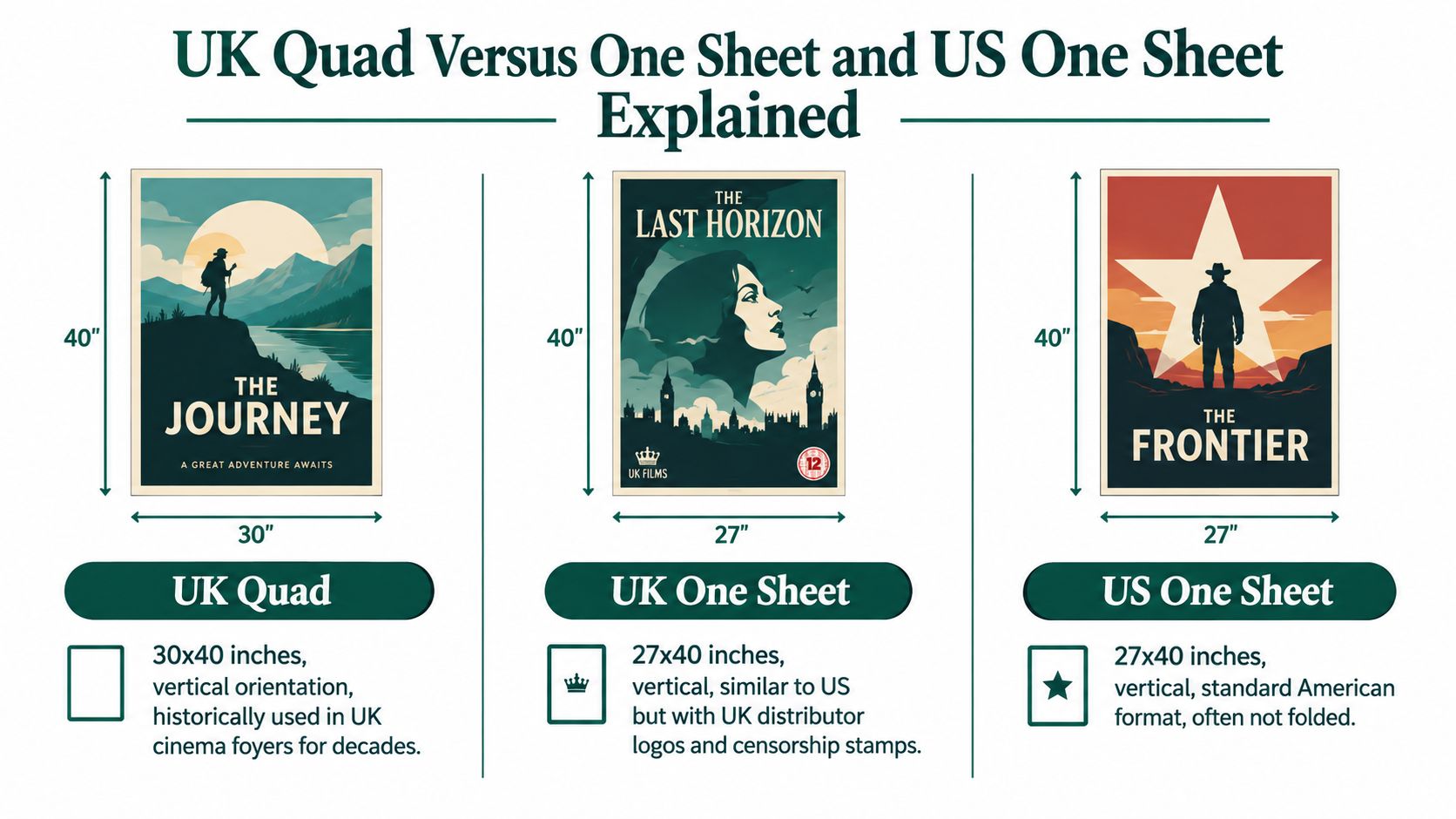
Here's the short version. The British Quad is the classic UK cinema format. The British One Sheet is a later portrait-format alternative. The US One Sheet is also portrait and can look similar at first glance, but it belongs to a different cinema system and shouldn't be mistaken for a British original.
Pulp Fiction Poster Formats at a Glance
| Format | Size | Orientation | UK Relevance for Pulp Fiction |
|---|---|---|---|
| UK Quad | 30 x 40 inches | Landscape | The key format for the 1994 UK original |
| UK One Sheet | 27 x 40 inches | Portrait | More relevant to later UK usage than to the classic 1994 British issue |
| US One Sheet | 27 x 40 inches | Portrait | Collectable, but not a UK original format |
The accepted UK size references are straightforward. The British Quad measures 30 x 40 inches and is the long-established, most common UK poster format. The British One Sheet measures 27 x 40 inches and is portrait in layout (UK movie poster names and sizes).
Why the Quad matters most
For Pulp Fiction, the UK Quad is usually the format a British collector means when they say “original UK poster”. It's wide rather than tall, so the artwork sits differently on the paper. That alone weeds out many mistaken listings.
Measure first. Don't estimate from photos.
A poster around 30 x 40 inches fits the classic British expectation for this title. A portrait poster around 27 x 40 inches needs more scrutiny. It may still be a legitimate poster, but it doesn't automatically match the standard first-release UK collecting target.
When a 27 x 40 poster changes the conversation
Independent UK cinema-poster guidance states that the UK One Sheet is 27 x 40 inches and became common practice in UK cinemas around the year 2000, in line with the US cinema standard (UK cinema poster sizes guide). That makes a useful dating checkpoint.
If a seller presents a portrait 27 x 40 Pulp Fiction poster as the standard 1994 UK cinema original, I'd want a very good explanation. It may be later UK usage, or a non-UK format being described loosely.
Artwork differences aren't a minor detail
Collectors sometimes assume that if the image is recognisable, the format doesn't matter. It does.
Different formats often involve slight cropping changes, logo placement changes, certification details, and changes in how text sits around the image. A design that looks “basically the same” in a thumbnail can prove to be a different issue once you see the borders and layout properly.
For buyers who want a deeper primer on the general distinction, this guide on the difference between a one sheet and a quad movie poster is a useful companion.
Buy the format first, then the image within that format. Collectors who reverse that order usually overpay for the wrong thing.
How to Authenticate an Original and Spot Reprints
A seller sends you a "rare original" Pulp Fiction poster. The photo looks right at first glance. Then the measurements are vague, the borders are cropped tight, and there is no clear shot of the fold pattern. That is usually where the trouble starts.
With this title, the trouble is predictable. The recalled Lucky Strike image has been copied for years, and many buyers focus on the artwork before they check whether the sheet itself behaves like a 1994 UK cinema poster. For a UK collector, that order needs reversing.
Start with the physical format, not the story
The recalled design matters because it can be valuable. It also attracts the worst descriptions.
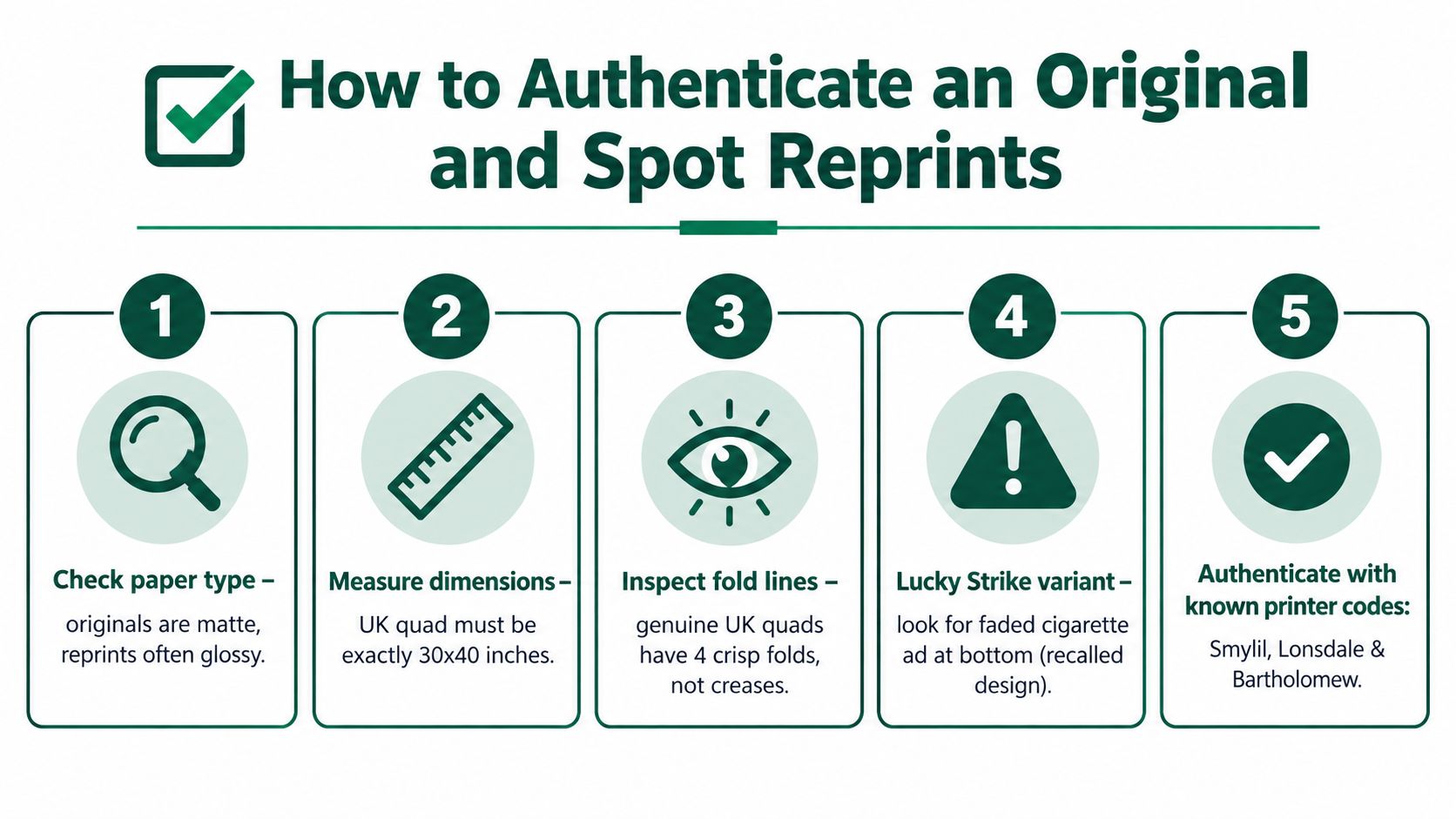
If someone is offering a 1994 UK Quad, I want evidence of a period UK cinema printing. The recalled image on its own proves nothing. Anniversary reissues, commercial reproductions and modern bootlegs can all copy the same art. The useful checks are plain ones. Exact size, correct proportions, period fold pattern, border width, paper stock and print texture.
The first hard filter is simple. Ask the seller to measure the sheet edge to edge on a flat surface and photograph all four borders. A true UK Quad should look like a UK Quad before you worry about rarity.
Print tells that separate originals from copies
Under magnification, originals and later copies part company quickly.
A genuine period offset print should show a regular lithographic dot structure. Reprints often show digital patterning instead, with fuzzy rosettes, sprayed-looking colour transitions or blacks that sit flat and dead on the paper. I also check the fine type. On copies, small credits and legal text often look slightly thick, soft or broken, even when the main image looks convincing in a phone photo.
Borders help more than buyers expect. Bootlegs commonly miss the original spacing by a small amount, especially where the image sits within the sheet. If one side looks pinched, or the artwork appears enlarged to fill the paper, I assume reproduction until proven otherwise.
Paper matters too. Cinema paper from the period tends to feel functional, not decorative. If the surface is overly glossy, bright white, or heavy like a modern art print, that needs explaining.
The fold question is part of authentication
For this title, folds are not just a condition point. They are part of the identification.
Many supposed originals turn up rolled because rolled posters are easier to sell to newer buyers. Sometimes that is fine. Sometimes it is a later issue, or a copy printed for the retail trade rather than cinema use. A seller should be able to describe the fold history clearly. If the poster was folded, ask for close shots of the crossfolds. If it was rolled, ask why, and ask whether there is any provenance behind that claim.
Linen backing also needs care. Backing can preserve a poster well, but it can hide restoration, trimmed edges and signs that would otherwise help date the piece.
Seller language usually gives the game away
I pay close attention to how the poster is described.
Good sellers separate UK Quad, UK One Sheet and US One Sheet properly. They say whether the poster is folded or rolled, whether it has been backed, and whether they believe it is first release, recalled, later issue or anniversary material. Weak listings drift into phrases like "collector print", "museum quality" or "super rare original style". Those phrases sell mood, not evidence.
For a broader baseline on what UK collectors should expect from genuine cinema paper, this guide to original movie posters in the UK is a sensible reference point.
Questions worth sending before you buy
Keep the message short and specific.
- Is this a 1994 UK Quad, a later UK issue, or a US format?
- What is the exact measured size, edge to edge?
- Was it issued folded or rolled, and can you show the fold intersections or the absence of them?
- Can you provide close photos of the borders, corners, credits and any printer's details?
- Has it been linen backed, trimmed, restored or cleaned?
- If you are calling it the recalled Lucky Strike version, what physical features support that identification apart from the image?
A careful seller will answer those plainly.
Source discipline carries over from other areas of collecting too. If you also buy music paper, a guide on where to find a Cure poster makes the same point from a different angle. The item matters, but the seller and the evidence matter just as much.
Condition Grading and What Fold Lines Really Mean
Condition is where many buyers either overreact or switch off. Neither helps. A Pulp Fiction original should be judged in the context of how UK cinema posters were distributed and handled, not by modern print-shop perfection.
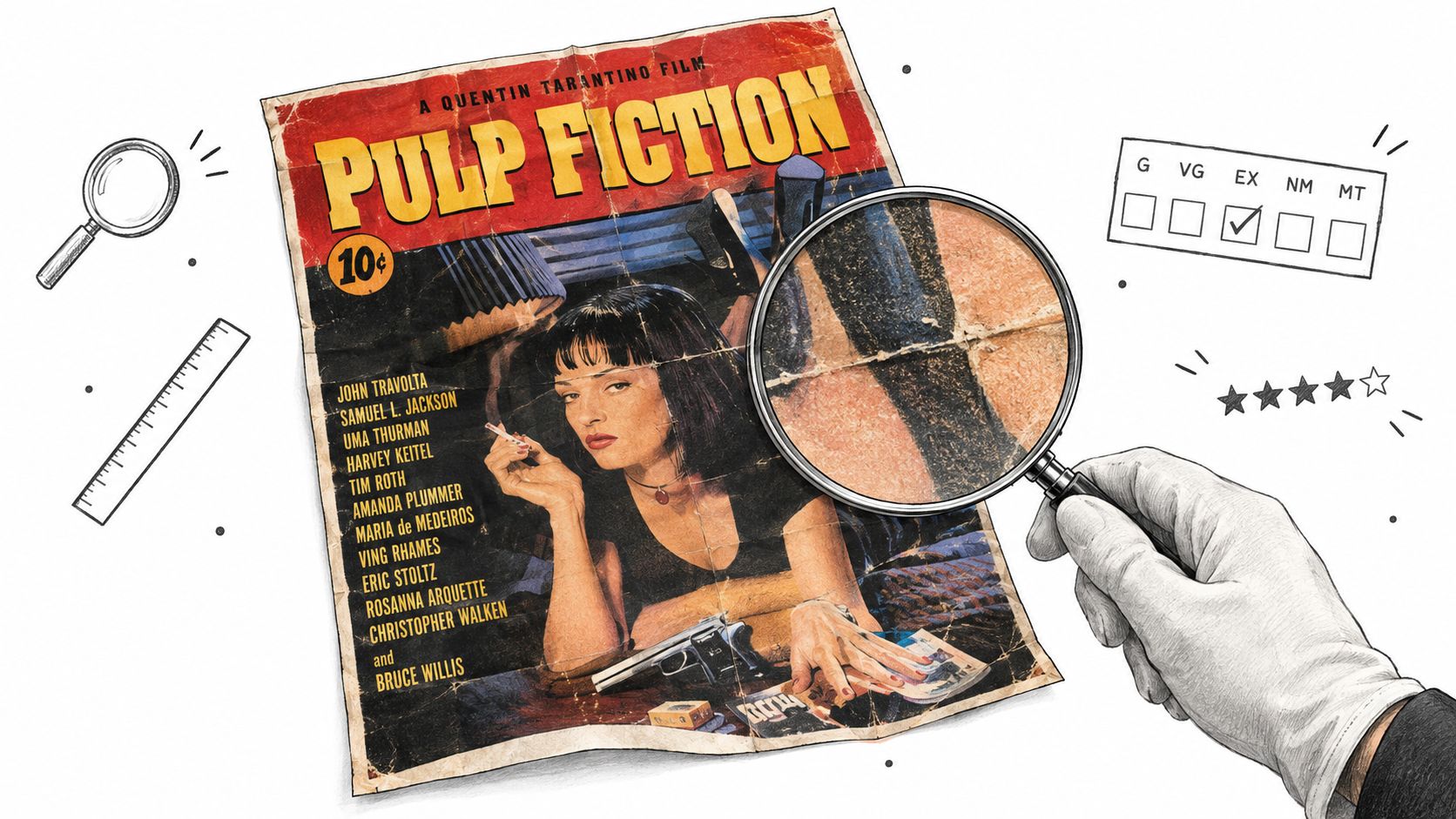
For UK posters, the practical handling rule is established. A UK collecting guide notes that the British Quad remains the standard size for UK movie posters and that older posters were usually folded at the time of printing, while more recent posters are often rolled (UK poster size and handling guide). For a 1994 Quad, fold lines can be entirely period-correct.
Folds are not automatically damage
A folded original from the period should not be marked down in your mind because it isn't flat and rolled. Collectors who only buy rolled posters often end up applying the wrong standard to titles from the folded era.
That doesn't mean all folds are equal. Clean, stable fold lines are one thing. Fold wear, separation at crossfolds, tape marks or paper loss are another.
Collector's rule of thumb: Period folds support authenticity. Condition depends on how those folds have survived.
What to inspect in listing photos
Condition descriptions vary, so ask for images that let you judge the paper yourself.
- Corners and edges show whether the poster was handled roughly, pinned repeatedly or trimmed.
- Fold intersections reveal the most vulnerable stress points.
- Surface colour tells you whether the blacks remain strong and whether the reds and yellows still present well.
- Reverse shots, if offered, can help identify repairs, tape residue or backing work.
- Border width helps confirm whether the poster remains at proper format size.
Linen backing and desirability
Linen backing isn't automatically a plus or a minus. It depends on why it was done, how well it was done, and what the collector wants. Some buyers like the stability and display ease. Others prefer untouched paper, even with honest age and fold character.
Where buyers go wrong is assuming backing erases all condition questions. It doesn't. It changes them. Once a poster is backed, you need to know what was conserved, what was restored, and whether any cropping or edge work altered the original sheet.
For this title, I'd rather own a straightforward, honest original with visible age than a heavily altered piece presented as “mint” without explanation.
Typical UK Price Ranges and What Drives Value
Pulp Fiction sits in that healthy part of the market where demand is broad, the image is iconic, and original material remains desirable across both film fans and paper collectors. That doesn't mean every example is expensive. It means the spread between ordinary and strong examples can be significant.
A useful UK snapshot comes from auction and retail references that show how much format, condition and release type can move the needle.
Indicative UK Market Examples for Pulp Fiction Quads
| Variant | Condition Detail | Indicative UK Price |
|---|---|---|
| 1994 early UK Quad | Double-sided, unfolded example catalogued in a London auction | £200 to £300 |
| Original UK Quad retail example | Standard original listing | £375 |
| 2024 anniversary British Quad | Later anniversary release listing | £595 |
Those figures come from UK auction and retail material showing a condition-driven spread for the title, including a 1994 early double-sided unfolded example at £200 to £300, a separate original UK Quad retail example at £375, and a 2024 anniversary British Quad listed at £595 (Propstore poster auction catalogue).
Why the spread exists
The numbers only make sense when you compare like with like.
An unfolded original often carries a premium because many period posters were folded in circulation. A clearly identified original UK Quad sits in a different lane from a later commemorative issue. An anniversary release may command strong money if demand is high and presentation is sharp, but that doesn't make it a substitute for a 1994 first-release piece.
Then there's the recalled-design factor. Market attention around rare Pulp Fiction poster material in Britain has been strong enough that UK coverage reported a recalled original expected to fetch up to £1,500 at auction, while a London sale of Pulp Fiction-related poster material at Propstore closed at £3,150 in 2024. The same report also noted that more than 550 cinema posters worth over £200,000 were being sold in London, which gives a sense of the wider collector appetite around that auction environment (UK auction coverage of recalled poster demand).
How to use price without being misled by it
Don't treat prices as a menu. Treat them as context.
If a seller offers a supposed 1994 UK original at a suspiciously low level, that may reflect condition, but it may also reflect misidentification or reproduction status. If a seller asks a premium, the poster needs to justify it through format, originality, condition or scarcity. Price alone proves nothing.
The safest approach is to build a budget around the specific category you want. Decide first whether you want a 1994 UK original, a recalled-design specialist piece, or a later authorised anniversary poster. Once that decision is fixed, prices become far easier to read.
Framing Shipping and Long Term Care for Collectors
Once you've bought the right poster, the next risk is damaging it after the fact. That happens more often than most collectors admit. Framing, packing and storage matter because paper damage usually arrives through ordinary handling, not dramatic accidents.
Frame for the actual format
A 30 x 40 UK Quad needs a frame sized for a British poster. A 27 x 40 One Sheet needs something different. Don't force one into the other with trimming, pressure or oversized mounts that leave the sheet shifting inside the frame.
Use archival methods. Acid-free backing, stable mounts and non-reactive materials are the standard to aim for. If the poster has folds, the frame should accommodate the sheet without flattening it aggressively under poor materials.
For buyers comparing options, this guide on how to frame a poster covers the fundamentals well.
What good shipping looks like
A serious poster should travel in a way that respects the paper.
- Custom tubes reduce slack and movement in transit.
- Acid-free tissue protects the printed surface.
- Kraft paper layers help buffer against abrasion.
- Format-aware packing matters because a UK Quad and a One Sheet don't roll and sit in exactly the same way.
If you're buying from abroad, ask how the poster will be packed before you pay. A good item sent badly can arrive as a compromised item.
Storage between display periods
If the poster isn't going straight on the wall, store it somewhere dry, clean and stable. Avoid lofts, garages and anywhere temperature or moisture swings sharply. Keep it away from direct light. Handle it with clean hands and a cleared surface. If the sheet is valuable or delicate, archival sleeves or proper flat storage are better than improvising with household materials.
Collectors who stay patient at the buying stage should stay just as patient once the poster arrives. Preservation isn't exciting, but it's what keeps a good piece good.
If you're looking for a genuine Pulp Fiction original movie poster, or want help separating a true UK Quad from later reissues and lookalikes, Famous Movie Posters specialises in guaranteed original cinema posters with careful authentication, protective packing and UK-focused format guidance. If the title you want isn't currently listed, their Request a Poster service is a sensible route for sourcing hard-to-find originals without gambling on vague marketplace listings.