



You've found a Reservoir Dogs poster with the right artwork, but the listing leaves you guessing. Is it a British cinema original, a later theatrical printing or a decorative reproduction? Before you pay, you need more than a familiar image and the word original in the description.
The useful checks are practical: identify the format, establish which printed version is being offered, inspect the paper and compare like-for-like sold examples. Then budget for getting it home and protecting it properly. A good purchase can become an expensive mistake if the seller's packing or your framing method damages the sheet.
Table of Contents
- Reservoir Dogs Poster Sizes and Versions at a Glance
- Artwork and UK Release History to Know
- Verify Authenticity and Buy with Confidence
- What Shapes the Value and How to Benchmark
- Shipping and Handling Your Poster
- Storing and Displaying a Paper Poster Safely
- Framing Options and When to Choose Each
Reservoir Dogs Poster Sizes and Versions at a Glance
You're holding the poster by its edges, trying to decide whether its shape matches the listing. Orientation comes first. A British Quad is horizontal, while a US One Sheet is vertical. They aren't interchangeable descriptions, and a frame advertised for one won't automatically suit the other.
The Propstore UK Quad catalogue documents the British cinema format at approximately 30 × 40 inches, with single-sided and double-sided Reservoir Dogs examples recorded. Side printing is therefore something to establish, not something to assume from the title.
Reservoir Dogs poster formats
| Format | Orientation | Size | Side printing |
|---|---|---|---|
| UK Quad, 1992 cinema release | Landscape | 30 × 40 in (76 × 102 cm) | Unconfirmed for the individual sheet, request a reverse photograph |
| UK Quad, 1993 archive record, single-sided | Landscape | 30 × 40 in (76 × 102 cm) | Single-sided |
| UK Quad, 1993 archive record, double-sided | Landscape | 30 × 40 in (76 × 102 cm) | Double-sided |
| US One Sheet | Portrait | 27 × 40 in | Confirm from the individual sheet |
Use this as a format lookup, not a valuation table. A double-sided example isn't automatically worth more than a single-sided sheet. Nor does the presence of printing on the reverse establish when the poster was produced.
Ask for a photograph of the whole reverse rather than a close crop. You need to distinguish a printed reverse from an image showing through the paper.
Our guide to the difference between a One Sheet and a Quad movie poster helps if a seller mixes the terms. For this title, the horizontal dimensions point towards a British Quad and the portrait dimensions towards a US One Sheet. Side printing then helps distinguish the archive-listed British variants, but it doesn't authenticate them by itself.
Artwork and UK Release History to Know
Reservoir Dogs reached British cinemas in 1992 as an independent crime film directed by Quentin Tarantino, and the Original Film Art UK poster record associates the British campaign with “Let's go to work” imagery and blood-splatter artwork credited to Graham Humphreys. That attribution matters: it identifies a specific contribution to the campaign, rather than claiming that every element of the composition was his.
The British artwork became closely associated with the film's cult identity. Its appeal to a collector isn't just that it looks striking on a wall. An original theatrical sheet preserves material made to sell cinema tickets, not artwork subsequently adapted for home entertainment or reproduced for decoration.
Film dates and poster dates aren't the same
Say you find two apparently similar Quads with different catalogue years. That discrepancy needs an explanation, but it isn't automatically evidence that one is wrong. Film on Paper's archive records 1993 UK Quads in both single-sided and double-sided forms, with the blood-splatter contribution attributed to Humphreys.
A 1993 Quad date does not mean the film opened in Britain that year. It can describe the particular printed or circulated version being catalogued. A seller should distinguish the film's release year from the date assigned to the object.
The BBFC classification record lists cinema submissions dated 25 June 1992, with Rank Film Distributors, and 20 November 1992. Those entries place the British campaign within the original exhibition history, but a classification date alone doesn't date an individual sheet.
The film also returned to UK cinemas in June 1994, according to the Reservoir Dogs release history. Later cinema circulation is another reason not to treat every theatrical poster bearing the title as an original-run printing.
What to record from a listing
- Year: Record whether the seller means the film year or the poster's attributed printing or circulation year.
- Side printing: Save a reverse photograph alongside the description.
- Artist credit: Note the precise attribution, including whether it refers specifically to the blood-splatter artwork.
Use these checks before treating a catalogue description as settled.
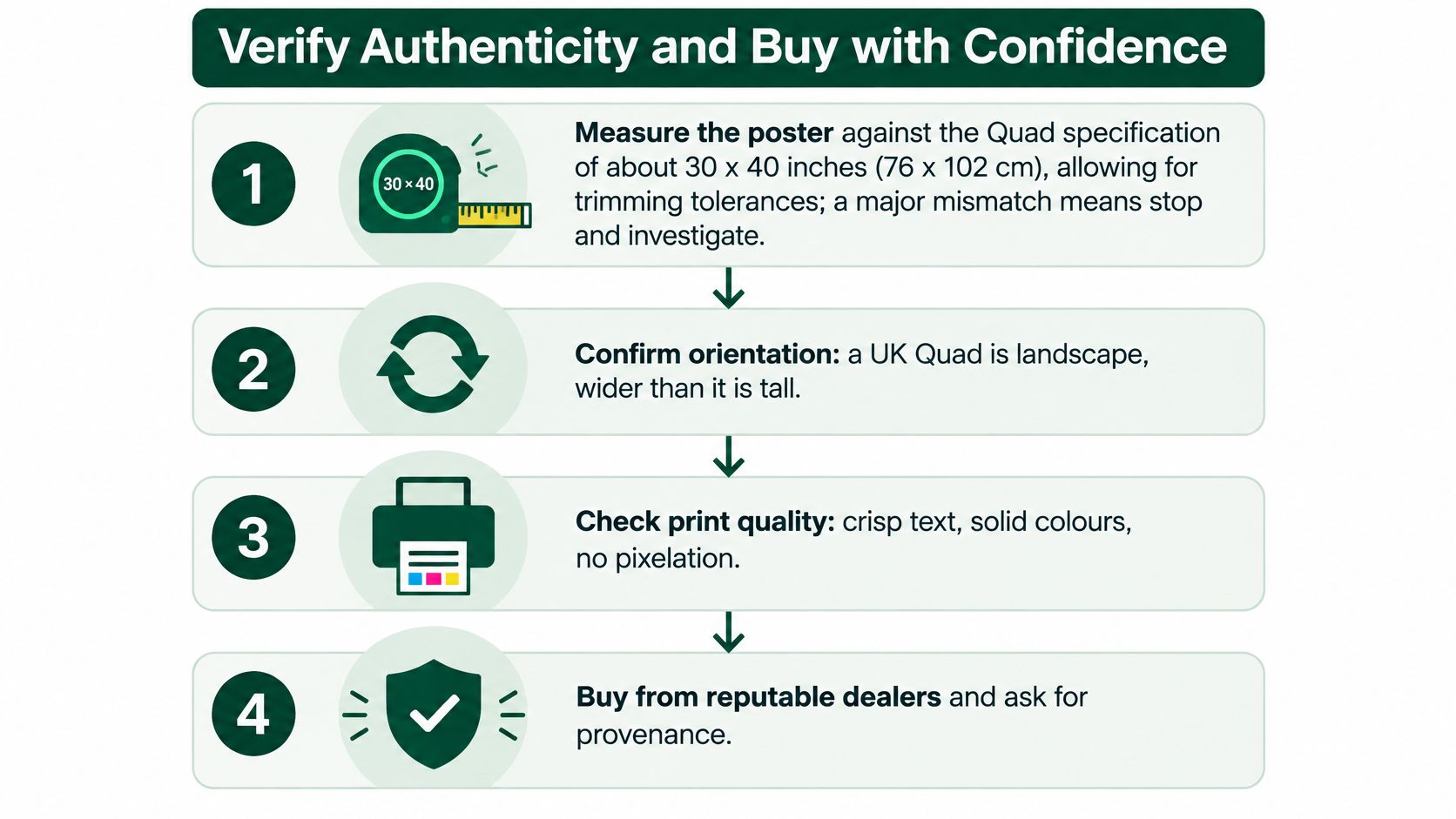
Verify Authenticity and Buy with Confidence
No single check proves originality. The aim is to establish whether the dimensions, printing, paper and ownership history form a consistent account. If they don't, stop before trying to explain away the mismatch.
Checks to make with the poster in hand
- Measure the actual paper. The British Quad specification is approximately 40 × 30 inches (101.6 × 76.2 cm) in horizontal orientation, as described in the Eastern Daily Press guide to cinema posters. Allow for modest trimming tolerances, but investigate a substantial mismatch rather than accepting a claim that all old posters differ.
- Confirm the orientation. Read the artwork in its intended position. A British theatrical example should have horizontal proportions; don't judge it against a portrait-format template.
- Reconcile the catalogue details. Check the stated poster year and side printing together. If the description gives one version but the reverse photograph suggests another, ask the seller to correct or substantiate it.
- Compare the campaign artwork. Examine the lettering, credits, composition and blood-splatter treatment against a documented example. Familiar imagery isn't enough, because a reproduction can copy it.
- Inspect the physical printing. Use a magnifier for small lettering and printer marks, then a torch held at a shallow angle to reveal folds, surface abrasion and repairs. Pixelation is a warning, but crisp printing alone isn't a certificate of age.
Don't scrape an edge, wet the paper or attempt a solvent test. These checks should remain non-destructive, particularly if you may need to return the sheet.
Questions to settle before paying
Request a full front photograph, a full reverse photograph and close-ups under raking light, meaning light directed across the surface rather than straight at it. Ask for the exact format, measured dimensions, attributed year, side printing and artwork credit in writing.
Then establish the commercial terms:
- Provenance: What does the seller know about where the poster came from?
- Originality: Will the seller confirm theatrical originality in writing?
- Condition: Are there repairs, backing, trimming or concealed losses?
- Returns and packing: What happens if the description is wrong or the parcel arrives damaged?
For broader collecting discipline, Volkswagen Memorabilia's smart buying tips for diecast collectors offer a useful companion perspective. The relevant habit is to verify the specific object rather than rely on a recognisable subject or persuasive listing.
Our guide to original movie posters in the UK provides further context. At Famous Movie Posters, we sell only guaranteed originals, with hundreds of posters searchable by decade, genre or franchise; if the version you want isn't listed, our request form lets you specify it, and we'll do our very best to get it.
The visual checklist can help organise an inspection, but packaging or a scannable code cannot establish a vintage poster's originality.
Passing the checks is consistent with an original, not proof. If doubts remain, consult a paper conservator or specialist auction house.
Walk away if the seller can't give a coherent answer on format, year, side printing and provenance.
What Shapes the Value and How to Benchmark
An asking price tells you what a seller wants, not what a comparable poster sold for. Start with the object's identity and condition before attaching any figure to it. A listing without dimensions or format is too incomplete for a meaningful comparison.
The main value drivers are straightforward, but they interact:
- Specific version: Separate an original-release cinema Quad from an archive-dated variant rather than grouping every British sheet together.
- Overall condition: Assess folds, tears, fading, staining and paper loss. Record whether rolled storage is documented, not merely implied by the absence of visible folds.
- Side printing: Match the printing configuration when comparing examples.
- Format rarity: Look for evidence of availability, not an unsupported rare label.
- Provenance: Retain documentation that connects the sheet to its described history.
- Alterations: Record backing, repairs and permanent mounting. Don't compare an altered sheet with an untouched example without allowing for the difference.
Build a useful sold-results record
First, identify the version using the physical checks. Save the listing photographs and description so you aren't relying on a seller's title after the page disappears.
Next, find completed specialist auction results for the same format, side printing and comparable condition. Read the condition report rather than judging from the thumbnail. A clean-looking image may conceal restoration or losses described elsewhere in the catalogue.
Finally, record the sale date, condition and whether the published result includes the buyer's premium. If you must add fees or delivery, keep those separate so you don't compare a hammer price with another buyer's total outlay.
Benchmarking rule: The closer the physical match, the more useful the sale. A dramatic-looking result for a different version is a weak comparison.
Without verified sold records for each version, a broad price range would give false confidence. Use a short comparison sheet with columns for version, condition, sale date, result basis and supporting photographs.
A claimed original offered far below comparable sold examples deserves scrutiny, not an automatic purchase. It might have an ordinary explanation, but you should establish that explanation before paying.
Decide whether you're buying a collectible to preserve or a display piece to enjoy. Both are reasonable choices. They lead to different tolerances for existing damage and different protection budgets.
Shipping and Handling Your Poster
Choose the packing method before the seller dispatches it. Flat delivery between rigid boards is preferable where practical, especially for a sheet that shouldn't be forced into a curve. Rolled delivery can work, but the tube must be sturdy, the roll loose enough to avoid compression and the contents secured against movement.
For the conservative packing approach described here, use a tube longer than the poster's long edge. An oversized tube isn't protection by itself: the wrapped roll also needs support so it can't slide into an end cap.
Agree the packing and delivery
- Ask whether it will travel flat or rolled. Don't assume the method from a stock photograph of a mailing tube. If the sheet is fragile or heavily folded, discuss whether rolling is appropriate at all.
- Specify the protective layers. Use acid-free tissue or suitable conservation wrapping against the paper, with no tape touching the poster. Tape should secure the outer wrapping, not the collectible.
- Arrange tracked, signed-for delivery with insurance at the declared value. Confirm that the courier's terms cover paper collectibles and the parcel's dimensions. A booked insured service isn't necessarily cover for every type of item.
Open the parcel without adding damage
Photograph the parcel before opening, including dents, crushed ends or damp patches. Then photograph the protected contents before unrolling or unfolding them. Cut tape away from the poster, keeping blades outside the protective inner wrapping.
Support the sheet on a clean, dry table. Don't pull a tightly curled edge flat or weigh it down with household objects; stop if the paper resists. Rolling under pressure can introduce permanent creases, and removing those is a conservation problem rather than a home-flattening job.
Check the corners, folds and edges against the seller's photographs, then report discrepancies within the agreed returns window. Keep all packaging until the matter is settled.
Agree delivery timing so the parcel isn't left in a hot or damp porch. Once unpacked, move it into stable interior storage, not back into a transit tube indefinitely.
Storing and Displaying a Paper Poster Safely
Treat museum limits as a practical target for the room, not a reason to assume that a frame makes the poster safe. Museums Galleries Scotland's paper-care guidance recommends 45–65% relative humidity, short-term fluctuations of approximately ±5%, temperatures of 10–20°C, display light no higher than 50 lux and an annual dose of about 100,000 lux-hours.
Storage and display limits for paper posters
| Factor | Recommended limit | Why it matters |
|---|---|---|
| Relative humidity | 45–65% | Reduces conditions that make cellulose fibres swell and shrink |
| Short-term humidity change | Within about ±5% | Limits distortion and loss of flexibility |
| Temperature | 10–20°C | Supports slower chemical ageing and reduces damaging heat exposure |
| Light level during display | Maximum 50 lux | Reduces fading and yellowing |
| Annual light dose | About 100,000 lux-hours | Provides a basis for rotating the poster into dark storage |
| Storage location | Away from radiators, bathrooms, windows and direct sunlight | Avoids humidity swings and light damage |
Paper responds to moisture in the air. As cellulose fibres absorb and release water, they change dimension; repeated cycling can distort the sheet, reduce flexibility and cause shrinkage. Stability matters as much as choosing a reading within the recommended band.
Light causes a different set of problems. It accelerates cellulose breakdown and can fade, yellow or bleach the image and leave the paper brittle. UV protection doesn't remove the need to control visible light.
Make the room work for the poster
Choose an interior wall away from heating, plumbing and direct daylight. Use a digital thermometer-hygrometer to check the room rather than relying on whether it feels comfortable, and use a lux meter to assess the display position.
For cumulative exposure, multiply the measured illuminance in lux by the hours displayed. Keep a simple log and include daylight exposure, not just the hours when a picture light is switched on. Rotate the poster into dark storage before the recommended annual allowance is exhausted.
Store it supported in a suitable conservation folder or enclosure, without heavy objects pressing on the image. Our movie poster storage FAQ can help you plan an arrangement that also makes retrieval safer.
This month's routine: Choose the room, record the display hours and set a rotation reminder. A manageable routine is more useful than protective materials left unused.
Framing Options and When to Choose Each
The cheapest frame isn't necessarily the cheapest way to own an original. Acidic backing, unsuitable mounting and poor light control can leave you paying for conservation work or accepting permanent damage. Spend on the materials touching and surrounding the paper before paying extra for an elaborate moulding.
Icon's guidance on caring for art on paper supports UV-filtering glazing, acid-free or cotton-based boards, separation from the glazing and reversible mounting. Those are the specifications to discuss with a framer, rather than accepting conservation as an unexplained label.
Indicative framing costs for a UK poster
| Option | Indicative cost | Key features |
|---|---|---|
| Basic conservation materials | About £80 | Acid-free or cotton-based boards, reversible paper hinges |
| With UV protection | About £100 | Adds UV-filtering glazing |
| Museum-grade framing | £250 or more | Full conservation specification, chemically stable boards, UV-filtering glazing and reversible mounting |
These are indicative budgeting figures, not quotes for a particular frame. Ask for an itemised specification covering glazing, backing, hinges, spacers and fitting. A price alone doesn't tell you whether the poster can later be removed safely.
Standard decorative framing may be acceptable for replaceable wall art. An original theatrical sheet needs a different approach: an air gap prevents contact with the glazing, while suitable paper hinges support the poster without permanently bonding its whole surface to a board.
Avoid lamination and adhesive mounting for a collectible. They can make later treatment difficult or impossible and usually reduce long-term collectability. A perfectly flat appearance isn't worth achieving through an irreversible process.
Choose the specification around the actual sheet
Ask yourself these questions before approving the work:
- How fragile is it? Brittle paper, torn folds or old repairs may need a conservator's assessment before a framer handles it.
- How long will it be displayed? A permanent wall position needs a realistic rotation plan, not just upgraded glazing.
- How much sunlight reaches the wall? If direct sun crosses it, choose another location. More expensive glass isn't permission to use a damaging position.
- What can the budget support? If proper framing isn't affordable yet, protected dark storage is preferable to permanent cheap mounting.
I would prioritise reversibility and stable materials, then choose the moulding around the remaining budget. Ask the framer how the sheet will be removed, what adhesive will be used on the hinges and whether the backing specification will appear on the invoice.
Choose a framing tier, obtain the written specification and confirm that the mounting can be reversed before handing over the poster.
At Famous Movie Posters, we offer guaranteed original cinema posters and a request service for specific titles and versions. Visit Famous Movie Posters to browse the catalogue or tell us which Reservoir Dogs poster you're seeking, including the format and side printing you want.