



If the sheet only says Singin' in the Rain, do you know which printing you are holding? Most buyer notes stop at original versus reprint. That split is too coarse. A 1952 cinema sheet, a later British revival and a London stage poster can share the title and still belong to different decades, different sizes and different prices.
Singing in the Rain posters are dated documents. The useful work is matching edition, period and marks before you talk about grade or a frame.
Table of Contents
- Singing in the Rain Poster Variants at a Glance
- Dating and Authenticating an Original Poster
- Condition Factors That Move a Poster's Value
- Storing Your Poster Without Damaging It
- Display and Framing for Quads and One Sheets
- Confirm the Edition Before You Buy or Request One
Singing in the Rain Poster Variants at a Glance
| Edition | Period | Identifying marks |
|---|---|---|
| 1952 US one sheet | 1952 original release | US printing, studio and printer credits |
| UK quad | Original UK issues, standard quad size | UK distributor and printer details |
| London Palladium stage poster | c. 1983 stage production | Names Roy Castle; calls it the first-ever stage production; V&A S.3198-1994 |
| BFI-linked UK revival material | 2019 UK re-release | Later distributor and campaign markings |
| International issues | Each country's own release year | Country of issue and measured sheet size |
Read the rows as a lookup, not as proof. A match tells you what to ask for next.
1952 US one sheet. This is the portrait sheet often meant when searching the film, at 27 x 41 inches. Look for US printing, studio credits and a printer's line. A pretty image with none of those lines is not this row.
UK quad. Sellers in Britain usually mean a 30 x 40 inch sheet (76 x 101.6 cm). The marks that matter are a UK distributor and a UK printer, not the film still alone. If you are still mixing the two cinema formats, the difference between a one sheet and a quad is the cleanest way to separate them before you compare prices.
London Palladium stage poster. The Victoria and Albert Museum records a London-made poster of about 1983 for the London Palladium, where the musical opened on 30 June 1983 at Oxford Circus. It promoted the show as the "first-ever stage production", named Roy Castle, and classed the event as a musical and a world premiere. The sheet is 50.7 cm high by 31.8 cm wide, held as S.3198-1994. Date, venue, performer and that accession number separate a theatrical poster from an undated decorative print. A cinema still with no Palladium wording is a different object.
2019 UK revival material. A later British campaign can be a genuine poster and still not be a 1952 issue. Expect a later distributor and campaign type, not the printer lines of the first run.
International issues. Sizes are not shared across countries. Measure the sheet. Do not borrow the US or UK figure.
Put one question to any listing: which edition is this, and which row does it match?
Dating and Authenticating an Original Poster
Work with the sheet in hand. No single check settles it. A seller who gives measurements, printer details and provenance is easier to trust than a title and a photo.
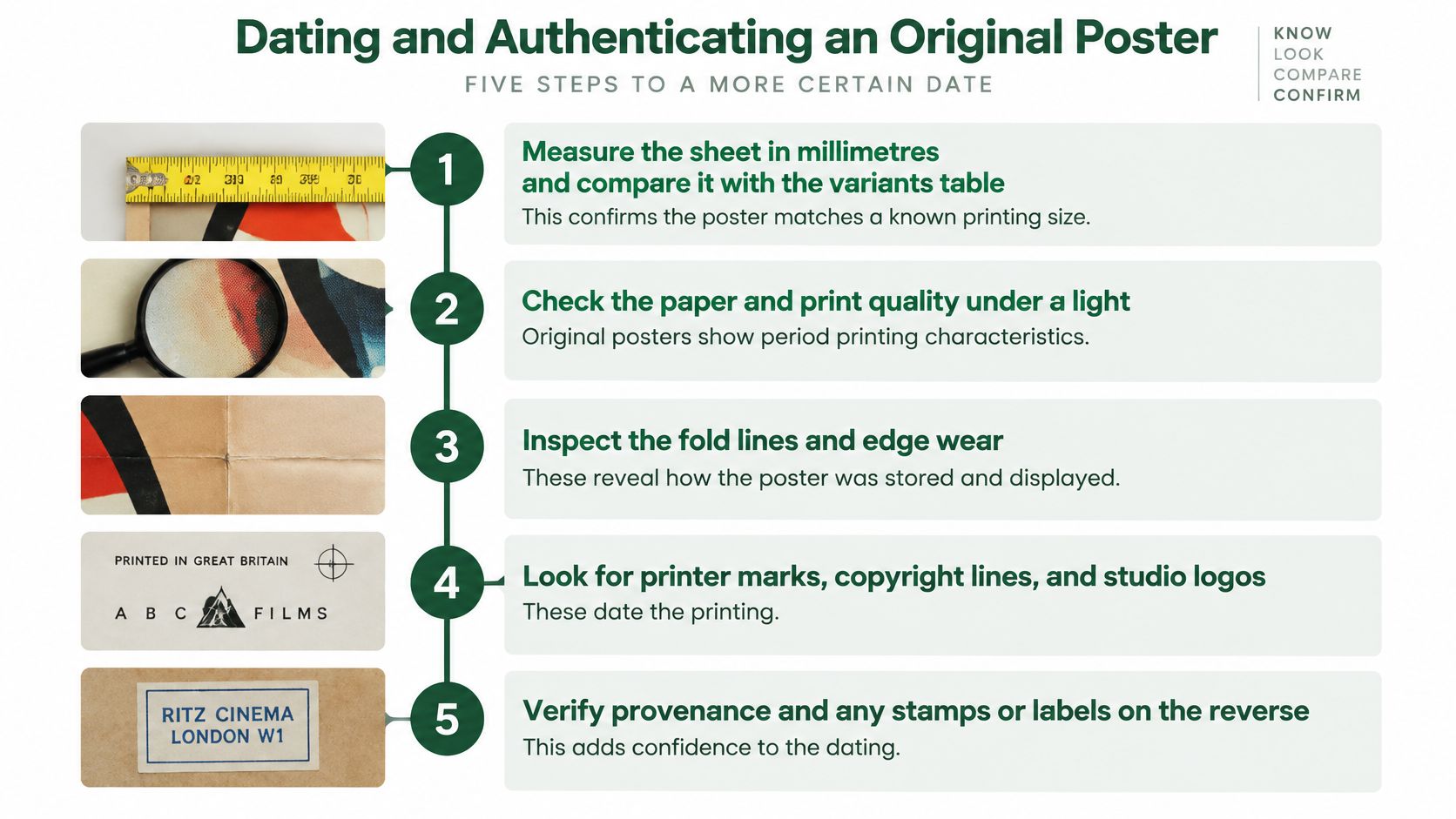
- Measure in millimetres and set the result against the variants table. "One sheet" is not one universal size, so a label on its own can send you to the wrong frame.
- Check orientation. BFI catalogue records list single sheets at 1,017mm by 763mm and, separately, a vertical one sheet printed in the USA. Country of issue and trim both change what you should order.
- Read the printer, studio and distributor lines and compare them with a known copy of the same edition. Credits are where a revival campaign usually gives itself away.
- Check the title styling. The BFI catalogues the film as Singin' in the Rain, while plenty of listings write "Singing in the Rain". Wording on its own proves nothing.
- Look for venue or production wording. Palladium, a performer's name, or "stage" points away from the 1952 cinema run.
- Compare the release context. The British Board of Film Classification lists a 1952 production of 102 minutes and 38 seconds, with a UK release dated 22 August 2019 through BFI Films. That engagement opened on 18 October across 31 screens and took $22,618. A revival poster can be genuine and still not be a first-release original.
- Confirm the paper has not been trimmed. Trimming changes the measured size and can remove the very credits you need.
- Note paper and later printing. An undated, decorative finish belongs with reproductions, not with a dated cinema issue.
Practical rule: If two checks disagree, stop and ask for the missing measurement or the printer line. Do not average them into a guess.
For a wider sense of what "original" means on the British market, see original movie posters in the UK. I would not buy from a description that cannot name the edition.
Condition Factors That Move a Poster's Value
Grade follows what the paper has been through, and not every mark costs the same. Some marks are the history of a folded cinema sheet. Others cut stability, display and price.
| Factor | What to check | Effect on value |
|---|---|---|
| Folds and creases | Original fold lines versus later damage | Heavy creasing lowers grade |
| Tears and losses | Edges, corners and missing paper | Reduces value and display options |
| Restoration or mounting | Records of past repair and any float or sling mounting | Undisclosed work lowers grade |
| Ink loss and fading | Colour strength in daylight and under UV | Affects appearance and authenticity |
| Adhesive and tape damage | Residue, lifted paper and staining | Recognised conservation issue, lowers grade |
Folds versus later creases. A cinema sheet was often folded for posting. Those lines are expected. Fresh breaks, crushed corners and random creases are handling damage. BFI paper conservators list severe creases and folds, tears, losses, and earlier conservation that may itself have damaged the item. Heavy creasing lowers grade because it affects stability, not only looks.
Tears and missing paper. Check edges and corners. A loss that reaches the image, or a tear that will open when the sheet is lifted, narrows both price and how you can show it.
Restoration. Previous work can be the damage. Undisclosed repair deserves a lower grade and a written line of its own. Conservators may humidify paper with fine water vapour so fibres relax, then use float mounting, sling mounting or Melinex corners. Those are specialist jobs. Do not flatten, wash, trim or mount a brittle sheet, old tape, ink loss or an old repair at the kitchen table.
Ink and tape. Weak colour can be fade, or it can be a later print. Tape residue, lifted fibres and stain are conservation problems, not "light wear".
Record each mark on its own line. Then sort the sheet:
- Original and unrestored. Period credits, honest folds, no added repair.
- Original with declared restoration. The same credits, plus a stated repair or mount.
- Reproduction. No period printer line, or a decorative finish with no exhibition date.
Storing Your Poster Without Damaging It
Stable air beats a heroic low number. The BFI collection policy treats posters as paper and, following BS5454, recommends 16–19°C and 45% to 60% relative humidity.
| Condition | Recommended benchmark | Why it matters |
|---|---|---|
| Temperature | 16–19°C | Stable conditions slow paper ageing |
| Relative humidity | 45%–60% | Damp promotes mould, foxing and cockling; dryness makes paper brittle |
| Sleeves and enclosures | Archival polyester, polyethylene or polypropylene | Protects against handling and environmental risk |
| Boxes and wrapping | Acid-free tissue, Tyvek bags, Melinex sleeves, acid-free boxes | Avoids acidic ordinary cardboard and brown paper |
| Light exposure | Out of direct sunlight | Limits fading and colour loss |
Damp encourages mould, foxing and cockling. Very dry air makes fibres brittle. Chase a steady room, not the coldest cupboard.
What to put the sheet in
Keep valuable sheets flat where you can. Sleeve them in archival polyester, polyethylene or polypropylene. The BFI's own list for posters and ephemera is acid-free tissue, Tyvek bags, Melinex sleeves and acid-free cardboard boxes. Ordinary cardboard and brown paper are acidic, so leave them out.
Do not overfill a flat file. Weight on the lower sheets creases them, and dragging one out scuffs the edges. Support the sheet with both hands and lift by the edges.
A rolled poster can be flattened under light, even weight. Allow weeks. Thick modern paper takes longer than a thin 1950s sheet. Forcing it with heat or a damp cloth is how tears start.
Our own stock sits in buffered flat files, with premium sheets in acid-free polyester pockets, for the same reason: alkaline storage and less handling.
Once a month, look for new mould, a fresh crease or edge loss, and note the date. More on day-to-day habits sits in this guide to storing movie posters. The BFI also flags tears, folds, curling, surface marks and damage from labels or tape as treatment issues, so those lines belong in the condition note, not in a shrug.
Display and Framing for Quads and One Sheets
Frame the sheet you measured, not the size printed in the listing title. A mount border needs extra allowance inside the frame. A quad and a portrait one sheet do not share an orientation, so the moulding changes with the edition.
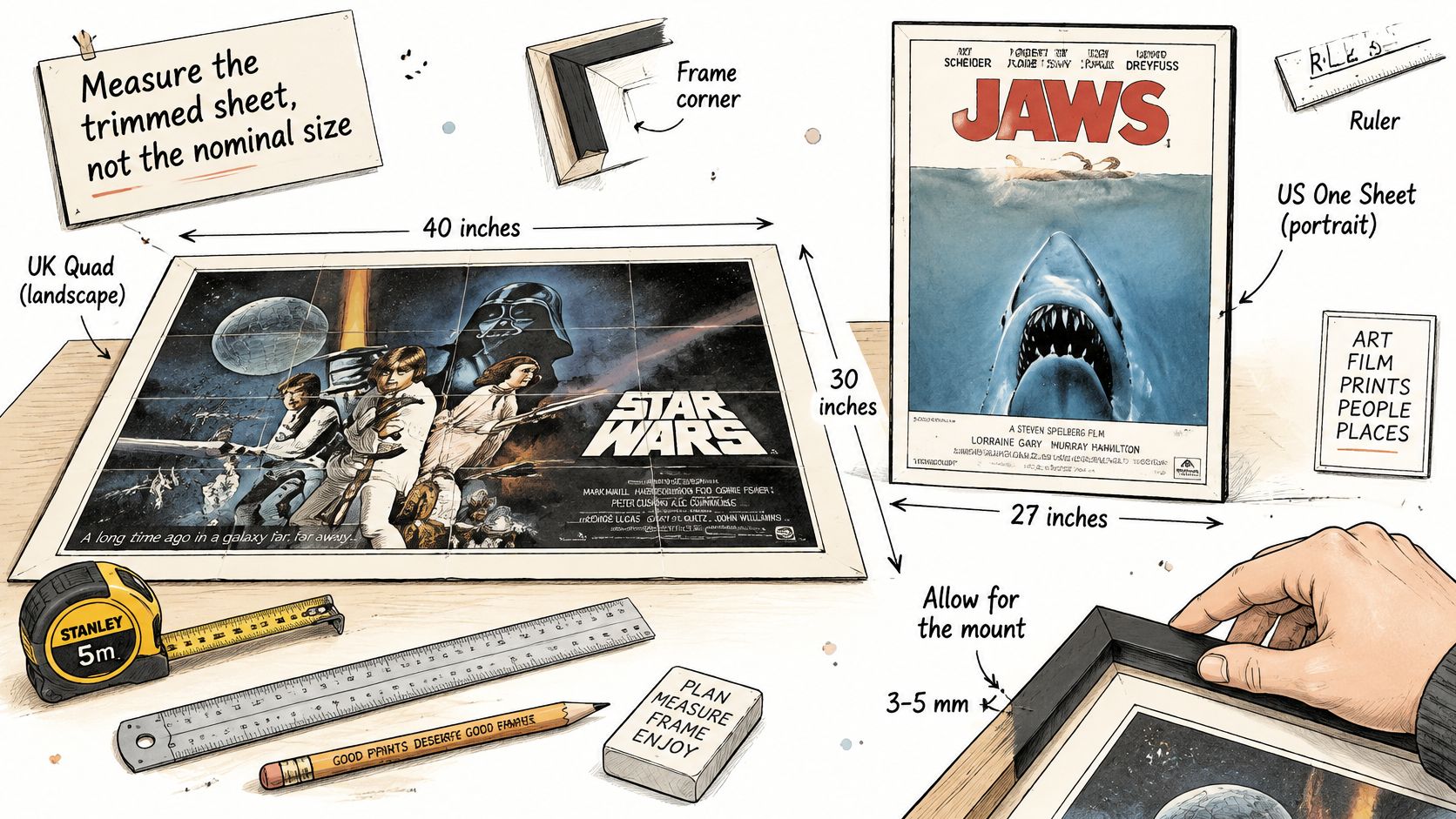
Set-up in order
- Measure at three points and keep the smallest reliable figure. Posters are rarely square to the millimetre, and a tight frame will buckle the sheet.
- Fit UV-filtering glazing. It slows light-driven fade. It does not make a sunny wall safe.
- Use an acid-free backing or mount. Keep permanent adhesive off the sheet. Tape and labels are a known cause of stain and skinning.
- Hang away from sun, radiators and damp walls. The storage range still applies once the sheet is on show.
- Rotate what you hang. One sheet left up for years takes the light that the others avoid.
A poster on open display in a warm room needs more frequent checks than one in a sealed frame. Look for new cockling after a damp week, and for colour shift on the side facing the window.
If you are building a run of frames rather than a single sheet, these cohesive country-style wall display tips are a useful check on spacing and mix before you commit to mouldings.
The short measuring walk-through below is worth ten minutes before you order glass. It shows why a nominal "movie poster" size fails once the sheet has been trimmed.
I would frame to the verified size, not the label. A cheap frame in the wrong orientation costs more than measuring twice.
Confirm the Edition Before You Buy or Request One
Confirm the edition before you pay or send a request. A wrong row means the wrong size, the wrong decade and, often, the wrong object.
Use four lines and do not skip one:
- Edition row from the variants table, named in full.
- Measured size and orientation, in millimetres, not the seller's nickname.
- Dating marks from the checklist: printer, distributor, title styling, venue wording.
- Condition history, with any restoration declared as its own line.
Ask for measurements, a condition report and any known provenance. If one of those is missing, the listing is unverified. Ask again. A low price does not fill the gap.
We sell only guaranteed original movie posters, so a request should name the edition rather than the film alone. Browse by decade and test each listing against those four lines. If the sheet is not in stock, use the request form and say which row you want. We will do our very best to get it. We ship to nearly every country, but confirm that before you order. A UK quad and a US one sheet travel differently, and the postage is not the same job.
Write the four lines down, set them against the table, then send the request or place the order. That is the whole decision.
Famous Movie Posters specialises in guaranteed original cinema sheets, including musical titles such as Singin' in the Rain, with authentication and archival handling built into how we keep and pack them. If you already know whether you want the US one sheet, the UK quad or a later issue, we can help you match that edition rather than a decorative copy. Visit Famous Movie Posters and send the four lines with your request.