



You've got a listing open, the title says original, and the photo is just clear enough to show Robert De Niro. The price looks either like a bargain or a stretch, and you can't tell which from the picture. A photograph won't show small printer's type, a distributor credit, or whether the sheet was folded when it left the cinema.
A Taxi Driver 1976 poster is a specific British or American cinema sheet from the first release, not every poster that names the film. Later Quads, anniversary designs and display reprints all turn up in the same search. I would match the sheet to an edition before I looked at the price. A genuine later printing can still be authentic, and it can still be the wrong thing to pay a first-release price for.
Table of Contents
- Which 1976 Taxi Driver Poster Edition You Have
- How to Verify a Taxi Driver Poster Is From 1976
- Condition, Folds and Restoration That Change Value
- What Taxi Driver Posters Have Sold For
- Where to Buy and What to Confirm Before You Pay
- Storing, Packing and Displaying Your Poster
Which 1976 Taxi Driver Poster Edition You Have
Match the sheet in front of you to one row before you read a seller's story. Format, period and artwork do that job faster than a close-up of the star.
| Edition | Format and size | Period it represents | What to check |
|---|---|---|---|
| 1976 UK Quad | approx. 102 × 76 cm (40 × 30 in), landscape | Original 1976 British cinema campaign | Printed date, Columbia-Warner credit, artwork matches 1976 campaign |
| 1976 US Style A one-sheet | approx. 104 × 69 cm (41 × 27 in), portrait | Original 1976 US release | Dimensions and portrait format; not interchangeable with UK Quad frames |
| Anniversary re-release UK Quad | British Quad, landscape, anniversary artwork | A later anniversary campaign, not 1976 | Artwork differs from the 1976 campaign; treat as a later edition |
| 1976 double-bill UK Quad | UK Quad, landscape | Original 1976 British double-bill issue | Double-bill billing and printed date |
| Later UK re-release material | Usually a UK Quad, landscape | Later UK classification and re-release cycles | Printed year against the specific re-release the listing claims |
These rows are different objects. A 1976 UK Quad is the wide British cinema sheet, about 102 × 76 cm. A 1976 US Style A one-sheet is a portrait sheet, about 104 × 69 cm. The areas look close. The shapes are not. A Quad frame leaves gaps or forces a crop on a one-sheet, and a one-sheet frame will not take a Quad. If you want that settled before you order glass, the one-sheet and Quad comparison is the practical reference.
Anniversary art is a different poster
A later anniversary British Quad carries imagery made for that campaign, not the 1976 cinema artwork. The giveaway sits in the printer's type: the sheet names the later campaign year even though the film is from 1976. Vintage Movie Posters shows how later British Quad material gets grouped by star and title rather than by first release, which is why a star search turns up several editions side by side. Treating any British Quad as a first-release Quad is where buyers go wrong.
A 1976 double-bill UK Quad is still a first British issue. It shares the sheet with a second film, so the billing names both titles, and that second title is what confirms the edition. Later re-release paper can be an official cinema poster, printed for a real engagement, and still belong to a later period. Read the printed year on the sheet and hold it against the campaign the listing describes.
Practical rule: Original does not automatically mean 1976 original. A later licensed re-release can be authentic, and it should be described and priced as its own collectible.
Posters from the 1940s to the 1990s can often be checked through a printed release date, National Screen Service information where it exists, dimensions, archives and provenance. Provenance strengthens the identification. It does not replace the type printed on the sheet.
Compare the artwork, the dimensions and any printed date with the table before you talk about price. If those three don't agree with the edition in the listing title, stop there.
How to Verify a Taxi Driver Poster Is From 1976
Work through one sheet in this order. The listing title is the last thing to trust, not the first.
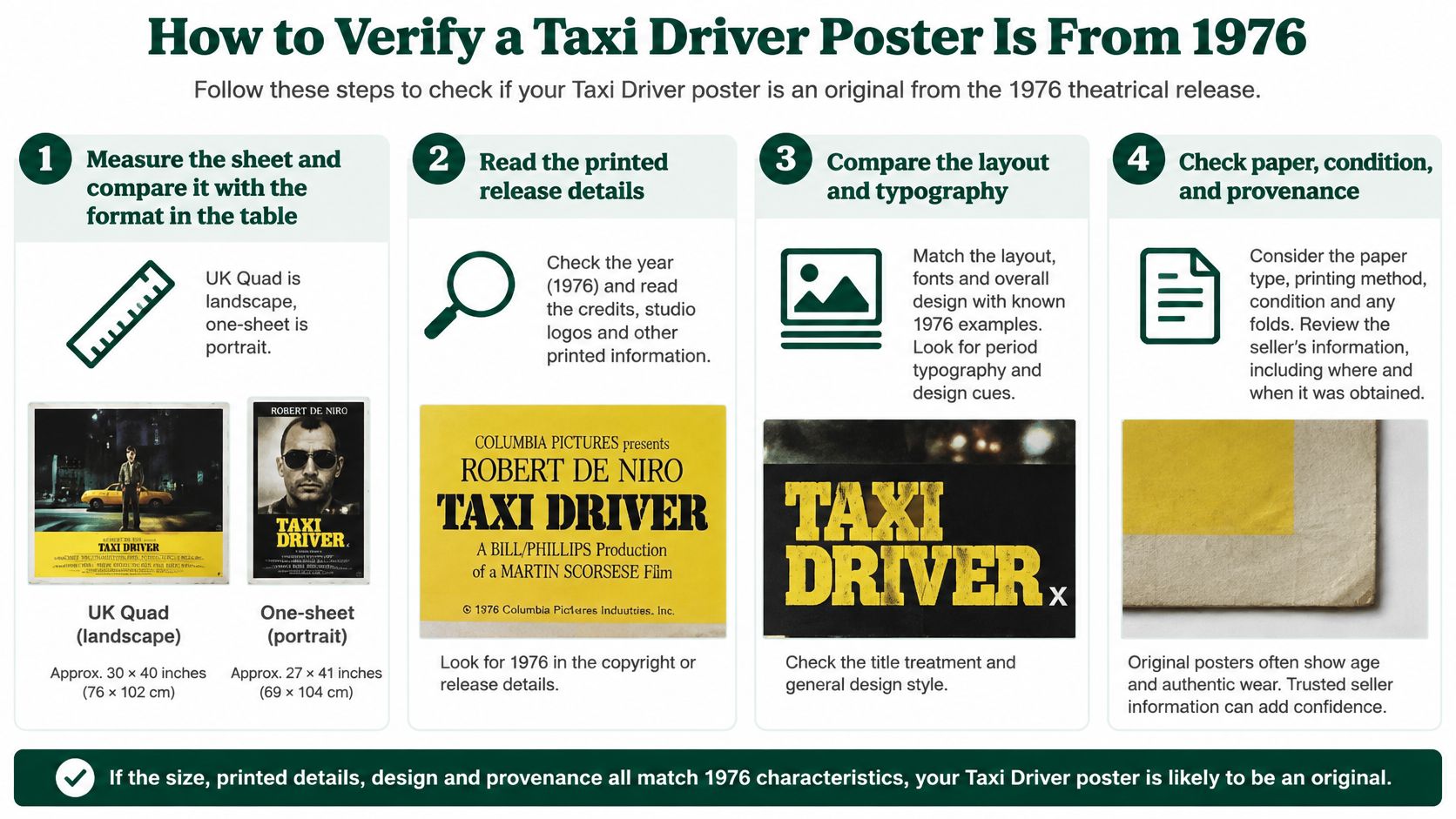
- Measure the sheet. Lay it flat, or ask for measurements taken flat, and compare them with the format you think you have. A UK Quad is wider than it is tall. A one-sheet is portrait. The usual slip is judging shape from a phone photo, which turns both into the same rectangle.
- Read the printed release line. Look for a year, a printer's mark and, on a British first-release sheet, a Columbia-Warner credit. Sellers often say "1976" because that is the film's year, while the type on the poster names a later campaign.
- Use the UK record as a date check, not as a stamp you expect to see. The British Board of Film Classification classified the 1976 version for cinema on 2 April 1976, named Columbia-Warner Distributors, and recorded that cuts or alterations were required. UK cinemas took the film in September 1976, months after the US release, so a genuine British Quad documents that distribution, not merely the production year. The same record gives an approved running time of 113 minutes and 35 seconds, while a 2006 version runs 113 minutes and 39 seconds. Different circulation versions existed, and their paper should not be mixed up.
- Compare the artwork with the 1976 campaign. Anniversary imagery points to 2016. If the layout was drawn for a birthday reissue, it isn't a first-release sheet, however official the printing is.
- Look for printer marks and any National Screen Service information. NSS marks are an American habit more than a British one, so their absence on a UK Quad isn't a fail by itself. A date that fights the campaign, or NSS style on a sheet sold as a plain British Quad, is a reason to slow down. What "original" means in this market is set out in this guide to original UK movie posters.
- Ask where it has been. A written note of ownership, plus any earlier auction record, is provenance. "It's been in the family," with no names and no paperwork, is not.
- Record folded or rolled before you pay. Those two states behave differently on a wall. Leaving that until after payment is how a cross-fold turns up in the tube.
What a credible set looks like
You want matching dimensions, a printed date or campaign credit, a distributor line where that edition should carry one, and provenance in writing. One of those is a hint. Together they are a case you can defend. A seller's sentence on its own is not evidence. The sheet is.
Condition, Folds and Restoration That Change Value
Catalogues separate folded examples from near-mint rolled ones, and that split moves both price and how the sheet will sit behind glass. A Sotheby's original film posters sale is typical of the way houses record issue state, because fold lines, cross-fold separation, edge wear and paper flattening change display quality and what a conservator has to do later. Verify format, exact dimensions, issue state and restoration before you choose glazing or commission a frame.
Faults worth naming
Fold lines on a cinema Quad often record how the sheet was issued. A fold is not a defect to hide. A truthfully described folded original can still be a sound buy.
Cross-fold separation is different. Where the folds meet, the paper can split. That is structural, not patina, and tape makes it worse.
Edge wear, tears and pinholes come with cinema use. Small pinholes at the corners are common on an unrestored Quad. A tear that runs into the title is another matter, and it should be priced as damage.
Creasing and fading show up once the sheet is on a wall. Creases catch raking light. Fade usually means years of sun, and the colour doesn't return.
Tape, adhesive and retouching should be named in the description. Finding them under a lamp after delivery is too late to renegotiate.
A fold can be honest history. A painted repair that nobody mentioned is a different purchase from the one you thought you were making.
Restored is not the same as tidy
A restored sheet has been treated. That can mean a linen backing, infill, colour touch-in or flattening. An unrestored sheet still shows the state it was issued in. Flattening can quiet a fold and can also change how the paper pulls once it is framed. A rolled sheet and a folded sheet hold different tensions, so they don't behave the same way behind glass. Ask for any restoration in writing, not as a passing comment in a message thread.
Five minutes before you agree a price, run this list.
- Issue state: folded or rolled, written in the listing.
- Structure: splits at the cross, tears, lifting corners.
- Surface: tape, stains, fade, pinholes.
- Intervention: linen, paint, replaced margins, or none stated.
- Photos: raking light, front and back, not one flattering straight-on shot.
If the seller won't do that pass, you're pricing a story rather than a sheet.
What Taxi Driver Posters Have Sold For
Sold prices, estimates and missing prices need to stay in separate columns. Mix them and you'll either overpay or walk away from a fair hammer price.
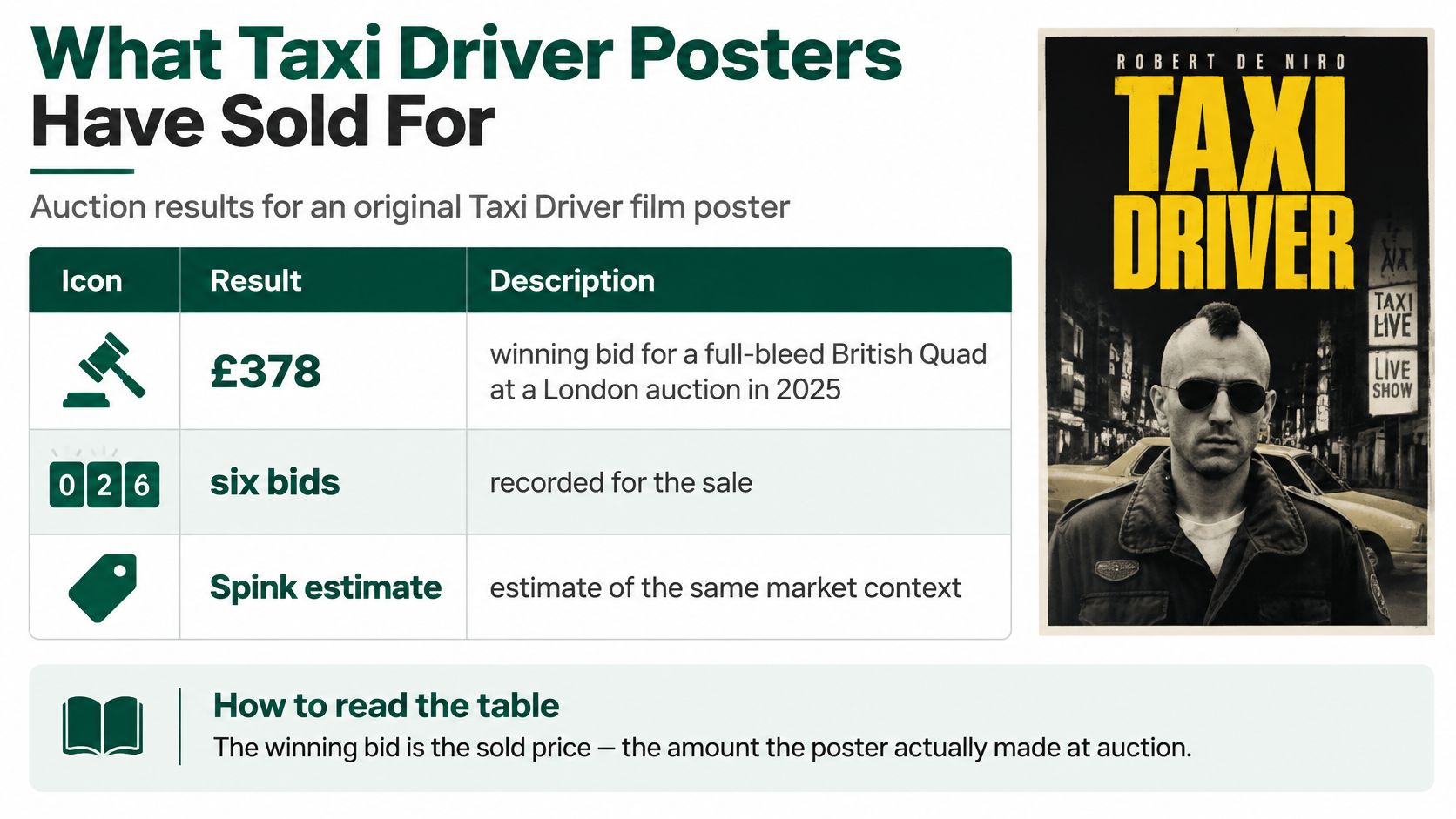
| Item | Price or estimate | Date and source |
|---|---|---|
| Full-bleed British Quad, London auction | Winning bid £378 (six bids) | 2025, Propstore |
| Framed US One-Sheet (1976), London auction | Sold; price not stated | Sold 4 July 2025, Propstore |
| Original US Style A (1976) | Estimate £800 to £1,200; starting price £700 | 2025, Spink UK vintage film-poster auction |
| Original double-bill UK Quad (1976) | Sold for £40 | Sale year not stated, Omega Auctions archive |
The first row is a result. A Propstore London auction listing recorded a winning bid of £378 for a full-bleed British Quad Taxi Driver (1976) poster in 2025, and it recorded six bids. That figure is what the bidding reached. It isn't a retail asking price, and it isn't a guarantee that the next Quad will land there.
Estimates are not results
Spink published an estimate of £800 to £1,200 and a starting price of £700 for an original US Style A Taxi Driver (1976) poster in its 2025 UK vintage film-poster auction. An estimate is the house's pre-sale range. A starting price is where bidding is invited to open. Neither tells you what a buyer handed over.
Propstore reported that a framed US One-Sheet Taxi Driver (1976) poster sold in its London auction on 4 July 2025. The page calls it an original 1976 poster and gives no price. Don't borrow the Spink estimate and pretend it belongs to that framed sheet.
Omega Auctions recorded an original double-bill UK Quad as sold for £40. The archive page doesn't state a sale year. Keep that figure as undated context. It isn't a current price for a double-bill sheet, and it isn't a reason to expect every British Quad to be cheap.
Why those figures sit so far apart
Popularity doesn't price the paper. The British Film Institute describes the film as a major contemporary success, with worldwide takings estimated at $21 million against a production budget of $1.3 million by the end of 1976. Demand for the title has been there for decades. A £40 archive result and a £378 full-bleed Quad are still different objects: edition, format, condition and provenance, not a film people have forgotten.
Match your sheet to the nearest row, then set an expectation from sold figures for that kind of sheet. Leave estimates in a separate note. If your row has no stated price, say so, and don't fill the gap with a number from a different format.
Where to Buy and What to Confirm Before You Pay
Where you buy changes who carries the risk, not whether the edition still has to be checked.
| Channel | Best for | What to check |
|---|---|---|
| Specialist poster dealers | Clear edition descriptions and a considered choice | Written confirmation of edition, dimensions, condition and restoration |
| Auction houses (Propstore, Spink, Omega Auctions) | Documented provenance and published sale records | Buyer's fees on top of the hammer price, and condition notes in the catalogue |
| Request-a-poster services | Hunting one specific edition, such as a 1976 UK Quad | How the sheet is verified before payment and what happens if it is not as described |
| Private sellers and online marketplaces | Possibly lower prices | Edition, condition and provenance; no dealer guarantee to rely on |
A specialist earns the difference when the description names the edition and the faults in writing. We sell only guaranteed original movie posters, and we have sources for posters from all over the world, which matters when a 1976 UK Quad isn't sitting on a shelf.
Auction houses such as Propstore, Spink and Omega Auctions are stronger on published records. Read the condition note, then add the buyer's premium to the hammer before you decide the lot is "cheap." A winning bid is not the amount that leaves your account.
A hunt for one edition
A request service suits someone who wants a single row from the table, a 1976 UK Quad rather than the 2016 anniversary design. Ask how that sheet is checked before money changes hands, and what happens if it arrives as a different printing. If the answer is vague, you don't have a service yet. You have a search with no standard.
Private sellers and marketplaces can be cheaper. You then carry edition, condition and provenance yourself. There is no catalogue correction after you've paid, and a friendly message thread isn't a guarantee.
Before you pay, do this and don't shuffle the order.
- Confirm the edition from format, artwork and any printed date.
- Get the condition in writing, including folds, rolling, restoration and retouching.
- Ask for provenance and any earlier sale record.
- Compare the ask with sold results, not with estimates or starting prices.
- Only then choose a frame and glazing.
A later re-release can still be a good purchase. Buy it, and describe it to the next person as the edition it is. Paying a first-release price for anniversary artwork is the mistake. Owning the anniversary artwork on purpose is not.
Storing, Packing and Displaying Your Poster
A rolled sheet belongs in a sturdy tube. A folded example belongs flat, in an archival box or a proper flat file. Both want a dry place out of direct sun, and a cupboard on an outside wall in a British winter is a poor stand-in. Damp and heat move through paper faster than many collectors expect. Neither shows up until the sheet is opened months later.
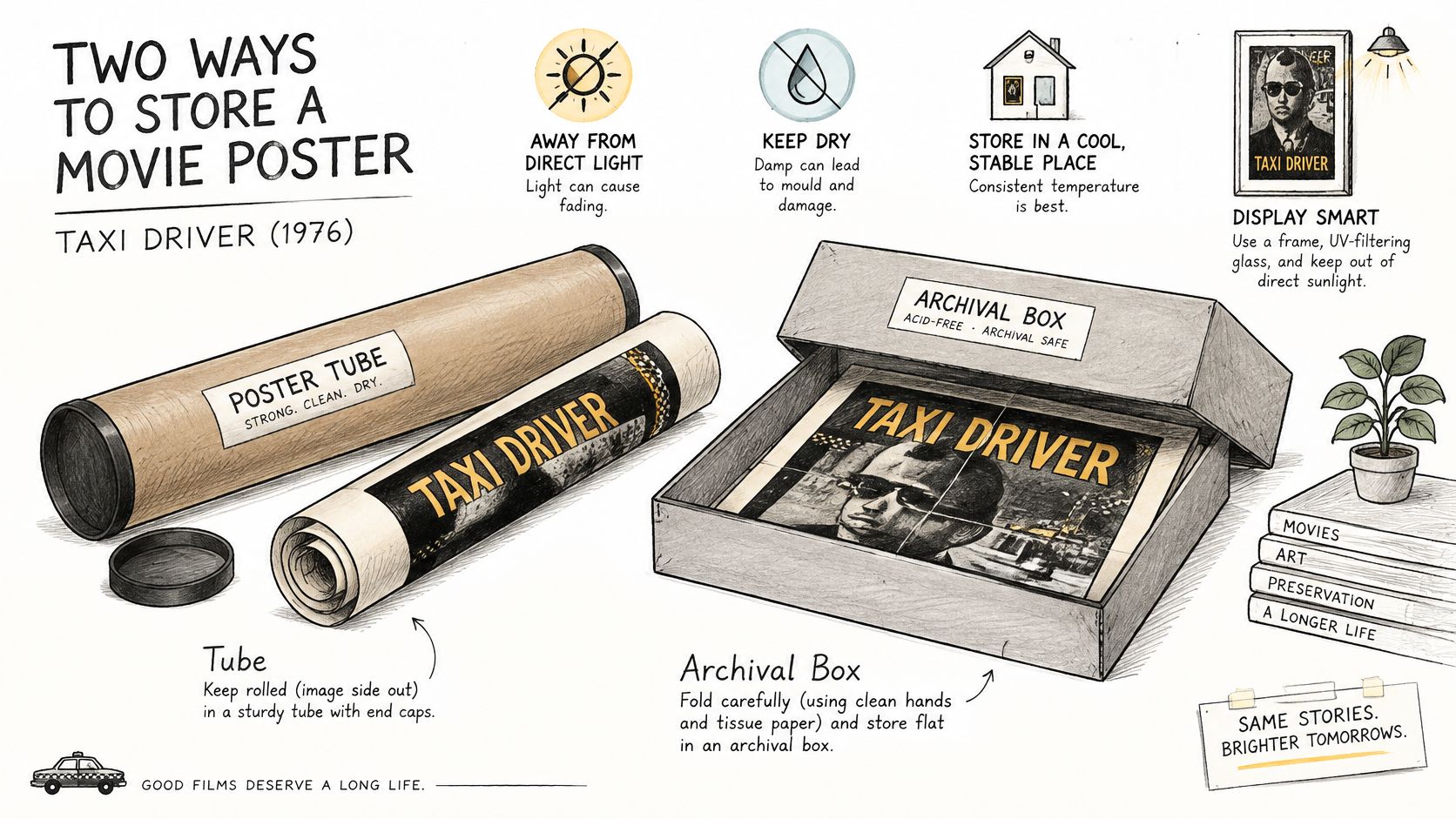
Don't iron original folds at home. Heat and steam can scorch ink and set a crease harder than it was. If a fold needs treatment, that decision belongs with a paper conservator, and only after you've decided the fold is damage rather than the way the sheet was issued.
Packing a sheet to post
Roll the poster around acid-free tissue, then slide it into a rigid tube made for that format. Don't fold it again to save postage. A new fold across an old one is where splits begin, and a UK Quad rolled wrong can pick up edge damage before it leaves the room. Label the tube with the edition, not just the film title, so the next person doesn't assume every Taxi Driver tube is 1976.
Flat files and archival boxes take up real space, and a growing collection can outgrow a flat quickly. If home storage won't stretch, compare the space you have with off-site options and check drive-up storage unit costs before you commit. Paper still needs a dry, stable unit. A cheap lock-up that sweats in summer is not archival storage with a different postcode.
Display without erasing the history
Archival mounting uses reversible hinges on acid-free board. Reversible framing does the same job and lets you take the sheet out later without soaking it. A permanent dry-mount is hard to undo. I wouldn't use one on a scarce 1976 example.
The frame has to be built for a 102 × 76 cm UK Quad. An off-the-shelf 27 × 41 inch one-sheet frame will not fit it. Specify UV-filtering glazing, an acid-free backing, and a real gap between glass and print so the ink doesn't stick when the room warms up. City flats run warm and bright. A sheet opposite a window will fade, however careful the framing looks on day one.
Propstore's Taxi Driver (1976) material sits in a market where posters double as home décor, and that changes what the paper has to survive. A sheet that spent decades in a flat file now faces radiators, sunlight and central heating for years at a stretch. The framing choices above are what stand between the image and that room.
Preservation keeps the sheet as it is. Restoration changes it, and any restoration should stay on the written record. A 2016 anniversary Quad can go up boldly if you want the image. A scarce 1976 sheet calls for lower light, no home experiments and handling you could explain to the next owner. Day-to-day habits for tubes, flat files and handling are set out in how to store movie posters.
If you want to see cinema paper handled before it ever reaches a frame, this short film is worth the few minutes.
If you want a Taxi Driver sheet that has already been checked for edition, condition and originality, Famous Movie Posters sells guaranteed original cinema posters and can search for a specific 1976 Quad or a later printing rather than guessing from a title. Tell us which edition you want, and we'll treat a revival as a revival instead of dressing it up as a first release. Visit Famous Movie Posters to see original posters in stock or to ask for the sheet you're after.