



You've found a Terminator poster with the right image, a convincing description and the word original in the listing. But the seller gives only the film title and year, with no measurements, reverse photograph or explanation of which cinema campaign it belongs to. Before you compare prices, establish exactly what's being offered.
Table of Contents
- Terminator Poster Issues at a Glance
- Where the UK Terminator Poster Story Starts
- Telling a UK Quad from a US One Sheet
- What Makes a Terminator Poster Rare
- What Terminator Posters Sell For
- How to Check a Terminator Poster Is Genuine
- Storing and Displaying a Quad Without Damage
- Your Next Step Before You Buy
Terminator Poster Issues at a Glance
A Terminator listing can look convincing while still leaving the key question unanswered: which British campaign does the sheet belong to? Use this lookup to separate the films before judging condition, rarity or price. It covers the main collectable cinema issues, not every advance poster, character design, cinema display or home-entertainment promotion.
Original Terminator poster issues by film
| Film | Release position | UK campaign detail | Main UK format | Collector note |
|---|---|---|---|---|
| The Terminator | 1984 first British campaign | BBFC classification 8 November 1984; Rank Film Distributors | UK Quad with painted Schwarzenegger portrait | Artwork linked to Mike Francis; check against the January 1985 release |
| Terminator 2: Judgment Day | 1991 sequel campaign | Opened 16 August 1991 | UK Quad, single and double-sided examples | Major UK box-office campaign; identify the particular printing |
| Terminator 3: Rise of the Machines | Post-1991 sequel | British theatrical issue distinct from advance artwork | UK Quad | Separate advance artwork from the main release design |
| Terminator Salvation | Post-1991 sequel | UK paper identified by territory and distributor credits | UK Quad | Identify the artwork version before comparing prices |
| Terminator Genisys | Post-1991 sequel | Cinema issue rather than home-entertainment use | UK Quad | Request reverse photographs to establish sheet type |
| Terminator: Dark Fate | Post-1991 sequel | UK campaign with character variants treated as separate printings | UK Quad | Don't treat every character image as the same issue |
An original issue here means a poster printed for the film's first theatrical campaign. A later theatrical re-release can still be genuine cinema paper, but it is not a first-release issue. Home-video advertisements, licensed decorative prints and fan-made images sit in different categories again.
That distinction matters because sellers sometimes use “original” to mean merely old, or not photocopied. Neither description establishes that the paper was produced for the campaign you want to collect. Condition can mislead too: a clean unfolded sheet may be a later reproduction, while a folded quad with period cinema use may be exactly the right object.
Identify the campaign, not just the character
Arnold Schwarzenegger's face is not an attribution. Start with the complete film title, territory, format and campaign stage, then establish the artwork version and printing characteristics. Treat each sequel as a separate buying decision rather than assuming everything carrying the franchise name shares the same history.
British distributors could commission artwork specifically for the UK market rather than reuse the US campaign. Different-looking British and American posters can therefore both be authentic first-release material. The reverse is also true: a familiar image can appear on a later reproduction without making that reproduction an original cinema poster.
A useful description should tell you:
- What it is: The exact film, territory and theatrical issue.
- What you'll receive: The physical sheet, its measurements and whether it has backing.
- What has changed: Repairs, trimming, restoration or mounting.
- What supports the description: Clear photographs, identifiable credits and a credible ownership history.
Buy the identified piece of paper, not the film title attached to it.
The practical order is format first, rarity second and price third. Authentication determines whether the description holds together; storage and buying costs determine whether the purchase makes sense for your collection.
Where the UK Terminator Poster Story Starts
The British Board of Film Classification record dates The Terminator’s UK cinema classification to 8 November 1984, recording a running time of 107 minutes and 1 second, a 2D presentation and Rank Film Distributors as distributor. That gives a collector a British chronology to check, rather than relying solely on the film's American release history.
Classification isn't the same event as a cinema opening. A seller can accurately describe the film by its production year while the British poster belongs to the subsequent UK release campaign. The question is whether the distributor, artwork and intended exhibition fit together.
Follow the British paper trail
Say a listing describes a sheet as an early British original, but the small print points towards a home-entertainment distributor. The image might be period-appropriate, yet the object still belongs to another campaign. Read the credits before accepting the headline description.
Keep these distinctions clear:
- Classification: An official milestone in the film's British release history.
- Theatrical campaign: The advertising prepared to bring audiences into cinemas.
- Subsequent exploitation: Revival screenings, home entertainment and other later uses.
For the sequel, 25thframe's UK box-office record records an opening on 16 August 1991, an opening-week gross of £4,631,895, seven consecutive weeks at the top of the UK chart before dropping to second in early October, and approximately £22.3 million across 24 chart weeks.
That was a substantial British cinema campaign, not a modest sequel release. It explains the breadth of promotional material a collector may encounter, although ticket sales don't establish how many particular posters survived.
Cinema staff folded, displayed, removed and discarded advertising. A large campaign can leave plentiful examples of one design and relatively few clean examples of another. Before agreeing a sale, check both the date printed on the sheet and the campaign it served; later artwork can look entirely convincing in a small listing photograph.
Telling a UK Quad from a US One Sheet
A UK Quad is a wide, horizontal sheet; a US One Sheet stands upright. Bannerworld's UK poster-size guide gives the standard Quad dimensions as 30 × 40 inches, equivalent to 762 × 1,016 mm.
Think of the Quad as a cinema screen and the One Sheet as a tall hallway poster. That visual distinction is the fastest first check.
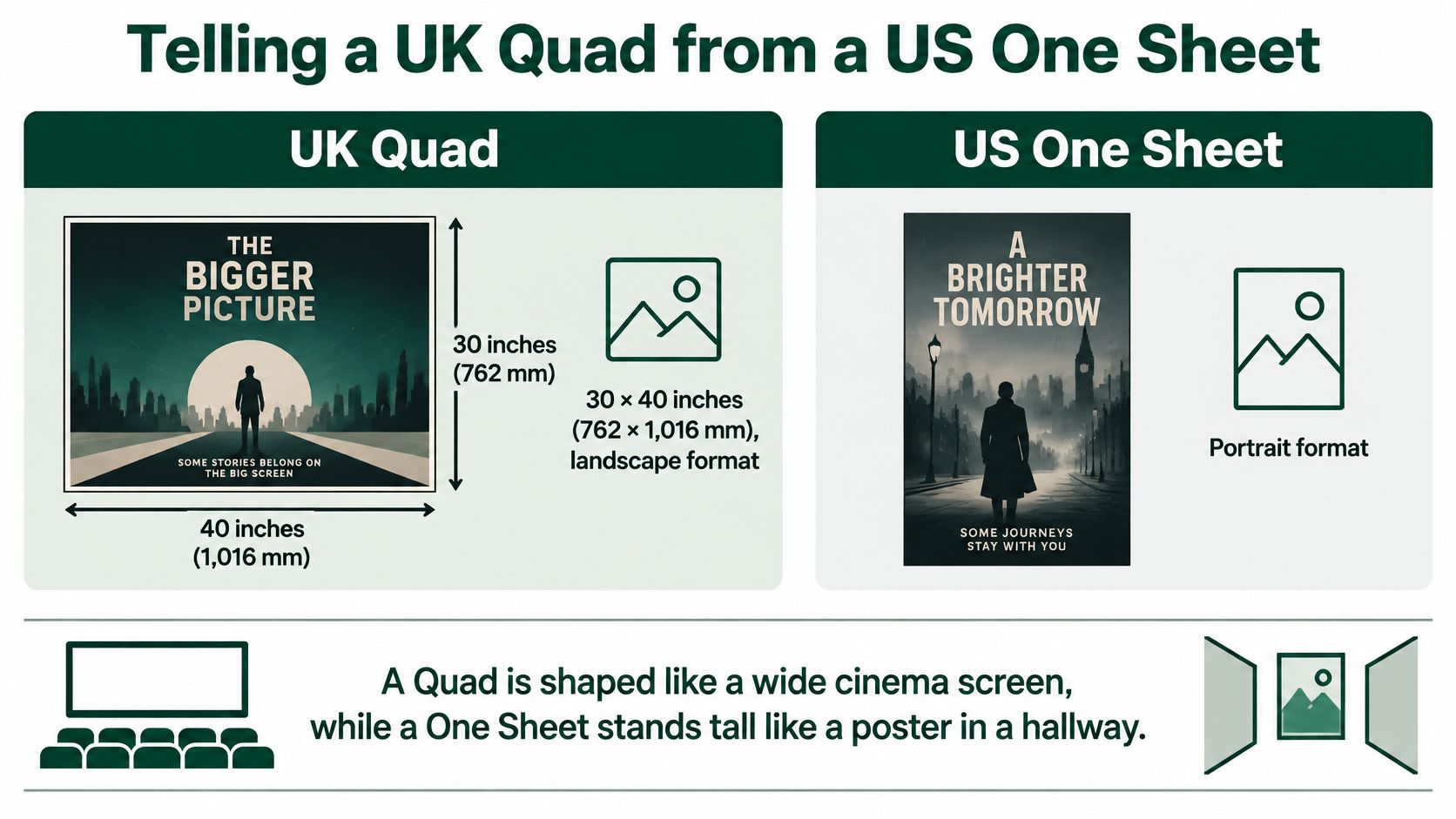
UK Quad versus US One Sheet at a glance
| Feature | UK Quad | US One Sheet |
|---|---|---|
| Size | Standard Quad dimensions given above | Establish the dimensions for the particular issue |
| Orientation | Landscape | Portrait |
| Typical artwork | Often UK-specific, sometimes painted | Usually the US campaign artwork |
| Sheet type | Single or double-sided | Single-sided examples; verify the particular issue |
| Fold patterns | Commonly folded for distribution | Commonly folded for distribution |
| Printer credits and borders | Check against the UK print run | Check against the US print run |
The painted British original
Film on Paper's documented example identifies the British The Terminator Quad as a single-sided poster, approximately 30 × 40 inches, attributed to Mike Francis and associated with the January 1985 UK release. Its painted Arnold Schwarzenegger portrait reveals the robot endoskeleton beneath the human exterior, unlike the photographic US design.
Don't reject a British sheet because it doesn't resemble an American reference image. Compare like with like: territory, artwork and printing.
Double-sided printing also needs identifying. It can affect desirability and display choices, particularly where a lightbox is involved, but it isn't an automatic upgrade over a single-sided original from another campaign.
For a broader format explanation, the guide to the difference between a One Sheet and a Quad helps distinguish the terminology. Measure the actual paper before ordering a frame, including any backing margins: a domestic frame sold as poster-sized may be unsuitable.
What Makes a Terminator Poster Rare
Rarity works rather like a concert ticket: how many were printed matters less to a buyer than how many survive in collectable condition and how many people want them. A common ticket to a celebrated event can attract more interest than an obscure ticket that scarcely anyone collects.
The same applies to Terminator movie posters. Without reliable print-run records, a seller shouldn't turn an impression of scarcity into a confident production figure.
The relationship between survival and demand is more useful than an unsupported rare label.
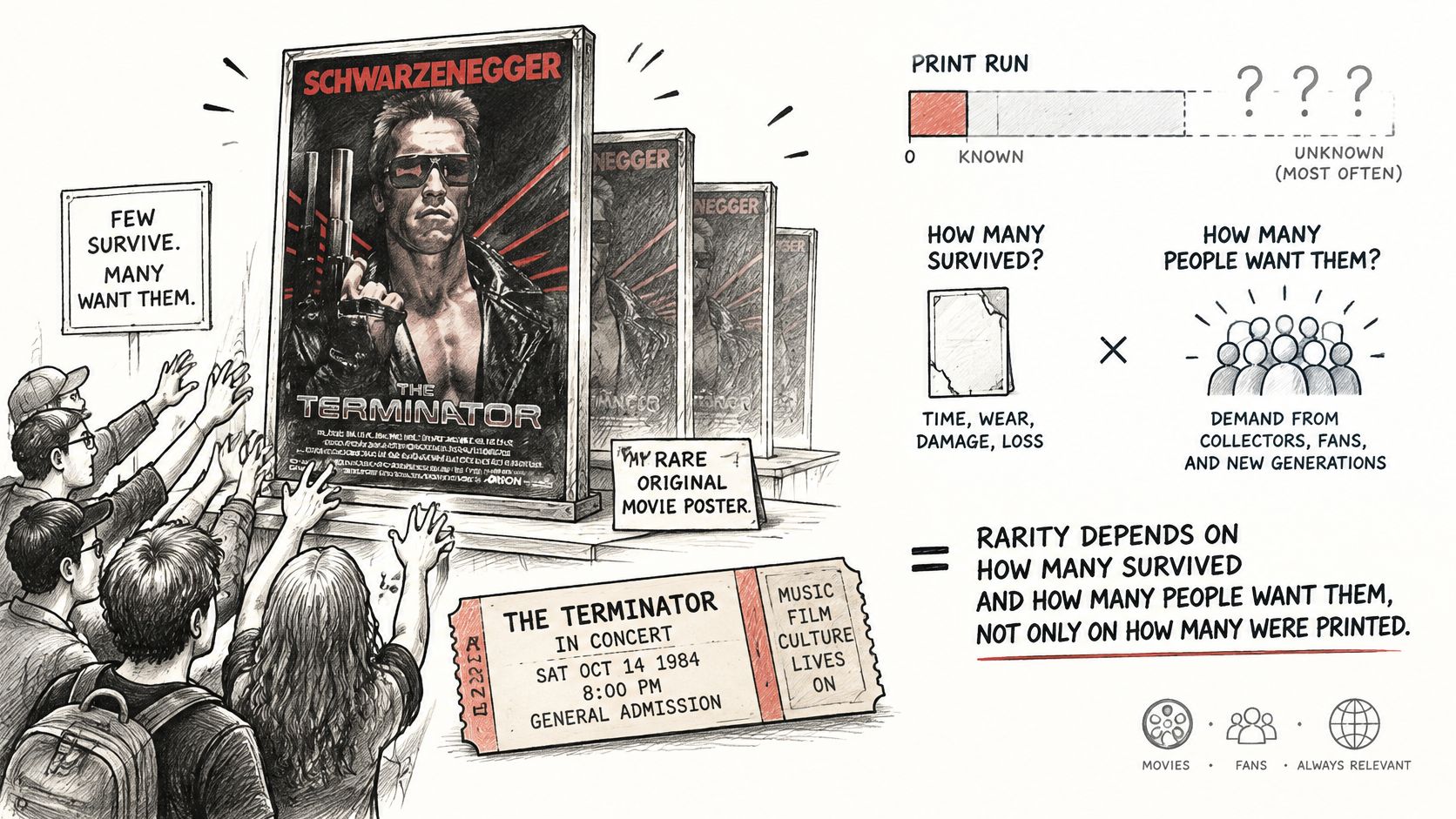
What changes desirability
Start with issue identity. A first theatrical printing and a later reproduction aren't competing on equal terms, even when they use the same artwork. Among genuine theatrical pieces, collectors may favour the first release, an advance design or a particular territorial interpretation.
Then consider the physical object:
- Format: A buyer collecting British Quads won't necessarily pay the same for another country's sheet.
- Printing: A double-sided example needs comparison with the same version, not an unrelated single-sided issue.
- Condition: Paper loss, staining, fading and tears matter more than a vague excellent label.
- Presentation history: Linen backing, flattening and repairs can change both appearance and how condition should be assessed.
The sequel's prominence helps explain why buyers continue to seek its advertising. That demand can support strong prices for appealing examples, but popularity alone doesn't make every sheet scarce.
Folds and restoration need context
Original theatrical posters were commonly folded for distribution. The UK collector guidance on poster formats and framing supports asking for detailed photographs and measurements rather than assuming an unfolded sheet is automatically more authentic or valuable.
An unused rolled example may be desirable. So may a folded copy with strong colour, complete borders and a clear history. The relevant question is what condition is normal for that particular issue, not whether the seller has used the phrase never folded.
Restoration requires equally careful judgement. Professional repair can make a damaged original suitable for display, but the work should be described precisely. Ask where paper has been added, where colour has been replaced and whether printed detail has been reconstructed.
Dealer's judgement: Pay for the original paper and the disclosed work separately in your mind. A smoother surface doesn't erase a history of damage.
For a pause from listing photographs, this video is an optional viewing reference.
Linen backing isn't proof of rarity, and it isn't necessarily a fault. It becomes a problem when the backing prevents you from understanding the original sheet's condition. Treat rare as a conclusion supported by origin, survival and demand, not as a substitute for that evidence.
What Terminator Posters Sell For
Excalibur Auctions records a UK Quad for The Terminator (1984) selling for £550 in 2026, against an estimate of £200–£300. A double-sided Terminator 2 (1991) UK Quad at Excalibur Auctions sold for £150 in 2025, against £80–£120.
Treat those as two separate UK campaigns, not a Terminator price index. The 1984 quad and the 1991 double-sided quad were sold to different cinema audiences, printed in different runs and survive under different pressures, so a strong result for one does little to set the ceiling for the other.
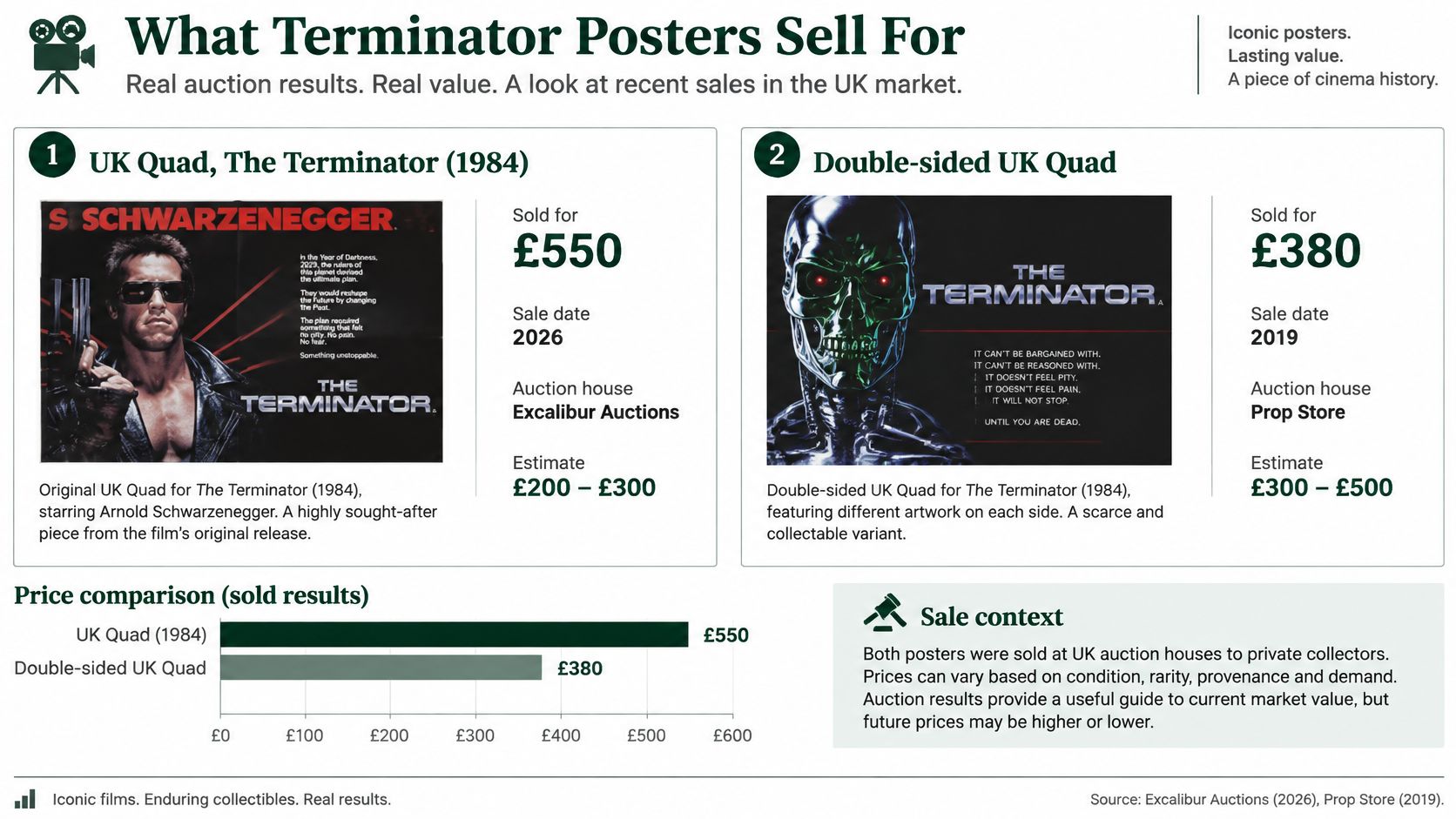
Recent Terminator poster auction results
| Poster | Sale year | Estimate | Result |
|---|---|---|---|
| UK Quad, The Terminator (1984) | 2026 | £200–£300 | £550, Excalibur Auctions |
| Double-sided UK Quad, Terminator 2 (1991) | 2025 | £80–£120 | £150, Excalibur Auctions |
I would leave a US One Sheet outside this comparison until a completed sale supplies a year, estimate and result. An attractive American sheet is a different issue, and an unfolded example still needs the same evidence.
For another territorial comparison, Omega Auctions lists an original Polish The Terminator (1984) poster sold for £260, on an auction page dated 2026. Useful as a reminder that national campaigns price differently; it cannot stand in for a British Quad or a US One Sheet.
Build a usable comparison
Match film, country, artwork variant, format, restoration and condition before treating another sale as evidence. A trimmed sheet and an intact example should not be valued together just because the title matches. Glossy listing language needs the same caution: desirable condition helps, though condition alone does not create rarity.
Use the guide to original movie poster prices to separate price drivers from headline asking figures. An unsold listing shows the seller's hope; a completed sale shows a buyer's commitment.
- Auction purchase: Establish whether the reported figure includes buyer's premium and other charges.
- Dealer purchase: Consider the description, authenticity assurance, returns position and delivery arrangements.
- Total budget: Include conservation and display costs before deciding your bidding ceiling.
Choose the purpose first. A display purchase can tolerate a neatly repaired fold line if the colour is strong and the history is clear; an archival purchase puts more weight on untouched paper and full margins. Set your ceiling before the room or the countdown decides it for you.
How to Check a Terminator Poster Is Genuine
An attractive photograph establishes that you like the artwork. Authentication requires evidence about the sheet itself. Ask for that evidence before negotiating, while the seller still has the poster available to photograph and measure.
Keep the checks together so a plausible answer in one area doesn't distract from a contradiction elsewhere.
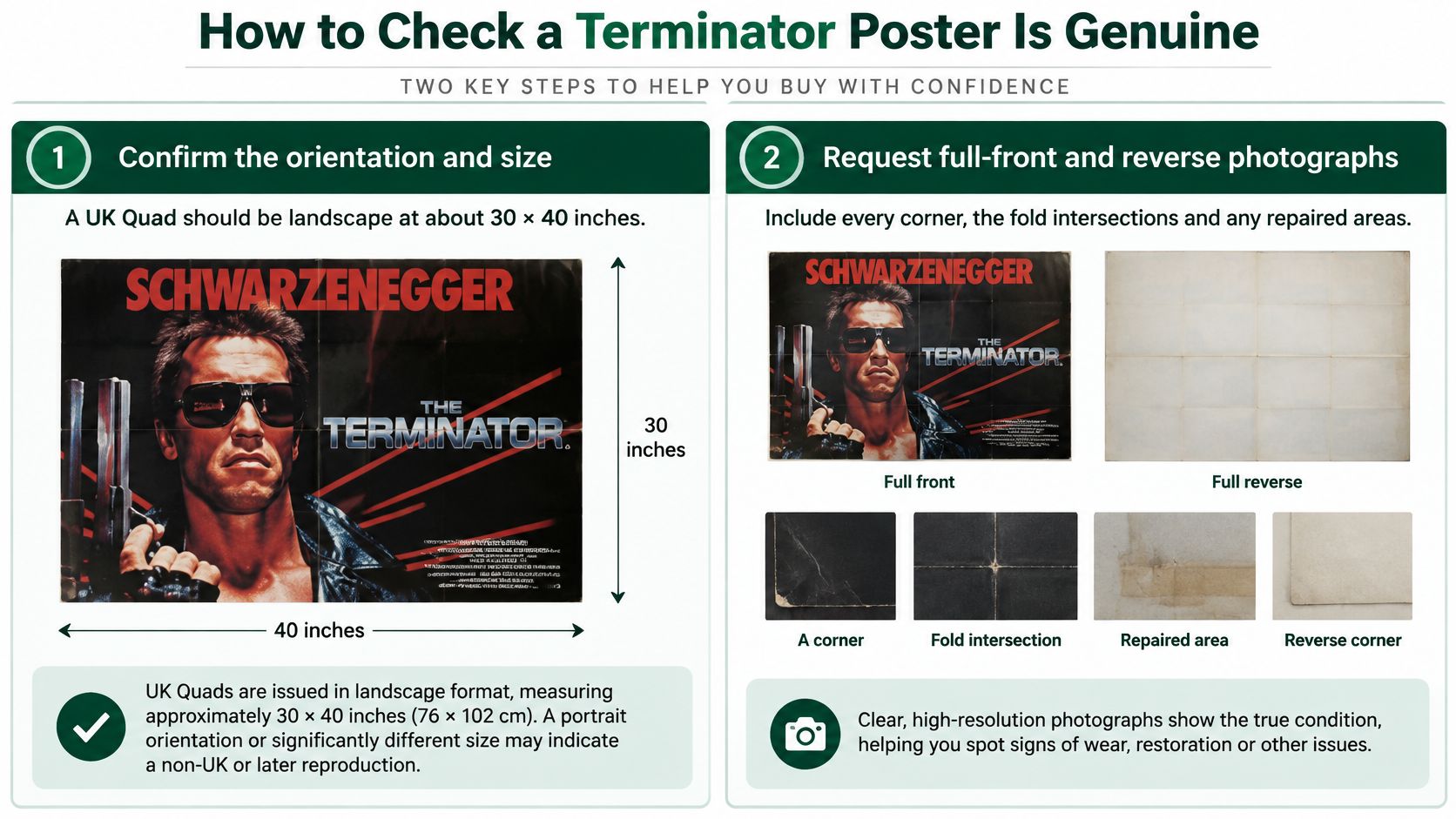
Establish the physical object
- Confirm orientation and measurements. Ask for the actual paper dimensions, not the frame size or the seller's estimate from a photograph. The reason is practical: the wrong proportions can expose a misidentified format, cropping or a decorative reproduction. The common mistake is accepting UK Quad as a measurement rather than a claim that needs checking.
- Request a complete photographic record. Ask for the full front, full reverse, every corner, fold intersections and repaired areas. Use the National Archives' guidance on protective polyester sleeves as a handling caution: static can catch flimsy or badly damaged paper, so photographs shouldn't require a seller to pull a vulnerable sheet repeatedly from unsuitable protection. The common mistake is requesting close-ups of the central image while ignoring the edges and reverse, where condition problems are often easier to recognise.
- Match the date to the campaign. Separate the film's year from the British release and the date of the particular printing. The reason is that classification, release, copyright and later exhibition can leave different dates in descriptions without necessarily indicating a fake. The common mistake is declaring a poster wrong because every date doesn't match, or accepting it because just one does.
Read the evidence in the margins
- Inspect printer, distributor and release details. Request sharp, straight-on photographs of the lower credits, borders and any small-print markings. These details help distinguish territories and campaign versions, although a credit line alone isn't conclusive because reproductions can copy it. The common mistake is treating a familiar studio logo as a complete certificate of authenticity.
- Compare the artwork with a trustworthy reference. For the first film's British painted design, examine the portrait, exposed machinery, lettering and arrangement of the credits rather than merely recognising Schwarzenegger. Artist attribution should agree with the documented design, not serve as a decorative name in the listing. The common mistake is comparing a British issue with a US image and assuming the difference proves a problem.
- Get restoration details in writing. Ask specifically about linen backing, washing, bleaching, flattening, paper replacement and in-painting, rather than asking only whether the condition is good. The reason is that repair can conceal the original extent of tears or missing paper while remaining acceptable when properly disclosed. The common mistake is interpreting professionally restored as meaning untouched, or assuming a backed poster's reverse can still be inspected directly.
- Test the description against a genuine comparable. Look for completed sales of the same issue and assess whether the seller's condition description explains the price difference. This won't authenticate the poster by itself, but it can reveal when an ordinary sheet is being presented as an exceptional variant without supporting evidence. The common mistake is using the highest asking price available to justify any cheaper listing.
Before paying: Save the photographs and the seller's written answers with the invoice. They form part of the object's collecting record.
A never-folded claim should lead to questions about storage and ownership, not an immediate premium. Ask whether the poster has been flattened, backed or restored, and whether the seller can explain how it remained unused.
An open seller may not know every detail, but should distinguish what they know from what they assume. A clear admission that provenance is incomplete is more useful than a confident story that changes when you ask for the reverse photograph.
Storing and Displaying a Quad Without Damage
The Archives and Records Association UK guidance recommends paper-archive storage at roughly 13–23°C, with an annual average below 18°C and relative humidity between 35% and 60%, warning that fluctuations accelerate degradation. A stable room matters more than an impressive tube or frame.
Storage and display conditions for a UK Quad
| Condition | Recommended range or practice | Why it matters |
|---|---|---|
| Temperature | Archive range stated above; avoid swings | Changes accelerate paper degradation |
| Relative humidity | Archive range stated above; avoid damp | Damp encourages mould and cockling |
| Light | Out of direct sun; UV-filtering glazing for display | Light fades inks |
| Storage position | Flat, horizontal, in acid-free folders | Reduces bending and repeated rolling |
| Mounting | Reversible conservation hinges, no adhesive tape or dry-mount | Unsuitable mounts cause irreversible damage |
Protect the sheet during handling
Store it flat in a conservation folder or box, supported across its full area. Avoid rolling unless unavoidable, and never force curled paper flat with heavy objects on the printed surface.
Use appropriately sized archival protection matched to the paper's condition. An acid-free enclosure is preferable where a plastic sleeve would snag fragile areas; ordinary cardboard, brown envelopes and unidentified plastic wallets aren't suitable substitutes.
For temporary moves:
- Support the whole poster: Use a clean, rigid board beneath its enclosure.
- Clear the route: Open doors and prepare the destination before lifting.
- Keep hands off the image: Handle the enclosure wherever possible.
The movie poster storage FAQ offers further practical storage guidance. If domestic space is unsuitable, Orange Box Self Storage's resource on comparing climate controlled storage facilities provides a starting point; ask about actual environmental stability rather than relying on the label alone.
Display without sacrificing preservation
Use reversible conservation mounting, acid-free support and UV-filtering glazing, with separation between paper and glazing. Rotate displays rather than leaving an original exposed indefinitely.
Keep frames away from direct sun, radiators, spotlights, fireplaces and damp rooms. Tape and dry-mounting may produce a tidy-looking frame but can permanently alter the poster. If it couldn't survive being moved unsupported, give it rigid protection before moving it.
Your Next Step Before You Buy
Don't pay until the film, campaign, format and orientation agree with the object being offered. Establish a credible comparable sale, then decide whether you want a display piece or something primarily for long-term collecting. That decision changes what condition compromises are sensible.
For display, reserve money for a suitable frame, conservation mounting and glazing. For storage, the National Archives' guidance on caring for prints recommends acid-free folders, translucent acid-free tissue and horizontal storage, while warning against strong daylight and unsuitable locations such as damp cellars and uninsulated lofts.
Make the purchase conditional on evidence
Set your ceiling using comparable sold examples in matching condition, then add fees, delivery and preservation costs. Don't let a low advertised price conceal expensive restoration or an unsuitable mount that you'll need to address.
Famous Movie Posters is one UK seller you can ask for the same format, provenance and restoration details you would request from an auction house or independent dealer. Apply the same questions regardless of where you buy.
If the seller can't substantiate an important claim, request written clarification or walk away. You don't need to prove something is a reproduction to decide that the evidence isn't strong enough for your money.
- Confirm the format: Identify the actual sheet and campaign, not just the title.
- Check the provenance evidence: Retain photographs, restoration disclosures and the invoice.
- Set a defensible budget: Use completed sales and calculate the full acquisition cost.
Famous Movie Posters offers guaranteed original cinema posters, including UK Quads and US One Sheets, with protective packaging and free UK shipping. Visit the catalogue to look for Terminator material, or use the Request a Poster service for a particular issue, and ask about its format and condition before committing.