



You're scrolling through a listings site late at night when one sign catches your eye. It's a glowing, double-sided cinema panel described as “original”, while a near-identical version appears elsewhere as a far more expensive collector's piece. The designs look alike, but that doesn't mean the objects are alike. Provenance, substrate, construction, surviving hardware and the quality of any restoration determine whether you're looking at a reclaimed British cinema artefact or a decorative reproduction.
That distinction matters because the UK's cinema environment changed dramatically. Cinema admissions reached 1.64 billion in 1946, before falling to 54 million by 1984, a contraction that left original exterior signage from surviving pre-multiplex cinemas comparatively scarce and historically important (Image Technique's history of UK cinema signage). Many buildings were demolished, rebranded or stripped during refits, so an authentic sign can be difficult to replace once it's gone.
Table of Contents
- Why You Need to Know What You Are Looking At
- The Main Types of Vintage Cinema Sign
- Materials and Construction Through the Decades
- How to Tell an Original From a Reproduction
- How Original Cinema Signs Were Made and Lit
- Restoration and Preservation Without Causing Damage
- Where Collectors in the UK Actually Source Signs
- The Collector Mindset Before You Buy
Why You Need to Know What You Are Looking At
A seller's photograph shows a faded cinema sign with chipped paint and rusty fixings. That surface may record years above a British cinema entrance, or it may be factory-applied distress on a newly made panel. Original signs can have dents, oxidised hardware, altered wiring and cracked covers, so age alone does not settle the question. The practical task is separating honest age from manufactured patina.
Identify the object's status before judging its price:
- Authentic collectible: made for, installed at or issued by a cinema, with physical evidence and, ideally, documented provenance.
- Reclaimed architectural object: a genuine component removed from a cinema building, though its precise display history may be incomplete.
- Decorative replica: newly manufactured in a cinema-inspired style, without a connection to an original venue.
Descriptions should state which category applies. “Cinema style”, “retro-inspired” and “in the manner of” can describe a well-made decorative product, but they do not establish heritage value. Stock photography, missing reverse views and no account of removal or ownership history should make a buyer cautious.
Practical rule: Pay for the evidence, not for the atmosphere created by the photograph.
Surviving British signage is limited because single-screen picture palaces were replaced, remodelled or given new uses. Frontages were stripped during refits, and many buildings disappeared altogether. The first UK Odeon opened in Leicester Square on 2 November 1937, following a seven-month build. Its Art Deco façade influenced later cinema branding and signage, but an Art Deco appearance does not prove that a loose sign came from that period.
Check the format, substrate, fixings, construction and any surviving illumination. Ask for photographs of the reverse, mounting points, cable entry and maker's marks, then compare those details with the claimed venue history. Restoration records matter too: a repainted face or replaced lettering can affect both authenticity and future conservation.
The aim is to identify what you are holding before collector-level money changes hands, rather than treating every old-looking object as rare.
The Main Types of Vintage Cinema Sign
A reclaimed sign can look impressive in a photograph and still be the wrong object for a collector. Start with its original position in the building. Foyer displays, projecting entrance panels and large illuminated fascias served different distances, weather exposure and programme-change routines, so location often reveals more than a seller's listing title.
A readograph or marquee was a letter-changeable display, usually backlit and framed by a row of lamps. Cinema staff could update the programme without replacing the complete face, while the illuminated border kept the wording visible from the road. Clip-on lettering and bow-fronted sections remain strongly associated with the mid-century cinema style, although modern fabricators reproduce both features. One London project described by Goodwin & Goodwin used a 15m x 1.2m illuminated lightbox with bow-fronted sections and clip-on acrylic letters, showing the scale this format can reach today (Goodwin & Goodwin cinema signs).
A British Quad poster board belongs to a different category. Measuring 30 x 40 inches, it is normally a horizontal paper display rather than a self-contained architectural sign. The dimensions affect frame choice, fold assessment and catalogue descriptions. A U.S. one-sheet is typically 27 x 40 inches, so sellers and buyers should not treat the two formats as interchangeable (Poster Collector's UK poster size guide).
Double-sided enamel panels were commonly fixed to projecting brackets and faced passing traffic. Their steel substrate, fired coating, old bolt holes and surviving brackets can support a claim of architectural salvage, especially when the reverse retains dirt patterns or fixing marks consistent with outdoor use. A venue connection still requires provenance.
Large fascias are more difficult to assess. They may use fibreglass, moulded plastic or aluminium, and removal often leaves only lettering, corners or mounting sections. Fragmentary survival is common, but damage and missing components affect display options and value.
| Format | Typical Size | Survival | Collector Note |
|---|---|---|---|
| British Quad poster board | 30 x 40 inches | Relatively common as paper memorabilia | Check format, folds and paper condition |
| Readograph or marquee | Building-dependent | Survives in varying condition | Interchangeable letters and illuminated borders are important clues |
| Double-sided enamel panel | Building-dependent | Scarce when venue-linked | Inspect fired finish, brackets and reverse |
| Fascia or architectural lettering | Building-dependent | Often fragmentary | Weight, fixings and removal history matter |
Listings frequently blur these names. Ask exactly where the object was installed, what remains of its fixing system and how it was removed. A flat poster board should not command the price of an illuminated façade panel just because both display a cinema name.
Materials and Construction Through the Decades
Material evidence helps establish a sign's history, but it cannot date an object on its own. A sign may contain repairs, replacement faces or parts made at different times. Compare its construction with typography, venue records, hardware and provenance before describing it as genuine UK cinema salvage.
Earlier paper displays commonly used printed card with timber or aluminium framing, plus coatings designed to tolerate repeated handling. Uneven trimming, exposed paper fibres and wear following folds, pinning or frame contact are useful observations. The British Quad's history provides a clear reference point. It developed from the older Crown system. A Crown measured 20 x 15 inches, while a Quad measured 30 x 40 inches, four times the Crown size (Learn About Movie Posters' British Quad history).
Enamel signs have different construction clues. Their steel substrate feels rigid, while the glass-like coating may chip at corners. Lettering can show slight registration variation from manufacture. Old bolt holes, bracket marks, dirt protected by washers and paint loss around the perimeter may indicate outdoor use. These details do not prove a cinema connection individually, but a consistent group of marks can support a salvage history.
Later fascia systems often used moulded plastic, fibreglass, acrylic and applied graphics. Ageing acrylic may yellow, making a later lightbox appear older than it is. Reproductions commonly use digitally printed film, foamboard or lightweight coated metal. Sharply machine-cut edges and evenly spaced pre-drilled holes deserve close examination.
Compare the whole object
Inspect the reverse before judging the front. The back may preserve the clearest evidence of how a sign was built, installed and altered:
- Frame construction: Look for hand-finished joints, older fasteners, welds and repairs.
- Surface finish: Genuine wear usually gathers around edges, fixing points and exposed faces. Uniform artificial distressing is less convincing.
- Lighting components: Old lamp housings, wiring channels and ventilation arrangements may support an architectural history. Unsafe wiring must never be energised.
- Replacement parts: A new acrylic face or modern LED conversion can be a sensible restoration choice, provided the seller identifies it clearly.
LED illumination is increasingly used in restoration and custom work because it can reduce running costs and improve energy efficiency while retaining warm-white styling. An LED-converted sign can remain an interesting reclaimed object, but the conversion belongs in its condition and alteration record, not in a claim that the construction is wholly original.
How to Tell an Original From a Reproduction
Handle the item methodically. A strong seller should welcome detailed questions and provide photographs of the front, reverse, edges, fixings, labels and any damage. If you can inspect it in person, take a small torch and a magnifying glass. Don't scrape, flex or wet the surface to test it.
Four checks before payment
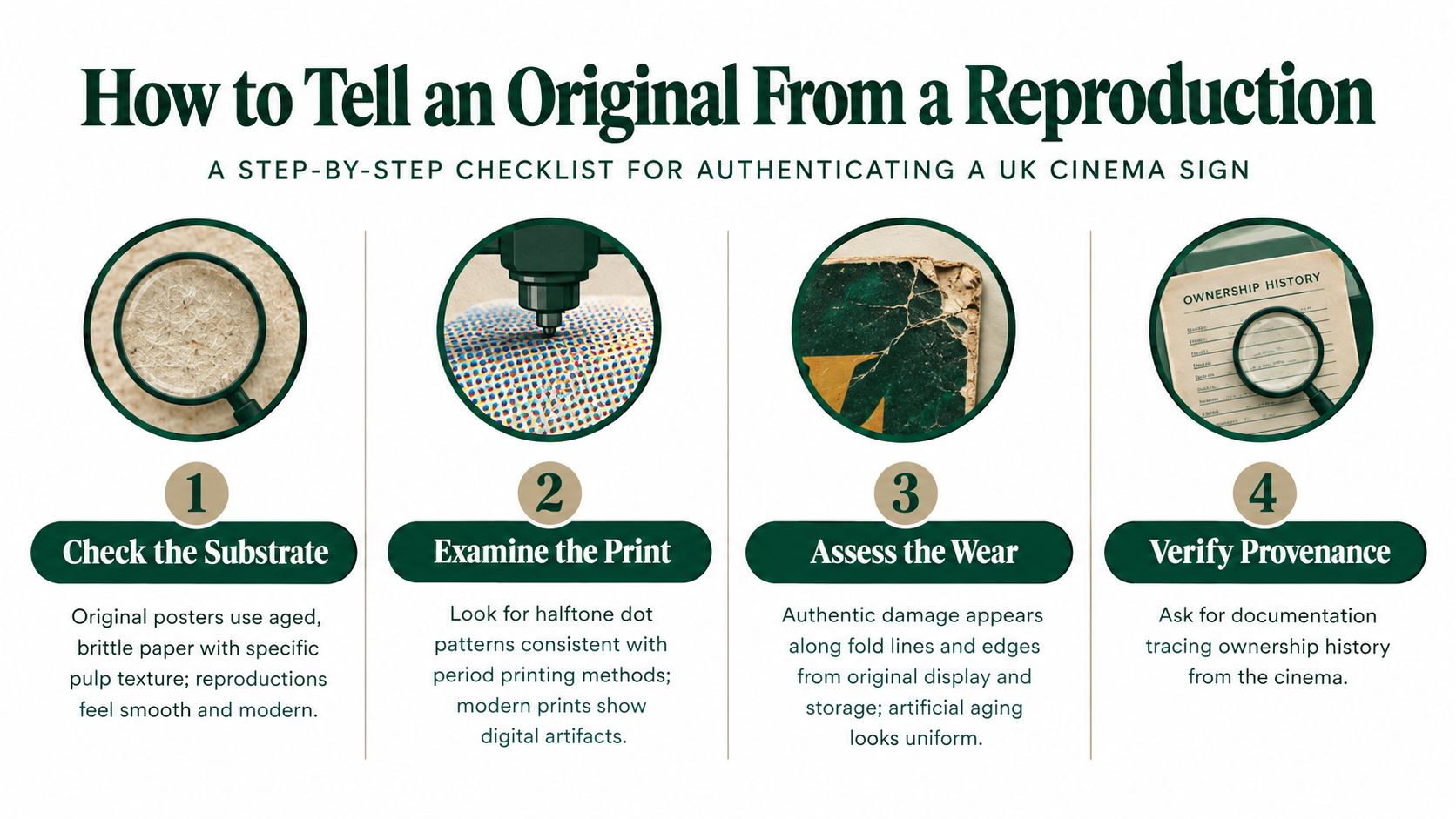
1. Check the substrate. Paper from an older display may show brittle edges, foxing, tobacco staining or a pulp texture consistent with age. Bright, smooth, mechanically cut stock points towards a reprint, although a carefully conserved original may look cleaner than expected. A Quad's format should also be checked against its stated dimensions and orientation. Pre-1985 British Quads were generally machine folded before issue, so a plausible fold pattern can support the description, while a crease from a modern postage tube tells you very little (Art of the Movies poster format guide).
2. Examine the print. Use magnification to distinguish period halftone or screen-print characteristics from digital output. Enamel panels may show fired lettering, edge chips and slight registration drift. Vinyl decals and perfectly flat digital transfers are more typical of reproductions or later alterations.
3. Assess the wear. Genuine wear usually relates to use. Fold lines, frame shadows, fixing points, exposed corners and areas repeatedly touched by staff should not all age in exactly the same way. Uniform brown staining, identical abrasion around every edge or freshly distressed lettering can indicate artificial ageing.
4. Verify provenance. Ask where the sign was removed from, who removed it, when it was acquired and whether photographs show it in situ. A receipt, cinema closure material, estate paperwork or correspondence with the venue can help establish a chain of custody. The UK guide to verifying original movie posters is also useful for building a broader authentication habit.
Seller language matters. “Original design” may mean only that the design imitates an older sign. “From an old cinema” is weaker than “removed from the former ABC cinema at a named address”, supported by photographs and paperwork. If the listing shows only a staged interior image, uses “style of” and declines to photograph the back, price the item as decorative until evidence changes that view.
How Original Cinema Signs Were Made and Lit
A working cinema readograph was built for daily changeovers, weather exposure and repeated handling. Its framed display held removable letters or programme information, while lamps behind the face kept the message legible after dark. That combination of advertising flexibility and architectural scale helped make readographs a familiar feature of British picture houses.
Traditional examples generally used metal frames, translucent panels and internal lamps. Depending on the period and design, programme material might be painted, printed or mounted behind glass or Perspex. Later lightboxes often used fluorescent tubes to spread light evenly across the face. Access panels, brackets, ventilation openings and electrical fittings were part of the construction, not incidental additions. Their condition can reveal how the sign was installed and maintained.
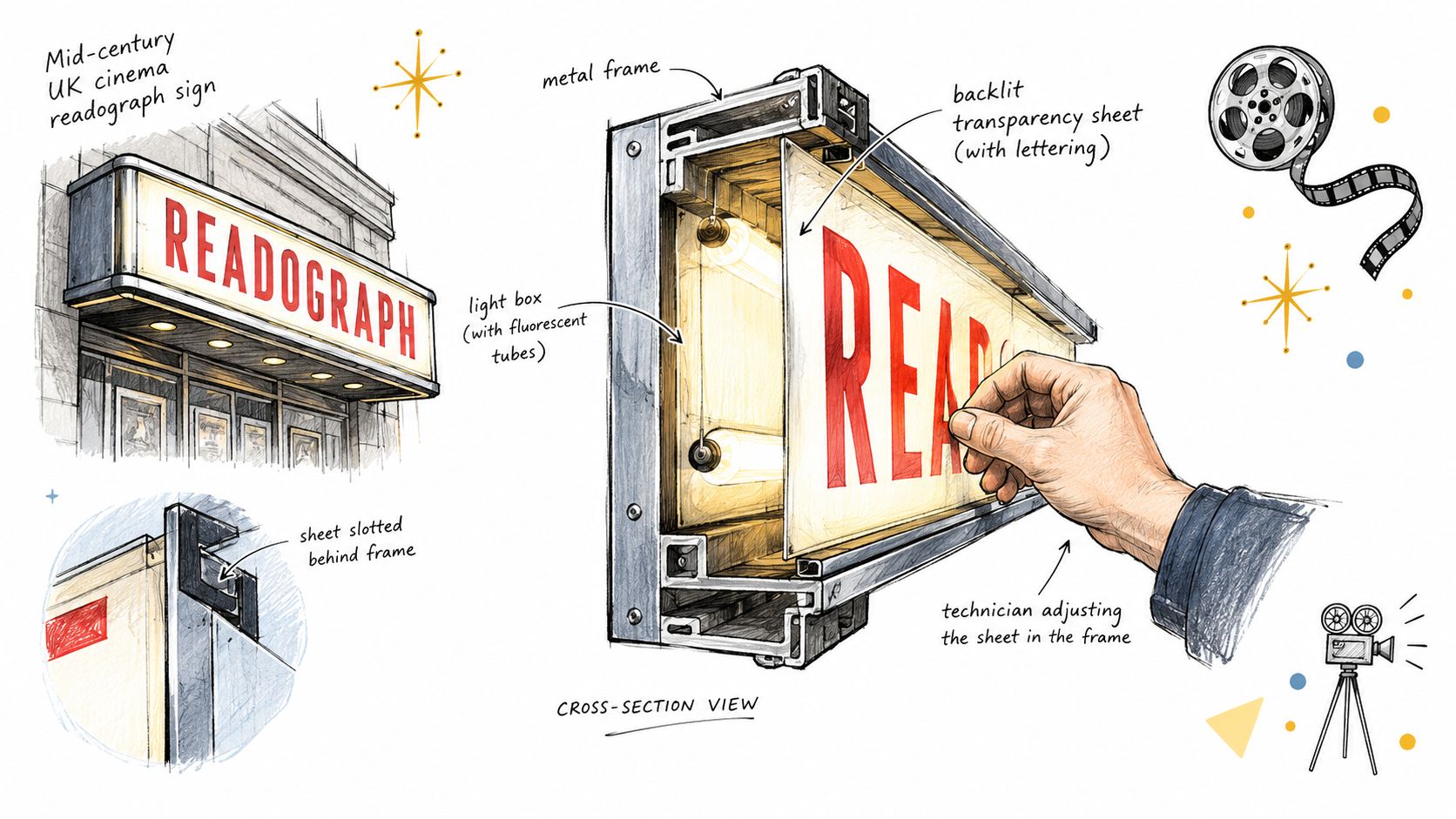
A salvaged lightbox from a closed ABC cinema in north London shows why structure and provenance matter. Its aluminium frame was dented, the Perspex cover cracked and the original metalwork still carried theatre branding. Those faults supported its history. In the trade, honest dents and documented alterations are more convincing than a bright replacement face attached to an invented backstory.
Why illumination changes the buying decision
Lighting adds both value and risk. Old wiring may be unsafe, lamp holders can become brittle, and a replacement face may hide whether the original display remains underneath. Ask whether the unit has been electrically tested, which components have been replaced and whether the lighting is suitable for display use only.
Modern LED conversions can reduce running costs and improve efficiency while retaining a warm-white appearance. The trade-off is originality. A sympathetic conversion can make a fragile sign practical to display, but record it clearly as a conversion rather than presenting it as untouched period equipment. That distinction matters to collectors, insurers and anyone assessing the sign's future restoration.
Restoration and Preservation Without Causing Damage
The safest first action is documentation. Photograph every face, edge, fixing, label, crack, stain and loose component before cleaning. Record measurements, materials, wiring condition and any information supplied by the seller. This creates an insurance and provenance record, and it stops later restoration from being mistaken for original condition.
Keep the sign away from direct sunlight, radiators, damp walls and rapidly changing temperatures. UV exposure fades inks and can damage sensitive surfaces, so museum glazing or UV-protective glass is appropriate for framed memorabilia. Conservation-grade framing should also include an acid barrier, because acidic backing boards can cause acid migration into paper and other vulnerable materials (Fine Art Restoration's film memorabilia conservation guidance).
Use reversible methods first
- Handle carefully: Clean, white cotton gloves are sensible for enamel panels and metalwork, while paper should be supported from underneath rather than lifted by a corner.
- Remove loose dust: Use a soft, natural-bristle brush without pushing dirt into cracks. Don't apply household polish or solvent to a printed face.
- Choose storage materials: Acid-free tissue and pH-neutral supports reduce contact risks. Archival pockets made from 100% archival-quality polyester are inert, acid free, strong and suitable for handling, unlike cheaper PVC sleeves that can damage paper over time (Preservation Equipment's archival poster sleeves).
- Leave paper alone: Don't use tape, laminate a poster, iron folds or flatten it with improvised weights. Linen backing should be considered only when tears threaten the paper and should be undertaken by a qualified conservator.
- Treat metal conservatively: A soft brush and minimal distilled water may be suitable for an unprinted metal frame, but not for lettering, paper, enamel chips or electrical components.

Bronze, brass and other decorative metals need separate judgement because cleaning can remove evidence of age. For general background on cautious domestic metal treatment, see this practical guide to bronze cleaning for homeowners, but don't apply a household method to a cinema sign without identifying the metal, coating and painted areas first.
This video can help visualise the principle of gentle conservation, but it shouldn't replace an assessment by a paper, metals or electrical specialist.
For paper display, use UV-filtering glazing with an acid-free mount and avoid pressing the artwork tightly against the glass. The poster framing guide from Famous Movie Posters covers the same conservation logic in a display context. Anything you can't reverse should be left to a conservator, not a general framer.
Where Collectors in the UK Actually Source Signs
Original UK cinema signage usually appears through salvage and trade channels rather than ordinary homeware listings. Specialist auctions can offer condition reports and stronger descriptions, but experienced bidders often follow them closely. Provincial clearances and cinema liquidations may produce better buying opportunities, although records can be limited and removal damage is more likely.
Dealers with established mailing lists are useful for provenance-heavy material. They may know the previous owner, the venue, and the repairs already carried out. Estate sales can reveal foyer boards, poster frames and individual lettering. Local advertising clearances sometimes produce fragments, but those need careful checking against period construction and cinema history.
Online marketplaces provide the broadest choice, though description quality varies sharply. Current marketplace indexing shows listings from about £4.50 to £185.88, with many decor-led entries, reinforcing the need to separate replicas from genuine collecting material (UK cinema sign marketplace index).
Asking price is not proof of authenticity. A low price may indicate a reproduction, missing hardware or an overlooked salvage opportunity. A high price may reflect polished photography and a familiar chain name without evidence linking the object to that venue.
| Source | Typical Items | Price Range |
|---|---|---|
| Specialist auction houses | Enamel panels, foyer boards and documented memorabilia | Varies by condition and provenance |
| Cinema liquidations | Readographs, lightboxes, fascias and fittings | Varies widely |
| Established memorabilia dealers | Attributed signs, lettering and related paper material | Varies by rarity and documentation |
| Estate sales | Smaller foyer displays and framed cinema material | Often difficult to predict |
| General online marketplaces | Replicas, decorative panels and occasional salvage | About £4.50 to £185.88 on one UK index |
Before paying collector prices, ask four direct questions:
- Where was it removed from? Request the cinema name and location.
- What supports that history? Ask for removal photographs, receipts or correspondence.
- What has been changed? Confirm whether the face, wiring, lamps, brackets or paint are replacements.
- Can it be inspected independently? A serious seller should explain inspection and return terms.
For related paper collecting, this guide to 1920s movie posters shows why age, format and authenticity should be assessed separately.
The Collector Mindset Before You Buy
The first decision isn't which sign to buy. It's what job you need the object to perform. A decorative replica may be entirely suitable for a themed room, while an original reclaimed panel belongs in a display where its condition and history can be protected. A working lightbox introduces electrical and heat considerations that don't apply to a flat poster or unlit enamel sign.
Three mistakes appear repeatedly.
Paying for a reproduction as though it were original. A digitally printed face, modern mounting holes and generic ageing should put the brakes on the purchase. If the seller can't identify the venue or explain construction, value the object for its design and materials, not an implied cinema connection.
Over-cleaning away the history. Dirt trapped behind a bracket, old fixing marks and uneven fading can help explain how a sign was used. Aggressive polishing, repainting or solvent cleaning may make the piece brighter while removing the very evidence that supports its story.
Ignoring restoration cost. A cracked Perspex cover, unsafe wiring or flaking paper may be repairable, but the price should reflect the work. Ask for a written conservation opinion before treating a damaged sign as an investment-grade purchase.

Decide your standard before bidding
For a wall display, prioritise safe mounting, UV protection and visual stability. For an insurance-grade collection, prioritise documentation, condition photography and reversible treatment. For working illumination, require an electrical inspection and keep modern conversions clearly recorded.
A finite supply of surviving picture-house material favours honest condition and traceable history. Decorative replicas can be manufactured again, but a sign that retains original venue evidence can't be recreated by distressing a new panel.
Run this checklist before committing funds:
- Identity: Is it a sign, a poster board, a fascia component or a replica?
- Construction: Do the substrate, print and fixings support the claimed period?
- Provenance: Can the seller trace it to a named cinema or credible collection?
- Condition: What is original, what is damaged and what has been replaced?
- Treatment: Has anyone cleaned, repainted, rewired or relit it?
- Display: Can you protect it from UV, unsuitable plastics, damp and heat?
- Exit value: Would the next buyer receive the same documentation you received?
Famous Movie Posters specialises in guaranteed original film posters, including British Quads and other cinema formats, with guidance on authentication, framing and archival handling. Visit Famous Movie Posters to browse verified memorabilia or use its sourcing service when you're building a cinema-themed collection around an authentic vintage sign.