



The most attractive wall spot is often the worst one for a poster. A bright feature wall looks brilliant on day one, then daylight, heat and moisture start doing the actual work on the paper. If you want vintage movie posters framed properly, stop treating “framed” and “safe” as the same thing.
A poster can look immaculate and still be built from the wrong materials. Acidic board, tight glazing, a cold external wall and a radiator below it will steadily punish the sheet, even if the moulding looks expensive. That's the gap this topic keeps missing, and it's the one serious collectors should care about.
Table of Contents
- Why Framed Is Not the Same as Archival
- Buying Pre-Framed Versus Framing Yourself
- The Archival Framing Workflow Step by Step
- Glazing, Light and Humidity the Way UK Experts Frame It
- Where to Hang a Framed Poster in a Real UK Home
- Authentication, Folded Posters and Condition-Based Choices
- Looking After a Framed Poster for the Long Term
Why Framed Is Not the Same as Archival
A frame is presentation. Archival framing is protection. Those two things overlap sometimes, but plenty of posters in decent-looking frames are being handled badly.
The look can be right while the build is wrong
Retail framing often solves the visual problem first, then leaves the conservation problem to chance. A poster can be centred, clean and nicely lit, yet still sit against acidic materials or press straight into glazing when the room gets humid. That's how a display that feels polished ends up shortening the life of the sheet.
The dangerous bit is that buyers tend to judge the frame by sight. They don't see whether the backing board is conservation grade, whether the paper is isolated from wood-based materials, or whether the glazing has enough separation to avoid sticking. If you're storing paperwork, certificates or other flat items for the long term, a practical guide like GDPR compliant document storage shows the same principle, materials and environment matter more than appearances.
A frame should protect first and flatter second.
Ask what's inside the frame
If a framer can't tell you what the mount board is made from, what the glazing does, and how the poster is kept off the glass, treat that as a warning. A sympathetic-looking frame can still introduce acids, trap condensation or clamp a folded sheet too tightly. That's not archival, it's just decorative.
For vintage movie posters framed in a UK home, the practical question is simple, does the build reduce risk, or just hide it? The usual instinct is to ask only about size and style. Ask about board, glazing, spacing and reversibility instead, because those are the parts that decide whether the poster can survive being on the wall.
The other trap is assuming that a frame bought with the poster must be suitable for that poster. Sometimes it is. Often it isn't. The safest habit is to inspect the construction before you trust the label.
Buying Pre-Framed Versus Framing Yourself
Buying pre-framed is convenient, but convenience does not equal proper protection. A custom conservation frame costs more and takes longer, yet it lets you control the materials, the depth, and the fit. DIY can work for a low-value piece, but it is the easiest way to end up with a frame that looks right and treats the poster badly.
The three routes really offer three different outcomes
A pre-framed poster from a retailer suits buyers who want something ready to hang and are not dealing with a rare sheet. The trade-off is simple, you accept someone else's choices on glazing, backing, and internal depth. If the retailer uses a one-size-fits-many build, the poster may look fine at first and still be wrong for the format.
A custom conservation framer gives you real control. That matters for a British Quad, because the 30 × 40 inch format does not match a standard US One Sheet shape, which is approximately 27 × 40 inches. A frame made for one does not automatically suit the other, so check the measurements before you order. If you want a plain cost comparison, the guide to how much it costs to frame a poster is useful because price only makes sense once you know what build you are paying for.
DIY is for buyers who already understand the risk. Off-the-shelf frames are often fine for modern prints, but vintage British formats are awkward if you want proper borders, a spacer, and enough depth for safe glazing. Force the sheet into a frame that is too shallow, and you are choosing stress over preservation.
| Choosing How Your Vintage Poster Gets Framed | Pre-framed from poster retailer | Custom conservation framer | DIY with off-the-shelf frame |
|---|---|---|---|
| Fit | Quick, but often generic | Exact to the poster | Depends on what you can buy |
| Materials | Varies widely | Controlled and specified | Usually basic unless upgraded |
| Authenticity handling | Often minimal | Better for originals and fragile stock | Easy to mishandle folded paper |
| Conservation | Can be decent, can be weak | Strongest option | Usually the weakest unless you know what you're doing |
Here is the blunt rule. If the poster is replaceable, pre-framed can be acceptable. If the poster matters, pay for the right construction.
The Archival Framing Workflow Step by Step
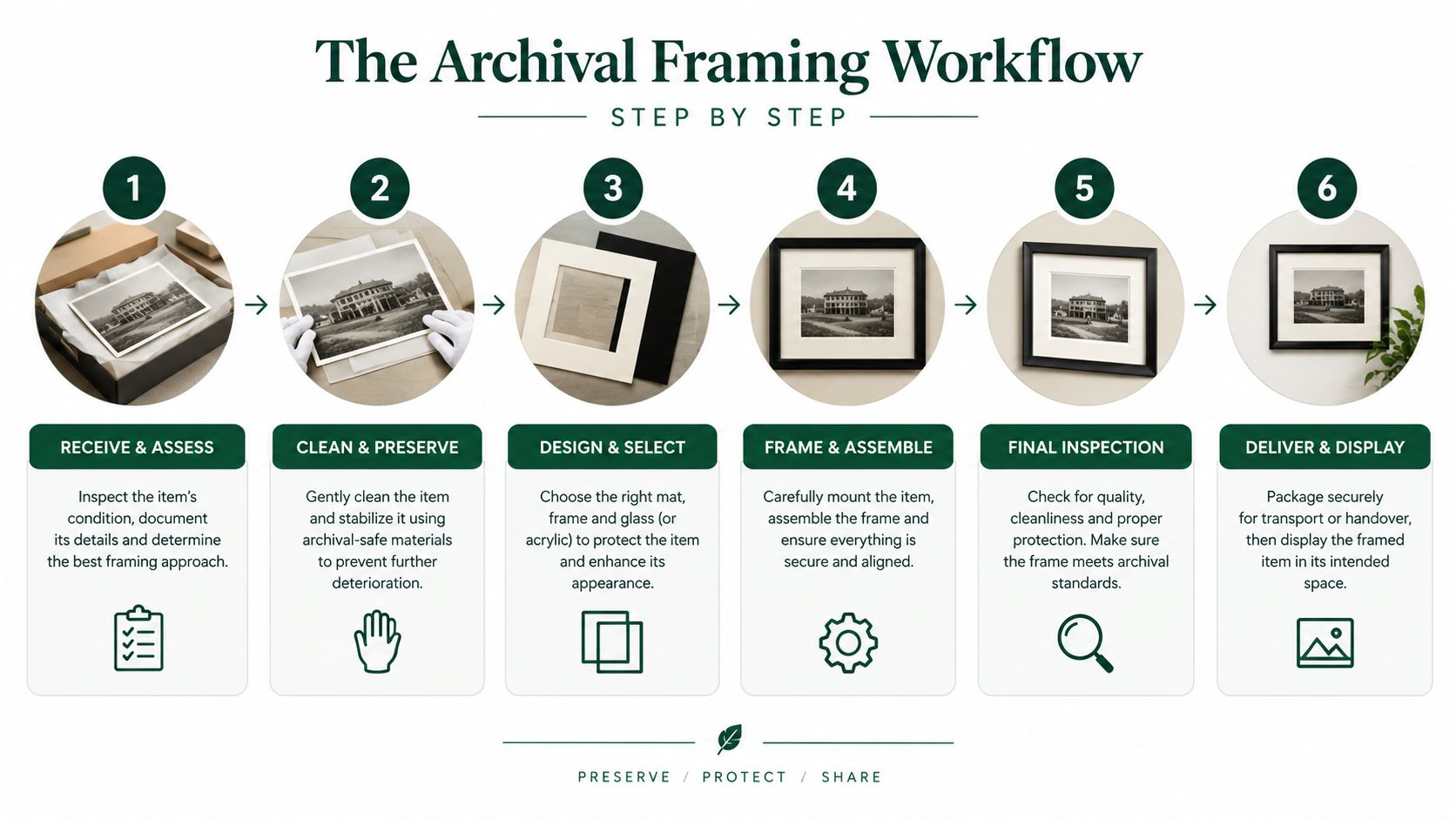
A proper archival build starts with the board, not the moulding. For a UK Quad, I'd specify acid-free conservation board or cotton museum board as the visible support. Ordinary board is where long-term trouble begins, because acidic materials keep working on the paper.
The layers that matter
First comes the mount or backing support. It holds the poster flat without forcing it, and it should stay reversible where possible. For a valuable original, reversible paper hinges with wheat-starch adhesive are the sensible route, because they hold securely without locking the sheet into a permanent bond. If you want the basic mechanics laid out before you order the parts, the guide to how to frame a poster pairs well with the layer-by-layer logic here.
Next is the spacer. It keeps the paper away from the glazing, which matters whether you choose glass or acrylic. Without that gap, condensation or a pressure point can make the poster stick to the front. If you are packing a sheet for transport before framing, find removal packaging that protects corners and surface, because bad handling causes avoidable damage before the frame is even built.
Never let a vintage sheet touch the glazing directly if you care about the object rather than just the look.
Then comes the glazing choice. For large posters, Tate's guidance notes that UV-absorbing 3 mm acrylic is widely used for works on paper, while 5 mm acrylic is used for frames over 1 metre in either direction. Smaller permanently framed works may use 4 mm low-reflective glass, while larger works may need 4.4 mm laminated glass. That is the kind of detail worth giving a framer, because it changes the build from the front layer down.
The back of the frame matters too. The internal structure should be deep and rigid enough to carry the glazing without flexing, and the rebate should be sealed against dust while still allowing slight thermal movement. I'd also insist on an isolating layer between the mount and any wood-based backing board, because you do not want contaminants migrating into the sheet over time.
For a poster that is low value and meant for casual display, you can simplify the build. Skip museum-grade hardware, but do not skip the spacer and decent board. Once those two are wrong, the rest of the frame is decoration.
The straight-up view is this. If you are framing an original British Quad, do not economise on the hidden layers. That is where damage is prevented, or baked in.
The practical part is packing and handling before the frame reaches the wall. Use materials that protect the poster through transport and the handoff to the framer, not cheap fillers that crease the sheet or bruise the corners.
Glazing, Light and Humidity the Way UK Experts Frame It
For paper on a wall, light is the enemy that looks harmless. Art UK advises keeping works on paper at 50 to 80 lux and ultraviolet radiation at or below 75 microwatts per lumen because excessive exposure bleaches pigments and discolours paper. That's not museum fussiness, that's the line between a poster that stays sharp and one that fades into a washed-out shell.
What to ask for at the framer
I'd specify UV-filtering acrylic for larger or more vulnerable pieces, and I'd consider low-reflective glass where the size and weight are manageable. Tate's technical guidance is useful here because it gives concrete thicknesses, not vague reassurance. The point isn't to impress anyone with premium glazing, it's to stop light damage and keep the sheet physically separated from the front.
Humidity is the other silent killer. Art UK recommends a stable relative humidity within roughly a 20% band and below 65%. For a house, I'd treat 45 to 60% RH as the practical sweet spot, because it's stable enough for paper and realistic in an ordinary room.
Why a spacer still matters
Even the best glazing is not enough if the paper can press against it. The spacer creates the gap that prevents sticking and reduces trouble from condensation. Without it, a small temperature swing can turn a clean display into a problem frame.
There's also a placement issue that matters more than many admit. South-facing daylight, especially through a window close to the frame, is a bad idea for anything original or delicate. The poster may survive for a while, but you're spending its display life quickly.
Keep the frame out of direct daylight, keep humidity steady, and keep the poster off the glass. That combination does the real preservation work.
The choice between acrylic and glass comes down to the room as much as the poster. Acrylic makes more sense where weight, size and shatter risk matter. Glass can work well on smaller, permanently hung pieces, but only if the frame depth and spacing are properly thought through.
If a framer can only talk about “museum quality” in general terms, push for specifics. Ask about UV filtering, thickness, spacing and whether the frame has been built to keep the poster from touching the glazing.
Where to Hang a Framed Poster in a Real UK Home
A good wall can still be a bad wall for a poster. The National Archives is clear that framed paper should be protected from daylight, especially strong exposure from south-facing windows, and it warns against hanging a frame directly against an external wall because the cooler surface can create condensation and mould inside the frame. That advice should be taken seriously in any normal UK house.
Room by room, the rules are simple
In a living room, pick the wall with the least direct sun, not the one that looks best in photographs. A bright feature wall may feel perfect for a reveal shot, but it's often the quickest way to bleach a vintage sheet. If the only good wall is sunny, rotate the poster rather than leaving it up permanently.
In a hallway, watch the temperature swings. Front doors, draughts and nearby radiators are rough on paper, especially if the frame is on an outside wall. A stairwell can work well if it's cooler and shaded, but only if the poster isn't catching passing light all day.
In a bedroom, the danger is usually heat. Don't hang a framed poster above a radiator or any other heat source. That placement invites distortion, and it can also encourage humidity problems inside the frame.

A quick wall check before you drill
- Check the sun path: If the wall gets hard daylight for much of the day, don't use it for an original poster.
- Check the wall type: An external wall raises condensation risk, especially in colder months.
- Check the heat sources: Radiators, fireplaces and vents are bad neighbours for paper.
- Check the room use: Busy rooms increase bumps, dust and accidental knocks.
- Check the fallback plan: If the wall is too exposed, use rotation or flat storage instead.
A framed poster doesn't need to live on the wall all year to count as properly displayed. Temporary rotation is a smart choice for anything more valuable or more fragile than a modern reprint. The bravest decision is often to leave a wall empty.
Authentication, Folded Posters and Condition-Based Choices
A lot of original British posters arrive in the condition you would expect from a working cinema item. Machine-folded before 1985 is common, and older sheets can also be flattened under weight, cockled, or worn at the edges. None of that makes a poster worthless, but it changes how you frame it and how much restraint the frame needs.
One poster, three different framings
Take a clean, flatter Quad with strong paper and little edge wear. It can sit in a tighter mount and a shallower-looking presentation without much risk, if the board selection and spacing are right. The poster is still original paper, but it behaves more like a stable display piece.
Now take a folded example with visible creases and slightly brittle corners. That sheet needs wider borders, more internal depth, and a frame that does not force the folds flat against the front. Clamp it too tightly and the fold lines become stress points, then the damage shows later.
Then there is the compromised piece, the sort that has been handled badly, stored in the wrong place, or flattened with too much force. The V&A's conservation logic matters here: support the sheet evenly, keep tension low, and choose reversible mounting whenever possible. The museum's poster project also showed how varied large paper can be, which is exactly why one-size framing fails so often.
For a collector buying from a reputable retailer, “guaranteed original” should mean more than a line in the listing. If you want a benchmark for what verified originals look like, this guide to original movie posters in the UK sets out the authentication standards to expect. It should mean the poster has been sourced and described accurately, stored sensibly, and handled in a way that respects condition instead of hiding it. Famous Movie Posters sells verified originals and also offers framed posters in the UK, which is useful if you want sourcing and framing under one roof.
Good framing follows the condition. Bad framing pretends every poster is a fresh print.
The practical test is simple. If the sheet is flat, stable, and healthy, frame it cleanly. If it is folded, fragile, or slightly distorted, the frame has to be more forgiving. That is the whole job.
Looking After a Framed Poster for the Long Term
A framed poster doesn't get protected once, it gets protected repeatedly. I'd check the rebate and back edges for dust every few months, because dust build-up tells you where the seal is failing. Once a year, review the light exposure and humidity in the room and decide whether the poster still belongs there.
Watch for early foxing and cockling. Foxing shows up as brownish spotting, while cockling means the paper is starting to ripple or distort. If either appears, take the poster down and reassess the room before the problem gets embedded.
Rotate valuable sheets between wall display and flat storage if you want them to last. When you remove one, handle the frame by its sides, keep the poster vertical and don't let the sheet rub against rough surfaces. If it ever has to come out of the frame, support the paper fully and don't tug at the corners.
An ordinary UK home is perfectly capable of housing a vintage poster well. The trick is to treat the poster like paper with a history, not just decoration with a price tag. Get the materials right, place it sensibly and keep an eye on the room, and the frame will do its job.
If you want original UK Quad and one sheet posters with proper authenticity handling, visit Famous Movie Posters and choose a piece that suits the room you have, not the wall you wish you had. If you'd rather buy once and frame once, their catalogue and framing options make it easier to match the poster, the format and the level of protection in one go.