



Most advice about antique posters UK starts with age. That's the wrong place to start. A poster isn't valuable because it has yellowed paper or an old-looking title. What matters is whether it's an original, which format it was printed in, how well it has survived, and whether the seller can explain where it came from.
I've handled enough original British film, transport and exhibition posters to know that attractive decoration can hide poor buying decisions. A later reproduction may look perfect on a wall, while an honest original with folds, pinholes or careful restoration can carry the history collectors want. Before you spend money, ask four questions: Is it original? What format is it? What is its condition? Where is it coming from?
Table of Contents
- Why ‘Antique' Is the Wrong Question When Buying UK Posters
- UK Poster Formats and Sizes You Need to Know
- How to Tell If a UK Poster Listing Is Original
- What Genuinely Counts as an Antique UK Poster
- Where to Buy Antique Posters in the UK Safely
- Storage and Handling Standards for Original UK Posters
- A Practical Buying Checklist for First-Time UK Collectors
Why ‘Antique' Is the Wrong Question When Buying UK Posters
The word antique is too blunt for the British poster market. In ordinary conversation, it often suggests something made before the 1920s. Serious poster collecting works differently. Transport, exhibition and film material from the twentieth century forms much of the market's practical centre, and a poster's significance comes from its production history and survival, not from crossing an arbitrary age line.
A limited cinema poster made for a particular British release can be more interesting than a widely reproduced sheet from decades earlier. A later UK Quad issued for one cinema run may have a stronger collecting case than a heavily copied 1950s image that has lost its original margins and printing character. Rarity is not the same thing as age, and “vintage” in a listing doesn't prove either.
Originality comes before decoration
The Victoria and Albert Museum's poster collection contains more than 26,000 items, collected internationally from the early twentieth century to the present day. It includes work by Chéret, Toulouse-Lautrec, Cassandre and Edward McKnight Kauffer, alongside anonymous activist material. That range matters because it shows posters as design objects and historical documents, not disposable advertising.
London Transport Museum offers the same lesson from a British transport perspective. Frank Pick took charge of Underground publicity in 1908, and the museum cares for more than 30,000 posters representing up to 7,000 different designs, including preparatory artworks and finished prints, as explained in its history of poster design. Institutional collections preserve posters because their authorship, format, printing and cultural context matter.
Dealer's rule: Never let the word “antique” do the work that paper, format, condition and provenance should be doing.
Age still matters. Early printing methods, historic subjects and survival in good condition can make an older sheet desirable. But age is only one part of the assessment, and often not the first part. If a listing gives you a date but no dimensions, no reverse photograph and no explanation of origin, you haven't been given the information needed to buy intelligently.
UK Poster Formats and Sizes You Need to Know
Format is the quickest way to catch a careless listing. British cinema posters weren't printed to one universal size, and sellers who use “Quad” as a loose synonym for any British film poster create confusion around framing, storage and price.
The British Quad is commonly listed at 30 x 40 inches, or 762 x 1016 mm, while the British One Sheet is 27 x 40 inches, or 685.8 x 1016 mm, according to this UK poster-size reference. The Quad is the standard British cinema format, while older examples were usually issued folded and more recent posters are often rolled, as outlined by this British film poster size guide.
| Format | Dimensions (inches) | Dimensions (cm) | Common Use |
|---|---|---|---|
| British Quad | 30 x 40 | 76.2 x 101.6 | British cinema advertising |
| British One Sheet | 27 x 40 | 68.6 x 101.6 | Film advertising and release publicity |
| Double Crown | 20 x 30 | 50.8 x 76.2 | Smaller British advertising format |
| Three Sheet | 41 x 81 | 104.1 x 205.7 | Large-scale cinema display |
| Inserts and lobby cards | Varies | Varies | Smaller display and lobby promotion |
Measure before you buy
Ask the seller for the actual sheet measurement, not the advertised format. Measure from edge to edge, including the visible paper, and ask whether the poster has been trimmed. A small reduction can come from previous framing or conservation, but a supposed Quad measuring close to One Sheet proportions needs an explanation.
Don't assume every release of the same film used the same dimensions. British re-releases could have new artwork or a different issue format, and a later poster may not match the original campaign. The difference between a One Sheet and a Quad is therefore more than a framing detail. It helps you understand what the distributor intended and whether the listing's description makes sense.
Format also affects the rest of your budget. A Quad needs more wall space and a larger frame than a One Sheet, while a Three Sheet demands a very different display plan. Decide whether you're buying for a frame, a flat-file archive or a wider collection before you bid.
How to Tell If a UK Poster Listing Is Original
A photograph can make a reproduction look convincing. It can also hide trimmed edges, artificial ageing and restoration. I inspect a listing in a fixed order because attractive artwork encourages buyers to skip the boring evidence.
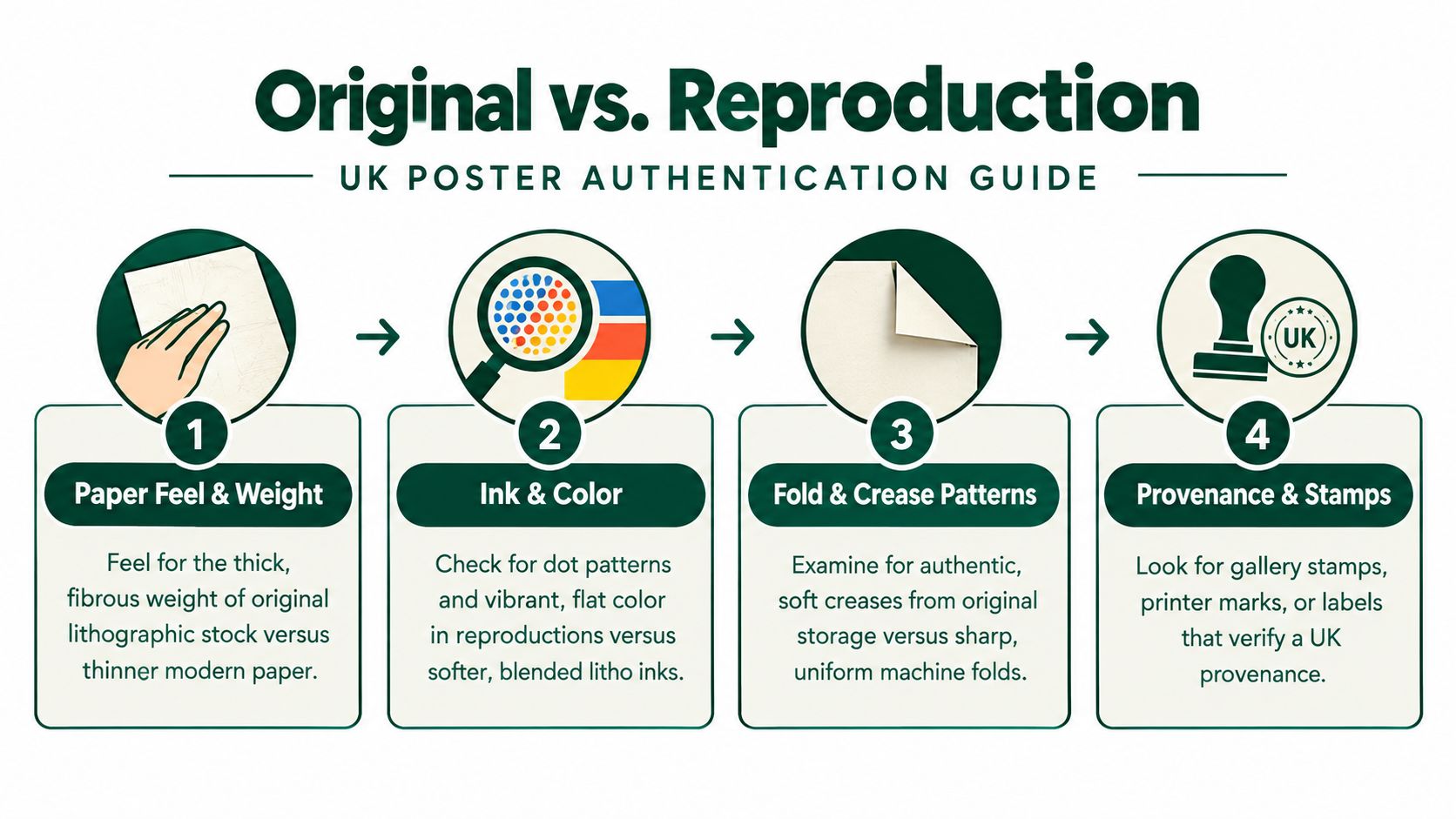
Start with the full sheet. You should see the margins, corners, credits block and, where possible, the reverse. A close crop of the artwork tells you almost nothing about originality. Compare the paper's character, the printing surface and the fold pattern with known examples, not with a seller's confidence.
Inspect the physical clues
Original lithographic stock can feel fibrous and substantial, while many modern reproductions use a smoother, more uniform sheet. Offset printing can show a regular dot pattern under magnification. Period lithography often produces softer blended inks, though printing techniques vary, so no single surface clue proves authenticity on its own.
Look at the folds next. Genuine UK Quads were commonly folded by distributors, often with three vertical folds. Softened folds, handling marks and small edge bruises can be consistent with an original that was stored and circulated. Extremely sharp, uniform folds on otherwise fresh-looking paper deserve scrutiny, as does a perfectly flat sheet described as an old folded original.
Read the bottom edge. The credits block, printer's details, copyright information, distributor marks and other production clues should agree with the film, country and period. NSS numbers can help with American material, while Crown Film Unit stamps matter for relevant British government and documentary work. They're clues, not certificates.
Test the seller's story
Ask for previous auction details, purchase paperwork, dealer invoices or collection history. Provenance doesn't need to be an elegant family story. A clear chain of ownership and a seller willing to show the reverse is more useful than dramatic language about rarity.
Common marketplace problems include trimmed reissues described as first releases, foreign-market posters relabelled as British Quads, and AI-enhanced scans that conceal restoration or make a digital reproduction look aged. If the seller refuses a full-resolution scan, gives inconsistent measurements or treats every question as an insult, walk away. This guide to original movie posters in the UK is useful background, but your own inspection still matters.
The embedded reference below shows the kind of visual comparison buyers should make before committing.
What Genuinely Counts as an Antique UK Poster
A battered Ealing Studios lobby card, a clean Carry On Quad or a Hammer horror release can all sit comfortably within a serious British collection, even though they don't share the same age, format or subject. Dealers and collectors judge the object in front of them, including its original use, printing history, condition and cultural pull.
Pre-1970s British cinema material remains particularly readable because it connects directly to the country's filmgoing history. An Ealing lobby card offers a smaller-format record of a studio campaign. A Carry On Quad carries recognisable British design and comedy history. Hammer horror posters appeal to collectors who value genre, artwork and the way a title was marketed to its original audience.
Transport posters follow a different collecting route. Designers such as Tom Eckersley and Edward McKnight Kauffer show how commercial commissions could become important graphic art. The V&A's international holdings include McKnight Kauffer, while London Transport Museum's preserved material demonstrates the depth of British transport poster design and the survival of both preparatory work and finished posters.
The 100-year test is too crude
A 1948 David Lean One Sheet may be more desirable than a tatty 1920s news bill. The older paper clears a dictionary definition of antique more comfortably, but the Lean poster may offer stronger authorship, subject interest, scarcity, condition and collector demand. A date can tell you when something was made. It can't tell you whether it deserves wall space or your money.
The opposite mistake is just as common. An 1980s reprint on aged-looking stock can appear old in an online photograph, particularly if the seller applies filters or supplies only a detail image. Modern reproductions imitate stains, foxing and softened colour, but they don't acquire original distribution history by looking tired.
Let the object prove itself
Ask what the poster was made for. Was it a British cinema release, a transport campaign, an exhibition, a political cause or a later decorative product? Then compare the format and printing evidence with that purpose. An object described as a “rare antique poster” but lacking a credible period, format or source should be treated as decorative wall art until proven otherwise.
That approach is more useful than policing the word antique. Collectors buy surviving evidence of a moment, not merely old paper.
Where to Buy Antique Posters in the UK Safely
The right buying channel depends on how much uncertainty you can handle. A specialist dealer usually offers the clearest description and the strongest opportunity to ask questions. An auction can offer discoveries and competitive buying, but the catalogue and viewing process place more responsibility on you. A fair gives you physical access, while an online marketplace gives you breadth and uneven quality.
| Channel | Authenticity Risk | Typical Price Band | Best For |
|---|---|---|---|
| Specialist poster dealer | Lower when descriptions and returns are clear | Varies by title, rarity and condition | First-time buyers and collectors seeking guidance |
| Major auction house | Moderate, because condition and attribution require inspection | Varies by estimate and bidding | Experienced buyers comfortable with catalogues and viewing |
| London or regional antiques fair | Moderate, depending on the dealer | Varies widely by stall and object | Buyers who want to inspect paper in person |
| Online marketplace | Higher, because descriptions and images vary | Varies widely | Experienced collectors who can verify listings independently |
Specialist dealers suit cautious buyers
Independent dealers in London and Bath, along with specialist businesses such as Reel Art and Cinema Poster Shop, can be useful when you need format knowledge, restoration disclosure and a return policy. Ask whether the sheet is original, whether it has been backed or linen-mounted, and what remains of the margins. A reputable dealer won't hide condition behind phrases such as “great for its age”.
Famous Movie Posters is one UK option for buyers looking for verified original film posters across formats including UK Quads and US One Sheets. Its catalogue is organised by decade, genre and franchise, and it also offers framing options, poster sourcing through its Request a Poster service, and archival handling information. Treat those features as practical buying support, not as a substitute for reading the individual listing.
Auctions and fairs reward preparation
Bonhams, Christie's and Dreweatts can provide specialist catalogues and established sale records, but you still need to study condition reports and inspect lots when possible. Auction descriptions may disclose restoration, backing, trimming or paper loss, but bidders should never assume an estimate guarantees authenticity or future value.
Olympia, Battersea and Newark fairs offer direct inspection and conversation. London also has recurring poster-focused market activity within antiques-fair listings, while specialist galleries and auction houses continue to trade original vintage posters nationwide. The current opportunity for buyers is not just browsing a broad “antique poster” page. It's choosing the channel that matches your ability to judge condition and provenance, as reflected by specialist poster auction activity.
Marketplaces require the hardest questions
eBay UK, Etsy UK and general antiques marketplaces can contain genuine material, but “antique”, “vintage” and “reproduction” are not interchangeable terms. Request the reverse, the complete margins, measurements and any printer or distributor marks. Check whether the image is a stock photograph, and don't treat positive feedback about delivery as evidence that the poster is original.
For old paper imported into the UK, ask about provenance and any applicable CITES requirements where materials or framing components may be regulated. If the seller can't explain the object's history, price it as an uncertain decorative purchase, not as a verified collectible.
Storage and Handling Standards for Original UK Posters
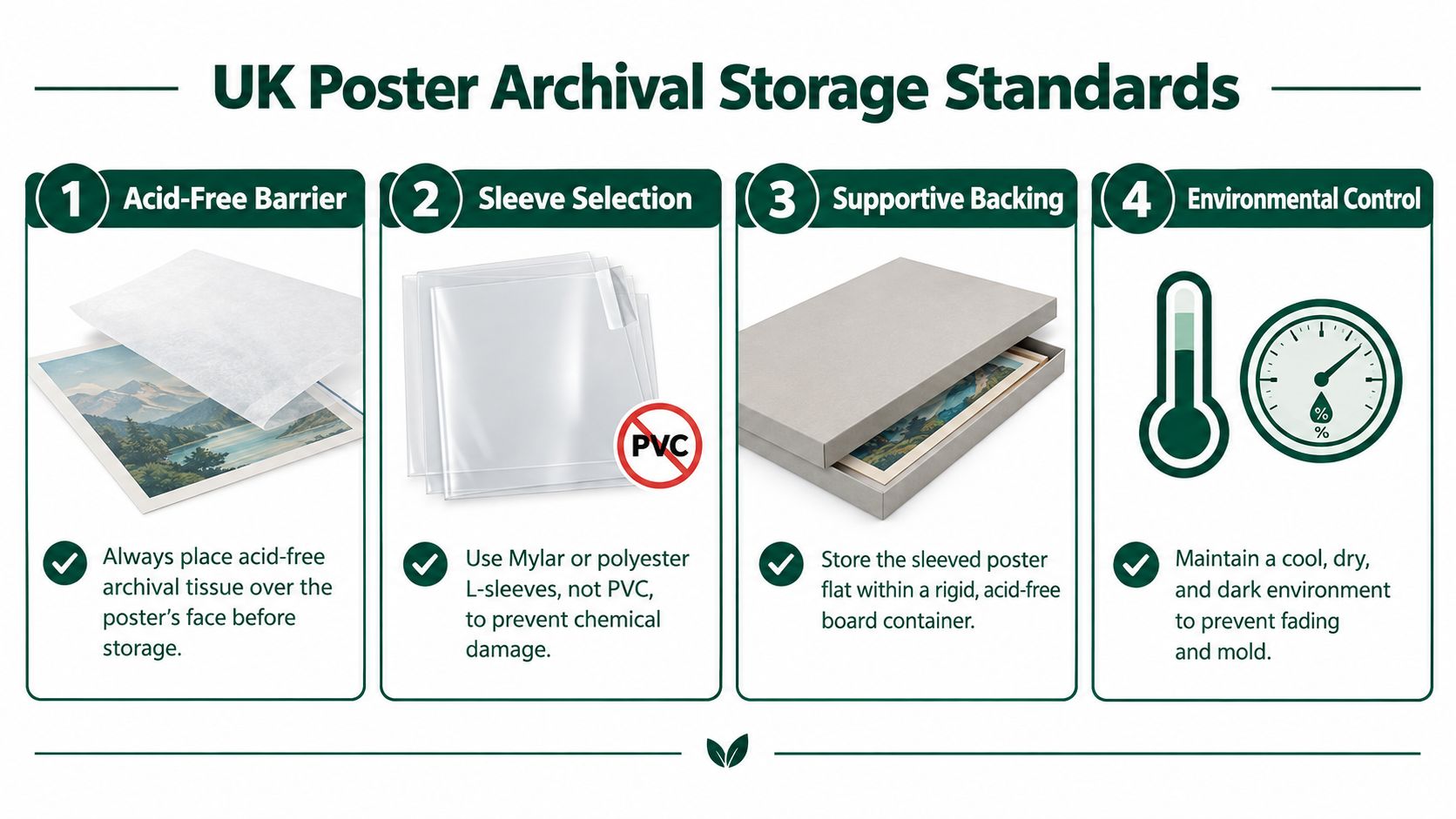
Storage damage is preventable, and it often begins the moment a poster arrives. The National Archives recommends separating paper items by size, using supportive folders or wrappers, and boxing material in small stacks to reduce mechanical stress, as set out in its guidance on storage for physical collections.
Put acid-free archival tissue over the printed face before storage. Use Mylar or polyester L-sleeves rather than PVC, then place the sleeved poster flat inside a rigid, acid-free board container. Separate different sizes instead of forcing a smaller sheet beneath a larger one.
Control the room and your hands
Keep posters flat in a cool, dry and dark room. Don't store them beside a radiator, boiler cupboard or sunny window. Central heating can create a dry environment, while damp rooms invite mould and distortion. You don't need to turn your home into a museum, but you do need to avoid rapid changes and obvious heat or moisture sources.
Handle large sheets with clean cotton or nitrile gloves and two hands. Support the entire poster rather than lifting it by one corner. Never use pressure-sensitive tape, laminate a sheet or place it directly against a non-archival backing board.
Brittle paper sometimes needs professional treatment. British conservation practice can use Japanese tissue backing, wheat-starch paste, washing and removal of old adhesive or linings to stabilise damaged sheets, as explained in this paper conservation discussion from the V&A. Don't attempt aggressive cleaning because a poster looks dirty.
Frame for protection, not convenience
For display, use UV-filtering glass or Perspex and archival backing. UK stockists such as Cowan's and Frames & Stretchers may suit standard work, while a bespoke framer in Soho can handle unusual dimensions, float mounting and conservation requirements. Check the frame depth before ordering, particularly for a backed or folded sheet.
The archival storage box guide covers the sort of purpose-built approach collectors should consider. Archive first, display second. Once paper has been creased, abraded, faded or exposed to unsuitable adhesive, you may not be able to recover its original condition.
A Practical Buying Checklist for First-Time UK Collectors
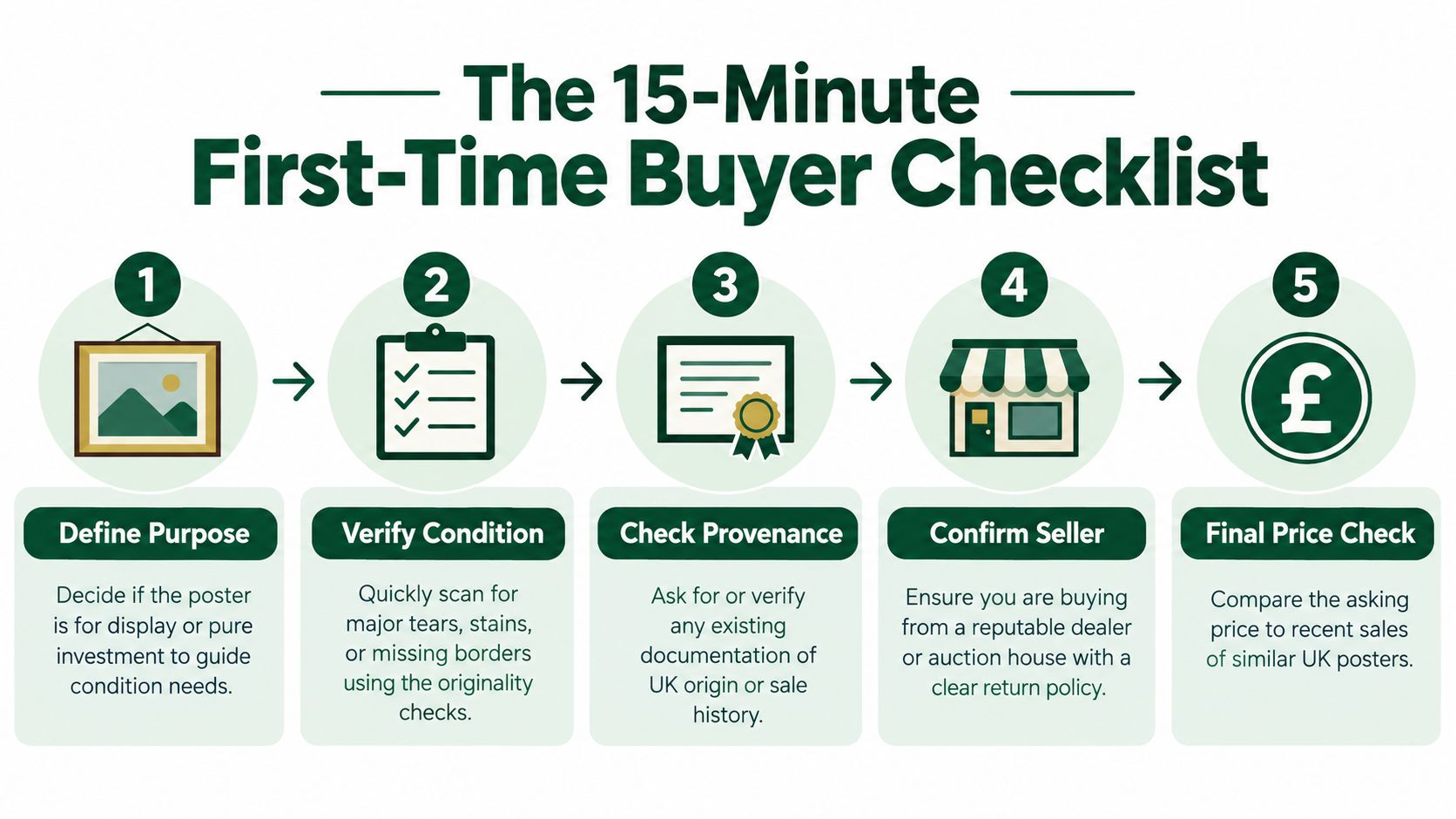
A disciplined buyer can screen a listing quickly without pretending that a short inspection replaces expert examination. Use this order, and stop if the seller can't provide basic evidence.
- Define the purpose. Decide whether you want a display piece, a research object or a long-term archive purchase. Display can tolerate visible history, but you still need to understand tears, stains, trimming and backing.
- Confirm the format. Measure the sheet and compare it with the claimed Quad, One Sheet or other format. Check whether it has been trimmed and whether the frame you intend to use will fit.
- Verify the condition. Ask for full images of the front, margins and reverse. Look for paper loss, repaired folds, pinholes, tape, staining, faded ink and signs of digital reproduction.
- Check provenance. Request invoices, auction lot history, collection labels or other documentation. Cross-check the seller against established trade networks, including the International Vintage Poster Dealers Association, where relevant.
- Set your limit. Decide your maximum bid or purchase price before viewing. Don't raise it because a seller calls the sheet “rare” without explaining why.
- Prepare storage and framing. Arrange suitable tissue, polyester protection, flat storage and a conservation-minded framer before delivery. A poster shouldn't spend its first weeks rolled on a table or leaning against a radiator.
Practical buying advice: A coherent collection grows from consistent decisions. Buy fewer uncertain sheets, ask better questions, and keep the evidence that explains each purchase.
That routine separates an original UK poster from an attractive reproduction more effectively than a vague search for “old” artwork. It also keeps format, seller, provenance, condition and preservation in one decision rather than treating them as separate afterthoughts.
Famous Movie Posters offers verified original film posters, including UK Quads and other formats, with catalogue filters, framing support and a Request a Poster service for harder-to-find titles. Visit Famous Movie Posters to inspect current originals, compare formats and choose a poster you can store and display properly.