



Archival storage paper is sheet material made for long-term contact with documents and posters, acid-free and usually carrying an alkaline reserve, rather than ordinary printer paper or gift tissue. For a domestic document collection, about 18°C and 50% relative humidity is a practical room target, but suitable paper and stable conditions need to work together.
Perhaps you've just unwrapped an original cinema poster and put it on the spare bed. The shipping tube is beside it, there's some brown card in the cupboard, and the packet of tissue you've bought says acid-free. What's less obvious is which material should touch the print, what should support it, and where the finished package should live.
An acid-free label isn't a preservation plan. The useful questions concern the sheet's composition, its measurable reserve against acid, the support around the poster and the conditions in that spare room.
Table of Contents
- What Archival Storage Paper Is For
- Acid-Free Buffered and ISO Specifications
- Why Everyday Paper Damages Posters
- Tissue Folders and Box Board Grades
- Flat Storage for Quads and One Sheets
- Temperature Humidity and the Spare Room
- Choose Paper Then Keep Posters Flat
What Archival Storage Paper Is For
A UK quad comes out of an old cardboard portfolio. Its colours still look lively, but the margin has turned tea-coloured where it rested against brown card. At an old fold, the paper feels stiff rather than supple.
That's a typical storage problem, not necessarily a printing problem. A collector may protect the image from scratches while overlooking the material touching its reverse and edges. The enclosure becomes part of the poster's environment.
A barrier beside the print
Archival storage paper belongs between the original and unsuitable neighbouring materials. It can take the form of conservation tissue, a buffered interleaving sheet or a paper folder. Proper archival boxes add a more substantial outer enclosure.
Think of the contact sheet as a clean barrier and, when buffered, a small chemical sponge. It separates the poster from newsprint, ordinary kraft and raw cardboard, while its alkaline reserve can neutralise a limited amount of acid. It cannot repair a brittle fold or reverse existing staining.
The distinction between a loose print and its protective folder is easier to recognise when the materials are laid out together.
Protection without unnecessary layers
For the yellowed quad, the first job is to remove the unsuitable backing without pulling at weak edges. The next is to provide a clean contact layer and a folder large enough to support the whole sheet. Adding several tissues while leaving the same raw card underneath wouldn't solve the underlying problem.
Practical rule: Choose each layer for a job, not because adding another layer feels safer.
A tissue protects a surface. A folder helps you retrieve the poster. A box shields the enclosed collection from everyday exposure and knocks.
That division matters when space is tight. A useful storage system lets you find a title, lift its enclosure and return it without catching corners or opening every neighbouring poster. Preservation includes making the collection easier to handle, not just wrapping it more thoroughly.
Acid-Free Buffered and ISO Specifications
The words on a packet describe different things. Acid-free describes acidity, buffered describes an added reserve, and permanent paper refers to a broader set of technical requirements. They aren't interchangeable promises.
Acid-free generally means the sheet was near neutral when manufactured. On its own, that claim doesn't establish fibre quality, strength or resistance to later acidification. A clean-looking sheet can still be poorly documented.
What an archive would measure
The National Archives framework of standards identifies ISO 9706:1994 for permanent paper and ISO 11108:1996 for archival paper, distinguishing requirements for permanence from permanence plus durability. The permanence criteria include minimum tear strength, an alkaline reserve, specified pH limits in a cold-water extract and a kappa-number limit on easily oxidised material.
Those tests answer separate questions. Tear strength concerns the sheet's mechanical performance. The pH test concerns acidity under a defined method, while the alkaline reserve measures its capacity to neutralise acid. The kappa-number requirement limits material susceptible to oxidation.
A supplier's single pH reading doesn't answer all of those questions. Nor does a statement that calcium carbonate has been added.
What archival paper labels guarantee
| Label | What it guarantees | What it does not prove | Sensible poster use |
|---|---|---|---|
| Acid-free only | Near-neutral pH at manufacture | An alkaline reserve or future stability | Only if fibre and supplier notes are also stated |
| Buffered alkaline reserve | Calcium or magnesium carbonate to neutralise acid | Full ISO compliance on strength and oxidation | Interleaving and folders beside posters |
| ISO 9706 permanent paper | Tear strength, alkaline reserve, pH limits, kappa-number cap | Durability under repeated handling; covers unprinted paper, not board | Document-grade sheets, not a free pass for boxes |
| ISO 11108 archival paper | Permanence plus durability for frequent use | That folders, boards or sleeves meet the same standard | Paper that will be taken out and checked often |
| Ordinary copy paper or kraft | Low cost and easy supply | Low lignin, alkaline reserve or long-term contact safety | Outer wrap in transit only, never years against ink |
Turn the specification into a buying decision
For paper supplies, request the fibre composition, buffer type and documented standard. Keep the product sheet with your collection records, especially when you buy a large batch of interleaving that may remain in use for years.
Check what was evaluated. A specification for an unprinted paper sheet doesn't automatically approve the finished folder, its adhesive, a backing board or an entire box.
At Famous Movie Posters, posters are stored in PAT-tested archival boxes containing a 3% calcium carbonate buffer, which raises the pH to around 8.0. These are specific enclosure details, rather than a general acid-free claim. They still don't make every material placed inside that box suitable for direct contact.
Treat a stated buffer percentage as useful evidence, not a substitute for the rest of the specification. Good purchasing means matching the documented material to its intended role.
Why Everyday Paper Damages Posters
Ordinary paper isn't a single material. Some copier papers have better permanence characteristics than others, while gift tissue, brown envelopes and inexpensive frame backing may have very little useful documentation. Their everyday purpose doesn't require the same evidence as long-term contact with an original print.
The problem isn't that every household sheet will immediately damage a poster. It's that you usually don't know enough about it to justify leaving it there.
Bright today is not stable tomorrow
Wood-derived paper can retain lignin and other components that contribute to discolouration and deterioration. The browning is a little like a cut apple changing colour in air, a useful visual analogy, although the chemistry isn't identical.
Acidic degradation products can affect adjacent paper. A poster pressed against unsuitable backing may therefore suffer at the contact area, even when the printed centre remains visually convincing. Strong ink colour is not a reliable condition test.
The West Yorkshire Archive Service packaging guidance distinguishes long-term chemical and physical stability from ordinary commercial-paper performance and stresses that permanence depends on correct conditions. Heat, high humidity, light, pollutants and water remain threats even when the enclosure paper is suitable.
Compare the jobs rather than the appearance:
- Copier paper: Useful for printing a catalogue list, but not a default interleaf unless its permanence specification is documented.
- Gift tissue: Suitable for presentation, but colour, softness and an acid-free slogan don't establish conservation suitability.
- Brown envelopes and mailers: Useful evidence of a poster's history, but better retained separately if their contact safety is unknown.
- Buffered conservation paper: Intended to provide a documented contact material and an alkaline reserve.
Replace the contact material, not the history
An original mailing envelope may be worth keeping with the collection. That doesn't mean the poster must remain inside it. Record the association on the folder and store the envelope separately.
Likewise, don't scrape away stuck backing or peel tissue from fragile ink merely to improve the enclosure. If materials are adhered, or the surface lifts when touched, stop and consult a paper conservator.
A new interleaf should make storage safer, not create a fresh handling injury.
Kitchen roll is another poor substitute. It's designed for absorption and cleaning, not as a documented conservation contact sheet. Use material intended for the job, particularly where old folds or worn margins already limit safe handling.
Tissue Folders and Box Board Grades
Start at the printed surface and work outwards. The material nearest the ink should be appropriate for direct contact; the next layer should provide support. Extra stiffness belongs outside the delicate sheet, not as unnecessary pressure against it.
This hierarchy keeps the functions separate.
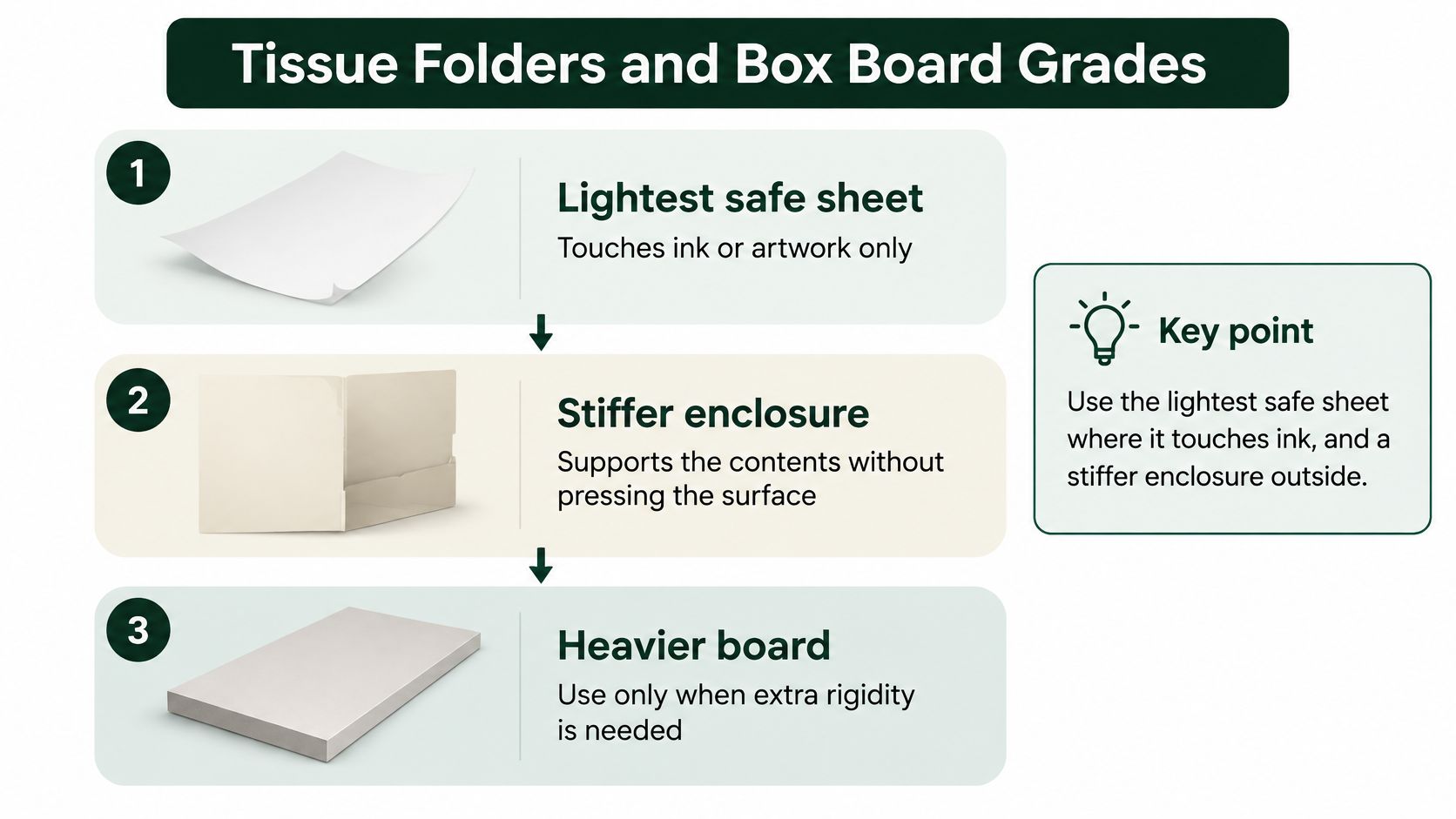
Choose the contact layer first
Conservation tissue is useful for light wrapping and interleaving. It can follow an existing fold without adding much bulk, but it can't carry a fragile poster safely on its own. Confirm whether it's buffered rather than assuming that every acid-free tissue contains an alkaline reserve.
A more substantial buffered interleaving sheet separates neighbouring posters. Folder-weight paper then provides an enclosure that you can lift and move, provided the poster's condition and the folder's stiffness make that safe.
Which archival sheet goes where on a poster
| Material | Job against the poster | Buffer | Watch-out |
|---|---|---|---|
| Acid-free tissue | Wrap and light interleaving | Confirm; may be unbuffered | Gift tissue is not a substitute |
| Buffered interleaving | Between posters in a stack | Calcium or magnesium carbonate | Does not support a torn sheet by itself |
| Folder-weight paper | One-poster enclosure you can lift out | Usually buffered; ask for documentation | One poster or a very small group only |
| Archival box board | Outer shell in a flat file or plan chest | Alkaline reserve; a paper standard does not prove the board | Don't skip interleaving because the box sounds archival |
| Archival polyester pocket | Clear housing for the most precious posters | None; the plastic is inert if truly archival | Ordinary sleeves can trap moisture and create static |
Fit matters as much as grade
Measure the actual poster before ordering. Include uneven edges, an existing conservation backing and any margin that needs support. Check the enclosure's usable internal dimensions, not merely its product name.
A folder described as suitable for a one sheet isn't automatically suitable for a quad. Formats differ, and original posters may have been trimmed or backed. The right fit leaves room to insert and retrieve the print without bending its corners.
The outer enclosure should accommodate the folder comfortably, too. A tight box can turn an otherwise good system into a repeated abrasion problem. The practical questions in this guide to archival storage boxes help distinguish the contact layer from the protective shell.
Polyester needs a condition check before use. Clear housing can reduce direct handling, but static makes it unsuitable for loose, powdery or flaking media. Don't force a damaged poster into a close-fitting pocket just because it's valuable.
Buy the missing function. If the poster already has appropriate interleaving but lacks support, another tissue sheet won't replace a sound folder.
Flat Storage for Quads and One Sheets
A tube solves a transport problem neatly. It doesn't provide convenient access to a collection, because each viewing requires you to unroll and control the whole sheet. Horizontal storage makes retrieval less disruptive.
The handling difference is shown below.
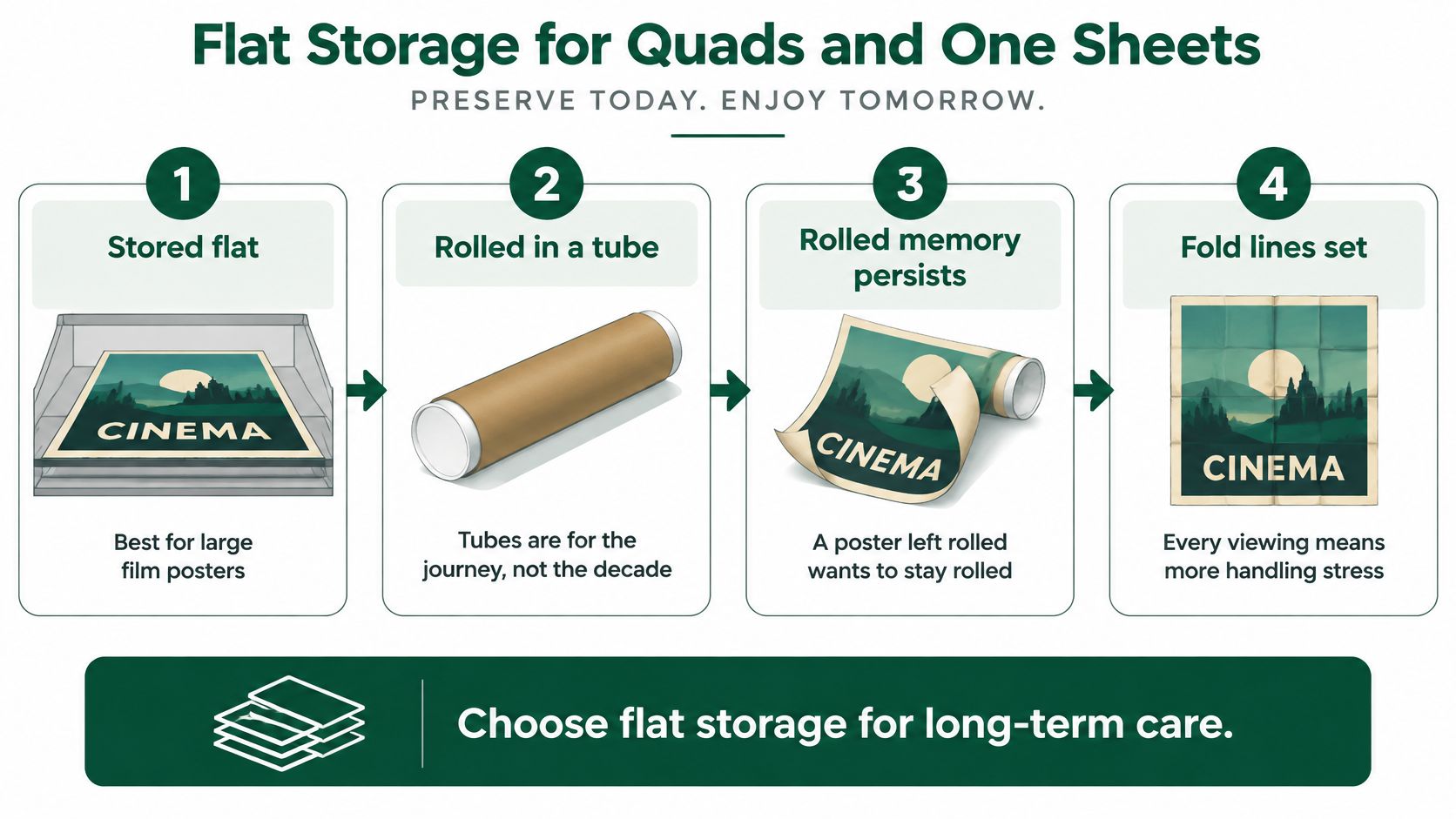
Build for retrieval rather than maximum capacity
Use conservation folders inside a flat archival box or plan chest. Keep the folder supported across its full area, and label it so you don't need to expose neighbouring prints while searching.
For a sound poster that's rarely viewed, an interleaved folder may be sufficient. A frequently inspected original may benefit from clear housing, provided its surface is suitable. At Famous Movie Posters, the most precious posters are stored in acid-free polyester pockets; posters are always stored flat and never stored in tubes.
Before buying furniture, check the difference between a one sheet and a quad movie poster. Plan around the largest supported enclosure you need, not the smallest poster currently in the collection.
- Support the stack: Contents shouldn't slide freely when the box is moved, but the lid shouldn't require force.
- Retrieve the enclosure: Lift the folder onto a clean work surface instead of pulling a poster by an exposed corner.
- Avoid added pressure: Don't use a box lid as a shelf for books, frames or other heavy objects.
- Separate unsuitable material: Keep acidic clippings, old mailers and unverified backing outside the poster's immediate housing.
Let condition set the pace
A tightly curled poster shouldn't be forced flat or reverse-rolled aggressively. Allow it to relax with full support in a suitable room; fragile folds, tears or resistant distortion warrant a conservator's advice before flattening treatment.
Flat storage also needs a sensible location. The National Archives preservation policy treats temperature, humidity, light, pollutants, pests and handling as interacting preservation risks, rather than problems solved by packaging alone.
The following video provides an additional visual reference alongside these handling decisions.
Leave enough clear space beside the storage unit to open a folder fully. If every inspection requires balancing a quad across furniture, the collection needs a better access arrangement, not a larger box.
Temperature Humidity and the Spare Room
A better sleeve can lose to a bad corner. Put an enclosed poster against a damp external wall and you haven't removed the environmental risk, only made it less visible.
Paper expands and contracts as its moisture content changes. Repeated cycles can cause cockling and place stress on old folds; damp conditions encourage mould, while prolonged dryness can leave paper brittle.
These are room problems before they're packaging problems.
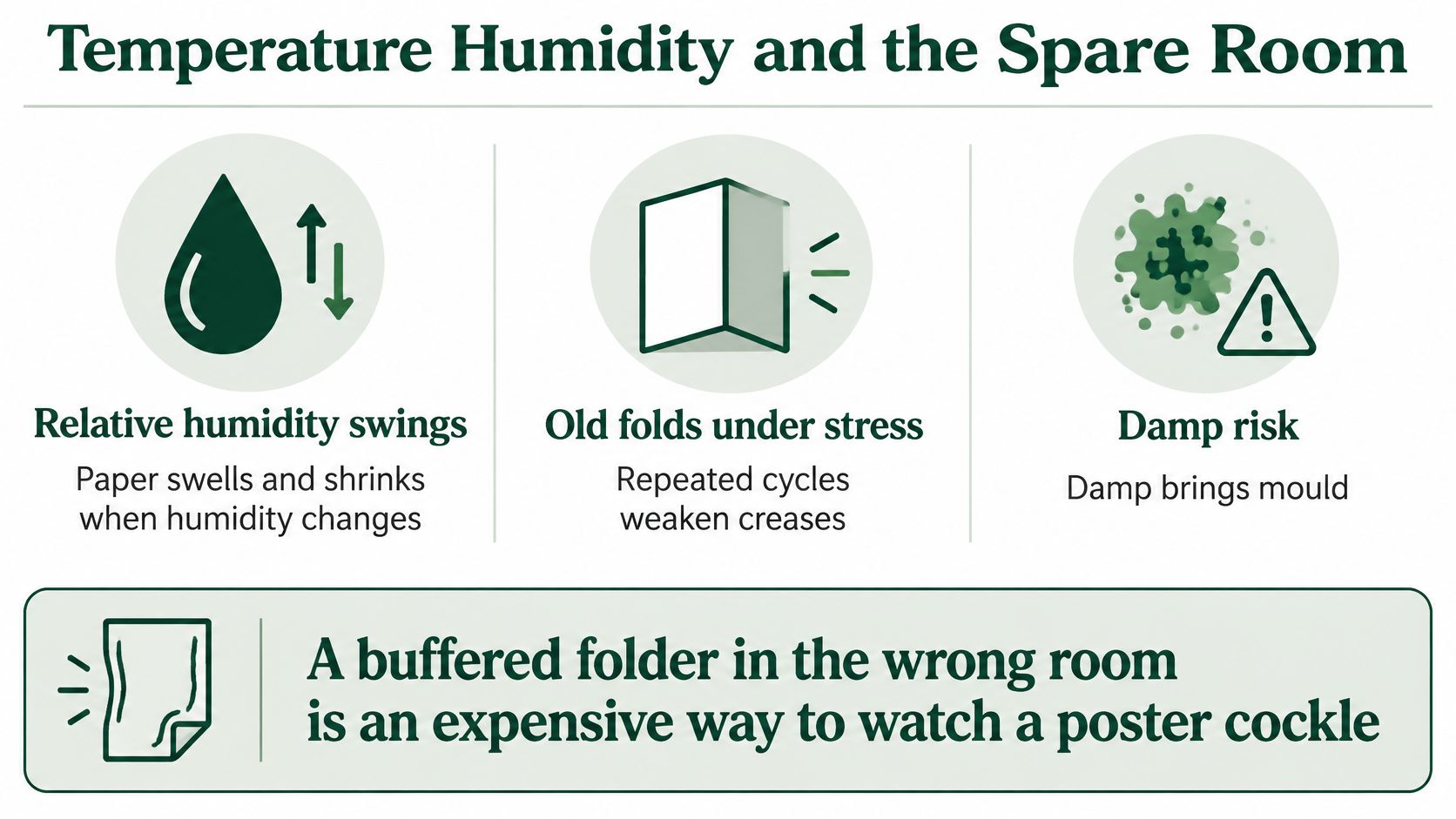
Read climate guidance as a working band
The Tameside guide to looking after records supports approximately 45–60% relative humidity for documents and gives about 18°C and 50% humidity as a practical target. Those figures are useful aims, not a reason to keep adjusting a room whenever the display changes slightly.
The broader paper-storage range is approximately 13–20°C and 35–60% relative humidity, while Museums Galleries Scotland gives around 45–65% with limited fluctuations and the Archives and Records Association UK favours consistently cool, generally stable conditions around 35–60%, as summarised in the environmental-management guidance. The National Archives introduction for non-archivists warns against keeping paper below 40% relative humidity for prolonged periods.
UK climate bands for paper posters at home
| Guidance | Temperature | Relative humidity | How to use it at home |
|---|---|---|---|
| National Archives paper range | About 13–20°C | 35–60%, not below 40% for long | The outer band; avoid the dry and damp extremes |
| Practical archive target | About 18°C | About 50% | A sensible aim for a spare room |
| Document storage guidance | Stable, away from radiators | About 45–60% | Watch for damp problems at the upper end |
| Museums Galleries Scotland | Cool and steady | About 45–65%, swings limited | Favour stability rather than abrupt changes |
| Archives and Records Association UK | Consistently cool | Generally 35–60%, stable | Don't force one universal setpoint; tighten conditions for sensitive pieces |
Measure the place where the box sits
Put a digital hygrometer or temperature-and-humidity data logger beside the collection. A reading by the doorway may miss the colder, damper conditions behind furniture.
Watch what happens during wet weather and when the central heating runs. If the readings swing sharply, investigate the location, ventilation and heating pattern before adding moisture-control products inside the box. Don't direct a fan heater or dehumidifier outlet at the collection.
Archival packaging is a second skin. It isn't a substitute for a suitable room.
Avoid lofts, cellars, garages, radiators and damp outside walls. Keep boxes off the floor and away from plausible leak routes. Inspect for mustiness, new spotting, softened board and evidence of pests, without repeatedly disturbing every print.
For practical access and enclosure questions, use the movie poster storage FAQ. If the room is unsuitable, relocating the collection is a more useful purchase decision than ordering another sleeve.
Choose Paper Then Keep Posters Flat
Buy from the print outwards, and keep the paperwork. The National Archives evaluation of archival box board explains why fibre quality and a measurable alkaline reserve matter to long-term stability. A vague acid-free statement gives you less to assess.
Put the decisions in order
- Choose the contact sheet. Use conservation tissue, buffered interleaving or appropriate folder paper. Obtain a supplier note identifying fibre composition, buffering and the relevant permanence specification.
- Check the outer support. Select board with its own archival evaluation and enough usable space for the enclosed poster. Reject unverified card rather than hiding it beneath better tissue.
- Use polyester selectively. Choose documented archival polyester where reduced handling offers a real benefit. Check that the surface is stable before inserting the poster.
- Distinguish transit from storage. A strong outer wrap and tube protect a parcel during its journey; unpack into supported housing after arrival. Famous Movie Posters packs posters with kraft paper and acid-free tissue paper, with bubble wrap and extra-durable poster tubes used for transit protection.
- Check the room. Measure beside the intended storage position and remove obvious risks from heat, damp walls and leaks.
- Upgrade the weakest layer first. Replace unsuitable material touching the print before duplicating an already adequate outer enclosure.
Make one useful change this week
Before founding Famous Movie Posters, the founder spent many years in the packaging industry, gaining knowledge of storing and preserving posters with archival-grade materials. The practical distinction is straightforward: packaging must suit both the object and what you're about to do with it.
This week, open an accessible folder on a clean surface and identify every material touching the poster. Replace any unverified contact sheet, retain the new specification, and place a hygrometer beside the box.
Famous Movie Posters offers guaranteed original cinema posters, including UK quads and US one sheets, supported by flat archival storage and protective transit packaging. Visit Famous Movie Posters to browse originals and choose a title with its future storage space in mind.