



Thirty-one feature films across a 34-year span make the Carry On films much more than a passing comedy craze. The British Film Institute records the cinema series running from 1958 to 1992, alongside one television series and four Christmas specials. For collectors, that longevity matters: a Carry On poster belongs to a particular moment in British cinema, not to a familiar comedy brand.
The title alone won't tell you which moment. An original cinema poster might advertise a film's first release, a later theatrical campaign or a differently classified version. Understanding the films and their distribution history is the best starting point for understanding the paper.
Table of Contents
- What the Carry On Films Are and How They Began
- Carry On Eras, Distributors and Film Counts
- Notable Carry On Films and What Set Them Apart
- Why Audiences Still Argue Over the Films
- How to Check an Original Carry On Poster
- Start Your Carry On Poster Collection
What the Carry On Films Are and How They Began
The Carry On films are a British ensemble comedy series, built around familiar performers rather than a continuing storyline. You don't need to watch them in order. The characters and settings change, but the comic ingredients remain recognisable: workplace friction, punctured authority, physical mishaps, innuendo and music-hall humour.
Think of a repertory theatre company changing its scenery. The performers might become soldiers, nurses or figures from ancient history, while audiences enjoy the pleasure of recognising their timing and mannerisms. Kenneth Williams, Sid James, Barbara Windsor and Hattie Jacques helped give the films that company identity, though they weren't all present throughout the series.
From National Service to a repeatable formula
The starting point was Carry On Sergeant, released in 1958, adapted from R. F. Delderfield's wartime stories and following inexperienced National Service recruits. It became the third biggest box-office earner in British cinemas that year, according to Art of the Movies' history of the Carry On films.
That success helps explain why a military comedy became the beginning of a franchise. Its setting was immediately legible to audiences familiar with barracks, instructions and institutional routines. The comic mechanism was straightforward: put ordinary people inside an organisation that demands obedience, then let human behaviour disrupt the rules.
The institution provided structure; the recruits provided disorder. You could understand the conflict without knowing anything about the characters beforehand. That made the approach adaptable to other workplaces and public services.
A useful distinction: Carry On continuity lies mainly in the performers and comic style, not in characters carrying their stories from film to film.
Producer Peter Rogers and director Gerald Thomas supplied a similarly consistent creative framework across the main film run. Their collaboration made the changing settings feel like variations on an established house style rather than unrelated productions.
How the production method shaped the films
The screen and stage history of the series describes Pinewood-based production, strict budget controls and films generally completed on schedule. Recurring performers, writers and technical staff could reuse production knowledge, facilities, sets and established working methods.
That doesn't mean the films were interchangeable. It means the team didn't have to invent a new production organisation whenever the setting changed. Like a theatre company with a familiar stage crew, they could concentrate on the next variation.
For a poster collector, the important distinction is between production identity and release identity. Familiar names in the credits help place a poster within the series, but they don't establish which cinema campaign it served.
The eventual closing feature was Carry On Columbus, arriving after a long interruption rather than as the next routine instalment. An original Carry On poster can therefore represent the franchise's institutional beginnings, its established spoof identity, its later changes or its attempted revival. Those are different collecting contexts, even when the same famous faces appear.
Carry On Eras, Distributors and Film Counts
| Period | Distributor | Films released | What the period was known for |
|---|---|---|---|
| 1958 to 1966 | Anglo-Amalgamated Film Distributors | 12 | Workplace and institutional comedies |
| 1966 to 1978 | Rank Organisation | 18 | Historical and genre spoofs |
| 1992 | United International Pictures | 1 | Carry On Columbus, made after a 14-year gap |
| 1958 to 1992 | All three distributors | 31 | Feature films in total |
The distribution periods and counts in this table follow Five Minutes Spare's Carry On chronology. Its account places the first 30 films between 1958 and 1978, a concentrated 20-year peak, rather than an evenly spaced sequence extending to the final revival.
The practical consequence is simple: most of the franchise's output belongs to its sustained original production period. The last entry shouldn't make you assume that Carry On remained equally active throughout its whole lifespan.
Read the periods as guides, not rigid artistic boundaries
The Anglo-Amalgamated period established the appeal of ordinary people negotiating institutions. The Rank period is strongly associated with the familiar historical and genre-spoof identity. United International Pictures marks the revival rather than another extended production cycle.
Those descriptions are useful shorthand, not sealed compartments. Historical parody had already appeared before the Rank period, and the films didn't abandon everyday British settings once they began sending up other genres. A distributor change isn't the same thing as a sudden creative reinvention.
The shared boundary year in the table also matters. Don't assign a poster solely because its film appeared around the transition. Read the actual credit rather than imposing a neat before-and-after rule.
A distributor name is a dating clue, not an authenticity certificate.
For collectors, the distributor credit is often the quickest way to narrow the likely campaign era. It can also expose a question worth investigating: why does a poster for an earlier title carry a credit associated with a different release context?
Keep the distinction between the film's original release year and the poster's campaign in view. A genuine theatrical poster can be later than the film it advertises. The table gives you a starting classification, while the object itself supplies the evidence needed to refine it.
Notable Carry On Films and What Set Them Apart
Five films make a useful tour of the series, from institutional comedy to historical spoof. The illustration marks the main stopping points.
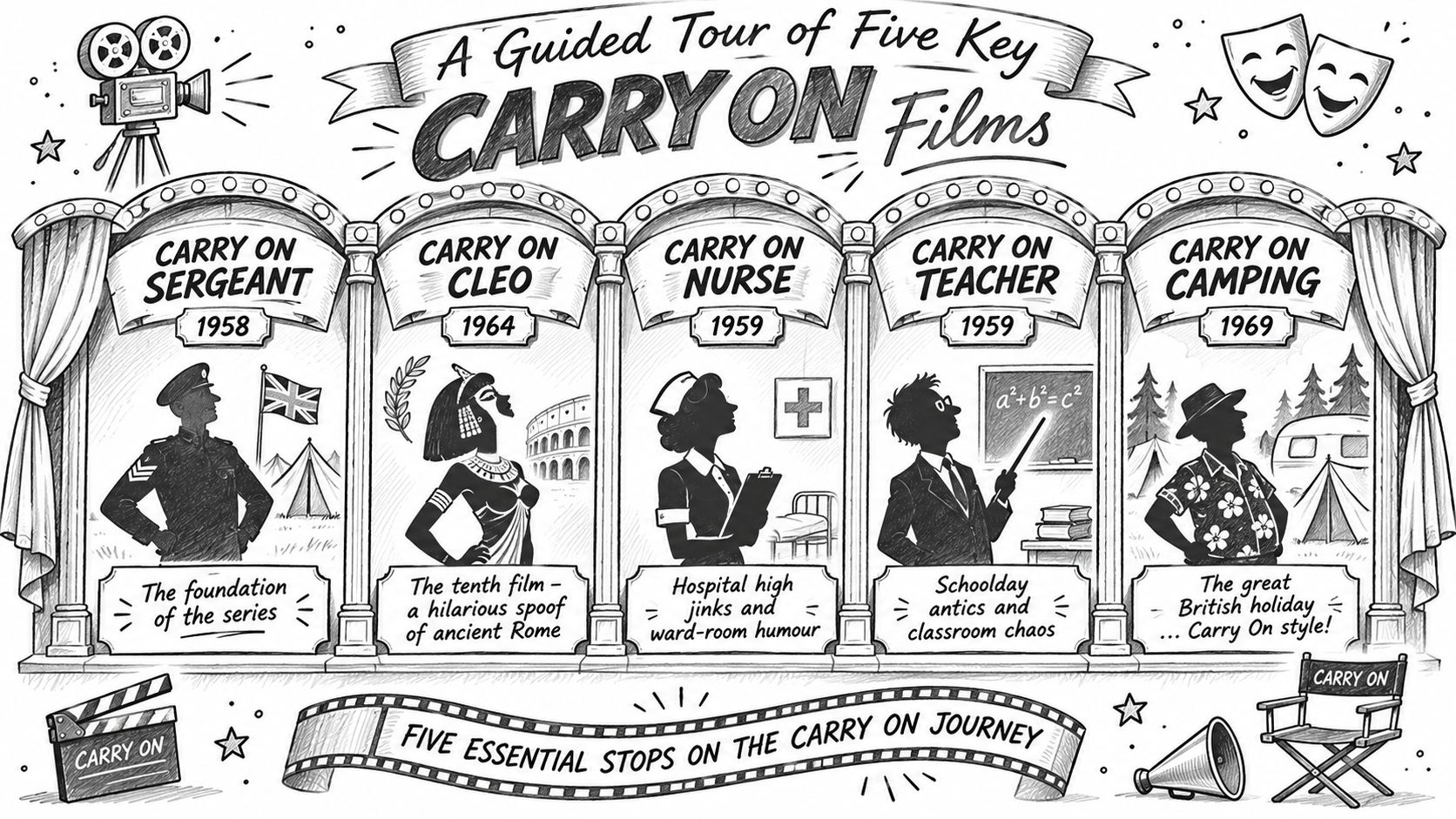
Foundations and historical spoofs
Carry On Sergeant is the foundation. Watch it for the relationship between authority and the awkward individuals expected to obey it. The later formula is not fully formed, and that is part of the interest.
Carry On Cleo arrived in the mid-1960s and became one of the series' defining entries. It borrows the visual language of Cleopatra, Ben-Hur and Spartacus, turning monumental spectacle into a setting for familiar human foolishness. The Victoria and Albert Museum's Carry On Cleo collection entry records it as the 12th most successful film at the British box office in 1965 and compares Carry On's longevity with James Bond. That comparison is useful because a durable franchise needn't depend on one hero or one genre.
Carry On… Up the Khyber, from the later 1960s, offers a different reason to watch: historical satire in which authority and ceremonial confidence become comic targets. Its imperial setting also makes critical attention to representation necessary.
Popular appeal and changing release versions
Carry On Camping became the top film at the UK box office in 1969, a peak recognised in the BFI's guide to British comedy films of the decade, and its Barbara Windsor sequence is often treated as an iconic moment. It is the crowd-pleaser to choose when you want to understand the franchise's broad domestic appeal, rather than treating it as a niche cult interest.
Carry On England is valuable for a different reason. Its initial AA-certified version was withdrawn and replaced by an A-rated cut, making it a useful example of how the film advertised could change within a title's release history. That matters for collectors: a single title can have more than one UK campaign tied to different release phases, so the poster's own credits and certification marks need checking.
Watch the accompanying video with performance in mind: delivery and reaction matter as much as the written joke.
Our guide to Carry On characters helps distinguish recurring performers from their changing roles. Choose Sergeant for the origin, Camping for the crowd-pleaser and Cleo for the spoof era.
Franchise longevity is not unique to Carry On: an account of how superhero films reshaped cinema shows another model, but Carry On posters are dated from their own release evidence.
Why Audiences Still Argue Over the Films
The Carry On films can challenge authority while repeating prejudices. Those qualities aren't mutually exclusive, and acknowledging one doesn't cancel the other.
Reducing the debate to whether the films are sexist or racist leaves too much unexplained. It doesn't account for why audiences recognised their own working lives in them, or why a comedy could mock social privilege while still presenting women through sexualised stereotypes.
Shared institutions and unequal representations
Academic analysis of the Carry On series identifies an egalitarian impulse in the hospital films, where class privilege becomes a target and the NHS appears as a shared public institution. Carry On Nurse, Teacher and Constable offer useful settings for considering how ordinary people encounter professional and institutional authority.
That doesn't make every joke egalitarian. A film may undermine a pompous superior while asking viewers to laugh at a woman's body or a caricatured outsider.
Similarly, Lancaster University's postcolonial analysis of Carry On Abroad connects its racial and gender stereotypes with anxieties surrounding the package-holiday industry's expansion during the 1950s and 1960s. The film can reveal British assumptions about travel without making those assumptions harmless.
A practical way to watch critically is to:
- Name the stereotype. Identify who becomes the joke and what assumption the scene asks you to accept.
- Locate the setting. Consider work, tourism, class or empire, rather than treating the humour as context-free.
- Separate intention from impact. A comic intention doesn't determine how a scene lands with every viewer.
Historical context explains a representation. It doesn't require you to excuse it.
Posters deserve the same attention. Advertising often compresses a film into its most exaggerated selling points, so a collectible image may be culturally revealing and uncomfortable at once. Treat it as a period artefact, not neutral nostalgia.
How to Check an Original Carry On Poster
A seller lists a Carry On England poster as "original 1976 cinema release". The paper looks aged, the artwork matches the film, and the price seems fair. None of that answers the question that matters: which campaign does this sheet belong to?
Authenticity and release phase are separate questions. A genuine cinema poster isn't necessarily a first-release poster, and a convincing period design isn't proof that the sheet itself is original.
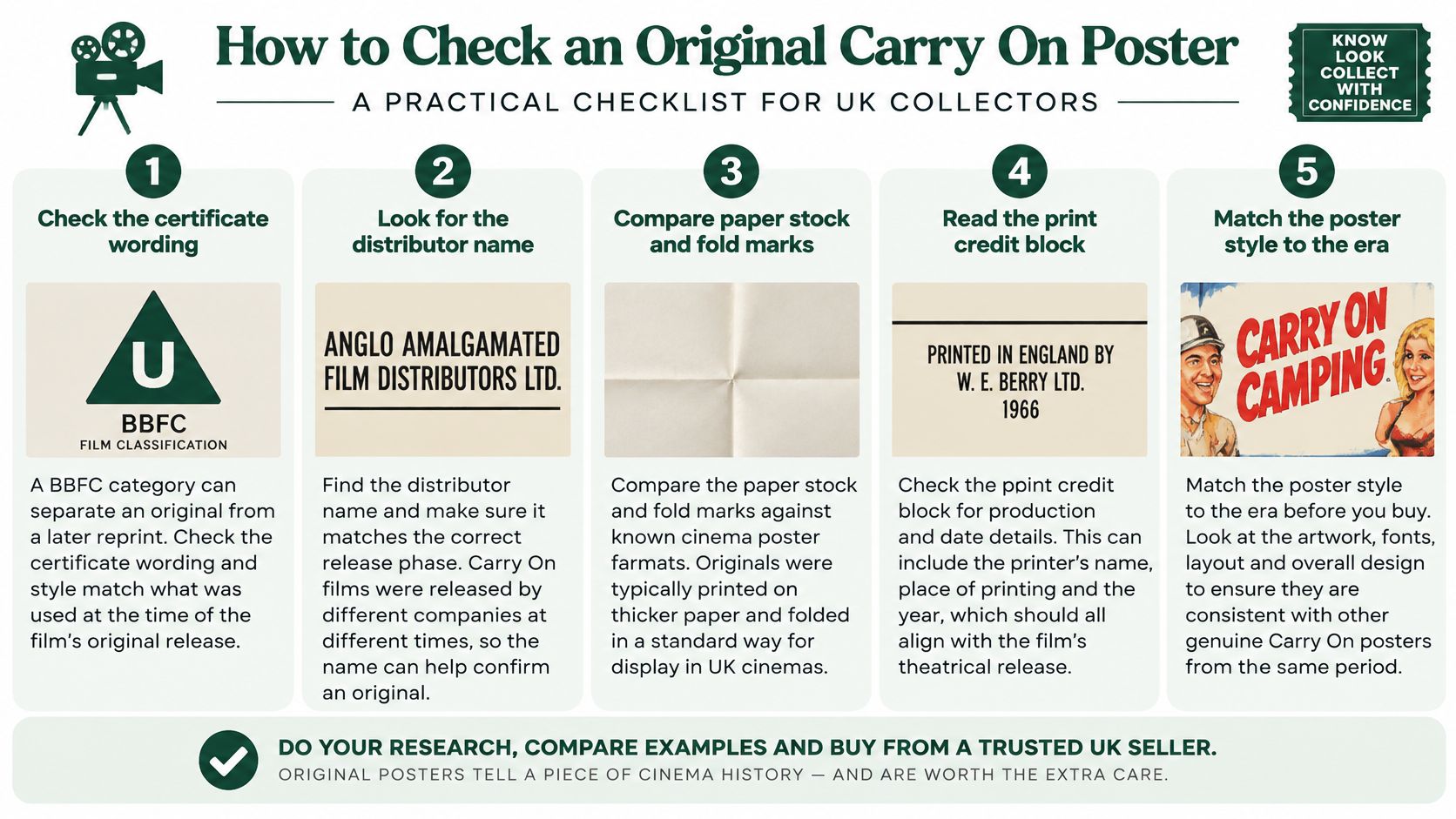
Use this checklist to organise the inspection, then request clear photographs of anything you can't read.
Read the campaign evidence
- Check the certificate wording. Transcribe the classification exactly rather than relying on a seller's description. A category can help distinguish campaigns for different cuts, but it can't establish authenticity by itself.
- Read the distributor credit. Match the printed company name to the distribution period, paying particular attention to transition titles and later campaigns. Don't confuse the distributor with the producer, studio or printer.
- Compare release wording and typography. Look at date panels, added captions, lettering and the relationship between artwork and text. Compare these with documented campaign examples, not merely an image of the same film title.
- Match the title, tagline and artwork. Request an uncropped front photograph and close-ups of the margins so you can identify layout variants. A different tagline may indicate another campaign, but establish that through comparison rather than assuming every difference means a reissue.
- Inspect the production and print credits. Record the production company separately from the distributor, then examine paper, folds, repairs and any backing. A familiar production credit won't date the poster on its own, and neither fold marks nor aged-looking paper prove originality.
Record the object, not just the film
Create separate catalogue fields for title, film year, campaign or release phase, distributor, production company and format. Add condition notes and keep photographs of the credit block alongside the full image.
Our guide to original movie posters in the UK provides broader collecting context. When reading a dealer's catalogue note, check whether it explains the identification or labels the poster original.
Before paying: Ask for the evidence behind a first-release attribution, especially when the certificate or distributor credit raises a question.
The worked example is Carry On England. The AA certificate used for its first UK release restricted admission to audiences aged 14 and over, and the film was later withdrawn after poor box-office performance and replaced with an A-rated cut, a sequence Melon Farmers' censorship history sets out in detail. A poster advertising the AA version and one advertising the subsequent cut may document different release phases. Across a series that ran for decades, the same title can carry several collectible UK versions, each tied to a different phase. Establish which campaign the sheet represents before comparing its desirability or price.
Start Your Carry On Poster Collection
Choose a collecting boundary before choosing a poster. A favourite performer, an institutional setting or a particular distributor period gives you a more useful focus than trying to acquire every recognisable title.
Use the catalogue to compare candidates rather than buying the first familiar image.
Make the first purchase a documented one
- Set your scope. Choose an early institutional comedy or a historical spoof, then look for material that fits that interest.
- Build a candidate record. Save the listing photographs and transcribe the certificate, distributor, release wording, tagline and production credit.
- Resolve the uncertainty. For an England listing, ask which classified version the poster promotes if the description doesn't say.
- Keep a spreadsheet. Separate the film's year from the poster's campaign, and record format, condition and the reason for your attribution.
- Compare before committing. Use our guide to original movie poster prices to frame your questions rather than assuming that an asking price confirms rarity or authenticity.
A small, well-documented collection is easier to understand and enjoy than an assortment whose release histories remain uncertain. If you need clarification about a listing, contact us at hello@famousmovieposters.co.uk before ordering.
Choose the title that matches the film you know best, and date its poster before you buy.
At Famous Movie Posters, we offer guaranteed original cinema posters, with free shipping on all UK orders. Visit our catalogue to look for Carry On material, compare the campaign details and choose a piece of British comedy history you can identify with confidence.