



'Destiny Calling' is a 1998 UK single by the Manchester band James, released on 9 March 1998, peaking at number 17 in the UK. No film poster tied to the title is documented in the records considered here.
The familiar advice to buy whichever image looks right isn't good enough for a collector. A convincing sleeve photograph or a poster with a familiar title doesn't establish what an object is, when it was produced or whether it's original. Start with the release record, then make the seller explain how the item fits it.
Table of Contents
- What Destiny Calling by James Refers To
- Poster Formats, Sizes and Whether One Exists
- Matching Catalogue Numbers and Release Details
- Live Performance History from 1998 to 2022
- Seller Checks, Delivery Times and Your Rights
- Condition, Handling and Storage for Paper Items
- Pricing, Availability and Comparing Listings
- What the Research Does Not Confirm
- Decide Which Item You Need Before You Buy
What Destiny Calling by James Refers To
The search Destiny Calling James most likely refers to the band's single, rather than a film, a devotional work or a general idea about following your destiny. The identifying details are recorded in One Of The Three's song archive, which gives the UK release as 9 March 1998, its chart peak as number 17, and its connection to The Best Of James.
Release reference for the 1998 single
| Detail | Confirmed value |
|---|---|
| Artist | James, Manchester alternative-rock band |
| UK release date | 9 March 1998 |
| UK chart peak | Number 17 |
| Compilation it promoted | The Best Of James, released later in March 1998 |
| Role in campaign | Lead single, one of two new songs recorded for the album |
These details identify more than a song title. They place the release within a particular promotional campaign, where new material gave listeners a reason to engage with a retrospective collection. The archive records that the record company chose the song as the more commercially accessible of the newly recorded tracks.
For collectors, that distinction matters. An item associated with the campaign should be assessed as a music release, music publicity or related promotional material unless there's separate evidence for another use. The compilation connection doesn't turn a music advertisement into cinema advertising.
Why the campaign matters
A seller might describe an object as an original promotional item. That description leaves important questions unanswered: original to which release, produced for what purpose, and distributed by whom? Ask whether it promoted the single, the compilation or a performance.
Keep those categories separate when building a collection record. A retail sleeve belongs with the edition it accompanied; a promotional sheet needs evidence of its intended use; a concert item needs a venue and event connection. Shared artwork can help you investigate, but it can't settle those distinctions.
The phrase also appears in unrelated devotional and motivational contexts. This guide concerns only the James track, and a title match elsewhere shouldn't be treated as evidence of a connection to the band.
Identification rule: Match the artist and the release campaign before judging the artwork.
For a quick match, check James, the release year and the connection to The Best Of James together.
Poster Formats, Sizes and Whether One Exists
No film poster for this title is documented in the available release records. That's a statement about the evidence, not proof that no paper promotional object was ever produced. A music poster, a later decorative print and an original cinema poster are different objects, even when sellers use similar wording.
The first question isn't whether an image would look good framed. It's whether the seller can identify what was printed and why. A listing headed Destiny Calling needs more than the title to establish a connection to James, and considerably more to establish a film connection.
| Format a seller might name | Orientation to check | What the description doesn't prove |
|---|---|---|
| UK Quad | Landscape | That the item advertised a film or was printed for cinema use |
| US One Sheet | Portrait | That the item is original, release-era or connected to James |
The song records don't establish poster dimensions. Ask for the actual measured width and height, rather than treating a format label as a measurement or importing dimensions from an unrelated listing.
A format isn't provenance
A seller can print a modern image at the dimensions of a cinema format. That doesn't make it a cinema-issued poster. Equally, a genuine music publicity item doesn't need to conform to a film-poster format to be worth collecting.
Size answers practical questions about framing, mounting and packing. It doesn't answer historical questions about authorship, distribution or release. Those require a traceable reference, an identifiable issuer or other supporting documentation.
Portrait and other items need appropriately proportioned frames. If shipment will involve rolling, the seller should also explain which edge will run along the tube and how the paper will be protected. Don't order a frame before you have the item's measured dimensions and know whether borders or irregular edges need preserving.
A useful seller response identifies the object precisely: music promotion, cinema publicity or later print. An evasive response concentrates on appearance while leaving its origin unresolved.
For any claimed film connection, ask which film and which release year, then verify both independently before paying.
Matching Catalogue Numbers and Release Details
CD JIMDD 19, CD JIMCD 19 and CD JIMED 19 are the UK CD edition identifiers associated with the single. Read the number on the actual disc, sleeve or spine, not just the number typed into a marketplace title.
UK catalogue editions of Destiny Calling
| Catalogue number | Format | Verification note |
|---|---|---|
| CD JIMDD 19 | CD | Matches one UK edition; check the sleeve against a dated reference |
| CD JIMCD 19 | CD | Matches one UK edition; sleeve and track details not confirmed |
| CD JIMED 19 | CD | Matches one UK edition; sleeve and track details not confirmed |
The release documentation doesn't establish which edition had a different sleeve, track listing or bonus material. Those details remain unconfirmed. Don't assign an attractive sleeve to an edition from memory or assume that similar catalogue numbers mean identical contents.
Run the checks in a fixed order
- Identify the release being offered. Establish whether it's the standalone single, a compilation appearance or a promotional object. Compare the claimed release date with the release reference, while allowing for the fact that publicity can precede retail availability.
- Check the recording and its position. Apple Music's catalogue entry identifies a recording of approximately 3 minutes 50 seconds and places it at track 9 on The Best Of James. That position belongs to the compilation entry, not automatically to a CD single.
- Read every printed identifier. Ask for legible photographs of the spine, disc face and reverse sleeve. If the components carry conflicting identifiers, ask the seller to explain whether the package has been assembled from separate copies.
- Check live claims against the event record. If the object advertises a performance or contains live material, establish the venue and date separately. A genuine song title doesn't validate an invented event.
- Compare the whole package. Look at typography, printed credits, track order and any edition-specific reference the seller supplies. A cropped front-cover image leaves too much unseen.
The most revealing mismatch may be a small textual detail. A seller who assigns the compilation's track position to a single, for example, may have copied catalogue information without examining the object.
A date outside the retail release window isn't automatically disqualifying. Advance publicity and later reissues can have legitimate explanations. The problem is an unexplained contradiction, not merely an unfamiliar date.
A catalogue match establishes consistency. It doesn't establish authenticity by itself.
Retain the photographs and the seller's written description with your receipt. If a dispute arises, you'll need evidence of the specific item and claims you relied on, rather than a general screenshot of similar artwork.
Live Performance History from 1998 to 2022
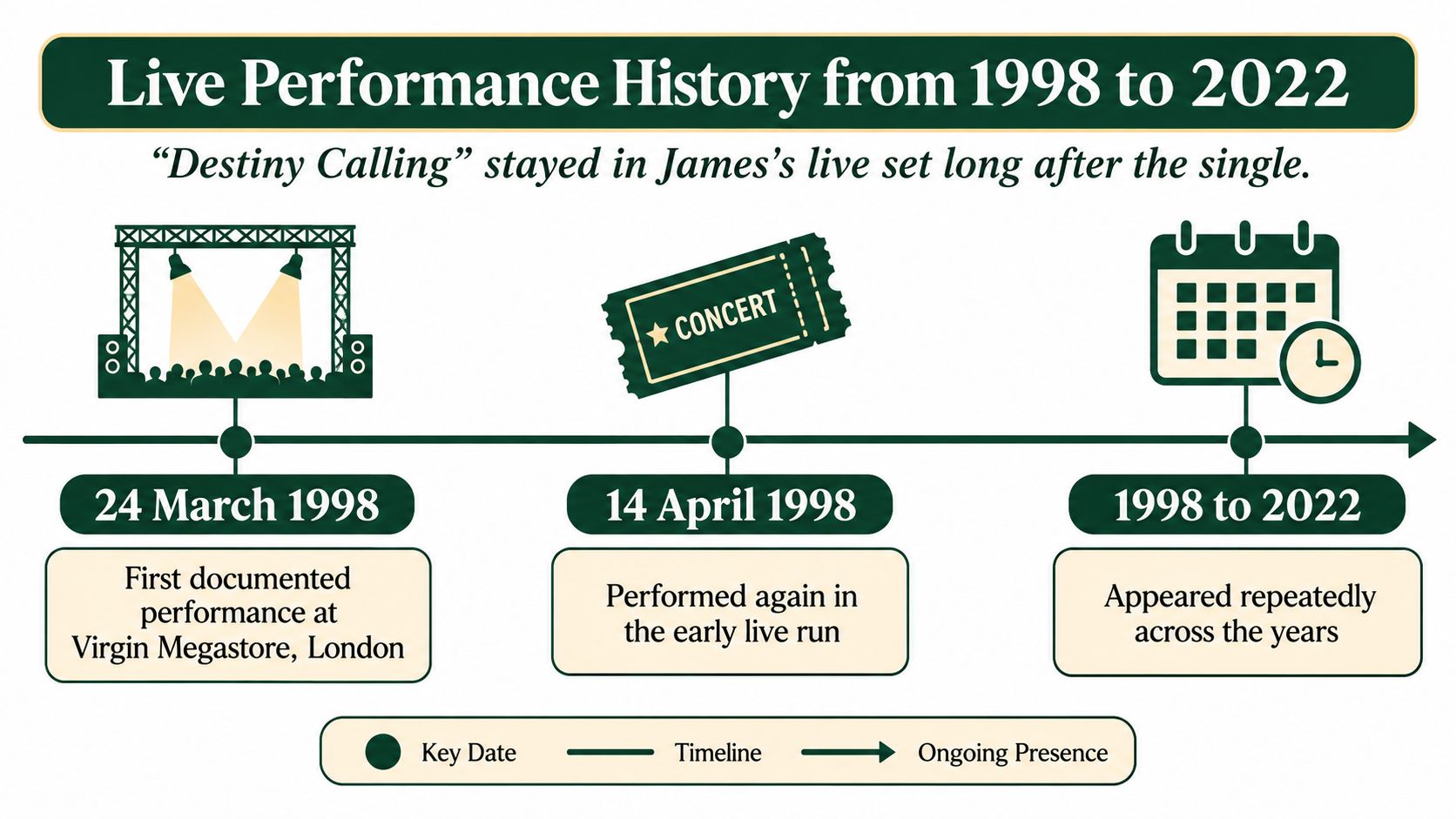
The first documented performance in setlist.fm's song record is 24 March 1998 at Virgin Megastore, London; the record also includes the 14 April 1998 Doncaster Dome concert, alongside Sit Down, Laid and Come Home. These entries place the song within both release-period promotion and the band's concert repertoire.
The documented dates and counts form a useful timeline, although they shouldn't be mistaken for a complete concert ledger.
Documented live performances of Destiny Calling
| Measure | Recorded value |
|---|---|
| First documented performance | 24 March 1998, Virgin Megastore, London |
| Doncaster Dome concert | 14 April 1998, alongside Sit Down, Laid and Come Home |
| Plays in 1998 | 18 |
| Plays in 1999 | 9 |
| Plays in 2007 | 8 |
| Latest documented performance | 11 June 2022, Royal Highland Centre, Edinburgh |
| Total documented performances | 62 by two artists, 60 by James |
The same compiled record lists 18 performances in 1998, 9 in 1999 and 8 in 2007, with 62 documented performances by two artists, including 60 by James. Its later Edinburgh entry extends the recorded history to 11 June 2022, more than 24 years after the UK single release.
What collectors can infer
The pattern supports a measured conclusion: the song wasn't confined to its launch campaign. There was concentrated early use followed by later revivals, so a concert-related object needn't come from the original release period to have a plausible connection.
It doesn't follow that the song appeared at every concert during those periods. Nor does a database entry authenticate a ticket, handbill or purported stage-used setlist. Event evidence and object evidence answer different questions.
For a dated gig item, check the artist, venue and event details before inspecting claims about its use. A printed setlist associated with a documented performance still needs its own provenance if the seller describes it as stage-used or band-owned.
A documented concert makes an association testable, not automatically genuine.
Seller Checks, Delivery Times and Your Rights
Start with the seller's claims about the object. Ask whether it sells verified originals only, whether reprints are excluded and what verification means for this particular item. A broad authenticity statement is less useful than a description that identifies the source, format, dimensions and condition.
Look for photographs of the actual item, including its reverse and any damage. Vague sourcing, missing rights information, unsupported film associations and a conspicuously low price all justify further questions. None proves fraud on its own, but you shouldn't pay a premium while the central claim remains unexplained.
Separate dispatch promises from legal rights
For UK online purchases where no different delivery period has been agreed, Coventry Trading Standards' consumer guidance explains that goods must arrive without undue delay and within 30 days of the contract. Failure to deliver within the applicable period can, in specified circumstances, allow the consumer to end the contract and seek a refund.
For late or missing deliveries, Coventry's fuller consumer guidance makes clear that the seller, not the courier, remains responsible. Contact the retailer first and retain your order confirmation, correspondence and tracking information.
Delivery problems and the buyer's position
| Situation | Statutory or stated position | Buyer action |
|---|---|---|
| No delivery date agreed | Statutory default delivery limit applies | Ask for a written timeframe before paying |
| Delivery late or missing | Seller is responsible; refund may apply in specified circumstances | Contact the retailer first and keep the order confirmation |
| Item damaged or materially different | Short-term rejection rights may apply | Photograph packaging and item on arrival and report promptly |
| Free UK shipping | A retailer's offer, not a universal statutory entitlement | Confirm the dispatch date and protective packing |
| Overseas delivery | Check the rate at checkout and indicative transit estimate | Compare the quoted cost and transit time before paying |
The Consumer Rights Act 2015 provisions on goods contracts provide a 30-day short-term right to reject goods that breach the relevant standards. The clock generally starts after the relevant ownership, delivery and any required installation conditions are satisfied, and it pauses during an agreed repair or replacement process.
For memorabilia, a material difference between the item and its description can matter as much as visible damage. An item sold as original but supplied as a reproduction raises a different issue from a correctly described original with a disclosed fold.
Preserve the evidence on arrival
Open the package carefully and photograph the outer packing, internal protection and item. Don't discard a damaged tube or attempt restoration before you've documented the problem and contacted the retailer.
Use the retailer's shipping protection and materials guidance to assess the packing description, then ask how your specific item will travel. A shipping promise should explain protection as well as price.
Keep any authenticity claim tied to the seller's written statements. No release guide can guarantee an individual object it hasn't examined.
Condition, Handling and Storage for Paper Items
Record the paper's condition before framing or trying to flatten it. Photograph the front, reverse, edges and corners under even light, then make separate notes for tears, folds, creases, pinholes, surface wear and fading. Avoid relying solely on a grade such as excellent, which doesn't tell another buyer what is present.
Use a clean, dry work surface larger than the item, and remove drinks, pens and adhesive tape. Support fragile paper rather than lifting it from a damaged corner. Clean, dry hands and careful support are more useful than handling the sheet confidently but without enough space.
Choose protection that suits the paper
- Handle by sound edges. Don't pinch printed areas or let a large sheet sag from a single grip.
- Prefer flat storage where practical. Use an appropriately sized archival sleeve and a rigid enclosure that supports the whole item.
- Check material specifications. Acid-free polyester pockets and PAT-tested flat-file boxes are useful reference points, rather than ordinary office wallets or unidentified plastic sleeves.
- Keep adhesives away. Don't attach pressure-sensitive tape to the original sheet to make home framing easier.
The retailer's poster storage and handling explanation describes archival pockets and buffered flat-file storage. Treat that as a reference for selecting materials, not permission to apply a chemical treatment to paper yourself.
A tightly curled poster needs patience. Don't reverse-roll it sharply, iron it, steam it or force it under unsuitable weights. If the paper resists gentle handling, consult a paper conservator before attempting flattening.
Storage priority: Preserve the sheet before trying to make it display-ready.
Keep stored items away from damp walls and direct sunlight. In a frame, use suitable spacing so the glazing doesn't touch the print, and avoid mounting methods that permanently bond the original to a backing board.
Pricing, Availability and Comparing Listings
There's no verified price benchmark or current stock figure for this title in the release and performance records. A seller's asking price is therefore an offer to assess, not evidence of market value. Nor does a sold-out label establish rarity.
Build a short comparison sheet around the actual objects being offered. A cheap decorative print and a documented release-era CD aren't competing examples of the same collectible, even if the listing titles look similar.
Compare like with like
- Total cost comes first. Add the item price, delivery and any separately quoted packing charge. For an overseas purchase, establish what the checkout total includes before comparing it with a domestic offer.
- Name the object precisely. Is it a CD, music publicity sheet, decorative print or claimed cinema poster? Don't compare prices until the category is clear.
- Check dimensions and orientation. Record the measured size and whether the image is wide or tall. Include any framing requirement in your own budget.
- Describe condition in plain language. Copy the disclosed defects into your comparison rather than repeating the seller's grade. Ask for evenly lit photographs where a crease or faded area is difficult to judge.
- Record provenance and terms. Note what the seller says about origin and verification, together with the returns procedure. A promise you can't find again won't help much later.
- Confirm availability. Distinguish an item physically held by the seller from one it hopes to source. Get a dispatch timeframe in writing.
For a broader valuation framework, DIYAuctions' advice to assess condition before valuing collectibles is useful context. Apply that principle to the object in front of you without treating a general guide as a price list for this release.
The cheapest listing isn't automatically the best buy. An inexpensive item with an unresolved identity may be poor value, while a more expensive example still needs evidence sufficient to justify its claims.
Keep personal appeal and collectible value separate. You can reasonably buy a clearly labelled modern print because you like it, but don't pay an originality premium for it.
What the Research Does Not Confirm
The release history is more secure than the object history. Knowing which song a title refers to doesn't identify every item offered under that title, and a correct catalogue number doesn't authenticate the paper or plastic carrying it.
Take the following unresolved points to the seller. Clear answers should distinguish documented facts from inference, rather than presenting confidence as evidence.
Questions that still need answers
- Film-poster status. No film poster tied to this title is documented in the records considered here. If the seller claims cinema use, ask for an independently identifiable film and release.
- Edition-specific contents. Sleeve variations, complete track listings and bonus material aren't established for each listed CD edition. Ask for a reference that matches the exact package.
- Current value and supply. The sources don't establish a going rate, stock level or present availability. Request evidence for claims such as scarce or unusually valuable.
- Individual authenticity. Dates, identifiers and track positions establish consistency only. Ask how the seller verified this particular object.
- Completeness of concert history. Compiled setlists document recorded appearances, not necessarily every performance. An absent entry isn't conclusive proof that an event didn't happen.
Unconfirmed details should remain labelled unconfirmed, not filled from memory. There's no advantage in making a collection record look complete if its contents can't be defended.
The guide to original movie posters in the UK provides broader collecting context when an object is offered as cinema material. It doesn't supply a missing film connection for this song.
A responsible seller may acknowledge gaps. What matters is whether the description stays within the evidence and whether you're comfortable buying on that basis. If the unresolved point is the very reason for the asking price, postpone the purchase.
Decide Which Item You Need Before You Buy
Choose the category before choosing the listing. A release-era music object, a cinema poster and a decorative image meet different collecting goals, and each needs a different kind of evidence.
If you want something directly associated with the James release, start with a clearly identified CD edition or documented music publicity item. Request readable photographs of the identifiers and contents, then decide whether you want a playable copy, a complete package or an object primarily for display.
Follow the route that matches your aim
- For a music collection, use the release and edition references to test the seller's description. OohYeah's shopping guidance for music fans offers additional buying context, but the specific object still needs its own checks.
- For a cinema-poster collection, establish the film title, release and format first. Don't substitute a shared phrase for a documented cinema connection.
- For a hard-to-source poster, a Request a Poster service can ask trusted partners about a specific title. Availability depends on what partners can locate, so a request isn't confirmation that an item exists or can be supplied.
Make the request precise enough to answer. State whether you want original cinema material, the format you can accommodate and the condition you'll accept. If your interest is the James song rather than a film, say so explicitly to avoid an unsuitable match.
Before committing, confirm delivery arrangements, retain the description and inspect the object on arrival. If it's materially different from what was sold, raise the issue promptly and consider the applicable rejection rights rather than attempting to fix it yourself.
Your next step is to confirm the catalogue number or poster title, then compare prices and terms for comparable items.
Famous Movie Posters offers guaranteed original cinema posters and a Request a Poster service for specific film titles. If your search has led you towards cinema memorabilia, visit Famous Movie Posters with the film title and preferred format, while keeping any James music collectible separate from an unverified film-poster claim.