



A poster can leave the warehouse looking perfectly secure and still arrive with a crushed corner, a damp edge or a crescent-shaped crease. The problem usually isn't one dramatic accident. It's the accumulation of ordinary handling, from a label being applied over a tube to a parcel sliding beneath heavier freight in a depot.
For original film posters, shipping protection material has to do more than fill space. It must stop surface abrasion, control bending, resist moisture and keep the item chemically safe during transit and storage. The right combination depends on whether the poster is rolled or flat, folded or unfolded, replaceable or irreplaceable.
Table of Contents
- What Happens to a Poster Between Shelf and Doorstep
- Acid-Free Tissue and Kraft Paper as the First Contact Layer
- Polyester Sleeves and Pockets for Premium Items
- Poster Tubes, Flat Boxes and Rigid Mailers Compared
- Buffering, pH and the Hidden Chemistry of Archival Packing
- Does More Protection Actually Pay Off
- A Bench-Tested Packing Sequence You Can Reuse
What Happens to a Poster Between Shelf and Doorstep
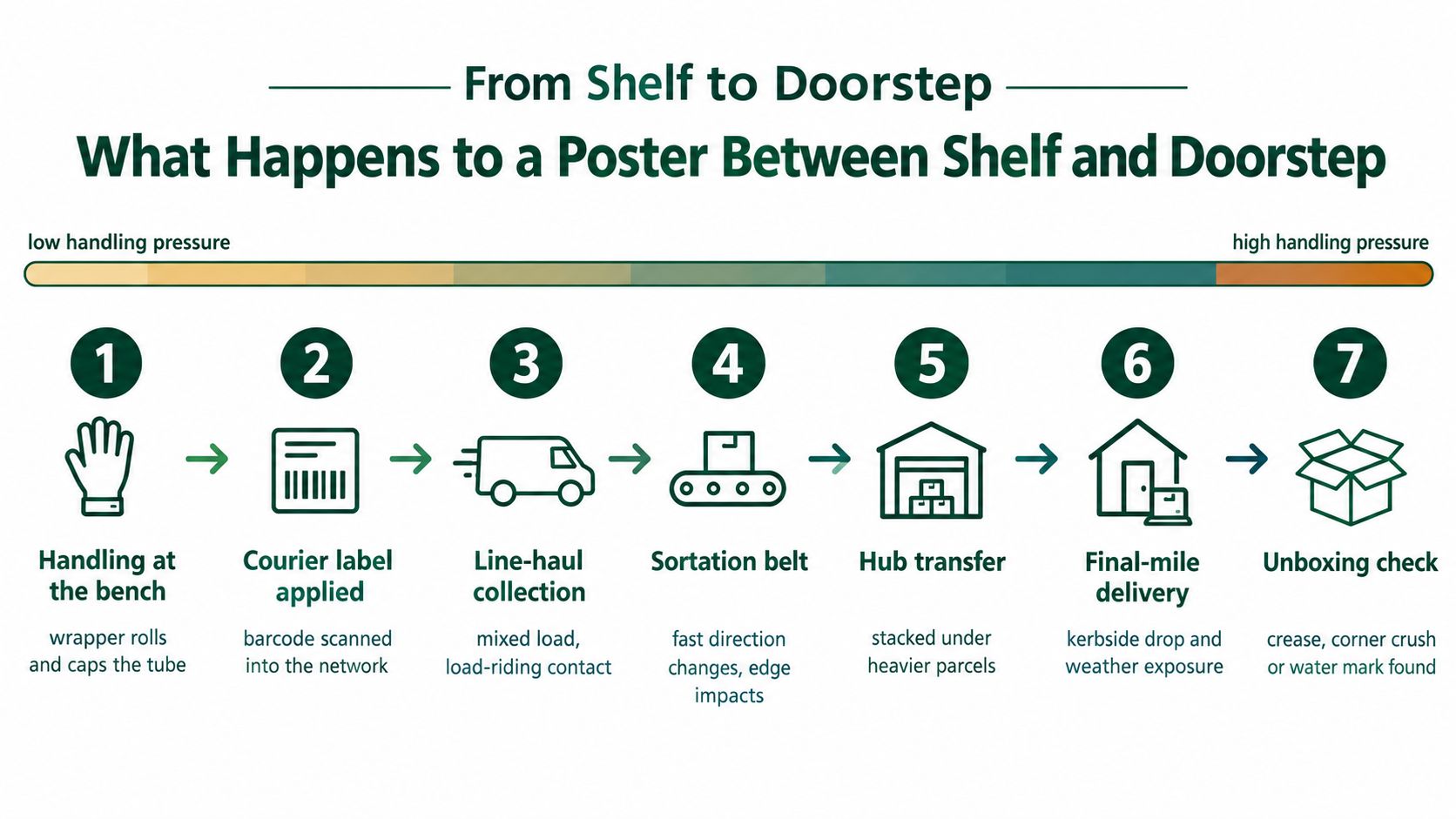
A rolled poster leaves the shelf in the hands of a packer who checks the print, adds its inner wrap and fits the outer tube. At that point, the main risks are still under control. The trouble begins when the parcel joins the carrier network.
The courier label may be scanned and applied across a curved surface. During collection, the tube sits against other parcels in a mixed load. On a sortation belt, it can roll, stop abruptly or strike a guide rail. A flat parcel faces a different problem. Its corners can catch beneath another box, while repeated pressure across the centre encourages bending.
The risks change at every hand-off
At a depot, a tube may be trapped under heavier parcels or pushed along a floor. A flat box can suffer edge compression from a stack that looks harmless until the lid is opened. In wet UK weather, a sodden parcel above it can transfer water to a weak seam or exposed corner. At the doorstep, the driver may slide the package against a wall, and the recipient may cut into it without knowing where the poster sits.
That chain is why a single outer box isn't enough. The inner layer protects the print from contact, the rigid layer controls shape, and the closure keeps the package intact. Each later material recommendation in this guide answers one of those specific handling risks.
A retailer also needs a packing area that supports repeatable work. Clear bench space, correctly sized tubes, clean tissue and a reliable sealing method prevent rushed decisions. General ecommerce guidance from Crayex Corporation's ecommerce page is useful for thinking about the wider relationship between fulfilment and customer experience, but poster packing still needs item-specific testing.
For collectors, the storage advice in this movie poster storage guide matters before and after the parcel moves. A poster that survives delivery can still deteriorate if it is returned to acidic cardboard or poor-quality plastic.
Acid-Free Tissue and Kraft Paper as the First Contact Layer
The material touching the poster is often more important than the material furthest from it. A rigid tube can prevent a crease, but it can't stop a rough inner surface rubbing against glossy ink as the poster shifts.
Wood-pulp packaging can contain lignin and other compounds that contribute to long-term paper degradation. UK conservation guidance recommends acid-free materials because they reduce the risk of acid and lignin damage, while conservation-grade boxes and folders provide protection from light, dust and moisture according to UK collection-care guidance.
Match the wrap to the poster
For a folded UK Quad, place clean acid-free tissue between folded faces before wrapping the complete poster. That interleaving reduces direct contact and helps prevent ink transfer or scuffing along a fold. For a rolled US One Sheet, wrap the outside with tissue before it goes into the tube, so the poster doesn't rub directly against the tube wall.
Kraft paper has a useful structural role. It can hold a roll together, form an outer wrap and provide clean void fill around the ends. It shouldn't be treated as an archival surface just because it looks natural. Use it outside the acid-free contact layer, not as a substitute for that layer.
| Material | pH / Chemistry | Best use for posters | Cost band |
|---|---|---|---|
| Archival acid-free tissue | Stable paper designed to reduce harmful contact | First-contact wrap and interleaving | Premium |
| Unbuffered acid-free tissue | Acid-free contact layer suited to sensitive surfaces | Colour-sensitive prints and short-term transit | Mid to premium |
| Clean kraft paper | Practical paper wrap and void fill, not the archival contact layer | Outer wrap, end protection and movement control | Low |
| Newsprint or ordinary cardboard | May contain lignin or acidic components | Avoid against the poster | Low, but false economy |
The choice doesn't need to be expensive for every order. A lower-cost acid-free tissue is still a more sensible first layer than kitchen roll, recycled newspaper or ordinary brown card. Keep tissue smooth rather than tightly creased, and remove grit or loose fibres before it reaches the print.
Practical rule: If the material touches the image, choose it for chemical stability and abrasion control. Choose kraft paper for the work it does outside that boundary.
Polyester Sleeves and Pockets for Premium Items
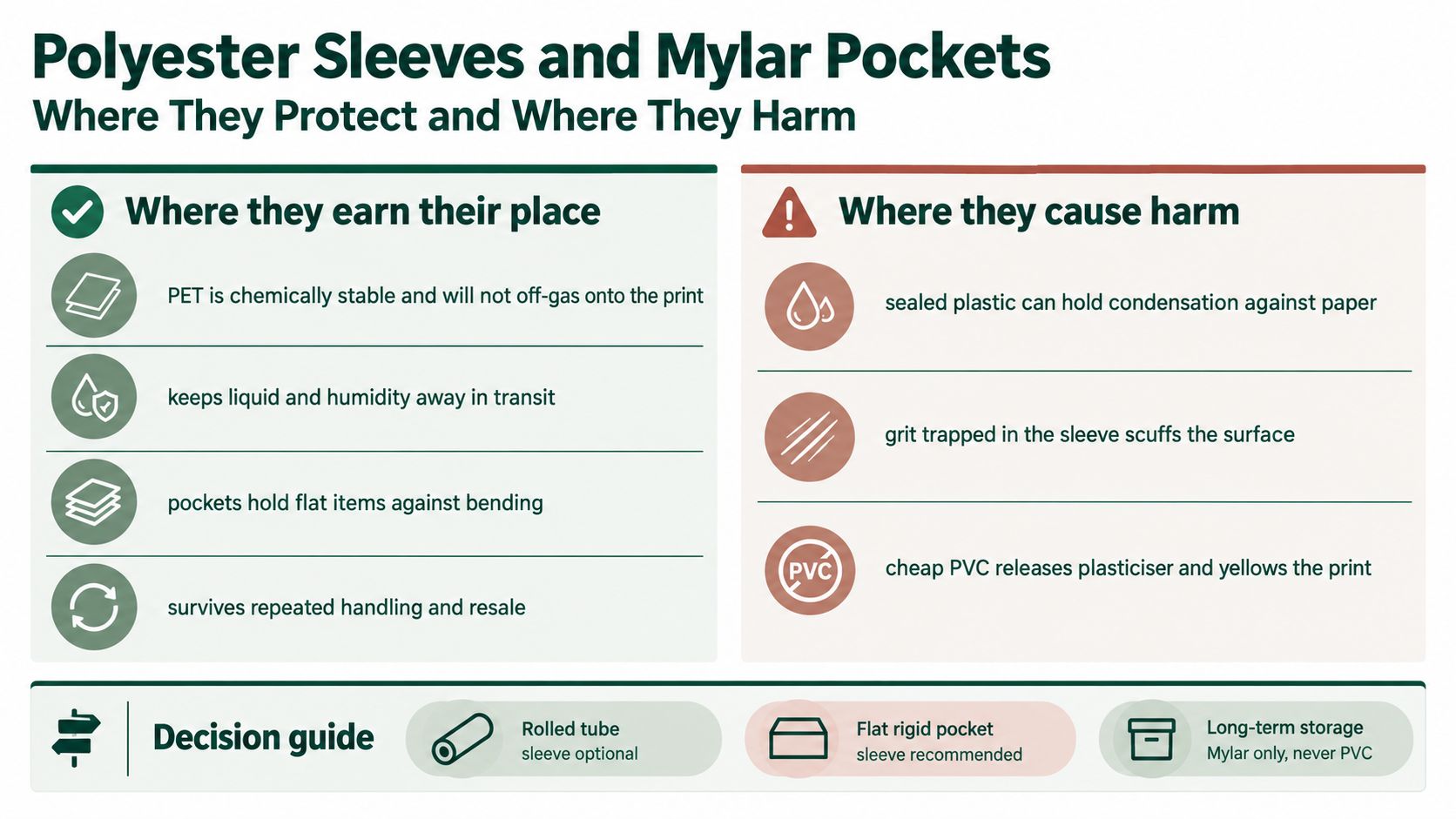
For a flat original poster moving between inspection, storage and dispatch, polyester provides a clean barrier without placing ordinary wood-pulp packaging against the print. Polyester is also sold as Mylar, Melinex and PET. A well-sized sleeve keeps dust, handling residue and light moisture away from the surface, which can matter when a valuable item is handled repeatedly at the packing bench.
Folded Quads, lobby cards and flat One Sheets can all suit a polyester pocket. The pocket lets you lift the item into a rigid folder without dragging the print across another sheet or board. It also gives buyers and staff a safer way to inspect the poster while reducing direct contact with the image surface. For flat paper items, the Archives and Records Association recommends one object per sleeve and notes restrictions around bulky or spine-bearing material in its storage-enclosure guidance.
The rolled-poster exception
A sleeve is a weaker choice for a poster rolled tightly into a shipping tube. Plastic film can trap condensation against the paper if the item enters the tube before it has adjusted to the surrounding temperature. Its slippery surface may also let the roll telescope inside the tube, leaving one end closer to impact at the cap.
The film offers no crush resistance. Under compression, it follows the poster instead of supporting it. For a rolled original, acid-free tissue is usually the more forgiving contact layer, while a rigid tube controls movement and bending.
Avoid PVC sleeves for valuable paper. Norfolk Record Office warns that PVC can degrade and damage contents, recommending conservation-grade materials for longer-term preservation through its packaging advice. Keep the sleeve open or fold it securely, with no adhesive touching the print. Self-adhesive archival tape should not contact glossy ink, since removal can lift or mark the surface, even when the tape is sold for conservation use.
Poster Tubes, Flat Boxes and Rigid Mailers Compared
The outer container should match the poster's shape. A rolled print normally belongs in a tube because the tube resists bending along its length and keeps handling forces away from the paper. A telescopic or spiral-wound kraft tube is practical for posters, maps and artwork, and suppliers commonly pair these tubes with end caps as described by Springpack.
The weak point is usually the end. Push-fit caps can loosen when a tube rolls or catches on a conveyor. A fitted disc, secure cap and taped seam create a more dependable closure. Add clean crumpled paper or tissue at each end so the poster doesn't reach the cap during a hard impact.
Choose the package by format and handling risk
A flat box is preferable when a poster must remain unrolled, particularly when a print has a fragile surface, established curl or dimensions that make a tube awkward. Double-wall board offers useful resistance to bending and corner pressure, but a large empty box can invite movement and may increase carrier charges because of its dimensions.
Stay-flat mailers suit smaller flat items such as lobby cards or trimmed prints. They're convenient, but the format has limited depth for cushioning. If the mailer flexes in the hand, it needs a rigid board insert or a stronger outer box.
| Container | Best For | Crush Resistance | UK Carrier Fit | Main Risk |
|---|---|---|---|---|
| Kraft postal tube | Rolled US One Sheets, UK Quads and similar prints | Good along the length, dependent on wall strength and caps | Efficient for long rolled items when correctly sized | Rolling, cap failure or exposed ends |
| Telescopic tube | Variable rolled sizes and protective oversizing | Good when the overlap is secure | Flexible, but excess length can complicate handling | Movement at the join |
| Double-wall flat box | Unrolled posters and larger flat prints | Stronger against bending than a thin mailer | Practical when right-sized | Corner crush and internal shifting |
| Stay-flat rigid mailer | Lobby cards and smaller flat items | Moderate | Convenient for compact parcels | Limited cushioning depth |
| Oversized outer box | Secondary protection around a smaller package | Potentially high, but only with controlled void fill | Can become inefficient by volume | The inner parcel slides inside |
There is a useful comparison between parcel packaging and broader secure portable storage solutions, because both depend on controlling movement and protecting the contents from the surrounding environment. For posters, though, the package must remain proportionate to the print.
The practical rule is simple. Rolled goes in a tube unless the print is over 1.4 m, then a flat box is safer. For everyday formats, measure the poster and select the smallest container that leaves room for the inner layer and end protection. Packing advice specific to poster tubes is also available in this poster tube packaging guide.
Buffering, pH and the Hidden Chemistry of Archival Packing
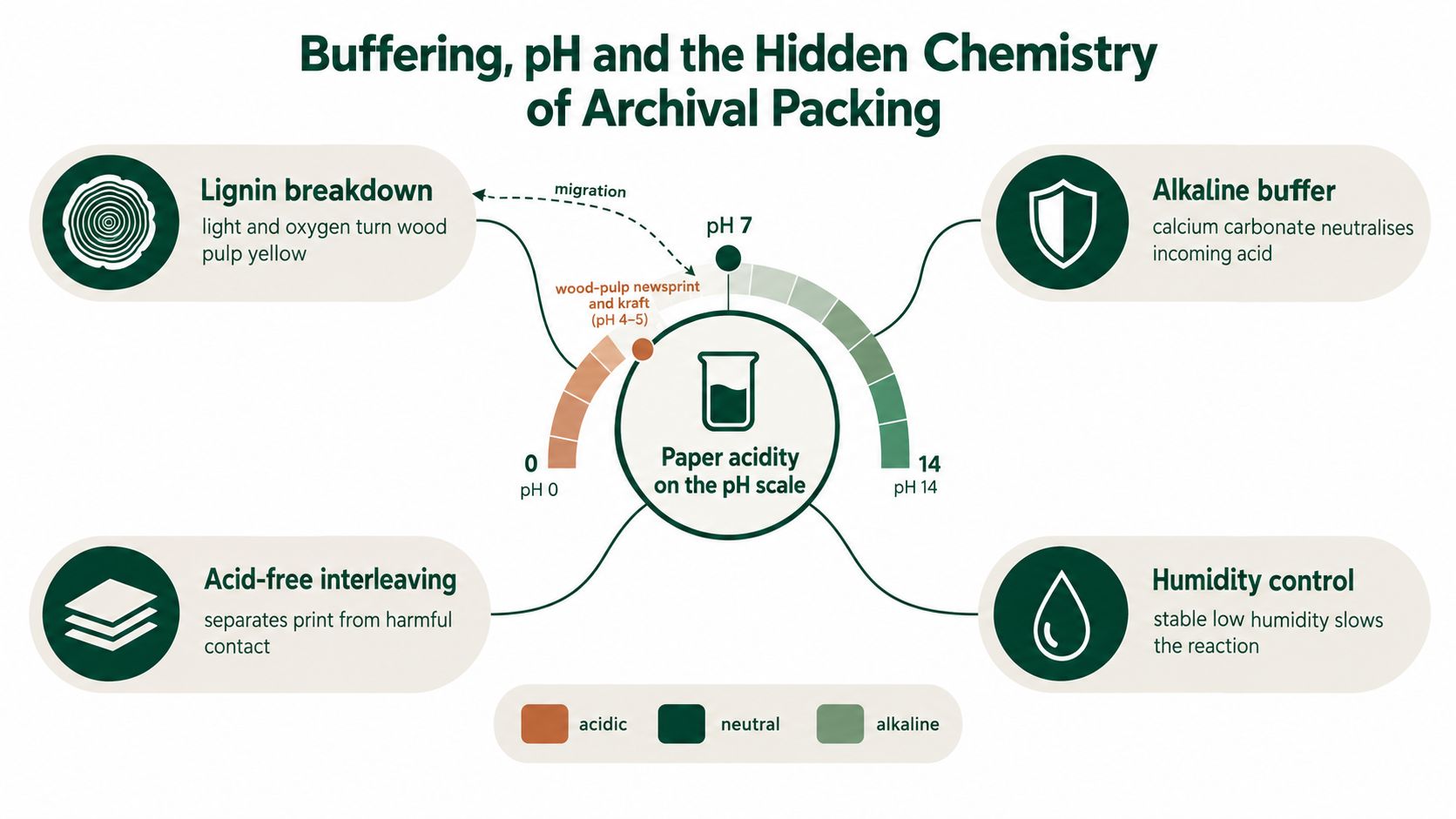
At the packing bench, “acid-free” is a starting point, not a complete specification. Paper and board for archival enclosures must withstand handling without harming the poster through direct contact or vapour exchange. The Archives and Records Association identifies calcium carbonate buffering, a pH range of 6 to 9, and the absence of lignin and sulphur as important characteristics for paper and board enclosures in its collections-care guidance.
Lignin occurs in ordinary wood pulp. As it ages, it can contribute to yellowing and degradation, allowing harmful compounds to move into adjacent paper. Ordinary cardboard can therefore work as an outer transit component, where it adds stiffness at reasonable cost, but it is a poor first-contact layer for an original print.
Read the specification, not just the front label
Buffered paper contains an alkaline reserve that helps neutralise acids introduced by the surrounding environment. Unbuffered acid-free tissue can suit some sensitive surfaces, so choose according to the poster's condition and the expected contact time. A material intended for a short journey does not always need the same specification as one used for long-term storage.
Polyester and polyethylene do not depend on a calcium carbonate reserve. A plastic sleeve still requires clean handling, suitable storage and an appropriate design. Stable film protects the surface, but grit trapped inside can scratch it during movement. Plastic also creates a sustainability trade-off, so use it where surface protection or handling control justifies the extra material.
Collectors comparing longer-term enclosures can use this guide to archival storage boxes. The same test applies to shipping protection material. Select components that are purpose-fit, strong enough for handling and unlikely to introduce a preservation problem.
Read the supplier's specification rather than trusting the front label. Check the paper chemistry, confirm that board is lignin-free and buffered where appropriate, and verify that any sleeve is polyester rather than PVC. That small amount of checking prevents a cheaper packing choice from creating a slower, less visible form of damage. For valuable posters, the right material is the one that addresses the actual risk without adding protection the parcel does not need.
Does More Protection Actually Pay Off
Extra material only earns its place when it removes a real failure mode. Tissue can stop scuffing, a rigid board can resist bending and a well-made tube can prevent a roll from collapsing. A second outer box may add little if the first package is already correctly sized and cannot move.
UK parcel damage gives retailers a reason to take that calculation seriously. One independent UK estimate puts damaged parcels at 23% of UK shoppers in the previous 12 months, with an annual cost exceeding £2.5 billion as reported by Floryn Packaging. That figure doesn't prove that any particular poster-packing method reduces claims, but it does show why replacing damaged collectibles, handling refunds and protecting trust cannot be treated as an occasional nuisance.
Put sustainability beside protection
The UK generated about 12.6 million tonnes of packaging waste in 2022, including roughly 2.2 million tonnes of plastic packaging, and about 51% of plastic packaging was recycled in the packaging data summarised by Timber Development. In 2024, the broader packaging recycling rate was 64.1%, with paper and cardboard at 74.3% and plastic at 51.0% according to UK waste statistics.
Those figures favour careful use of paper-based protection, but “paper” isn't a licence to overpack. Provisional 2025 data put UK packaging-waste recycling at 70.5%, which still leaves a gap between a material's label and its actual end-of-life outcome [in the same UK waste statistics]. A right-sized kraft layer that prevents a return is more defensible than a large amount of loose fill added without a handling purpose.
For practical alternatives to plastic-heavy cushioning, retailers can review options such as cost effective food delivery packaging, then test whether the material controls poster movement and surface contact.
My ranking is straightforward:
- Always worth it: A clean first-contact layer, secure end protection and a rigid container matched to the poster.
- Usually worthwhile: A stronger flat board or better tube for high-value originals and parcels exposed to difficult handling.
- Conditional: A polyester pocket for flat premium items, especially where repeated inspection is likely.
- Only for premium inventory: Double-boxing or a highly customised pack where the replacement cost and scarcity justify the extra weight and labour.
Don't claim that an added layer cuts damage unless you've recorded packing failures and tested the change. The honest measure is whether the protection addresses a known risk without creating unnecessary volume.
A Bench-Tested Packing Sequence You Can Reuse
Start with inspection, not tape. Confirm the poster's format, count the pieces and photograph the condition before wrapping. Look for loose ink, weak folds, edge tears and surface dirt, because a mark that appears after delivery may have existed before packing.
Rolled posters
- Interleave and wrap. Use clean acid-free tissue as the first layer. For a premium item, add a suitable polyester pocket only when the roll will not be tightly trapped or exposed to condensation inside the tube.
- Build end cushions. Crumple buffered tissue or clean kraft paper into soft end zones. They should stop the roll reaching the caps, not press hard against the poster.
- Fit the tube. Slide the protected roll into a correctly sized postal tube. It shouldn't telescope from end to end, but it also shouldn't be forced through a narrow opening.
- Close the ends. Fit the end discs or caps, reinforce the seams with suitable tape and check that no adhesive can contact the print. A kraft disc can add a useful barrier beneath the closure.
- Check movement. Gently rotate and shake the sealed package. If the roll slides audibly, reopen it and correct the end protection rather than adding more outer tape.
For a flat folded item, place a single clean sheet of archival interleaving between folded sections, then use a rigid mailer or flat box with corner reinforcement. A larger flat import may need a stronger board sandwich so the centre can't flex while the corners remain supported.
Before the parcel leaves
Record the item count, photograph the completed package and place “Do Not Bend” on more than one face where a flat shipment needs that warning. The label won't replace a rigid enclosure, but it gives the recipient and carrier a clear handling signal.
Collectors should open the package with a blunt tool kept away from the contents, remove tape without dragging it across the print and unroll the poster gradually on a clean surface. Support it under gentle, even weight until it settles, and never tape directly to the printed surface.
Famous Movie Posters offers guaranteed original US One Sheets, UK Quads and other film formats, with purpose-designed tubes, acid-free tissue and premium polyester protection used according to the item. Visit Famous Movie Posters to browse authenticated originals, request a specific title or find practical collecting guidance before your next purchase.