



You've unrolled a one sheet on the dining table, it's a fraction longer than the frame listing promised, and now you're wondering whether you've bought the wrong size or the wrong format entirely. That's the normal starting point with movie poster frames 27 x 41. The catalogue figure is a starting point, not a guarantee. Measure the sheet in front of you, then buy the frame to fit it.
Table of Contents
- 27 x 41 Frame Sizes at a Glance
- How to Measure a Poster Before You Frame It
- Choosing Frame Styles, Glazing and Backing
- Where to Hang a Framed Poster Safely
- Confirm Your Measurements Before You Order
27 x 41 Frame Sizes at a Glance
A 27 x 41 one sheet measures 27 by 41 inches and hangs portrait. In metric terms, the Art of the Movies framing guide gives that size as approximately 68.6 x 104.1 cm.
Sheet size is only the starting figure. The frame has to accept the paper, any mount, the glazing and the backing, and each part carries its own measurement.
27 x 41 frame sizes by component
| Item | Inches | Centimetres |
|---|---|---|
| Poster sheet | 27 x 41 | 68.6 x 104.1 |
| Rebate opening | 27.5 x 41.5 | 69.9 x 105.4 |
| Single-window mount opening | 25 x 39 | 63.5 x 99.1 |
| Double-window mount openings | First window 25 x 39, second cut to your measured item | First window 63.5 x 99.1, second cut to your measured item |
| Outside frame with 1.5 in moulding | 30.5 x 44.5 | 77.5 x 113.0 |
Why Clearance Matters
The rebate figure adds 0.25 in clearance on each side of the sheet. Paper needs that small breathing room to sit flat. Force it into an exact-fit opening and it can buckle against the glazing, especially when room humidity changes.
A single-window mount opening at 25 x 39 in sits about 1 in inside the sheet on every edge, hiding that strip of paper under the mount. That suits a poster with scuffed borders, but credits or artwork printed close to the edge get covered. The opening has to stay smaller than the sheet, or the paper drops straight through the window.
The moulding swallows the most wall. A 1.5 in moulding adds 3 in to each dimension once both sides are counted, taking a 27.5 x 41.5 in rebate out to 30.5 x 44.5 in overall. Measure your wall space against that outer figure.
The Quad Trap
The most expensive mistake in the UK is buying a Quad frame for a one sheet. The British Quad measures 40 x 30 inches and hangs horizontally, with a ratio of roughly 1.33:1. A one sheet runs taller at about 1.52:1, so the shapes don't match. Slide a portrait one sheet into a Quad frame hung horizontally and you face cropping or uneven borders. If the distinction still feels muddled, read the comparison of one sheet and Quad formats before you spend anything.
UK buyers meet both formats regularly, which is exactly why the mix-up happens so often.
Before you order, check the stated rebate size against your own poster. That check takes minutes and prevents nearly every wrong-size return.
How to Measure a Poster Before You Frame It
The printed size isn't always the size on the paper. Trims, folds and older production runs shift the finished sheet, sometimes by enough to matter in a tight frame. One documented 27 x 40 inch variant came from a removable three-inch strip, and historical British one-sheet documentation records that trimming, borders and folding could alter exact dimensions.
That's why I'd never frame from a catalogue entry. Measure your individual sheet.
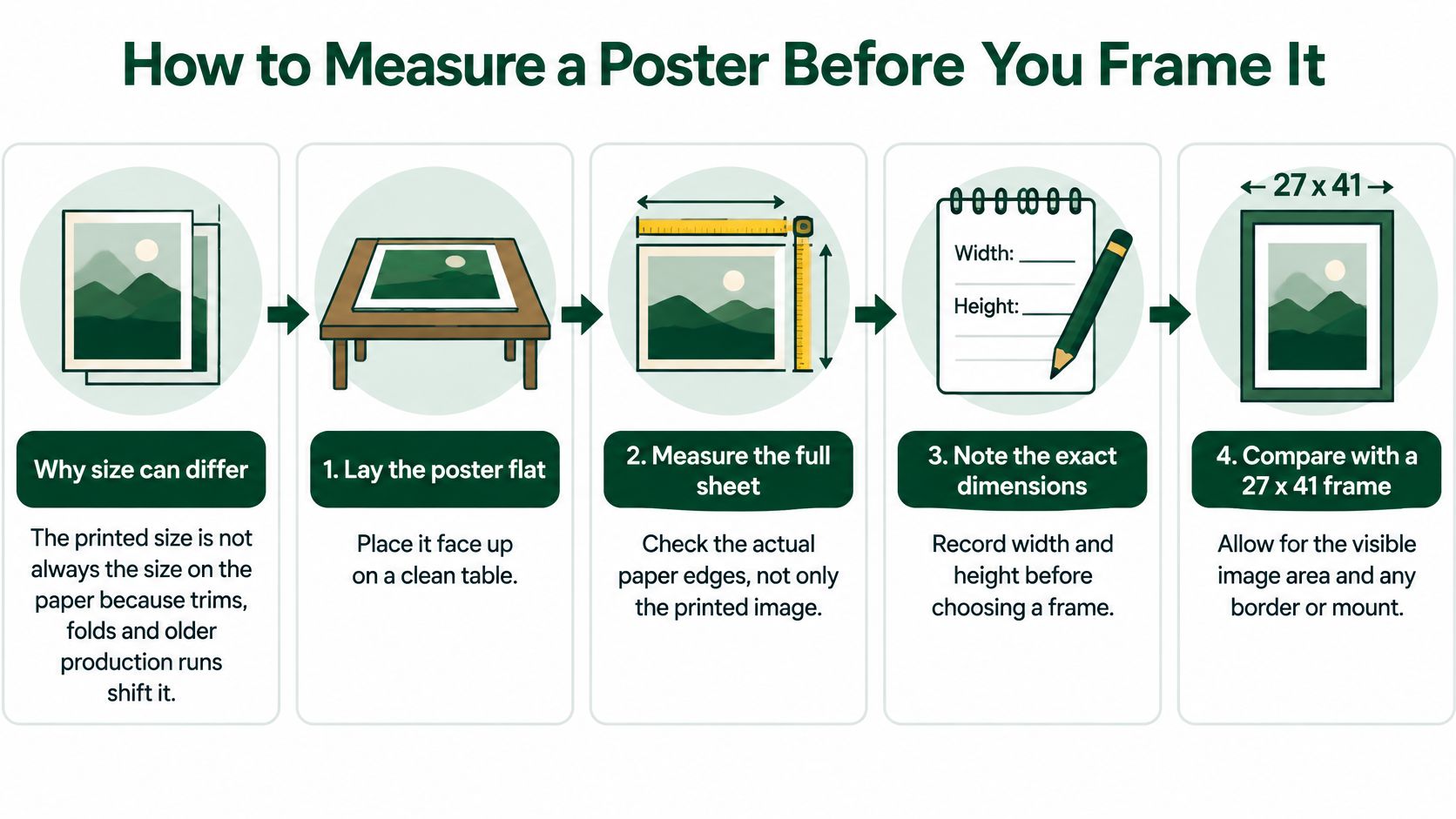
The Measurement Steps
- Lay the poster flat: Put it face up on a clean table with clean card underneath to protect the surface.
- Measure the width three times: Use a steel rule, not a cloth tape that stretches, and record readings at the top, middle and bottom.
- Measure the height three times: Run the rule along the left edge, the centre and the right edge, and write down each figure.
- Compare against 27 x 41: If your sheet reads closer to 27 x 40, treat that as the true size and ignore the listing.
- Record the condition: Note fold lines, creases and any trimmed edge, and mark them lightly in pencil on the back.
- Work out the rebate: Add 0.25 in to each side of your measured size. That's the opening the frame must accept.
- Write it down: Put the sheet size and rebate size on a card and give it to the framer, so there's no guesswork later.
Rolled Posters and Small Differences
A rolled poster can't be measured accurately until it's flat. Leave it under even weight for several days and let it relax on its own. Don't force the corners down, and don't crease it backwards to speed things up. You'll trade a curl for a crack.
Practical rule: readings along each side should agree within a millimetre or two. A bigger gap usually means a trimmed edge or a sheet that isn't square.
If one side is shorter than the opposite side, tell the framer before the mount is cut. A mount cut to nominal dimensions will show the discrepancy as an uneven border, and you'll notice it every time you walk past. Accurate figures at this stage cost nothing. Correcting a finished frame costs plenty.
Choosing Frame Styles, Glazing and Backing
A slim metal frame can keep a 27 x 41 poster light on the wall, while a deep shadow box adds weight and room for memorabilia. Choose the moulding around the finished frame's full package: glazing, poster, mount or spacer, and backing board all need to fit inside the rebate. A catalogue size describes the poster, not necessarily the sheet in front of you, so base the frame opening on the poster as it arrives.
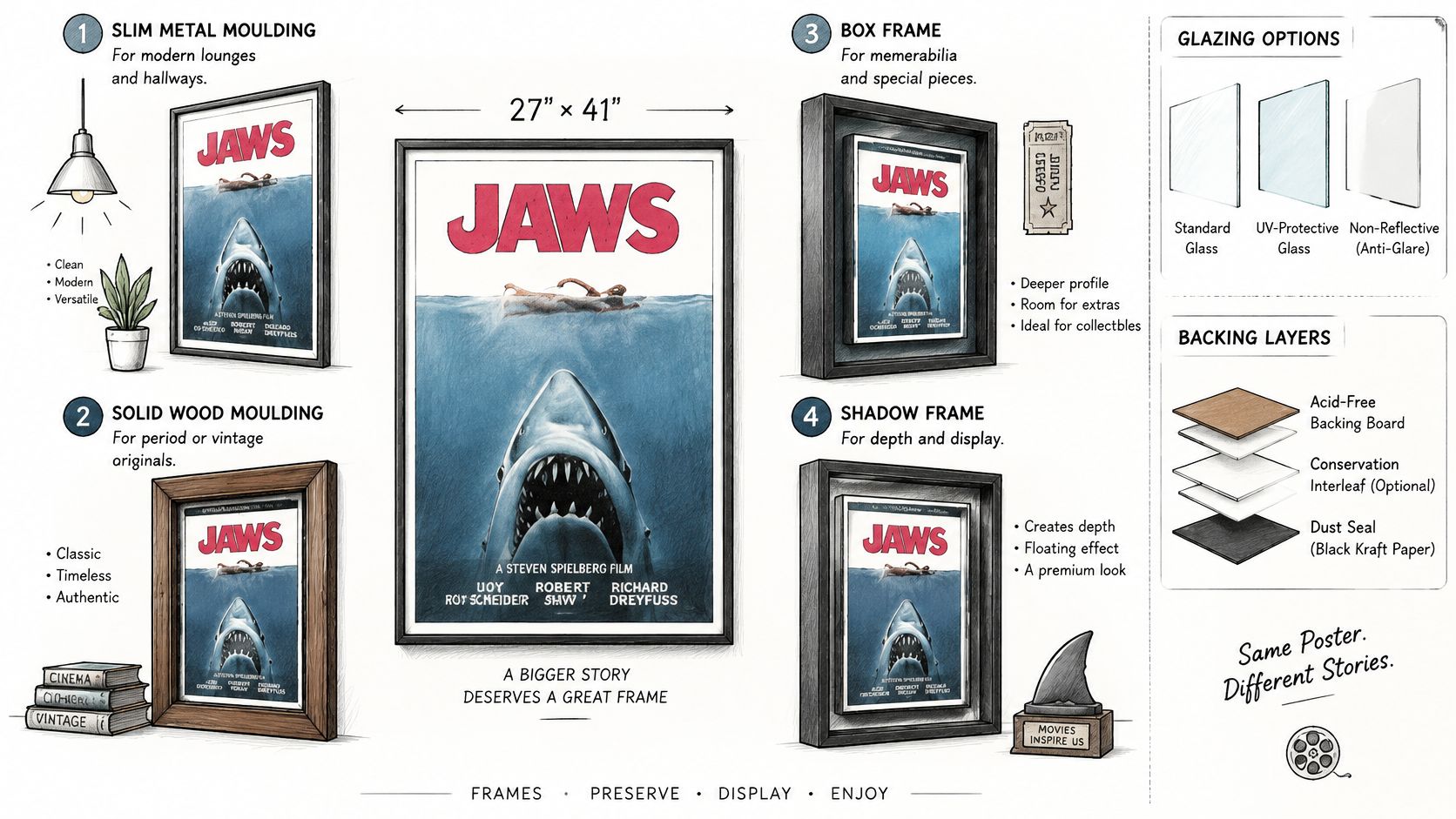
Frame styles compared for a 27 x 41 poster
| Frame style | Depth and weight | Best for | Watch out for |
|---|---|---|---|
| Slim metal moulding | Shallow, light | Modern lounges and hallways | Confirm rebate depth holds glass and board |
| Solid wood moulding | Medium to deep, heavier | Period or vintage originals | Check the backing board, not just the timber |
| Box or shadow frame | Deep, heaviest | Memorabilia with objects or layered items | Needs spacer and firm wall fixings |
| Clip frame or hanger | Minimal, lightest | Short-term or temporary display | No glazing, so no UV protection |
Check the rebate depth before ordering. It must accommodate the glazing, poster, mount or spacer, and backing board together. A shallow moulding may leave too little room for the board, even if its profile looks suitable in a product photo.
Slim Metal and Solid Wood
Slim metal keeps the frame visually quiet and reduces weight, which suits a hallway or contemporary lounge. Its shallow profile can limit the backing and glazing options, so ask for the rebate measurement rather than relying on the product listing.
Solid wood gives a tall one sheet a broader visual border and suits period interiors. It is heavier than slim metal. Check the board specification as well as the timber; good moulding does not guarantee suitable backing.
Box Frames and Clip Frames
A box frame has room for ticket stubs or a signed still alongside the poster, with a spacer to keep objects clear of the glazing. The added depth makes the finished frame heavier, so include its total weight when choosing wall fixings.
Clip frames and hangers suit temporary display of a reprint. They offer little protection from dust, splashes or light, and their grip can be difficult to reverse without affecting the paper. Keep them for posters you can replace.
The video below shows the framing choices and assembly steps.
Glazing as Part of a System
Specify glazing, backing and spacing together. Museums Galleries Scotland guidance on caring for paintings and frames recommends that qualified framers or conservators fit glazing, since its weight, thickness and fixing security must suit the frame. A practical specification includes UV-filtering glazing, acid-free conservation board, stable backing, and a spacer or mount.
Check the manufacturer's documentation for the UV performance of the glazing. Glass gives a hard, clear surface and resists scratching, but adds weight to a large frame. Acrylic is lighter, which can help on plasterboard or when the frame will be moved, but it scratches more easily and needs careful cleaning. For a large one sheet in a family home, lighter acrylic can leave more of the weight allowance for the frame and fixings.
Use a spacer or mount to keep the poster off the glazing. If moisture forms inside the frame, direct contact can make paper stick. For assembly order, see this guide to how to frame a poster properly.
Backing, Mounting and Condition Checks
Choose acid-free board for prints and similar objects. Museums Galleries Scotland's guidance on acid-free mounting materials explains that suitable tissue uses highly purified wood fibres without acid-producing lignin, and that some boards are buffered to help limit acid migration. Ask the framer to state the board type in writing.
Avoid ordinary cardboard, untreated MDF and permanent dry mounting. Acidic materials can yellow and embrittle paper, while bonding the sheet makes later conservation work harder. Acid-free tissue hinges at the top corners let the poster move slightly and can be removed later without tearing fibres.
Before closing the frame, check for tears, flaking ink, cockling or earlier restoration. Framing should not conceal active damage or force a sheet flat. Photograph both sides and keep the images with the measured dimensions and purchase paperwork. For transport, Foam Corner Protectors For Packing Frames help protect the vulnerable mitred corners.
For a tall, heavy frame, use two wall fixings rated for the combined weight of the glazing, board and moulding. A single central hook can let the frame tilt and put stress on one corner; two fixings spread the load and help keep it level.
Where to Hang a Framed Poster Safely
The commonest mistake is hanging a framed original opposite a window because the UV glazing feels protective. It isn't a licence for direct sun. UV filtration cuts ultraviolet exposure, but visible light, heat and humidity still act on the paper, and a portrait 27 x 41 sheet gives daylight a tall, uninterrupted surface to work on.
A guide to movie poster frames with lights puts light-sensitive material at around 50 lux, advises avoiding prolonged exposure above 100 lux, and calls for eliminating UV below 400 nm. Aim for stable conditions around 40 to 60% relative humidity and 16 to 25°C, with limited short-term fluctuation either side.
Room risks for a framed 27 x 41 original
| Location | Main risk | Verdict |
|---|---|---|
| Window-facing lounge | Direct sun, UV and heat | Avoid, or move to an internal wall |
| Basement | Damp and condensation | Only with a dehumidifier and a hygrometer check |
| Loft conversion | Heat swings | Avoid for originals |
| Hallway on an internal wall | Steady temperature, low light | Good choice |
| Home cinema | Prolonged strong lighting | Acceptable for short sessions, measure lux |
| Wall above a radiator | Heat and drying | Avoid |
Practical Checks Before You Drill
Buy a cheap hygrometer and leave it in the room for a week. If readings swing widely between morning and evening, the room will work against the paper no matter how good the frame is. Check the wall itself for cold spots and condensation, and favour internal walls over exterior ones, since an outside wall tracks the weather.
Keep the frame well clear of radiators and other heat sources. Rising warm air dries paper unevenly and encourages cockling inside an otherwise sound frame.
A home cinema can work well because light levels stay low during films, and this home cinema setup guide helps with layout planning. Watch the hours under strong spotlights, though, and measure lux at the poster surface if the room has display lighting. Where the poster shares the room with a screen, you can find art placement tips above TVs to keep the frame clear of heat-emitting displays and crowded sightlines.
Premium glazing reduces one risk. It doesn't make a bad room safe.
I'd take a dull internal hallway over a dramatic spot opposite glass every time. Rotate displays where you can, and give valuable originals long rests away from light. A frame's job is protection inside a stable room, not decoration alone.
Confirm Your Measurements Before You Order
Don't place the order until the framer confirms the rebate size, glazing specification and backing in writing. Use this checklist first.
- Measured figures: Sheet size and rebate size both written down.
- Mount choice: Single window or double window confirmed, with openings agreed.
- Glazing: UV-filtering, with the stated percentage on the quote.
- Backing: Acid-free and buffered, named on the specification.
- Mounting method: Hinged, not bonded with adhesive across the sheet.
- Fixings: Rated for the combined weight of the finished frame.
For price context, the At the Movies custom framing page listed in 2024 a glass 27 x 41 US One Sheet frame at £295 with a single-window mount and £370 with a double-window mount. Use those figures as a benchmark and ask other framers to quote the same specification, not just a headline price. Famous Movie Posters offers a frames collection and size guides that make a sensible starting point if you haven't chosen yet.
One legal note. UK online orders usually carry a 14-day cancellation window under the Consumer Council guidance on buying goods, and MoneyHelper consumer rights guidance states delivery is normally due within 30 days unless another period is agreed. Made-to-measure framing may sit outside cancellation, so ask before you pay, and get the packing method for transit in writing too.
Measure the sheet, specify the system, then choose the frame.
Browse guaranteed original one sheets, frames sized for the format and practical size guides at Famous Movie Posters, then order once your measured rebate size is confirmed. You'll get a frame that fits the poster you own, not the catalogue's approximation of it.