



You've found an original film poster, measured the wall, and ordered what looks like the obvious solution: a large UK picture frame. Then the frame arrives, the poster won't sit properly, the artwork is cropped, and the finished package is too heavy for the fixing you had in mind. That mistake is common because “one sheet” doesn't mean the same thing as A1, a UK quad, or every older poster sold under the name.
A successful display starts with the room, not the product page. The poster has to fit the aperture, survive the light, clear the glazing, pass through the doorway, and hang safely from the wall. This guide shows how to measure a one sheet, choose ready-made or custom framing, specify conservation materials, and plan the installation for a real UK home.
Table of Contents
- Why a One Sheet Frame Is a Different Job in the UK
- Measuring Your One Sheet Before You Buy a Frame
- Ready-Made vs Custom Framing for UK Buyers
- Glazing, Mounts and a Reversible Mounting Sequence
- Matching the Frame to the Room It Will Live In
- Safe Hanging and Installation in a UK Home
- Buying, Shipping and a Pre-Hang Checklist
Why a One Sheet Frame Is a Different Job in the UK
The most common buying error is ordering by the frame's outside dimensions. A retailer may describe a frame as “27 × 40 inches”, but what matters is the image opening or aperture, not the total width and height after the moulding is added. If you buy by appearance alone, the rebate can crop the artwork or leave too little room for the paper to move.
The modern UK one sheet is a portrait poster measuring approximately 27 × 40 inches, or 68.6 × 101.6 centimetres, equivalent to 685.8 × 1,016 millimetres. The UK quad is different. It measures 30 × 40 inches, is displayed horizontally, and is 3 inches wider, a difference of 7.6 centimetres. That makes one sheet and quad frames non-interchangeable. The distinction is set out clearly in this UK one-sheet frame sizing guide.
Vintage stock creates another trap. Older UK references identify a one sheet measuring 27 × 41 inches, approximately 68.6 × 104.1 centimetres. The extra inch may be hidden by a mount, but it can also leave the frame too short, particularly if you want to preserve the complete edge of an original. The portrait one sheet began appearing in the UK during the 1960s, while the horizontal quad remained the characteristic British cinema format. Earlier terminology can be even less consistent because some collectors use “UK one sheet” for the older 20 × 30 inch double-crown format. UK poster history and size references explain why the date, orientation and actual dimensions need checking.
By the end of the process, you should have four things written down: the poster's measured width, its measured height, its orientation, and the clear aperture you need. That small piece of preparation prevents most expensive framing errors.
Measuring Your One Sheet Before You Buy a Frame
Put the poster on a clean, flat surface. Don't measure it while it's rolled, held vertically, or trapped under a ruler at one corner. If it's a valuable original with folds, let a specialist assess it rather than trying to force it flat.
Measure the visible image area from edge to edge, including the printed paper you want displayed. Use a steel tape or long rule, keep it straight, and take the measurement in both directions. Record the result in inches and millimetres. For a modern nominal one sheet, the reference point is 27 × 40 inches, or 685.8 × 1,016 millimetres. Vintage examples may be 27 × 41 inches, or approximately 685.8 × 1,041 millimetres.
The three numbers that matter
Write down:
- Actual width, measured across the poster.
- Actual height, measured from top to bottom.
- Required aperture, allowing only the overlap or clearance your framer has agreed.
The aperture must be at least equal to the measured poster dimensions. A conservation mount can hide a small edge overlap when that's appropriate, but a mount shouldn't be used to disguise a frame that is too small. Paper responds to changes in humidity, so the sheet needs sensible clearance rather than being wedged tightly against the glazing.
A nominal one sheet has a display area of about 1,080 square inches, or 7,000 square centimetres, before rebates, mounts, glazing and edge clearance are included. The figure is useful for understanding the scale of the job, but it isn't a substitute for measuring the individual poster.
| Format | Orientation | Inches | Centimetres | Millimetres |
|---|---|---|---|---|
| UK one sheet, modern | Portrait | 27 × 40 | 68.6 × 101.6 | 685.8 × 1,016 |
| UK one sheet, older reference | Portrait | 27 × 41 | 68.6 × 104.1 | 685.8 × 1,041 |
| UK quad | Landscape | 30 × 40 | 76.2 × 101.6 | 762 × 1,016 |
A1 is not a replacement. It measures 59.4 × 84.1 centimetres, so its long edge is roughly 9 centimetres shorter than the one sheet's 101.6-centimetre height, and it's narrower as well. The frame may look close on a screen, but it won't provide the correct opening.
Rolled vintage stock and a modern flat one sheet also need different handling. A rolled poster may have edge curl, fold tension or paper distortion that requires a deeper rebate, a larger hidden allowance, or professional flattening before framing. A flat modern print is usually more predictable, but you should still confirm the actual sheet rather than trusting the label.
Ready-Made vs Custom Framing for UK Buyers
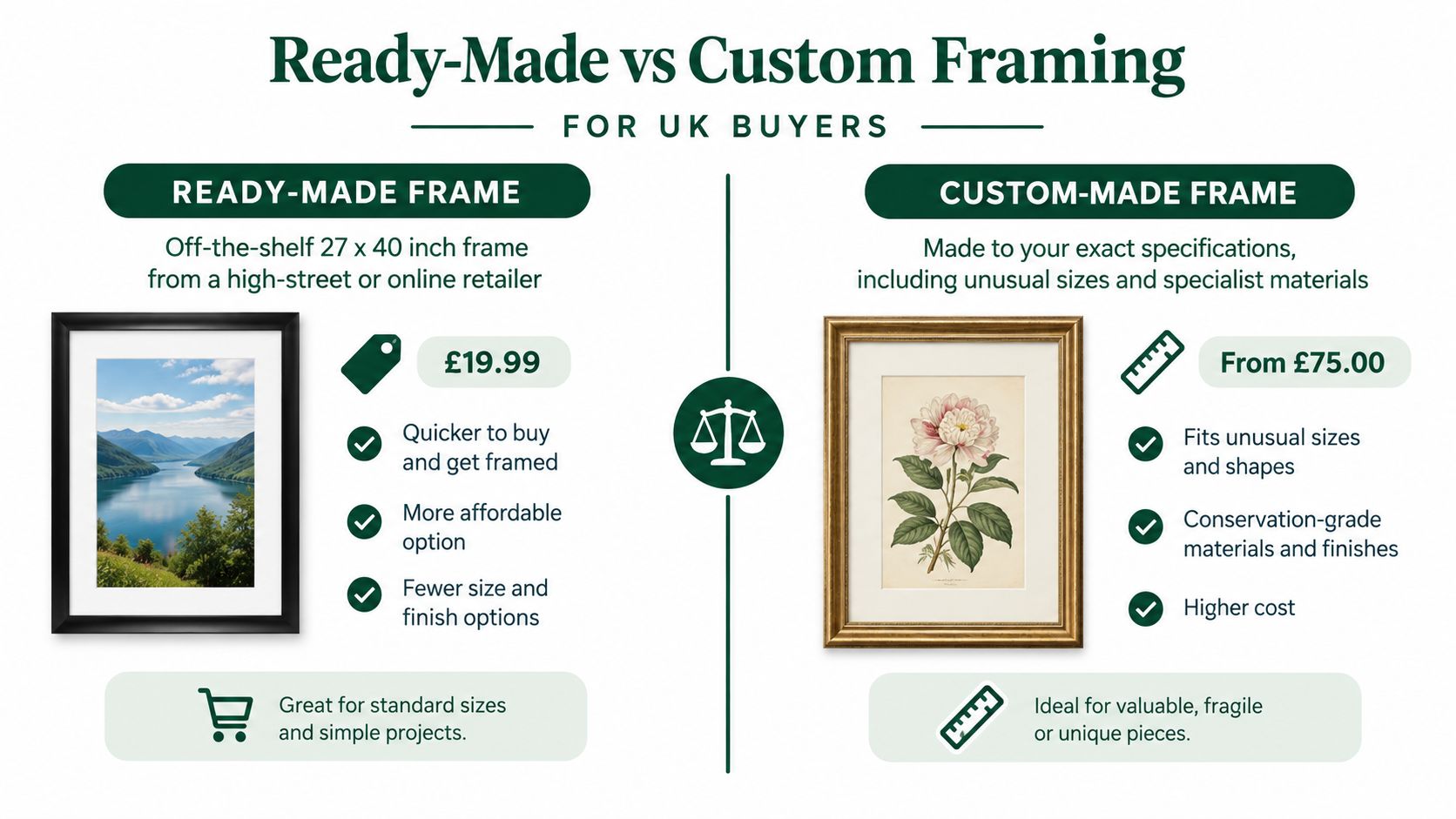
Once the measurements are reliable, the decision is fairly straightforward. A ready-made frame is practical for a modern poster that matches the nominal opening. Custom framing earns its cost when the poster is valuable, historically variable, folded, unusually sized, or destined for a room where conservation and safety matter more than the lowest purchase price.
Where ready-made works
An off-the-shelf 27 × 40 inch frame is usually the sensible route for a standard modern one sheet, a reproduction, or a collector working to a clear budget. It tends to be quicker to order and easier to replace. You can also avoid the consultation and measuring process attached to a fully bespoke job.
The limitations are just as clear. Ready-made frames often offer fewer choices of moulding, glazing, mount colour, rebate depth and backing. A nominal size may refer to a particular insert rather than the opening you need. Standard glass can also make a large frame awkward to lift, transport and hang.
Where custom is worth it
A UK framer can build around the poster you own. That matters for an older 27 × 41 inch sheet, a poster with uneven edges, or an original whose folds and paper movement must be respected. Custom work also makes it easier to specify UV-filtering glazing, a conservation board, spacers, a sealed back and load-bearing fittings as one coordinated package.
A proper framer will ask whether you want the full edge visible, whether a window mount is acceptable, how the poster will be attached, and where the finished frame will hang. Those questions are more useful than choosing a frame from a photograph. For wider framing principles, including how material and structure affect the finished display, this guide to framing canvas paintings like a pro offers helpful context, even though a paper one sheet needs its own conservation treatment.
| Choose ready-made if | Choose custom if |
|---|---|
| The poster matches 27 × 40 inches | The poster measures 27 × 41 inches or another size |
| Speed and cost matter most | The original has significant value |
| Standard glazing is acceptable | You need conservation-grade materials |
| You don't need a mount or special finish | You want spacers, a sealed back or a specific aperture |
The quick rule is simple: standard modern poster and a cost-conscious display, choose ready-made; valuable original, non-standard dimensions or preservation requirements, choose custom. Before paying, compare the actual aperture and materials, not just the advertised frame size. A useful companion is this guide to poster framing costs, particularly if you're comparing a basic frame with a conservation specification.
Glazing, Mounts and a Reversible Mounting Sequence
Glazing isn't a decorative afterthought. It controls ultraviolet exposure, reflection, weight, breakage risk and the distance between the paper and the front of the frame. For an original, those choices should be made before selecting the moulding.
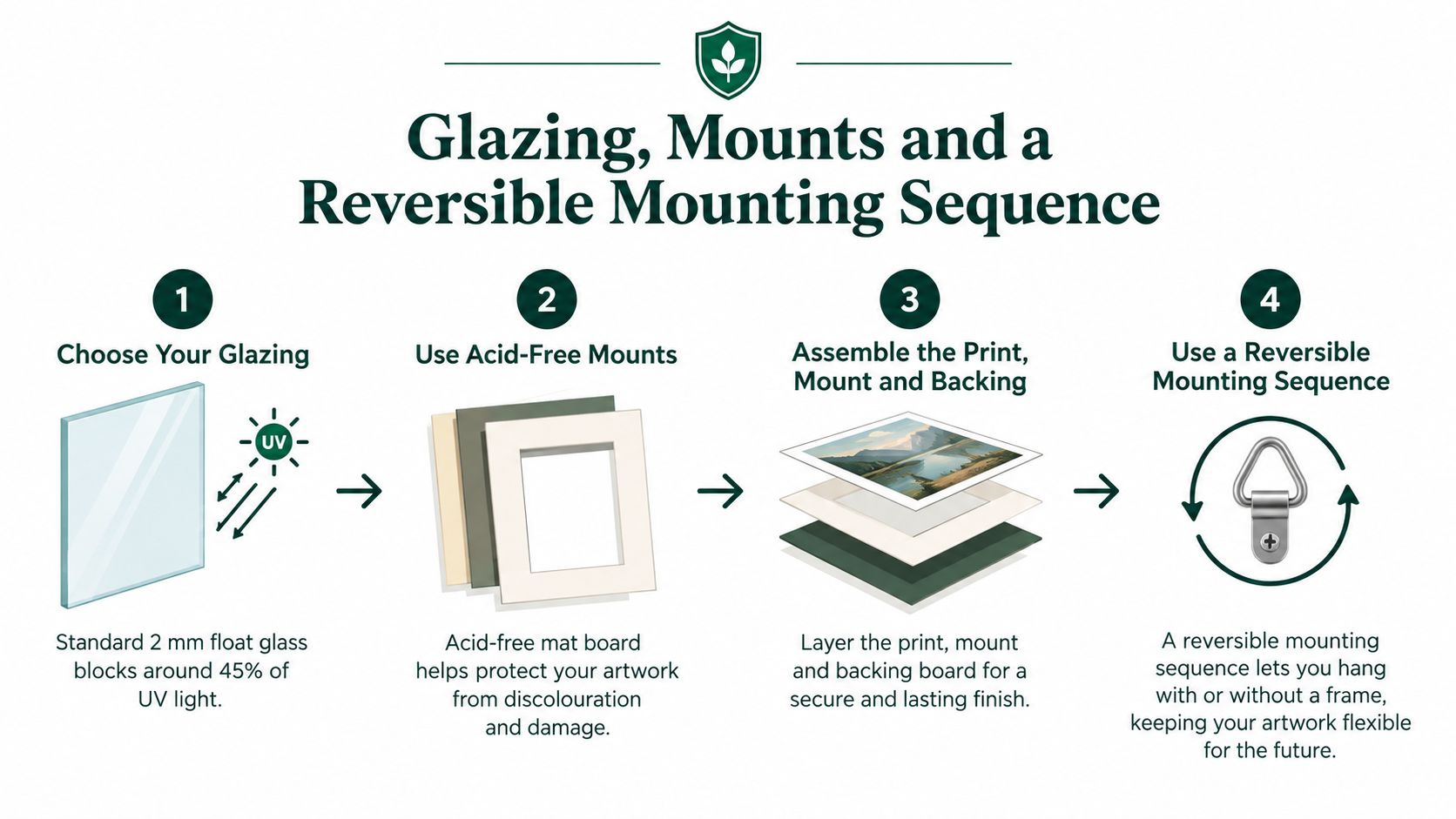
Standard 2 mm float glass blocks roughly 45% of ultraviolet radiation, while museum-grade glazing can block about 99%, as explained in this conservation glazing guidance. That doesn't make ordinary glass useless, but it does make it a poor default for a valuable poster displayed near daylight.
Make the glazing decision in the right order
Start with UV protection. Then consider low-reflection or anti-reflective treatment if windows, lamps or television screens create glare in the intended viewing position. Finally, decide between glass and acrylic.
Glass is rigid, scratch-resistant and optically familiar, but it adds considerable weight at one-sheet scale and can be dangerous if it breaks during transport or installation. Acrylic is lighter and safer to handle, especially in a busy household, but it needs the right surface and static-control specification because unsuitable acrylic can attract dust and create handling problems. A specialist explanation of glass types and their practical characteristics is available in this Binks Balustrades glass guide.
Build the package so it can come apart
For an original one sheet, the sequence should be reversible:
- Use acid-free, lignin-free mount and backing board.
- Attach the poster reversibly at the top edge with Japanese tissue and wheat-starch paste.
- Add spacers or a window mount so the paper never touches the glazing.
- Assemble the glazing, mount and backing with enough depth for the artwork to move naturally.
- Seal the back against dust, insects and humidity gradients.
Pressure-sensitive tape, spray adhesive, dry mounting and permanent lamination have no place in this treatment. They can make future removal difficult, introduce adhesive failure, and distort the paper. Don't press a historic folded sheet flat against the glazing just because the frame is shallow.
Conservation rule: The frame should protect the poster while allowing a future conservator to remove every layer without destroying the artwork.
Matching the Frame to the Room It Will Live In
A frame can be correctly sized and still be wrong for its room. The wall determines the daylight exposure, the winter condensation risk, the reflection angle, the fixing method and the practical route from the front door to the final position.
UK conservation guidance identifies an ideal temperature of 16–19°C and relative humidity of 45–60%, as outlined by the Institute of Conservation guidance. These figures describe a stable domestic environment, not a challenge to maintain laboratory conditions. Avoid rooms with sharp swings, persistent damp or direct heat.
The cold outside wall is an overlooked problem. The National Archives framing guidance warns that hanging framed paper directly against an outside wall can encourage condensation and mould. Leave the frame able to breathe, keep it away from damp surfaces and don't place it above a radiator just because that's the only empty wall.
Make the room part of the specification
Walk around the room at the time you'll normally view the poster. Check whether daylight falls directly on the artwork, whether a window reflects across the glazing, and whether a ceiling light creates a bright band over the image. Low-reflection glazing helps with glare, but it doesn't solve poor placement.
The contrarian point is important: UV glazing isn't permission to hang a poster in direct sun. Conservation advice still recommends limiting daylight exposure, and Museums Galleries Scotland also advises UV-absorbing glazing and limited display periods for paper objects.
Use this pre-purchase check:
- Light: Choose a wall away from direct sunlight and strong reflected daylight.
- Moisture: Avoid outside walls, bathrooms, kitchens with heavy steam and areas close to damp.
- Heat: Keep the frame away from radiators, fires and other heat sources.
- Depth: Confirm that the wall can accept the frame depth, mount, spacers and backing.
- Access: Measure the doorway, stair turns and lift before ordering the finished package.
- Appearance: Decide whether preserving the full paper edge matters more than a window mount.
For a smaller room, placement and visual balance matter as much as the frame finish. This small-space painting guide is useful for thinking about wall colour, available clearance and how a large artwork changes the feel of a compact UK interior.
Safe Hanging and Installation in a UK Home
A 27 × 40 inch frame is a substantial object before you add moulding, glazing, mount and backing. Glass can turn a visually simple poster into a heavy package, so plan its route through doorways, staircases and tight corners before the framer finishes it.
The wall construction matters. Plasterboard, brick and stud walls need different fixings, and the fixing must suit the finished load rather than the empty frame. Conservation guidance also stresses that hanging fittings should be secured to the frame itself, not merely to the backboard, with enough rebate depth for the artwork, mount, isolating layer and backing.
For a large frame, two-point hanging or a properly installed picture rail is usually more stable than one central fixing. It reduces swing and helps the frame stay level. Ask the framer to fit the hardware to the moulding, then choose wall fixings appropriate to the actual wall.
A safe frame is a system. The moulding, fittings, wall plugs and wall structure all share the load.
Acrylic is a sensible default for many UK homes, particularly where the frame will hang above a bed, sofa or busy walkway. Glass gives a rigid, scratch-resistant surface, but the handling and breakage consequences are less forgiving. If you choose glass, arrange help for lifting and never improvise with a fixing rated only for a small decorative frame.
Measure the wall position, mark both fixing points, drill to suit the wall, install the hardware, lift the frame with two people, and check it with a level. Leave the protective film on acrylic until the frame is secure. After the wall and fittings have settled, inspect the fixings again and check that the frame hasn't shifted.
Buying, Shipping and a Pre-Hang Checklist
Before checkout, confirm the clear aperture, glazing type, spacer depth, backing, attachment method, delivery packaging and wall fittings. For UK online purchases, goods should be delivered without undue delay and no later than 30 days, unless you and the seller agree a different deadline, under the Consumer Contracts Regulations guidance.
International buyers need to price the landed cost, not just the checkout total. GOV.UK explains that VAT can apply to goods sent from outside the UK, while Customs Duty may apply to non-excise goods valued above £135. HMRC also says import VAT can include the customs value, packing, transport, insurance, customs duty and other charges up to the first UK destination, so the declared value of a framed one sheet affects the calculation. Check the HMRC customs-value guidance before ordering abroad.
Use this final checklist:
- Measure the poster twice.
- Order by aperture, not outside size.
- Confirm UV glazing and reflection requirements.
- Specify spacers and a sealed back.
- Check the frame's load-bearing fittings.
- Match fixings to the wall.
- Inspect glazing, corners and backing on arrival.
- Recheck the frame after hanging.
For safe delivery, review the seller's poster shipping protection before payment. A frame that fits the poster but cannot survive the journey or the wall is not a finished solution.
Famous Movie Posters offers original film posters, framing options, purpose-designed protective packaging and UK and worldwide fulfilment. Visit Famous Movie Posters to find an authentic one sheet and plan its display around the room it needs to live in.