



You've got a poster tube on the table and a listing open on your phone, but you're not sure whether the sheet inside is an original cinema poster or a later print. The Live and Let Die poster most collectors mean is the 1973 British Quad, a horizontal cinema sheet with Robert McGinnis artwork, although that's only part of the British campaign.
Table of Contents
- Which Live and Let Die Poster You Are Looking At
- Live and Let Die Poster Sizes at a Glance
- How to Tell an Original 1973 UK Quad from a Reprint
- Odeon Variants and Why Rarer Does Not Mean Dearer
- Condition Terms and What Each One Means
- How to Store and Pack a Quad Without Damage
- Confirm the Format Before You Order a Live and Let Die Poster
Which Live and Let Die Poster You Are Looking At
A sheet can show the right artwork and still belong to the wrong campaign. Check the intended use before judging the picture: cinema posters, manufacturer tie-ins and decorative reproductions are different items.
The 1973 British campaign included several original formats, not just the familiar full-colour British Quad. The main possibilities are:
- British Quad: The horizontal-format cinema sheet featuring Robert McGinnis's full-colour design.
- US One Sheet: An American cinema poster in portrait format.
- Odeon-only promotions: Cinema advertising produced through Marler Haley, including designs specific to Odeon cinemas.
- US Glastron tie-in: Promotional material connected with the boat manufacturer, rather than a standard British cinema poster.
- Later reprints: Decorative reproductions, not original theatrical display sheets.
Place the sheet in its release campaign
The BBFC records the film's cinema classification on 13 June 1973. That date helps place a poster within the period, but it does not establish when cinemas screened the film. The British campaign used multiple formats, so an Odeon-only sheet should be assessed on its provenance, completeness and condition, not rarity alone. A scarce sheet with uncertain history or missing sections is not automatically a better purchase.
The word original needs context. A sheet made for the 1973 British theatrical campaign is a period cinema poster. Anniversary, home-video and later re-release materials belong to separate campaigns, even if they reuse familiar artwork. The documented British release chronology records the BBFC classification date.
Name the format first, then establish its campaign and provenance. Check whether the sheet is complete and look closely at its condition before weighing the asking price. Similar artwork alone cannot confirm that a poster is an original cinema issue.
Live and Let Die Poster Sizes at a Glance
| Format | Paper size (in / cm) | Orientation | Where it was used |
|---|---|---|---|
| US One Sheet | 27 × 41 in / 68.6 × 104.1 cm | Portrait | US cinema display |
| UK Quad, general release | 30 × 40 in / approximately 76 × 102 cm | Landscape | British cinemas, full-colour McGinnis design |
| Odeon two-colour quad crown | 30 × 40 in / approximately 76 × 102 cm | Landscape | Odeon cinemas only, Marler Haley |
| Odeon double crown, four designs | 20 × 30 in / approximately 51 × 76 cm | Portrait | Odeon cinemas only, Marler Haley |
| US Glastron tie-in | 12.5 × 18 in / approximately 32 × 46 cm | Portrait | US tie-in promotion |
| Framed UK Quad, mounted | About 38 × 47.5 in externally; not the paper measurement | Landscape | A recorded mounted example, not a standard frame specification |
The British measurements, framed example and Odeon formats are recorded in the British Quad and Marler Haley campaign description. The smaller promotional format appears in the Glastron tie-in auction listing.
Measure the paper, not its surroundings
Lay the sheet on a clean, supported surface and measure the unfolded paper edge to edge. Don't include a mount, backing cloth or frame. Take readings at several points, because trimming, uneven edges and small losses can affect the result.
A framed listing needs particular care. Its outside dimensions tell you how much wall space it needs, not whether the paper underneath is complete. Ask for the sheet dimensions separately, and ask whether the mount conceals any edges.
For broader format comparisons, the guide to Quad film posters helps distinguish the British landscape format from portrait alternatives.
Matching dimensions don't mean matching posters
The standard National Screen Service British Quad and the Odeon-only material belong to related but distinct parts of the campaign. Marler Haley supplied its special posters exclusively to Odeon cinemas across the UK between 1971 and 1987, according to the campaign description linked above.
That history explains why matching the usual Quad dimensions doesn't settle the identification. You must also compare colour treatment, typography and distribution evidence.
Measuring rule: A correct size is a useful starting point, not an authenticity certificate.
If a landscape sheet has neither a convincing distributor line nor credible Odeon provenance, investigate that gap before discussing its supposed rarity. Equally, don't reject an unfamiliar design just because it isn't the famous full-colour version.
How to Tell an Original 1973 UK Quad from a Reprint
Judge the whole design system, not one signature or one recognisable image. A reproduction can copy the artwork convincingly enough to look reassuring in a small photograph. Authentication needs the margins, reverse and physical sheet as well.
Use this visual checklist alongside detailed photographs.
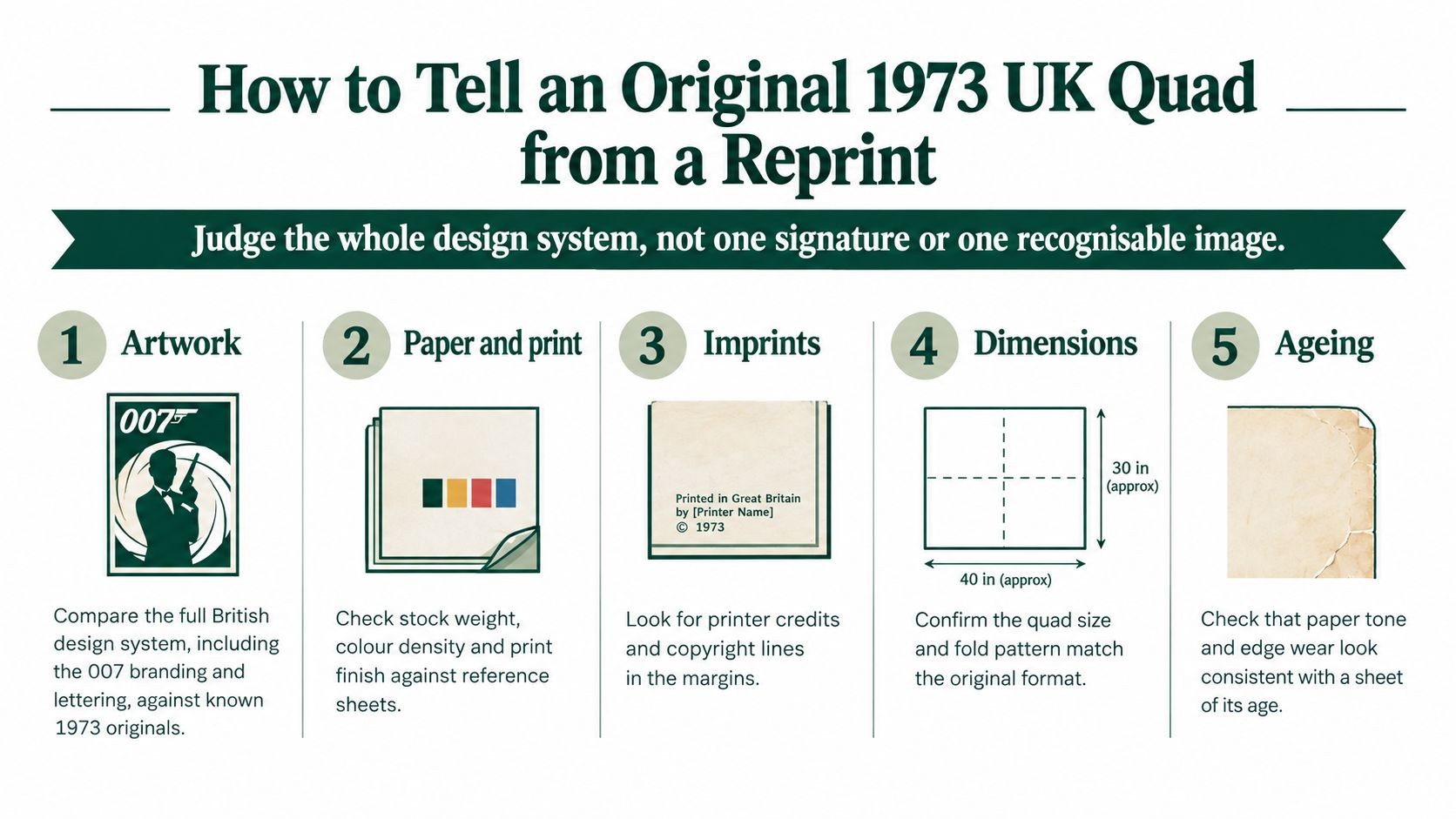
Compare the artwork and marginal printing
McGinnis's British design embeds the 007 identity into Roger Moore's name, while tarot-card imagery reinforces the film's themes and introduces Moore after Sean Connery. The specialist history of the Bond Quad design also attributes the rough concept to United Artists publicity and the principal execution to McGinnis, with unused illustrations attributed to Bob Peak.
Compare the title treatment, lettering and character arrangement against an established original. Don't settle for recognising Moore's face or finding the artist's signature. A copied signature remains part of a copied image.
Then inspect the smallest printing:
- Printer and distributor details: Request close photographs of the margins, not just a cropped image of the central artwork.
- Copyright and credit lines: Check their placement, legibility and relationship to the paper edge.
- Missing information: Ask whether trimming, restoration or photographic cropping explains the absence.
A reprint can include old credit lines, so their presence isn't conclusive. Their absence isn't an automatic verdict either. It's a specific question that the seller should answer.
Examine paper and folds together
Treat paper weight, surface finish and colour as comparative evidence. An unusually thick, bright or glossy sheet deserves closer examination, but none of those characteristics proves modern production by itself. Storage and conservation can change how old paper presents.
Don't demand dramatic yellowing as proof of age. Instead, ask whether the paper, printing and wear make sense together. A clean central image with worn margins may be perfectly understandable; artificial-looking damage needs a better explanation than “vintage”.
Fold lines deserve the same care. Look for handling wear along the crease, local colour loss and the relationship between folds and surrounding damage. Don't assume every original must show equally prominent folds, or that a crease makes a modern print old.
A convincing front photograph can sell the picture. Photographs of the reverse and margins help establish what the object actually is.
Separate restoration from attribution
Ask about in-fill, retouching and linen backing before treating an exceptionally tidy sheet as untouched. Restoration can make an original presentable without changing its campaign identity, but it changes the condition description you should expect.
The attribution needs precision too. A preparatory drawing, an unused illustration and a signed print aren't interchangeable with a distributed cinema poster. “McGinnis artwork” describes the design; it doesn't, by itself, authenticate the particular sheet.
Finally, check which release the seller is claiming. The account of the London opening on 5 July 1973 provides a useful campaign reference, but the film's release date printed in a description isn't evidence that the paper dates from that release.
A sheet that passes most checks but raises one unresolved issue needs a question, not an instant verdict. Ask for the missing evidence. If the seller can't supply it, price and confidence should reflect that uncertainty.
Odeon Variants and Why Rarer Does Not Mean Dearer
The 1973 UK campaign included more than the familiar full-colour Quad. The two-colour quad crown and four double-crown designs are Odeon formats described in this specialist account of the Odeon variants. Treat them as part of the campaign's family of original formats, not as unofficial substitutes.
To identify one, check the sheet's dimensions and layout against the format claimed. Compare the artwork and printed distributor or cinema line with the standard Quad, and ask for clear photographs of the full sheet and its margins. A design alone is not enough to establish that a particular poster is an original Odeon issue.
Assess the object, not the rarity label
A clean general-release Quad may suit a buyer better than a damaged double crown. A complete group with documented provenance may have stronger appeal than a single sheet, but neither rarity nor completeness guarantees a particular result.
Judge condition, provenance, completeness, restoration and demand together. Ask where the poster came from, what evidence connects it to the campaign, and whether it was acquired alone or with related display material. The guide to original movie poster prices offers broader context for comparing examples. Use it as context, not a formula: an uncommon Odeon variant still needs sound provenance, completeness and condition.
Condition Terms and What Each One Means
| Condition term | Typical meaning | What to check |
|---|---|---|
| Near mint or excellent | Little visible damage, bright colour and limited handling evidence | Fold lines under raking light and colour loss along creases |
| Very fine | Light handling wear, minor corner or edge marks | Corners, edges and small stains |
| Fine | Visible folds, light creasing and some edge wear | Fold-junction splits and paper loss |
| Good or fair | Heavy folds, tears, splits or missing paper | Stability of tears and whether image areas are missing |
| Restored or conserved | Repairs, in-fill or retouching, sometimes with backing | Written treatment details and specialist examination where needed |
| Linen-backed | Mounted on cloth for support and presentation | When backing was added and what work it conceals |
Treat these descriptions as working shorthand, not a universal grading scale. Sellers don't necessarily use “fine” or “excellent” identically. A useful condition report names the actual faults rather than asking you to trust the adjective.
Inspect where damage collects
Ask for photographs under raking light, with illumination coming across the surface rather than straight towards it. That makes creases, raised repairs and surface disturbances easier to see. A softly lit, straight-on photograph can make a creased poster look flatter than it is.
Look closely at fold intersections and anywhere a tear meets a crease. Check the margins for pinholes and missing paper. Along the folds, distinguish a visible crease from loss of printed colour or an actual split.
Fading needs separate attention. Ask whether the colours are even across the sheet and whether any area protected by a mount differs from the exposed image. Don't judge colour solely from a brightened listing photograph.
Understand what the treatment changed
In-fill replaces missing areas. Retouching adds colour to reduce the visibility of damage. Linen backing supports the sheet, but the backing label alone doesn't tell you how much repair accompanied it.
These treatments can make a fragile poster easier to display. The trade-off is that you're buying a treated object, and you need to know how much original paper and printing remain. Ask for written details, especially where work crosses faces, lettering or important artwork.
A specialist may use ultraviolet light to investigate repairs. It isn't a simple home test that reliably separates every original surface from every intervention.
Before payment: Get the condition report and restoration disclosure in writing, not just in a telephone conversation.
Request an overall front photograph, a clear reverse photograph where accessible, and close-ups of the folds and damaged areas. If backing prevents examination of the reverse, that limitation should be explicit.
A rolled sheet retaining a curl isn't necessarily damaged. Careful flattening is different from repairing tears, replacing paper or repainting an image, and the seller's description should preserve that distinction.
How to Store and Pack a Quad Without Damage
Good handling begins before you unroll anything. Clear a table large enough to support the entire sheet, remove drinks and sharp objects, and check that your hands and work surface are clean.
This handling guide summarises the main sequence.
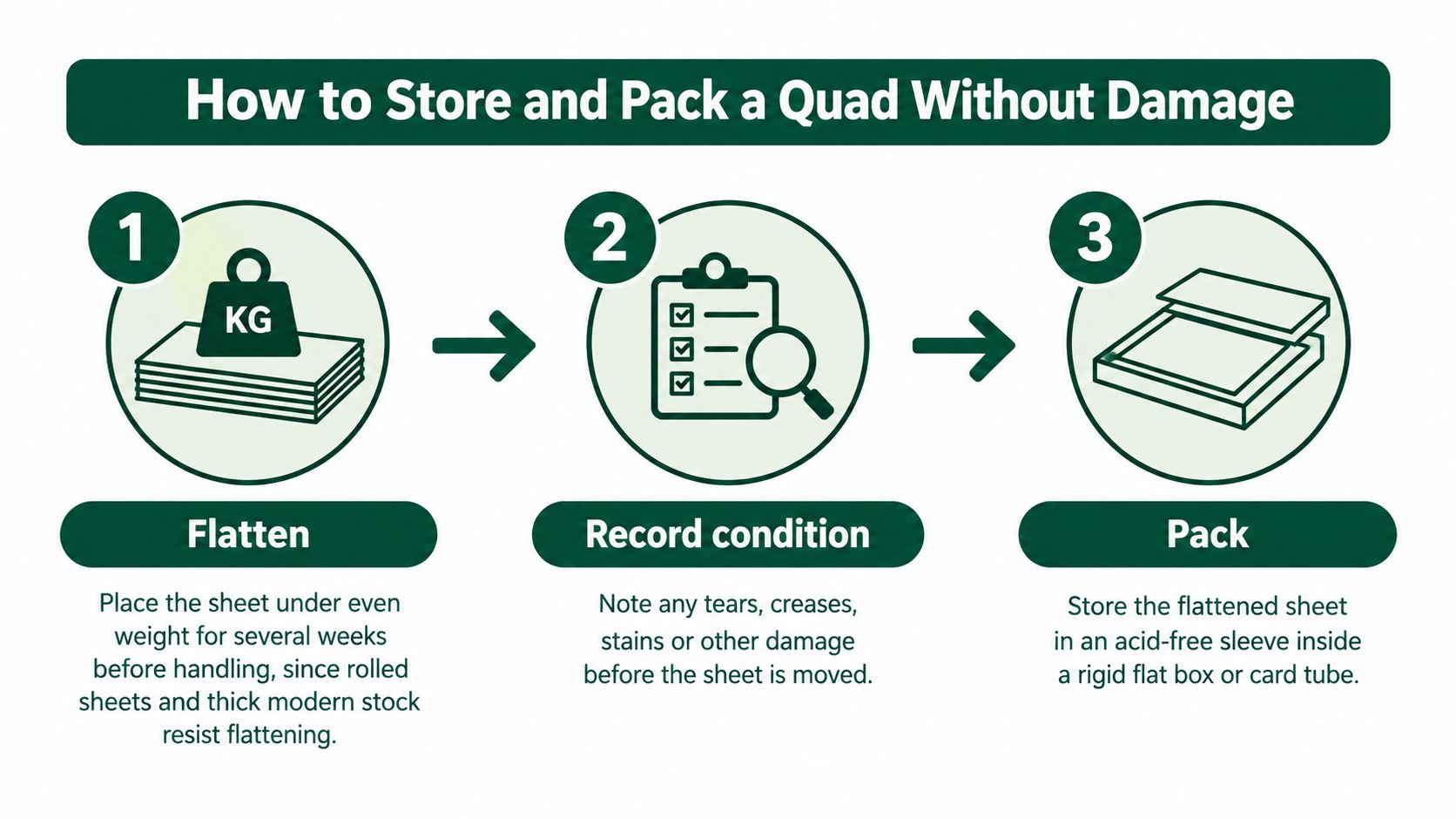
Prepare and protect the sheet
- Flatten cautiously. Let a sound rolled sheet relax under gentle, evenly distributed weight, with clean protective material separating it from the weights. Don't force it flat, reverse-roll it aggressively or apply household heat; brittle paper and existing tears need a conservator's advice.
- Record its condition before moving it. Photograph the front, reverse, margins and vulnerable areas, using the condition checks above. This gives you a reference if the sheet is later framed, shipped or offered for sale.
- Use a suitable protective pocket. An archival polyester pocket can reduce direct handling, but the opening must let the sheet slide in without catching corners. Don't push a weakened edge into a tight sleeve, and seek advice where the surface is flaking or friable.
- Support it in flat storage. Use a properly sized archival flat-file box with suitable acid-free board. Buffered board containing calcium carbonate is an option for maintaining an alkaline storage environment, but material compatibility matters more than buying something merely labelled “premium”.
Control the surroundings and packing
- Choose a stable room. Keep the box dry, dark and off the floor, away from radiators, direct sunlight, damp basements and lofts with fluctuating conditions. A spare-room cupboard is usually a more sensible starting point than an exposed wall beside a heat source.
- Frame without fastening through the paper. Ask a framer about UV-filtering glazing, separation from the glazing and reversible archival hinge mounting. Don't use pressure-sensitive tape, pins or glue to hold the poster in place, and remember that protective glazing doesn't make direct sunlight harmless.
- Match shipping protection to the object. Use a rigid tube with sufficient room for the chosen rolling direction, plus acid-free tissue and an outer protective wrap such as kraft paper. Don't roll tightly around a narrow core or assume a backed, brittle or already damaged sheet is suitable for tube shipping.
The practical poster-storage guide offers further handling context. For a valuable or unstable sheet, ask a paper conservator rather than experimenting with flattening methods.
The accompanying video provides another handling reference.
Ask the seller how they'll immobilise the packed poster and protect its ends. A sturdy outer tube alone doesn't prevent damage if the contents can slide around inside it.
A seller who can explain the packing method gives you useful evidence about their handling standards. Be cautious when the answer stops at “it'll go in a tube”.
Confirm the Format Before You Order a Live and Let Die Poster
Choose the format before choosing the listing. Decide whether you want the British cinema image, an Odeon promotional piece or an American format. That decision narrows the search and prevents an attractive photograph from distracting you from the wrong object.
Browse by the James Bond franchise and the relevant release decade, then read the complete description. Compare the condition wording with the photographs rather than treating either as sufficient on its own.
Make the seller answer the gaps
A purchase should leave no ambiguity about:
- Identity: The format and campaign year being offered.
- Condition: The named faults, not merely a favourable grade.
- Treatment: Whether backing, repairs or retouching are present.
- Practical fit: Paper dimensions, planned framing and delivery arrangements.
If nothing suitable is available, use a Request a Poster service. Specify the title, original campaign, preferred format and colour treatment, minimum acceptable condition and budget. A request for “the Bond poster” leaves too much room for misunderstanding.
Before paying, check delivery and returns terms at checkout. An originals-only retailer provides a useful baseline, but you should still understand the particular sheet's condition and restoration history.
Buy when the listing identifies the object clearly. Ask first when it doesn't. A straightforward answer is worth more than an enthusiastic rarity claim.
Famous Movie Posters offers guaranteed original cinema posters, not reprints, with a searchable catalogue and a Request a Poster service for specific titles and formats. Visit Famous Movie Posters to look for Live and Let Die, or submit your preferred format, condition and budget so the search starts with the right sheet.