



You've found a vintage British poster, unrolled it carefully, and realised it's wider than expected. The artwork looks right, the paper feels old, but the frame you had in mind is portrait-oriented and the seller's description says little beyond “original quad”. That moment is common, because collecting quad film posters involves more than recognising a famous title. Format, orientation, paper history, storage and provenance all affect what you should buy and how you should handle it.
Table of Contents
- Understanding the British Quad Format
- Wartime Origins and Historical Evolution
- Dimensions, Orientation and Layout Variants
- Authenticity Checks and Collecting Eras
- Framing Strategies for Large Format Art
- Archival Storage and Preservation Techniques
- Sourcing Originals Safely and Building a Collection
Understanding the British Quad Format
A British quad film poster is the standard UK cinema poster format measuring 30 x 40 inches, or 762 x 1016 mm, and it is normally arranged horizontally in the post-war period. The word “quad” is shorthand for Quad Crown, meaning four times the older Crown size of 15 x 20 inches. UK movie poster size guidance confirms the dimensions collectors should use when planning display, framing and storage.
That format proportion immediately separates a British quad from the American one-sheet. A one-sheet is generally portrait-oriented, so its artwork builds upwards through stacked billing, character portraits and title treatments. A quad gives the designer more horizontal space, often producing a broader, more cinematic composition. A useful comparison of the two formats appears in this guide to one-sheet and quad movie posters.
Start with the physical format
Before you assess condition or value, check three things:
- Measure the paper: Treat 30 x 40 inches as the reference format, while allowing for trimming, handling and condition issues.
- Confirm the orientation: A post-war quad is normally horizontal, although some designs have been displayed vertically or produced in portrait form.
- Separate the poster from its frame: A frame may hide trimmed edges, fold damage or an incorrect format description.
The dimensions matter operationally. A horizontal poster needs a wider wall area, a correctly proportioned mount and a backing system that supports the paper without forcing it into a narrow opening. Ordering a standard one-sheet frame for a quad can create pressure at the edges or leave the artwork visually unbalanced.
Why the format became distinctive
The British quad became the backbone of UK cinema display because it combined a large advertising surface with a practical paper format. Its horizontal layout also suited the 4:3 screen ratio common when the design emerged, helping artists create scenes that echoed the shape of the cinema image.
That history explains why a British original can look markedly different from an American counterpart for the same film. The title, cast and imagery may be familiar, but the composition reflects British distribution practice, British paper conventions and a different display environment. For collectors, the format itself is part of the object's identity, not merely a measurement to pass on to a framer.
Wartime Origins and Historical Evolution
The quad's history begins with the older Crown format, which measured 15 x 20 inches. A Quad Crown was four times that size, producing the familiar 30 x 40 inch sheet. Sources trace the quad's roots to the late 1930s, before it became the dominant British cinema poster format after the Second World War. Research into the history of the Bond quad shows how the format's development predates the post-war standardisation often associated with it.
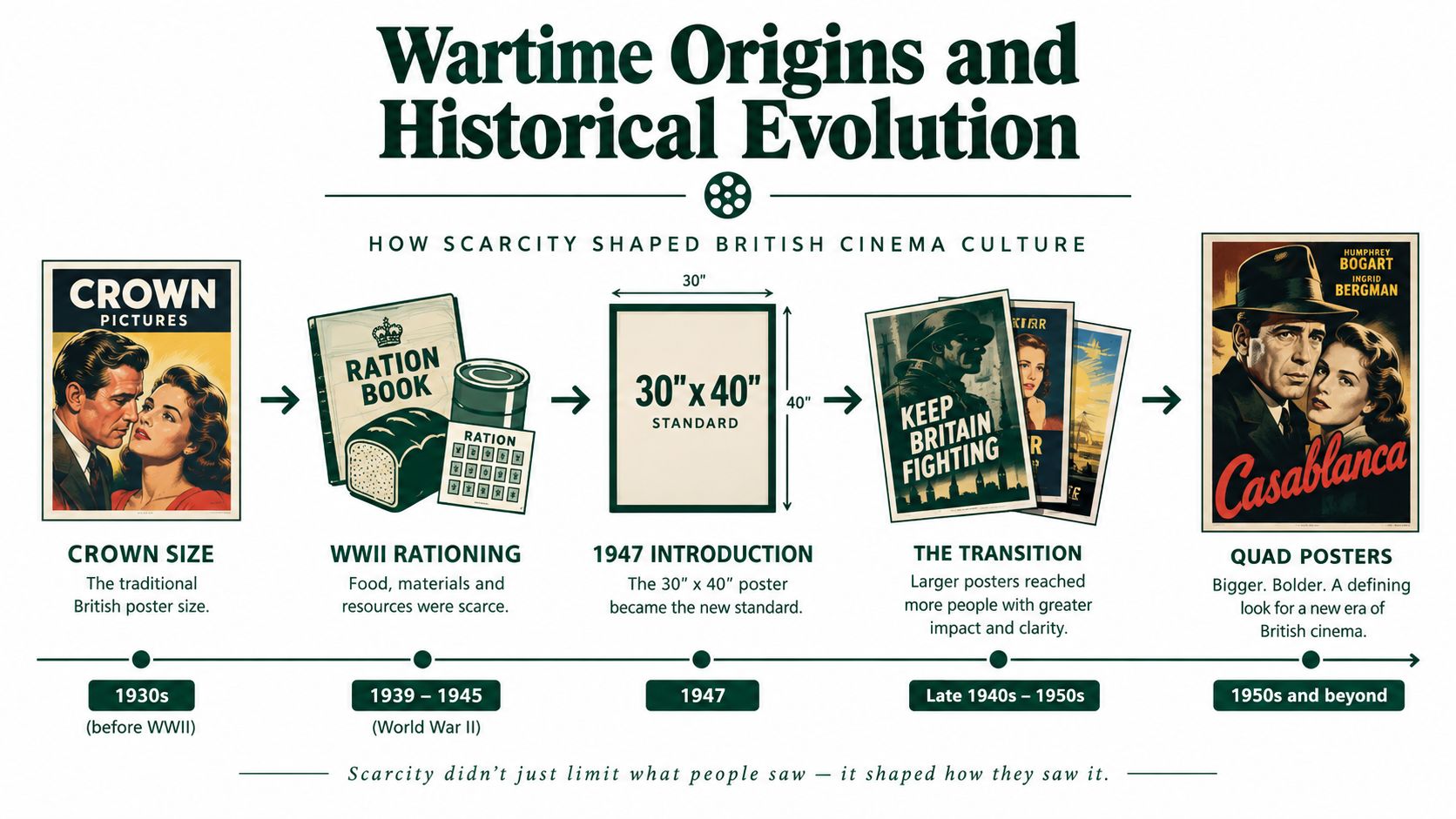
Scarcity shaped the standard
During and after the Second World War, paper rationing changed what printers and cinemas could produce. One account states that the Quad Crown became the maximum poster size permitted by the British Government during that period. That restriction gave an existing format greater authority, and practical necessity helped cement it as the standard British cinema display size for decades.
The result is a fascinating split in the surviving material. Early examples from the late 1930s and the wartime period may be portrait-oriented, or may show a visual language closer to the older Crown tradition. Post-war quads became predominantly horizontal, so orientation can offer an important clue when you're assessing an early example.
Practical rule: Never reject an unusual orientation automatically. First establish the film's release context, the format named by the seller and whether the design belongs to an early issue or a later British campaign.
Why early quads look different
The change wasn't only about paper. A horizontal sheet encouraged artists to spread action across the composition rather than build a tall arrangement around a central face. The relationship between poster and cinema screen also mattered, particularly while the 4:3 ratio was common. The quad could advertise the film with a wide visual rhythm that felt at home above a cinema entrance.
Collectors should therefore avoid judging an early quad by post-war expectations. A pre-war portrait design isn't automatically wrong, and a horizontal sheet isn't automatically a later reissue. Dimensions, orientation, printing, condition and provenance need to be considered together.
The history also affects rarity. Older paper was subject to folding, rationing and repeated handling, while later collectors often encounter post-war examples that followed more established distribution routines. Fold lines, edge wear and uneven colour may record the poster's working life rather than indicate a modern defect. British cinema poster size history explains how folded distribution and later rolled delivery created different preservation profiles.
Dimensions, Orientation and Layout Variants
The standard British quad measures 30 x 40 inches, or 76.2 x 101.6 cm, with post-war examples usually designed for horizontal display. A UK poster terminology guide identifies the quad as the standard British cinema format and connects the name with “quadruple crown”.
Those dimensions are a useful starting point, but fitting the poster into a modern home requires more than checking the wall measurement.
Horizontal is the default, not the only possibility
A horizontal quad needs a broad, uninterrupted area. The artwork may use the full width, placing figures, lettering and background action across the sheet. Rotating it or squeezing it into a portrait frame can disrupt the composition and put avoidable stress on the paper.
Pre-war examples complicate the rule, since quads were often issued in portrait format before the Second World War. A modern collector might also choose vertical display because of the room's architecture or the arrangement of other artwork. Separate the poster's original orientation from the orientation that works in your room.
Compare the wall before choosing the frame
Assess the wall, the furniture beneath it and the route into the room before ordering a frame.
| Display choice | What it does well | Main drawback |
|---|---|---|
| Horizontal display | Preserves the usual post-war presentation and gives the artwork room to breathe | Needs sufficient horizontal wall space |
| Vertical display | Can suit narrow walls or a modern gallery arrangement | May conflict with the original composition |
| Lightbox display | Creates strong visual impact in a cinema room | Requires careful heat, light and mounting control |
| Bespoke conservation frame | Adapts to the actual sheet and protects the edges | Costs more and takes longer than an off-the-shelf frame |
Measure stair turns, doorways and lifts as carefully as the final wall. A quad can fit the intended space yet fail during delivery or installation. In many UK homes, the width is the practical constraint, particularly above furniture or in rooms with limited clear wall area.
Allow space around the frame rather than treating every available centimetre as usable. A narrow opening may tempt you to trim, fold or force the poster into position, but those choices can permanently affect the sheet. Choose another wall or revise the frame design instead.
Authenticity Checks and Collecting Eras
A genuine cinema-issued quad carries evidence of production and use, but there isn't one universal test that settles every purchase. Start with the sheet itself, then compare the printing, paper, markings and history with the claimed title and era.
The most useful distinction is between normal age-related evidence and signs of a modern commercial reproduction. Fold lines, small handling marks and pinholes can make sense on an older theatrical poster. A perfectly pristine sheet deserves closer inspection, but age alone doesn't authenticate anything.
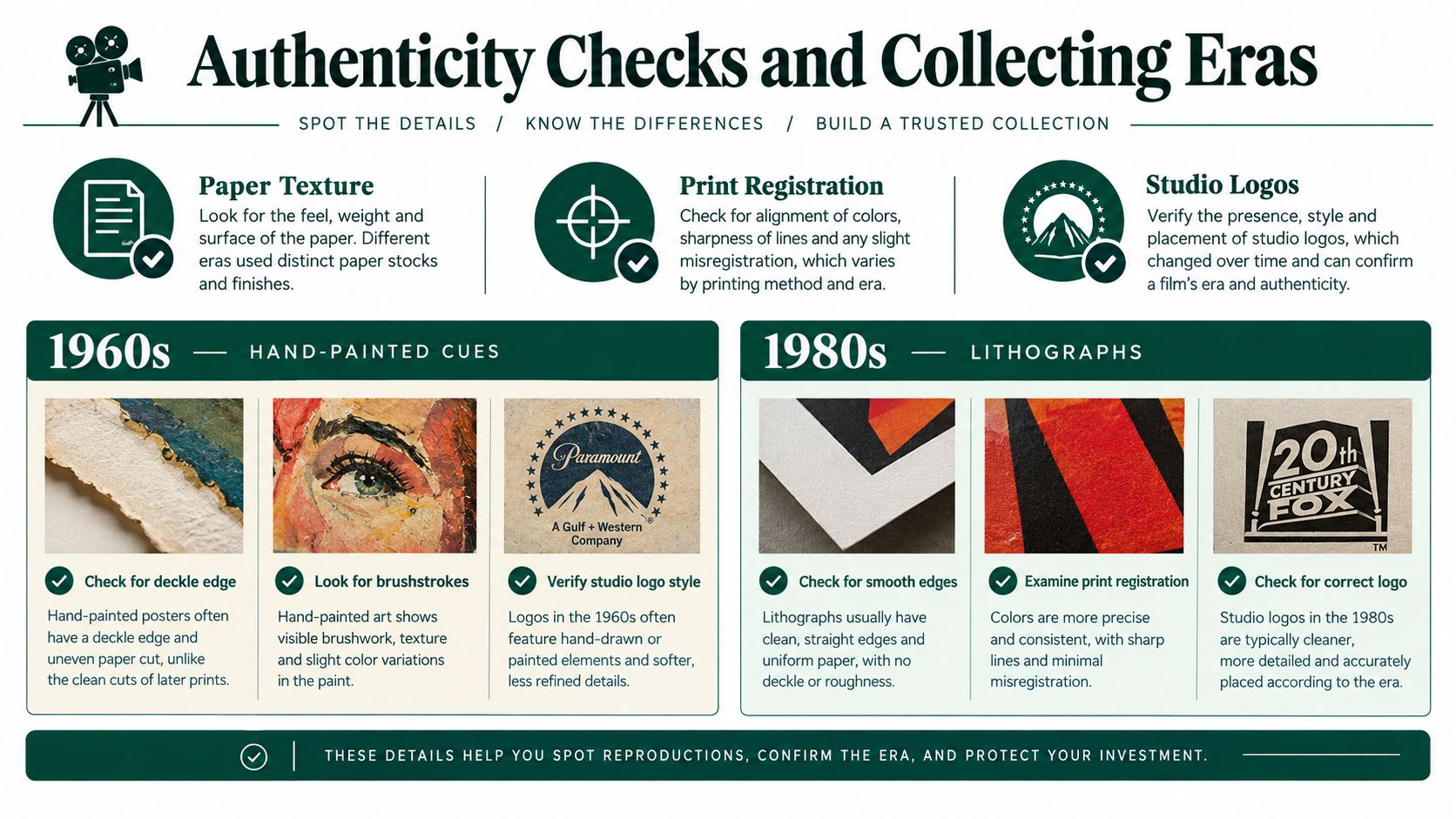
Inspect paper and print behaviour
Handle the poster under neutral light and look closely at the surface.
- Paper texture: Vintage stock often has a more natural, varied surface than bright modern photo paper. Excessive gloss or a plastic feel should prompt questions.
- Print registration: Era-appropriate lithographic printing can show subtle registration movement, while a digital reproduction may reveal pixel structure or unnaturally sharp edges under magnification.
- Colour relationship: Look for colours that sit naturally within the paper and printing process. Overly bright, perfectly uniform colour can be a warning sign, although faded originals may also have uneven tones.
- Edges and trimming: Check whether the sheet has been cut down. A smaller appearance may result from trimming rather than a legitimate alternate size.
Read the marks, not just the image
Look for printer information, studio identifiers, copyright lines, distribution markings and any relevant British Board of Film Censors information. Missing or inconsistent marks don't prove a fake by themselves, but they should lead to further questions.
The claimed era matters as well. A 1960s hand-painted design should be assessed for the visual and printing characteristics associated with that production period, while an 1980s lithograph belongs to a different manufacturing context. Don't let a familiar image override the physical evidence. The guide to original movie posters in the UK is useful when you need to compare format terminology and authenticity considerations.
Folded and rolled examples
Older quads were commonly folded for distribution, so crease memory and fold-line wear can be consistent with genuine use. Rolled examples are less prone to fold damage and are generally easier to present and archive in flat storage systems. Neither condition automatically makes a poster authentic or more valuable. The title, issue, design, provenance and overall condition still decide the collecting case.
Be especially cautious with descriptions that call a later reissue a first release. Ask for photographs of the full front, reverse, edges and printer details, then compare those details with established references before committing to a purchase.
Framing Strategies for Large Format Art
Framing a quad is a conservation decision before it's a decorating decision. The sheet is large, horizontal and often more fragile than it first appears, particularly if it has been folded, linen-backed, trimmed or repaired.
Begin by giving the framer the actual poster, not just the nominal format. A sheet described as a 30 x 40 inch quad may have small variations, softened edges or previous treatment. The frame opening should support the artwork without covering important borders or allowing the paper to shift against the glazing.
Choose support before appearance
A sound framing specification should cover:
- A conservation mount: Use materials suitable for long-term contact with paper and make sure the poster isn't permanently adhered to an unsuitable board.
- A stable backing: The backing must support the wide sheet across its full area without creating pressure points.
- Appropriate glazing: UV-filtering glazing can reduce light-related damage, while low-reflection options improve viewing in rooms with windows or strong lamps.
- A frame deep enough for the package: The framer needs room for glazing, mount, spacers and backing without squeezing the artwork.
Ordinary cardboard, cheap foamboard and unprotected wood can introduce acids or other unwanted substances. The poster shouldn't touch the glazing, because temperature changes and condensation can cause adhesion or surface damage.
Bespoke usually beats standard
Off-the-shelf frames are tempting because they're immediate, but they rarely account for a vintage quad's actual condition. A standard frame may be nominally close while applying pressure to a corner, hiding an edge or leaving too little depth for conservation materials.
Bespoke framing costs more, yet it lets the framer preserve the sheet's proportions and accommodate repairs. The visual result is also cleaner. A well-designed mount can give the artwork breathing room without making the poster look lost inside an oversized surround.
This practical guide to quad poster frames is a useful reference when you're comparing display approaches. Ask the framer whether the poster will be fully supported, whether the mount is reversible and how the frame can be opened for future inspection.
Framing instruction: Tell the framer that the poster is a collectible paper object, not a disposable print. That changes the choice of adhesives, boards, glazing and mounting method.
Keep the finished frame away from direct sunlight, radiators, damp external walls and areas where doors or furniture can strike it. A beautiful frame can't compensate for a poor position.
Archival Storage and Preservation Techniques
Many quads spend most of their lives in storage rather than on a wall. That makes the storage system part of the collection, not an afterthought. Paper responds badly to moisture, excessive light, acidic contact materials and repeated folding.
Use acid-free tissue, a suitable sleeve and a flat, supportive container. Archival guidance recommends acid-free materials and alkaline buffering rather than ordinary paper products. Buffered paper products may contain calcium carbonate at around 2% to 3%, which helps maintain an alkaline reserve. UK poster framing and archival guidance sets out the role of acid-free tissue, buffered storage, moisture protection and light control.
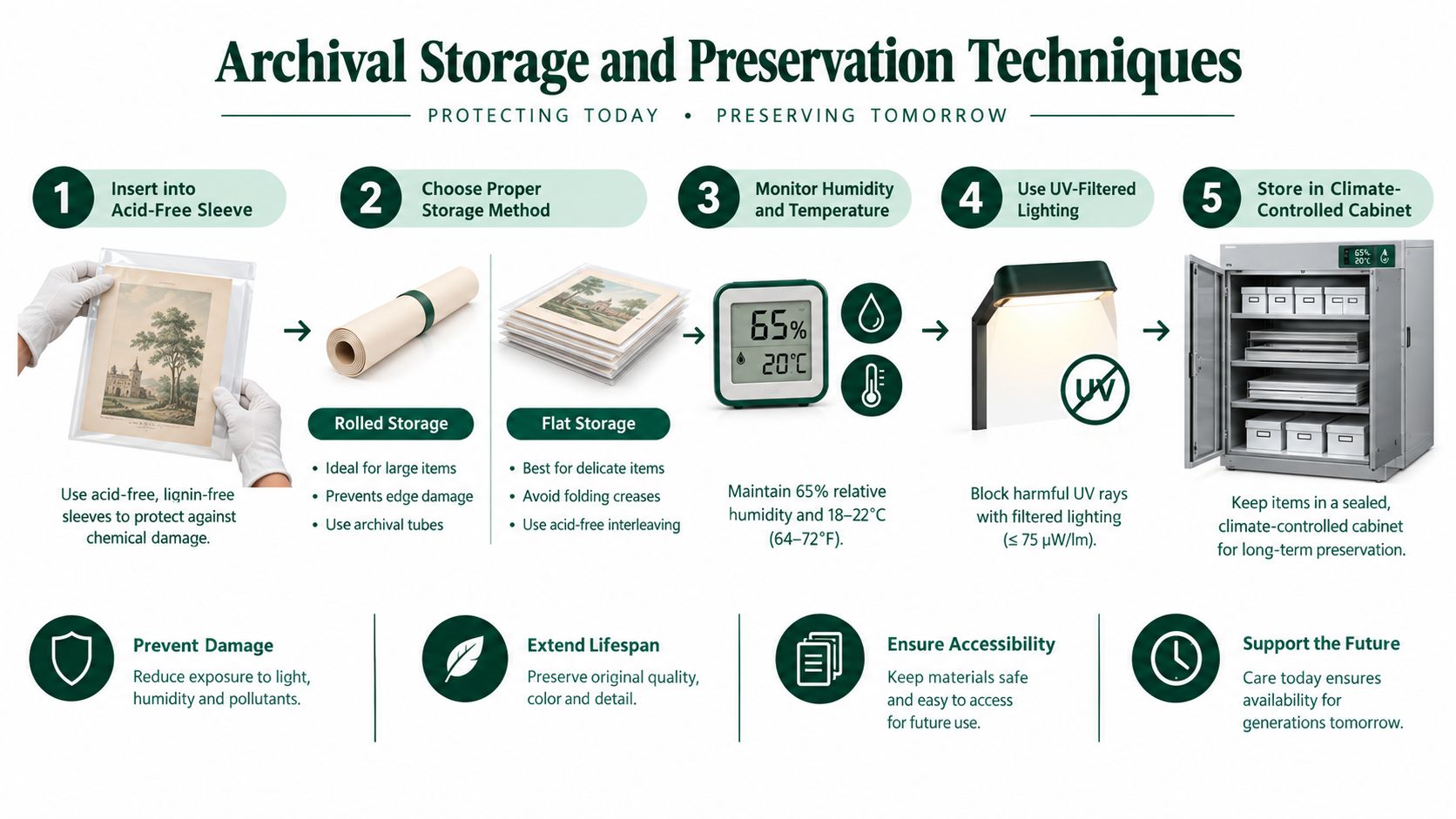
Build a safe storage routine
- Support the sheet flat: Use a rigid archival board or flat-file system that prevents sagging and corner curl.
- Separate surfaces: Place acid-free tissue between posters where ink, repairs or surface texture could transfer.
- Use an inert sleeve: Polyester can protect against handling and environmental dust, provided the poster is clean and dry before insertion.
- Monitor the room: Keep the collection away from damp, condensation and rapid environmental changes. A simple humidity monitor is more useful than guessing.
- Control light: Store posters in darkness or low light, and use UV-filtered glazing when you display them.
Don't fold a rolled poster to make it fit a box. Older folded examples should be handled along their existing creases, not repeatedly refolded. Rolling can be appropriate for transport when done by someone experienced, but long-term flat storage is generally easier for inspection and presentation.
Avoid basements, lofts with unstable conditions and cupboards against damp walls. If a poster has mould, active foxing or a strong musty smell, isolate it from the rest of the collection and seek advice from a paper conservator rather than trying household cleaning products.
Sourcing Originals Safely and Building a Collection
A quad collection is only as secure as the information attached to each purchase. Buy the poster, but also buy a clear account of what it is, where it came from, what condition it's in and how the seller will protect it during delivery.
A reputable dealer should provide more than a cropped image and a broad claim of originality. Look for full-sheet photography, condition notes, format confirmation and honest disclosure of restoration, trimming, backing or significant repairs. If the listing avoids those details, ask before paying.
Questions worth asking a seller
- Is it an original theatrical issue? Ask whether it's a cinema-issued poster or a later commercial reproduction.
- Which release does it represent? First release and re-release material can look similar while belonging to different collecting categories.
- What has happened to the paper? Request details of folds, tears, pinholes, staining, restoration and linen backing.
- How will it travel? A large paper sheet needs protective packaging matched to its format, with moisture and crush protection.
- Can you return it? A transparent return policy gives you time to inspect the poster properly.
Unverified marketplaces can offer attractive images without giving you enough physical evidence to judge the item. Popular films are particularly vulnerable to reproduction and misdescription, so confidence should come from documentation and the seller's handling standards, not from a familiar title alone.
Building a collection gradually is usually wiser than chasing every recognisable design. Choose a theme such as a director, genre, decade, artist or British cinema period, then keep records of the poster's format, release information, condition and conservation work. Those notes protect your own understanding and make future insurance, resale or inheritance decisions much easier.
Famous Movie Posters offers guaranteed original US one-sheets, UK quads and other cinema formats, alongside framing options, archival handling, worldwide fulfilment and a Request a Poster service for titles sourced through established partners. Visit the catalogue when you're ready to compare authentic quad designs, check available condition information and plan a safe next purchase.