



You've found a listing titled “original 1977 Star Wars poster”. The artwork looks right, the price seems plausible, and the seller has supplied just enough detail to sound reassuring. Then you notice the description doesn't say whether it's a UK quad or a US one sheet, whether it's single-sided or double-sided, or whether the poster has been restored. That missing information is where the buying decision begins.
For UK collectors, “original 1977 Star Wars poster” isn't a single, neatly defined object. The British release used more than one campaign design, and the poster's format, printing state, condition and documentation can matter as much as the film title itself. The practical question isn't just whether the paper is old. It's which British poster you're looking at, how it survived and whether the seller can prove its history.
Table of Contents
- Why Original 1977 Star Wars Posters Are Not One Simple Thing
- Understanding US One Sheets and UK Quad Formats
- How to Identify Genuine 1977 UK Star Wars Quad Variants
- Assessing Condition, Provenance, and Preservation Reality
- What Original 1977 Star Wars Posters Actually Sell For
- Sourcing, Handling, and Storing Original Posters Safely
Why Original 1977 Star Wars Posters Are Not One Simple Thing
The British cinema release opened on 28 November 1977, but the marketing artwork changed during that first exhibition period. The earliest UK campaign used the Hildebrandt brothers' Style B design. After about two months, British cinemas received Tom Chantrell's Style C artwork instead, as documented in this account of the Chantrell poster history.
That creates the first identification problem. A listing may say “1977 original” while leaving out the fact that the paper belongs to one of two principal British campaigns. Both can be historically important, but they don't represent exactly the same moment in the film's UK release. One records the opening campaign. The other reflects the later British marketing shift and was created specifically for the UK market.
The three questions every UK buyer should ask
Before considering price, identify three separate things:
- Which artwork is it? Is the design the Hildebrandt brothers' Style B or Tom Chantrell's Style C?
- Which printing state is it? Does the Chantrell poster predate the Oscar credit update, or is it the later Awards Version?
- Which physical object is it? Is it a genuine UK quad, a US one sheet, an overseas variant, a reproduction or a restored original?
The Chantrell design became the better-known British quad partly because it was made for the UK market and later reissued after the film's awards success. That's why specialist listings often describe examples as pre-awards, pre-Oscars or Awards Version. Those labels aren't decorative sales language. They describe different points in the poster's release history.
Practical rule: Never accept “original 1977” as a complete description. Ask for the country, format, artist, printing state and condition treatment.
The British release also sits within a wider piece of distribution history. Reporting on the original UK exhibition describes a rare dye-transfer IB Technicolor print preserved by the BFI, with only a “precious handful” produced for that first British release, as discussed in this UK-focused account of the preserved print. That doesn't prove a particular poster is genuine, but it reinforces the point that first-release UK materials belong to a specific and limited historical context.
A collector who identifies only the title is therefore doing half the job. The useful description might be “1977 UK Quad, Hildebrandt Style B, folded as issued” or “Tom Chantrell Style C, pre-awards printing, linen-backed”. Those details tell you what you're actually buying.
Understanding US One Sheets and UK Quad Formats
Start with the paper format before studying the artwork. The British UK quad is a horizontal poster measuring 30 by 40 inches, or about 76.2 by 101.6 centimetres, while the American one sheet uses a vertical layout. The UK dimensions are documented by this original UK Quad listing, and the conversion is also reflected in this Sotheby's measurement.
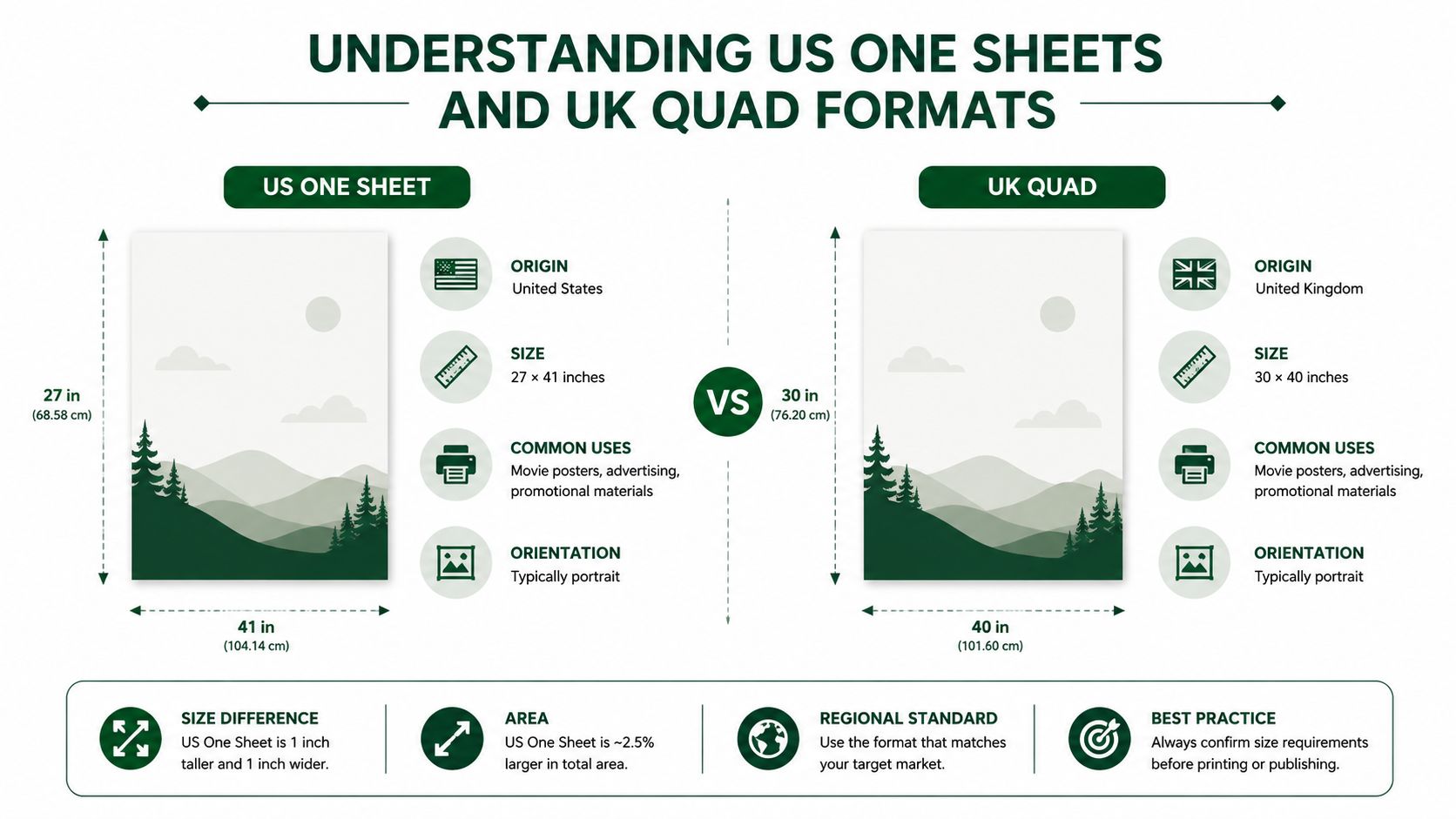
That difference changes everything from wall planning to storage. A horizontal quad needs a wide frame and suitable flat storage. A vertical one sheet needs a different frame profile and shouldn't be assumed to share the same paper dimensions just because both posters advertise the same film.
Identify the format first
| Format | Layout | Typical Dimensions | Key Identification Notes |
|---|---|---|---|
| US One Sheet | Vertical | US portrait format | American campaign format, not a British quad |
| UK Quad | Horizontal | 30 x 40 inches, about 76.2 x 101.6 cm | British cinema format, commonly issued folded |
UK quads commonly survive as single-sided or double-sided printings, and they were originally folded as issued. Fold lines alone don't make a poster suspicious. In fact, original folds can support a believable cinema-distribution history, provided the paper, printing and overall condition make sense.
For a practical format primer, compare the distinctions in this guide to one sheet and quad movie poster formats. The important point is simple: don't compare a UK quad directly with a US one sheet as though they were interchangeable editions.
The Chantrell Style C poster is often described in UK collectible markets as a first-release or pre-awards variant. That description is useful only after you've established that the item is a British quad. A modern reproduction can copy the horizontal artwork and approximate the size without sharing the historical paper, printing characteristics or issue history.
What to check on the physical sheet
Look at the edges before the centre image. Trimming can reduce the original dimensions, remove printer marks or alter the relationship between the artwork and the border. Measure the poster rather than relying entirely on the catalogue description, but treat a small difference as a prompt for investigation, not automatic proof of fraud.
Also ask whether the poster is still folded, has been flattened, or has been mounted. A flat appearance may come from careful conservation, but it may also conceal restoration, trimming or backing. The format tells you what the object claims to be. The paper and its treatment tell you whether that claim deserves confidence.
How to Identify Genuine 1977 UK Star Wars Quad Variants
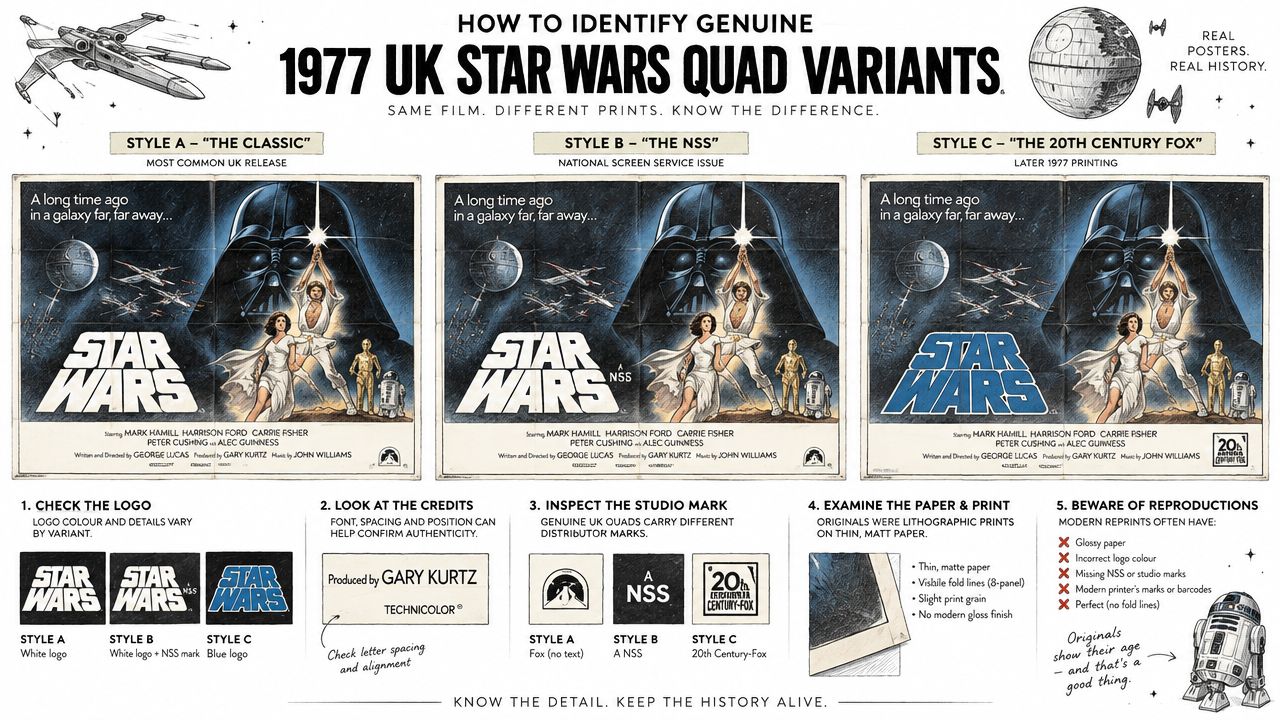
Authentication begins with the artwork, but it shouldn't end there. For the British market, the first visual comparison is between the Hildebrandt brothers' Style B and Tom Chantrell's Style C. The Hildebrandt design belongs to the opening UK campaign, while Chantrell's artwork followed shortly afterwards during the same British release period.
The distinction matters because a seller who calls every design “the original poster” is flattening a meaningful part of the film's marketing history. UK-sourced listings identify these as two separate 1977 campaigns, and this UK market reference for Star Wars quads also treats the Chantrell version as a pre-awards or first-release variant.
Read the credit block carefully
The Chantrell artwork was later reprinted with updated Oscar wording after Star Wars won 7 Academy Awards and received 10 nominations, as recorded in the UK poster history supplied by Prop Store. UK-focused sources refer to that later issue as the Awards Version.
That gives you a practical checkpoint. A Chantrell quad without the updated awards credits may be a pre-awards printing. One carrying the revised wording belongs to the later British reissue. Neither label should be treated casually, because the printing state places the poster at a different point in the film's commercial and awards history.
Examine the following details together rather than relying on one visual clue:
- Artwork attribution: Confirm whether the design corresponds to Hildebrandt Style B or Chantrell Style C.
- Credit wording: Check whether the Oscar information appears and whether its placement looks integrated into the original design.
- Typography: Look for unusual spacing, softened lettering or inconsistent reproduction in the title and credit areas.
- Colour balance: Excessively saturated colour can suggest a reproduction, although fading and restoration can also change the appearance of an original.
- Paper surface: Compare the texture and handling marks across the sheet. A suspiciously uniform, modern-looking surface deserves questions.
Don't confuse restoration with reproduction
An original poster can be cleaned, backed or retouched and still remain an original poster. The problem is that restoration changes the evidence available to you. Linen backing may stabilise fragile paper and improve display, but it can also make folds, tears and repairs harder to inspect without a detailed condition report.
The opposite error is assuming that an unrestored sheet is automatically superior. An original, folded-as-issued quad with honest wear may have a clearer history than a heavily treated example that looks immaculate under glass. Ask for high-resolution front and back photographs, including corners, folds, borders and the credit block.
The two British designs give the 1977 UK quad its strongest historical fingerprint. The Awards Version adds another layer. A reliable listing should state which one you're seeing, rather than hiding behind the broad phrase “vintage Star Wars poster”.
Assessing Condition, Provenance, and Preservation Reality
A rare design can still be a poor purchase if the paper has been badly handled or the ownership history is vague. In UK poster collecting, condition and documentation often determine whether rarity translates into value. A striking image won't compensate for undisclosed trimming, extensive retouching or a backing treatment that wasn't mentioned before sale.
Start with the condition report, then verify it against photographs. Professional UK auction guidance asks sellers for front-and-back photographs and history, making provenance part of the normal authentication workflow rather than an optional extra, as shown by this film poster auction guidance.
Separate issue condition from conservation history
“Folded as issued” describes how the poster was supplied to cinemas. It doesn't mean the sheet is undamaged. Inspect the fold intersections for small splits, pinholes, paper loss and colour wear. A folded poster may be entirely original, while a flat poster may have been linen-backed, cleaned or extensively restored.
Ask the seller to specify:
- Whether the poster is unrestored, restored or conservation-mounted.
- Whether it has been linen-backed or mounted to another support.
- Whether the edges have been trimmed.
- Whether tears, stains, pinholes or writing have been repaired.
- Whether the glazing or frame is archival.
A certificate of authenticity can help, but it isn't a substitute for photographs and a credible chain of ownership. The certificate should support the physical evidence, not carry the entire argument.
Provenance is most useful when it explains the object's journey, not when it merely repeats the word “authentic”.
Storage history matters because paper responds to its environment over time. A poster kept in unsuitable conditions may develop curl, brittleness, fading or surface damage that can't be reversed economically. A well-preserved example with a traceable conservation history may therefore be more buyable than a rarer variant whose treatment is unclear.
The contrarian point is easy to miss. Collectors often chase the rarest artwork first, then compromise on survivability and paperwork. For a 1977 UK quad, the stronger long-term purchase is frequently the poster whose variant, condition and conservation history can be demonstrated clearly.
What Original 1977 Star Wars Posters Actually Sell For
Price makes sense only after identification. The phrase “original 1977 Star Wars poster” can describe a Hildebrandt UK Quad, a Chantrell pre-awards printing, an Awards Version, a Spanish Style C poster or a different national format altogether. Those objects shouldn't share one price expectation.
The available UK market indicators show the scale of the variation. A 1977 Spanish Style C poster with Tom Chantrell artwork realised £200, while a UK-available Chantrell Style C example was listed at £7,110, and a rare Hildebrandt UK Quad reached £9,245, as set out in these UK market examples.
| Variant | Format | Typical Market Indicator |
|---|---|---|
| Spanish Style C, Tom Chantrell artwork | Spanish poster | Realised £200 |
| Chantrell Style C example | UK-available listing | Listed at £7,110 |
| Hildebrandt UK Quad | UK Quad | Reached £9,245 |
These figures aren't interchangeable valuations. The Spanish result demonstrates why the word “Chantrell” alone isn't enough. Country, format and campaign context remain essential. The Hildebrandt result shows how a less frequently discussed British design can command substantial attention when rarity, condition and documentation align.
Use measurements as evidence, not a guarantee
The standard UK Quad format is 30 x 40 inches, but one independent listing records a measured size of 30 x 39 14/16 inches, as shown in this measured UK poster listing. A slight difference can result from trimming, manufacturing tolerance or decades of handling. It should prompt a closer inspection of the edges and fold structure, not an instant verdict.
A buyer should compare the seller's description with the photographs and ask direct questions:
- Is this a British quad or another national format?
- Which artist and campaign design are represented?
- Is the Chantrell sheet pre-awards or the Awards Version?
- Is it folded as issued, rolled, flattened or backed?
- Does the price reflect the actual condition and documentation?
For broader context on how collectors assess vintage poster prices, consult this guide to original movie poster prices. The useful lesson is not that one figure represents “the value”. It's that two posters carrying the same headline description can occupy entirely different parts of the market.
A premium is easier to justify when the seller documents the variant, supplies clear front-and-back images, explains restoration and provides credible provenance. A vague listing with a dramatic frame and no condition detail is not a bargain just because its asking price is lower.
Sourcing, Handling, and Storing Original Posters Safely
Buy from a dealer or auction house that gives you enough evidence to make a decision before payment. A serious listing should identify the country and format, state whether the sheet is single-sided or double-sided, describe the fold lines and disclose restoration. If those details are absent, ask for them in writing.
A useful UK buying checklist looks like this:
- Request photographs: Insist on clear front, back, edges, corners and fold intersections.
- Check the format: Confirm that the poster is a horizontal UK Quad rather than a US one sheet or overseas issue.
- Ask about treatment: Find out whether it has been cleaned, linen-backed, mounted, trimmed or retouched.
- Verify the history: Request any ownership, auction or dealer records that support the provenance.
- Confirm the return terms: Make sure the written description and images form part of the purchase record.
Don't frame the poster immediately after delivery. Inspect it in good light, compare it with the condition report and retain all packaging until you're satisfied. A poor mount, unsuitable board or non-archival glazing can damage an original that arrived in sound condition.
For storage, use archival flat-file boxes with a calcium carbonate buffer and acid-free polyester pockets for especially valuable sheets. Purpose-designed tubes with acid-free tissue and kraft paper are safer for transport than improvised packaging, because the materials reduce abrasion and help prevent the poster from shifting inside the tube. More practical guidance appears in this resource on storing movie posters safely.
Keep temperature and humidity stable, and avoid prolonged direct sunlight. UV exposure fades inks and weakens paper, while repeated rolling and unrolling places unnecessary stress on folds and edges. Famous Movie Posters offers verified original film posters, including UK Quads, condition and format guidance, archival storage practices, framing options and a poster-sourcing service. If you're looking for a documented 1977 UK Star Wars quad, visit Famous Movie Posters and ask for the variant, condition history and provenance before committing to a purchase.