



You're standing at a UK poster fair with a rolled British Quad in your hand, and the seller says it's an original from the first release. The colours look right, the paper feels old, and the price is just high enough to hurt if you're wrong. That moment of doubt is exactly where careful buying starts.
Table of Contents
- The Vintage Poster Question Every UK Buyer Asks
- What Vintage Actually Means in the UK Poster Trade
- UK Poster Formats and Decades at a Glance
- Authenticity Checks That Actually Work in the UK
- Reading UK Condition Grades Honestly
- Preservation and Framing for British Homes
- Buying Safely from UK Sellers and Shipping with Care
The Vintage Poster Question Every UK Buyer Asks
The question isn't really whether you like the poster. It's whether the thing in front of you is a cinema-issued original, printed to advertise a film at the time, or a later copy made to decorate a wall. Those two objects can look surprisingly similar in a photograph and feel very different once you unroll them, measure them, and look at the edges under good light.
I've seen buyers fall for the same traps for years. A poster looks aged, so they assume it's valuable. A listing says vintage, so they assume it means original. A frame makes a reprint look important. None of those shortcuts work, and honest sellers know it.
A useful starting rule: Age, appearance, and value are three separate questions. Answer them separately before you pay.
What helps is a decision framework you can run in order. First, identify the format. Second, check whether the printing, paper, and marks fit that format and period. Third, read the condition description as a dealer would, not as a hopeful buyer. Fourth, think about where the poster will live in a British home, because damp walls and sunlight don't care what you paid. Finally, judge the seller and the postage as carefully as the artwork.
Why the British Quad Is Your Reference Point
Most online advice is written around the American One Sheet. That's a poor starting point if you're buying a vintage poster in the UK for a UK release. British cinemas used a different shape, different paper traditions, and different distributor practices. If you judge a Quad by One Sheet rules, you'll misread its size, its folds, and even what's normal wear.
This guide keeps the Quad at the centre. Once you understand that format, the rest of the market makes more sense. You'll know which questions expose a vague listing, which flaws are ordinary for a working cinema poster, and when a seller's silence about provenance should make you walk away.
You don't need specialist equipment to do this well. You need a tape measure, good photographs, a calm head, and the willingness to ask awkward questions before money changes hands.
What Vintage Actually Means in the UK Poster Trade
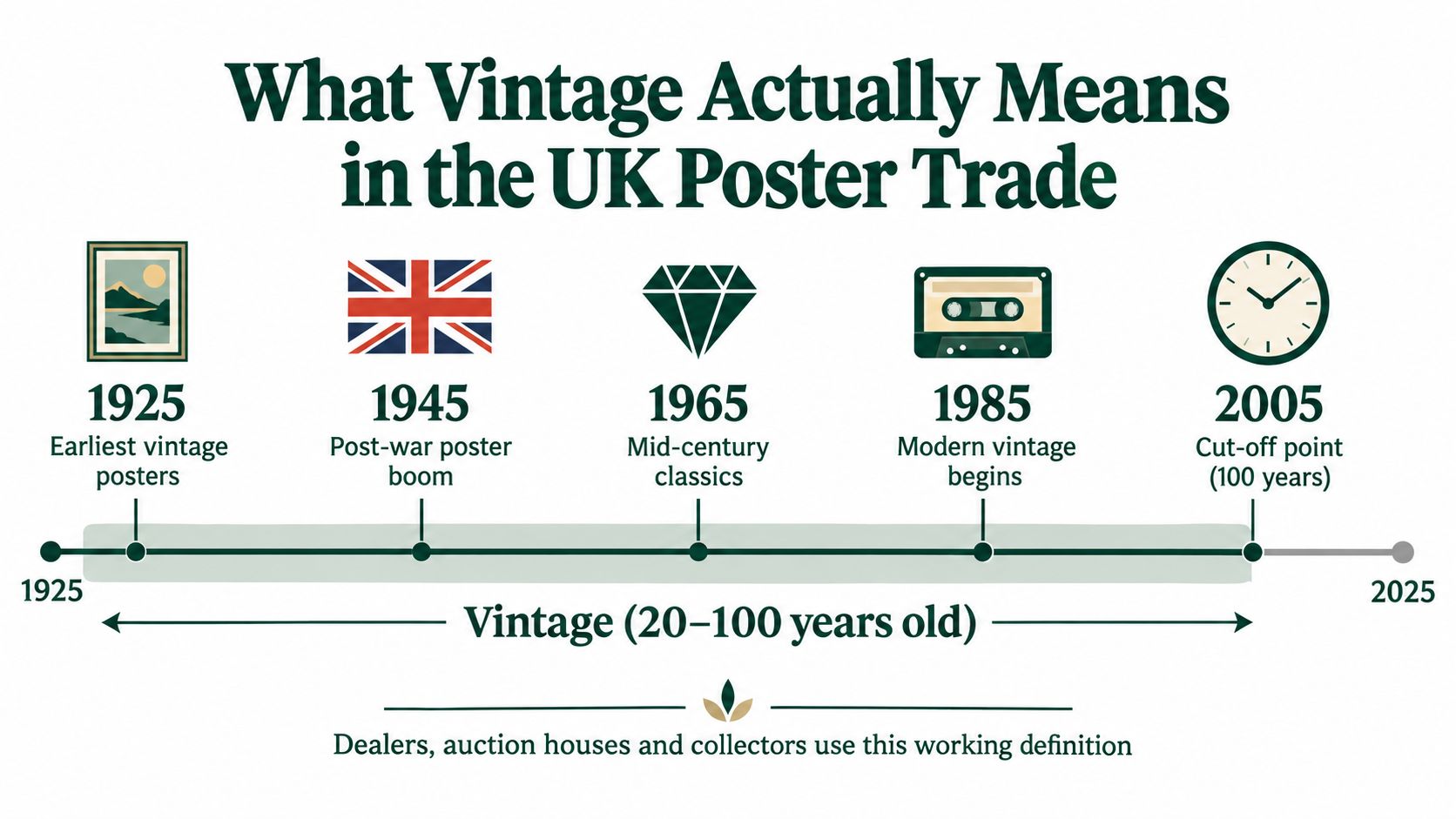
Dealers use vintage as a working label, not a legal guarantee. In plain English, it usually means a poster that's roughly 20 to 100 years old and was printed at or near the time it was meant to be used. Age alone isn't enough. A poster printed last year in an old fashioned style is retro, not vintage, however convincing the artwork looks.
Three ideas have to line up. The item should be old enough to belong to another period, original to that period rather than made later, and scarce in a way that reflects limited cinema or commercial distribution. Remove one leg and the word vintage starts doing dishonest work.
Words That Aren't Interchangeable
- Antique: Generally older than the vintage bracket. Use it with care, and expect paper to behave very differently.
- Retro: New material designed to look old. It's a style description, not a date.
- Reproduction or reprint: A later copy of an earlier image. It can be decorative and perfectly legitimate if it's described accurately.
- Original: Printed for its first intended use, such as a cinema release or a railway campaign, not produced later for the retail gift market.
That last distinction matters most. Two posters can share the same image and belong to entirely different collecting categories.
Britain's Longer Poster Tradition
Cinema didn't invent the British poster. The National Archives' collection of Victorian and Edwardian travel posters records promotional railway posters from at least 1897 to 1914, including Great Western Railway advertising for excursions from London to Wales, a Brighton Railway poster from 1903, a Midland Railway poster from 1907, and a Great Northern Railway poster for Mablethorpe from 1909.
Those railway companies sold places as much as journeys. Their illustrated posters taught people to imagine the coast, the countryside, and a day away by train. Film posters inherited that job later, selling a story and an evening out from a cinema wall.
The scale of what survived is substantial. The National Railway Museum's poster collection contains 10,700 posters and other railway artworks dating from 1804 to the present. That's a useful reminder for film buyers. A vintage poster in the UK sits inside a much longer national habit of printed persuasion, and that history rewards buyers who check dates, issuers, and purpose rather than trusting a nostalgic look.
UK Poster Formats and Decades at a Glance
Start every purchase with a tape measure. Format tells you what the poster was made for, where it was likely issued, and what frame you'll need. If the measurements don't match the claimed format, stop there and ask why before you discuss anything else.
The British Quad is the format you'll meet most often in the domestic market. The Science Museum Group's film poster records include a 1960 British Quad at 30 by 40 inches, and that size, roughly 76 by 102 centimetres, is the Quad standard. It's normally designed to sit wide rather than tall, and its proportions broadly reflect the traditional 4:3 cinema screen.
The name gives the game away. Quad comes from Quadruple Crown. A Crown sheet measured 15 by 20 inches, so a Quad was four times that paper size. Once you know that, the dimensions stop feeling arbitrary. They're a printer's logic, not a modern framing company's invention.
Common UK and US Film Poster Formats
| Format | Dimensions (inches) | Orientation | Region |
|---|---|---|---|
| British Quad | 30 by 40 | Landscape | UK |
| Crown sheet | 15 by 20 | Portrait basis for the Quad calculation | UK paper tradition |
| US One Sheet | Check the exact era and issue before buying | Portrait | US |
| UK One Sheet | Check the exact issue against seller measurements | Portrait | UK |
Use the table as a starting map, not a substitute for measuring the actual sheet. Trimming happens. Sellers sometimes measure the image rather than the paper, and that small difference can hide a cut margin or a reproduction.
If the contrast between the two main formats still feels fuzzy, read a focused comparison of how a One Sheet differs from a Quad in size and use before you order a frame. A wide Quad in a portrait frame isn't a near miss. It's the wrong object in the wrong box.
Why Early Quads Are Scarcer
Don't assume older automatically means the poster was once plentiful and became fashionable. The Tuli Research Centre's account of British Quad posters explains that many posters from before the Second World War didn't survive because paper was in short supply and used material was recycled. It also notes that the British government set the Quad as the maximum permitted poster printing size at the time.
That changes how you read scarcity. Limited paper reduced what could be printed, and recycling removed much of what had been used. A surviving early Quad is rare partly because the system that produced it was under strain. When a seller offers pre-war material casually, with no explanation of condition or history, that mismatch should sharpen your questions rather than soften them.
Ask for edge to edge measurements of the paper itself, in inches and centimetres. A confident seller won't treat that as an insult.
Authenticity Checks That Actually Work in the UK
There's no single magic test for originality. Anyone who sells you one is oversimplifying, and that includes the old advice to trust the smell of the paper or the warmth of the colours. What works is a hierarchy of evidence, where each check either supports the story or weakens it.
The visual checklist below sets out the order I'd use at a fair or from photographs at home.
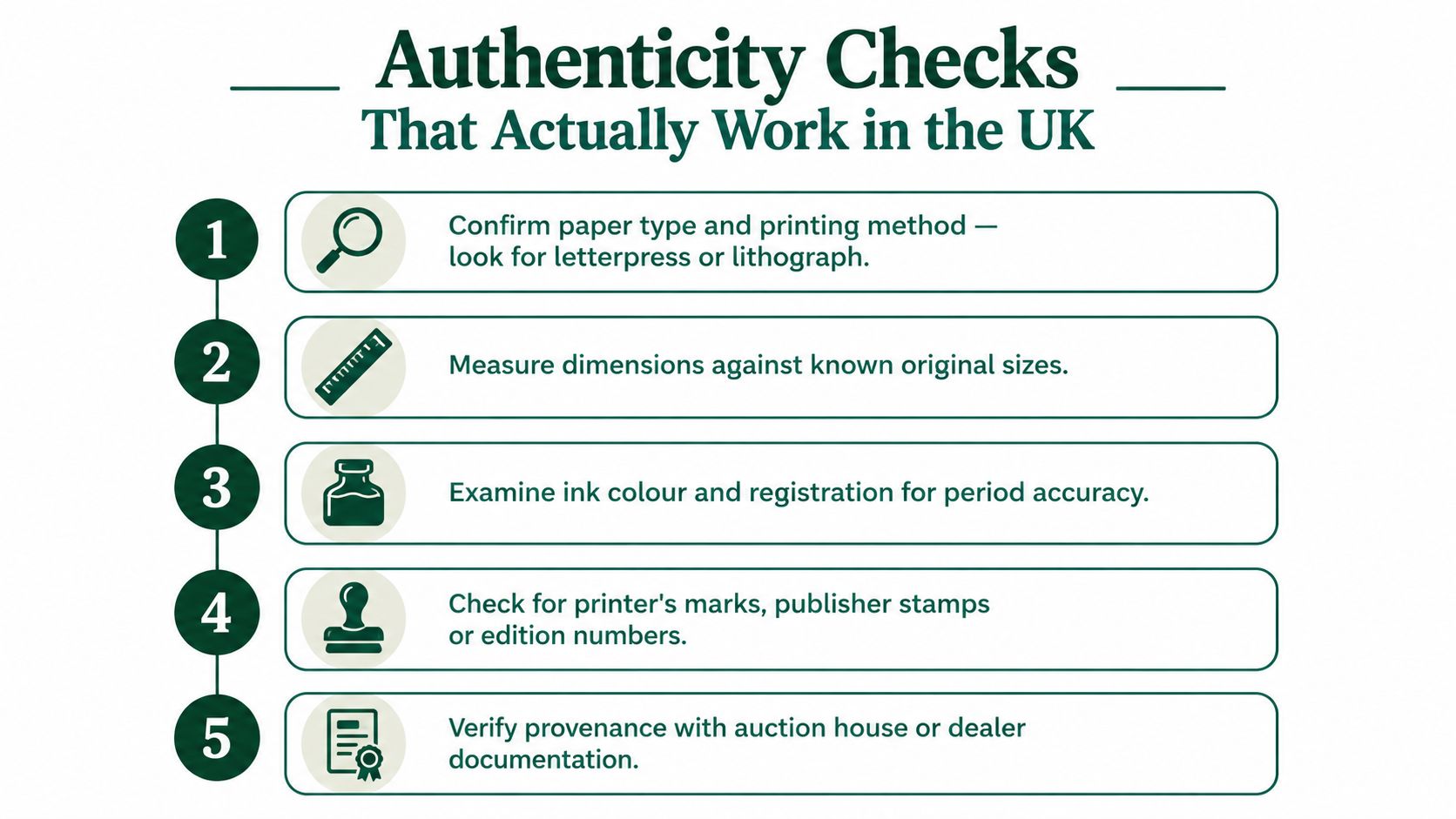
Run the Five Checks in Order
1. Confirm format and dimensions. A British Quad should match the size and shape discussed earlier. If it's noticeably smaller, it may be trimmed, a different format, or a retail copy. Size alone doesn't prove originality, but the wrong size is a strong warning.
2. Inspect printing and paper together. Period lithographic printing tends to show layered colour and small irregularities under close inspection. Modern digital output can look very clean and even. Pair that with paper weight and surface. Very bright, slick, heavy stock on a supposedly old cinema poster needs an explanation. Paper can be backed or restored, so treat feel as evidence, not proof.
3. Look for issue marks. Check margins and the reverse for distributor information, printer details, certification marks, cinema codes, or stamps that fit a UK release. Reproductions often crop these out or reproduce them too neatly. That said, a mark can be copied, so it strengthens a case rather than settling it.
4. Test the provenance. Ask where the poster came from and what supports that account. Gildings' memorabilia valuation guidance confirms that authenticity, condition, format, and provenance materially affect value, and that studio letters, documentation, and photographic evidence can strengthen provenance. Gaps aren't automatically fatal, because old cinema paper often passed through hands without paperwork. Vague, shifting answers are a different matter.
5. Get restoration disclosed. Restoration isn't forgery. A repaired tear, touched in fold, or linen backing can be honest conservation. Trimming, bleaching, and heavy repainting change what you're buying and should be stated plainly. Trouble starts when work is hidden to make a poster look untouched.
The same habit of checking claims against evidence applies well beyond posters, and it's worth learning to spot misinformation with this checklist when a listing leans on confident language instead of documents. In poster buying, you'd rather have boring paperwork than exciting adjectives.
To see how these surface details present on real paper, watch the short demonstration below and notice how much depends on close looking rather than a quick glance.
Before you pay, ask three direct questions. Is this a cinema issued original or a later commercial print? Has it been trimmed, backed, bleached, or restored? Can you show close photographs of all corners, the margins, and the reverse? A seller who can't answer may still be honest, but you're no longer buying with confidence.
It's also worth understanding what information a poster itself should carry, because missing credits, odd typography, or modern wording on an allegedly period piece can be the first crack in the story. Remember the contrarian point. An apparently aged poster isn't automatically valuable. Reprints can be distressed, folded, and toned to look old while lacking the scarcity of cinema distribution material.
Reading UK Condition Grades Honestly
Condition grades aren't regulated like weights and measures. One dealer's fine is another dealer's very good, and photographs lit kindly can hide a great deal. Read a grade as the start of a conversation, not as a verdict you can take to the bank.
Think in terms of a spectrum. At the top end, mint should mean a poster that appears unused, with clean margins, strong colour, and no meaningful handling wear. For a decades old British Quad that was printed to be pasted, pinned, or displayed in a busy cinema, true mint is unusual. If every old poster in a shop is described as mint, the word has stopped meaning anything.
What the Common Grades Look Like in Practice
- Very fine: Light handling only, perhaps a soft fold line or a tiny edge bump that doesn't intrude on the image.
- Fine: Clearly handled but presentable, with minor edge wear, a small pin hole, or gentle fold wear you'd notice on inspection.
- Very good: A working poster with a visible life behind it, such as a repaired tear, some margin toning, or fading along one edge.
- Good: Displayable, but you should expect obvious wear, losses, tape marks, staining, or restoration that affects how it reads from a distance.
Those descriptions need examples to be useful. A Quad with one pin hole in a white margin is a different purchase from a Quad with pin holes through an actor's face. A repaired tear in a dark area may disappear under glass, while the same tear across lettering will draw your eye every day. Location matters as much as size.
Folds deserve special attention because UK buyers often misunderstand them. A folded poster isn't necessarily damaged. Many cinema posters were folded for transport and storage, so fold lines can be part of an original's normal history. What you need to know is whether the folds are soft or worn white, whether they cross important artwork, and whether anyone has painted over them.
Restoration, Damage, and Price
Don't confuse a restored original with a fake. A fake misrepresents what the object is. Restoration changes the condition of a genuine object, and its effect on value depends on quality, extent, and honesty. Skilled, disclosed work that stabilises paper can help a poster survive. Heavy overpainting that makes a tired poster look freshly printed should lower your confidence and usually your offer.
Minor flaws are normal on mid century material. They matter disproportionately when the title is valuable and better examples exist. For a modest poster bought to enjoy on a wall, honest wear may be a sensible trade for a lower price. For a major purchase, small differences in colour, margins, and untouched folds carry real weight.
Before you commit, request close up photographs of corners, edges, fold intersections, and any area the description calls minor. Ask for a photograph under angled light if restoration is mentioned. If the price looks unusually good and the seller only offers a distant, glossy image, assume the missing detail is the reason.
Preservation and Framing for British Homes
Most damage I see doesn't happen in a dealer's flat file. It happens slowly in ordinary houses, on damp walls, above radiators, and in sunny rooms where nobody thinks of paper as a fragile material. A good frame helps, but it can't rescue a bad location.
The five habits in this visual guide cover the basics most homes can manage without specialist equipment.
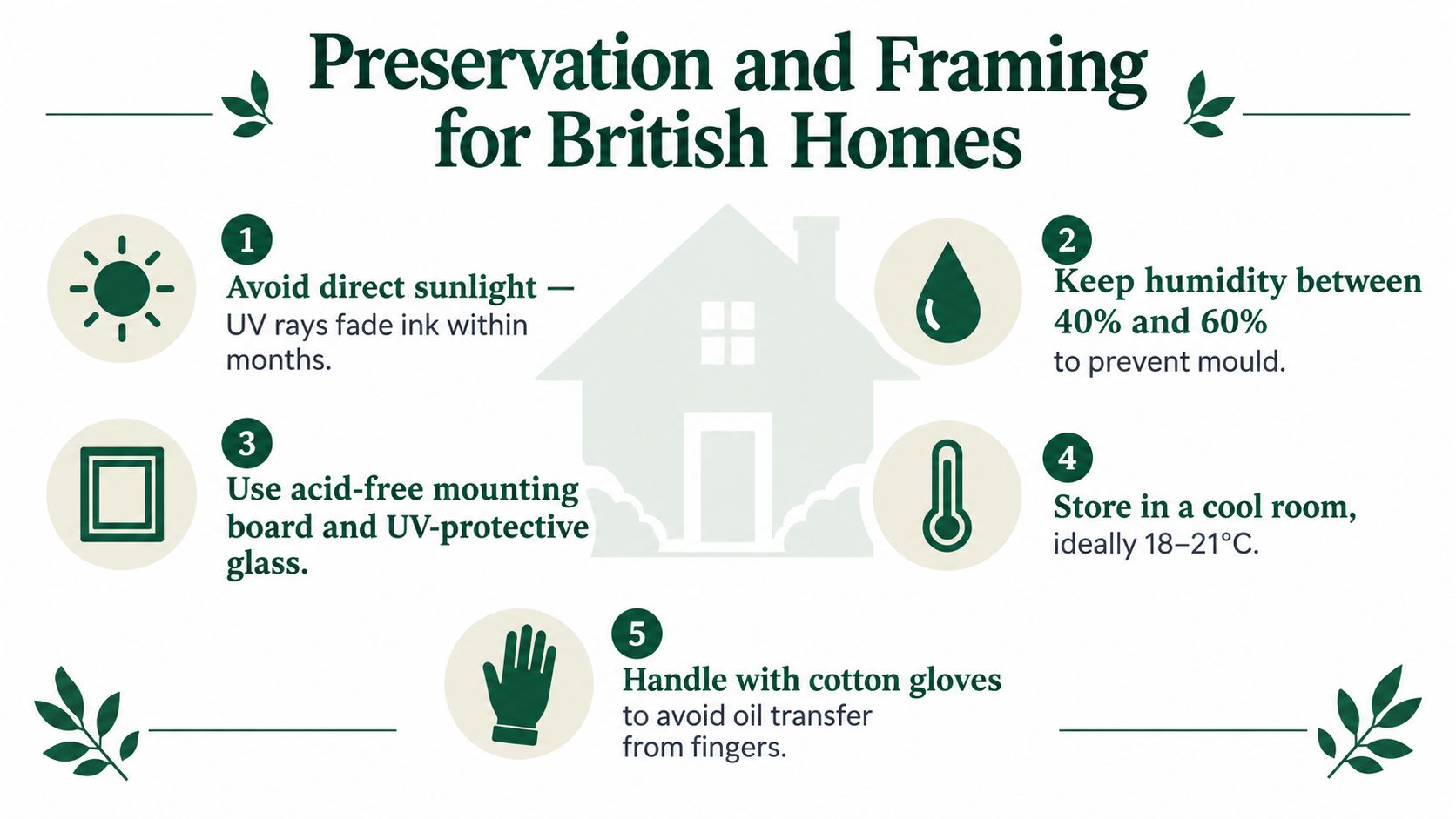
Stability Beats Perfection
The National Archives' environmental guidance for paper recommends approximately 13 to 20°C and 35 to 60% relative humidity for vintage paper stored in the UK. It stresses that stability over time matters more than repeatedly correcting short term fluctuations. The same guidance warns that relative humidity above 65% creates conditions where mould can germinate and spread, while prolonged levels below 40% can make paper dry and brittle.
That last point surprises people who assume drier is always safer. Paper expands and contracts as humidity shifts. Repeated movement stresses folds, repairs, and brittle edges. A steady room within a reasonable range is kinder than a room you keep drying out aggressively every time the weather turns.
Buy a calibrated thermo hygrometer and put it near the poster, not across the house. Check it across seasons. British homes can be damp in winter, warm in summer, and very different from one room to the next.
Choose the Room Before the Frame
- Living room interior wall: Often the safest display choice, provided it avoids direct sun and radiator heat.
- Hallway: Workable if it's dry and not blasted by cold air each time the front door opens.
- Bedroom: Usually calmer and darker, which suits valuable pieces you rotate.
- Bathroom and kitchen: Poor choices because steam and cooking create sharp humidity swings.
- Loft and basement: Risky for storage because damp, pests, and temperature changes are harder to control.
- External wall: Inspect for cold spots and condensation before you hang anything valuable.
Display is a higher risk use than dark storage. National Archives guidance on risks to paper records identifies light exposure, pests, pollution, and unstable conditions as major risks, and specifies stable conditions around 13 to 19°C and roughly 45 to 60% relative humidity for paper records.
Use UV filtering glazing, keep a gap between artwork and glazing, and rotate important pieces rather than leaving them exposed permanently. Don't frame a poster while it's still acclimatising after a cold delivery journey, and don't seal it against a damp wall. Trapped moisture can create a small, unhealthy climate inside the frame, leading to cockling, staining, or mould. Large wide Quads need proper support across the sheet so unsupported paper doesn't sag when humidity changes.
If you're arranging the work yourself, follow practical guidance on how to frame a poster without trapping or stressing the paper and ask your framer what materials will touch the artwork. As a benchmark, Famous Movie Posters describes archival storage using calcium carbonate buffered alpha cellulose paper and acid free polyester pockets for premium items, an approach detailed in its guide to archival poster materials, which specifies a 3% calcium carbonate buffer for maintaining an alkaline environment. For flat storage, the container must be large enough for the whole sheet. Never fold a Quad to make it fit a smaller box.
Buying Safely from UK Sellers and Shipping with Care
A trustworthy seller makes your checks easier. Look for an originals only policy stated without wriggle room, clear measurements, honest condition notes, and photographs of the actual poster rather than a generic image of the artwork. Storage and handling should sound specific. So should delivery timeframes, returns, and what happens if a tube arrives crushed.
Expertise shows in small details. A seller who knows the difference between a Quad and a One Sheet, explains folds calmly, and discloses backing or trimming without being dragged there is giving you usable information. A seller who repeats that a poster is rare, iconic, and investment grade while avoiding the reverse side is selling atmosphere.
Postage Is Part of Authenticity Care
A genuine poster can lose value in a badly packed tube. Rolled posters need a sturdy tube matched to their size, protective tissue, and enough room so the ends aren't crushed. Flat material needs rigid support. None of that is glamorous, and all of it matters.
Carrier rules set hard limits. Royal Mail's Signed For 1st Class conditions allow tubes and rolls up to 2 kilograms, with length no more than 90 centimetres and length plus twice the diameter below 104 centimetres. Compensation for loss or damage is only up to £20, or the item's value if lower. A valuable original may fit the tube rules and still need a service with higher cover. Ask which service will be used and what compensation applies before you pay, not after a parcel goes missing.
When the poster arrives, open it carefully, photograph any tube damage before you remove the contents, and let the paper acclimatise in a stable room before framing. Don't force a tightly rolled old sheet flat. Brittle edges crack when impatient hands try to help.
Red Flags Worth Acting On
- No close photographs: Especially of corners, margins, folds, and the reverse.
- Vague provenance: Phrases such as from an old collection with no further detail when the price demands detail.
- No returns policy: A serious concern for a condition sensitive purchase bought unseen.
- Generic stock imagery: You may not be looking at the copy you'll receive.
- Measurements that shift: Image size, paper size, and frame size described as if they're the same thing.
If the title you want isn't listed, a Request a Poster service can be useful, provided the seller explains how sourcing and verification work and gives you the same photographic evidence before you commit. Scarcity isn't a reason to lower your standards. It's a reason to keep them.
Your final decision should combine all the checks. The format fits, the evidence points the same way, the condition matches the photographs, the room at home is suitable, and the seller answers plainly. If one part fails, slow down. There will be another poster, and regret is a poor framing material.
Browse guaranteed original UK Quads, US One Sheets, and other cinema issued posters by decade, genre, and franchise at Famous Movie Posters, where you can also use the Request a Poster service for a title that isn't currently listed. Choose a piece you've checked properly, frame it for the room it'll live in, and buy the original you can enjoy without wondering what might be hiding in the margins.