



You spot a Stand By Me film poster at a car boot sale, or in an online auction with a tempting £25 price tag. The image looks right, the seller calls it “original”, and suddenly you're trying to decide whether you've found an authentic piece of 1986 cinema paper or a modern decorative print.
That decision deserves more care than nostalgia alone. Stand By Me was released in 1986, and the original UK and US theatrical posters are scarce beside the many later reproductions and reissue designs. The useful questions are practical: which format suits your wall, how do you authenticate it, what condition is acceptable, and where can you find the harder variants? For broader context on period cinema paper, this guide to posters from the 1980s is a useful starting point.
Table of Contents
- A First Look at the Stand By Me Poster Market
- Understanding the Main Poster Formats
- Recognising Different Artwork and International Editions
- How to Tell an Original From a Reproduction
- Condition Grading and What Prices Actually Look Like
- Framing, Mounting and Long-Term Care
- Sourcing Hard-to-Find Variants and Next Steps
A First Look at the Stand By Me Poster Market
You find a Stand By Me poster described as an “original”, perhaps priced attractively, and need to decide whether it is genuine 1986 cinema paper or a later decorative print. Treat that choice as a collecting decision, not a nostalgia purchase. The title alone proves very little. Format, release context, paper, condition and provenance determine what you are buying.
For Stand By Me, the British release belongs firmly to 1986. The BFI records the film as a 1986 USA title with an 89-minute runtime, while poster archives record a UK quad from the same year. That places the British sheet within the original theatrical period rather than among later video, DVD or gift-shop merchandise. The film's adaptation of Stephen King's 1982 novella The Body also gives the poster interest beyond its familiar image. The British poster record and release context connects the UK original with both a major mid-1980s coming-of-age film and the British cinema advertising system.
The £25 question
A £25 asking price needs investigation. It may indicate a reproduction, a damaged original, an incomplete sheet or a seller who has mistaken the format. A folded original with reasonable edge wear can still make a sound purchase, provided the faults are disclosed and the price reflects them.
Compare UK quads, US one sheets and foreign editions as separate markets. Do not assume that a familiar design in the wrong format carries the same collecting weight as the British theatrical sheet. Check the paper size, orientation, printer information, fold pattern and seller photographs before discussing value.
A UK retailer has listed an original Stand By Me quad at £840.00, showing how far British-format material can sit above decorative-print pricing. Current UK original quad listings provide a useful comparison for current asking prices. Treat that figure as a market reference, not a guaranteed sale price. Condition, restoration and whether the sheet is from the first release all affect the result.
Dealer's rule: Decide whether you want a film artefact or wall decoration before you negotiate. Buy the sheet, not merely the title.
Use this guide to posters from the 1980s for wider period context, then assess the specific poster in front of you. Format comes first, followed by artwork, authentication, condition and presentation. That order prevents you paying a premium for the wrong sheet.
Understanding the Main Poster Formats
A seller may show the right Stand By Me artwork on the wrong sheet. Identify the paper before judging the image, condition or price. Format determines how the poster was used, how it should be framed and how strongly it fits a British collection.
The UK quad
For a UK collector, the UK Quad is the principal British-format purchase. It measures 30 x 40 inches, or 101.6 x 76.2 cm, and is normally displayed horizontally. The format was standard for British cinemas, making the 1986 UK quad the key original British sheet linked to the film's first UK marketing campaign. This guide to UK poster dimensions and format terminology explains why a listing described as “40 x 30” can still identify the same sheet, depending on whether the seller gives width or height first.
Its broad proportions suit a wall above a sofa, desk or media unit. They also make sense historically in a UK collection because cinemas used this format locally. The name comes from the Crown system. One Crown measured 15 x 20 inches, and four Crowns formed a Quad Crown. This history of the British Quad and its dimensions places its widespread use after the post-war period.
The US one sheet
The US One Sheet is the main American alternative. It is portrait-oriented and is generally associated with US distribution and National Screen Service printing. Choose it if you prefer a taller frame, a narrower wall position or the photographic American campaign artwork.
Check every seller's measurements. British Quad dimensions are commonly written as 40 x 30 inches, while the US one sheet follows a separate national standard. This UK poster size reference recommends measuring the unframed paper rather than trusting the order in which dimensions appear in a listing. A frame, trimmed border or inaccurate description can otherwise make two different formats seem interchangeable.
Smaller and foreign formats
Lobby cards and half-sheets work when a full poster is too large. Group them as a compact cinema-wall display rather than treating them as substitutes for a quad or one sheet. Inserts, including UK 14 x 36 inch double crowns, and Japanese B2 chirashi examples are less common and deserve careful inspection before mounting.
| Format | Dimensions | Orientation | Country | Best For |
|---|---|---|---|---|
| UK Quad | 30 x 40 inches | Horizontal | UK | British cinema history and broad walls |
| US One Sheet | Commonly listed separately by US format | Portrait | USA | Taller walls and American campaign collecting |
| Lobby card | Smaller derivative format | Usually portrait or horizontal depending on set | USA and other markets | Compact displays and grouped collections |
| Half-sheet | Smaller derivative format | Portrait | USA | Tight spaces and lower-impact framing |
| Double crown insert | 14 x 36 inches | Horizontal | UK | Unusual British-format collecting |
| Japanese B2 chirashi | B2 format | Often portrait | Japan | International and graphic-design collections |
Read this explanation of the difference between a one sheet and a quad before ordering a frame. A portrait sheet cannot be framed as though it were a quad. Choose the format first, confirm the paper size, then assess artwork and condition.
Recognising Different Artwork and International Editions
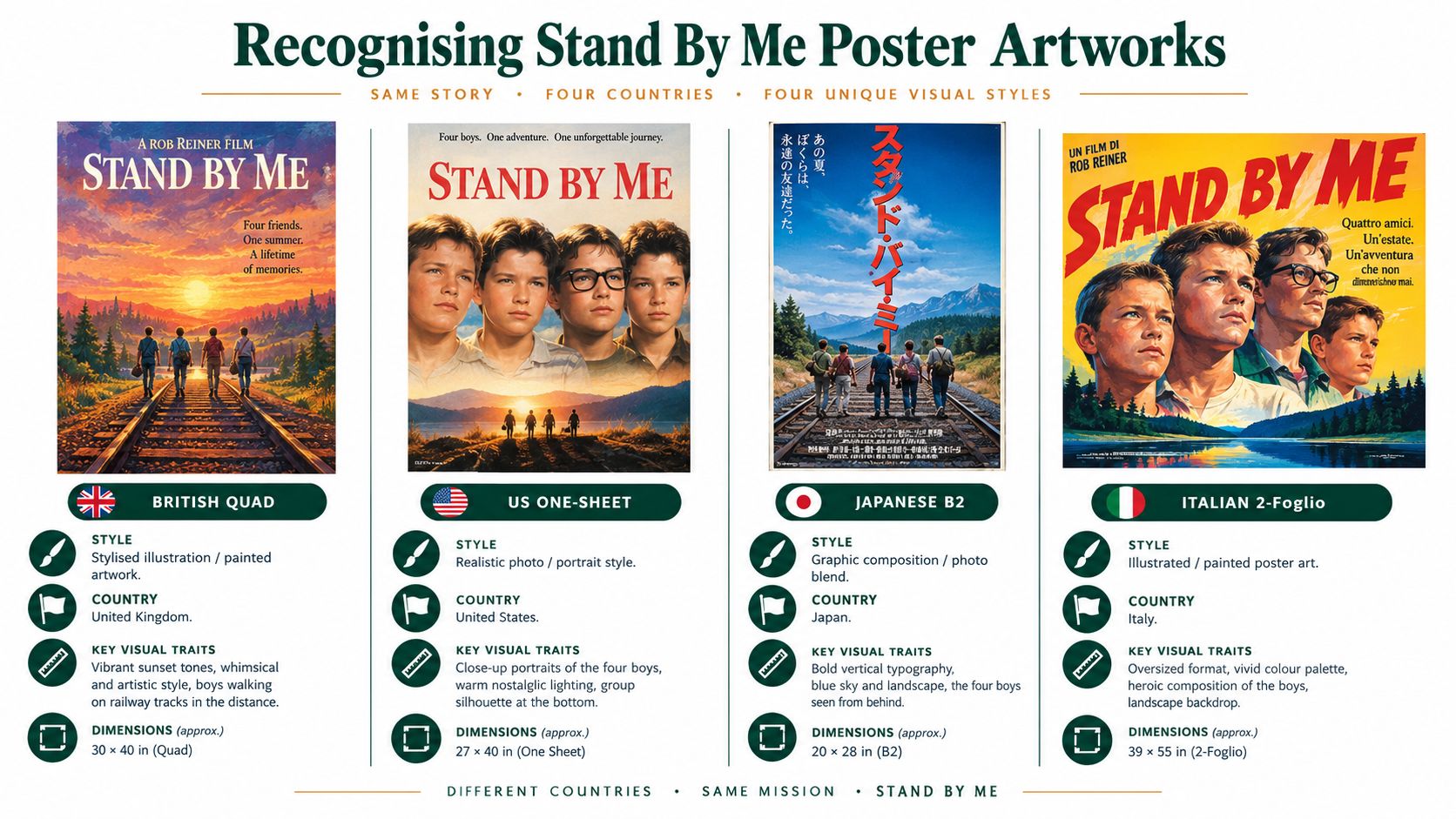
You should be able to identify the broad campaign family before you inspect condition. The British quad is generally recognised by its stylised illustration of the four boys walking along railway tracks, with a bold red title treatment and a painted, nostalgic feel. It has the visual character many UK collectors expect from a British theatrical campaign.
The US one sheet presents the same central friendship more photographically. The four actors appear walking along the track under stronger daylight grading, with a more realistic campaign image and the familiar American credit information. Don't assume a photographic design is automatically American, though. Sellers can mix up national formats, and later prints often borrow the most recognisable image.
Build a mental catalogue
You'll encounter several recognisable design groups:
- British quad artwork, illustrated, horizontal and strongly associated with the UK theatrical release.
- US one sheet artwork, photographic, vertical and usually carrying American distribution information.
- German A1, with a different crop, localised credits and a changed tagline.
- French grande format, often using a different national layout and text treatment.
- Australian daybill, narrower and more compact, with its own local printing conventions.
- Japanese B2, frequently more vertical and typographically distinctive.
- Japanese B2 chirashi, a smaller promotional format that can be more graphic than the main poster.
- Italian 2-foglio, an oversized format with a vivid colour treatment and a strong presence when displayed.
International editions may replace photography with painted artwork, alter the colour balance or rearrange the credits to suit local cinema advertising. That makes foreign paper worthwhile for collectors who care about design rather than only British release history. It also means “rare” needs qualification. A less common foreign format may be easier to find internationally than a premium UK quad.
Separate originals from reissues visually
The 1990s and 2000s video and DVD reissues often use a closer-cropped cast photograph. They can look polished and appealing, but they lack the original National Screen Service marks associated with theatrical distribution. A reissue isn't a worthless object. It's not the same thing as an original 1986 cinema poster.
Look for the campaign, not just the title: artwork, country-specific text, proportions and printer information should tell one consistent story.
How to Tell an Original From a Reproduction
Authentication starts with physical evidence. A seller's use of “mint”, “vintage” or “original” doesn't prove anything, and a clean rolled poster can deserve more scrutiny than a folded one. UK collector guidance distinguishes original cinema promotion from later retail reproduction and recommends checking dimensions, folds, printer marks and paper quality. This original-versus-reproduction guide is worth reading before you buy.
Check the sheet itself
Examine the paper under ordinary light first. A genuine theatrical sheet may show age, handling, fold memory or slight toning. That doesn't make it defective. It helps establish whether the object has lived the life of a cinema poster.
UK posters were commonly machine-folded before the mid-1980s, while later prints were more often rolled. For a Stand By Me original, fold-line memory, spine wear and edge cracking can provide useful clues, but none should be treated as a single decisive test. A poster with no folds may be genuine, and a folded sheet may be a later reproduction.
Hold the paper at raking light and inspect the ink. Original lithographic or silkscreen printing can reveal a dot-screen pattern, whereas digital reproductions often show unnaturally smooth blocks of colour. Look closely at the red title, the railway scene and small credit lettering. Pixelation, a substituted typeface or muddy edges should stop the purchase until the seller provides better evidence.
Verify marks and provenance
A US one sheet from the original campaign may carry a National Screen Service or comparable printer credit along the lower border. Copyright lines referring to Columbia Pictures and 1986 can support the identification, but a printed date alone isn't proof. Check that the artwork, paper, dimensions and marks agree.
Look at the reverse for foxing, age toning and old tape stains. Dealer invoices, auction records and provenance paperwork add confidence, especially where the seller's description is vague. Don't accept a photograph of a certificate as a substitute for examining the poster itself.
| Indicator | Original 1986 | Reproduction |
|---|---|---|
| Paper | Period stock with natural handling and age characteristics | Often unnaturally uniform or modern-looking |
| Folds | Consistent with period distribution, where present | May have no folds or artificial creasing |
| Printing | Dot-screen or period printing characteristics | Smooth digital colour blocks or visible pixelation |
| Credits | Appropriate distribution and printer information | Missing, altered or inconsistent marks |
| Dimensions | Match the claimed national format | Mismatched or vaguely described |
| Reverse | Possible foxing, toning, tape stains or handling evidence | Often clean, bright and commercially uniform |
| Provenance | Invoices, dealer history or auction documentation | Unsupported seller claims |
For a second reference point on buying original British paper, use this UK original film poster guide. Ask for unframed measurements, full-front and full-back photographs, close-ups of folds and every printer or copyright line before sending money.
Condition Grading and What Prices Actually Look Like
Condition applies to the whole sheet, not only the artwork visible behind glass. A clean image can still grade poorly if the poster has pinholes, brittle cross-folds, staining, tears or earlier repairs. Check the paper before judging the design.
The usual scale runs from Mint, Near Mint, Very Fine, Fine, Very Good, Good, Fair, to Poor. Use these terms to compare examples, not as fixed guarantees of value. Dealers grade differently, so insist on a written description and detailed photographs.
Read the grades honestly
- Mint: No defects and original gloss. Treat this claim cautiously unless the sheet has been examined properly.
- Near Mint: Almost perfect, with only very minor wear. A rolled example can command particular interest.
- Very Fine: Light handling with no tears. This is often the strongest practical display grade.
- Fine: Some wear and small creases, while the artwork remains convincing.
- Very Good: Visible creases and minor paper loss. Buy at this level only when the faults are reflected in the price.
- Good: Tears or stains, but still suitable for display after appropriate framing.
- Fair: Major damage or an incomplete sheet.
- Poor: Restoration is required and collectability is limited.
For a UK quad, inspect the cross-folds as carefully as the front image. Folded examples usually rank below rolled examples of the same poster because folds can turn brittle, split along the spine and catch under angled light. Do not pay rolled-sheet money for a folded Stand By Me quad because the listing photograph looks clean.
Prices need context
UK prices depend on format, originality, artwork, condition and provenance. An original Stand By Me quad has been listed by a UK retailer at £840.00, showing the commercial interest attached to authentic British-format material. Treat that figure as an asking price, not proof of a completed sale. Compare it with US one sheets and foreign editions only after allowing for their different sizes, artwork and collector demand.
Inspect all four corners, fold intersections and outer edges before agreeing a price. Pinholes, surface scuffs, brittle folds and old tape repairs can change value sharply. Restoration may improve presentation, but it does not remove the poster's condition history. For any expensive example, request unframed measurements and full-front and full-back photographs before paying.
Framing, Mounting and Long-Term Care
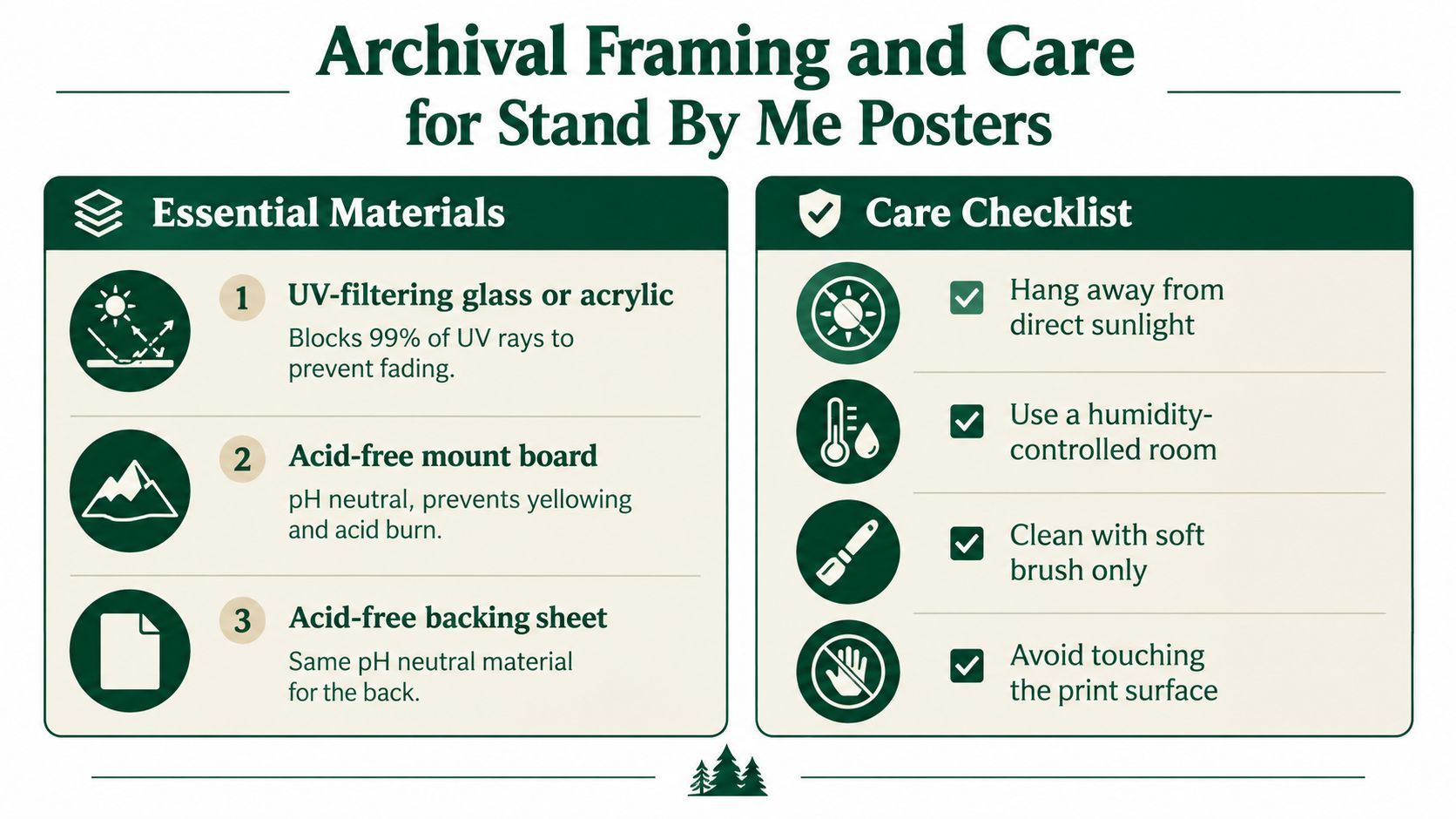
A Stand By Me quad deserves a frame built around conservation, not a high-street kit chosen by approximate size. Start with UV-filtering glass or acrylic, acid-free mount board and an acid-free backing sheet. Avoid pressure-sensitive tape, glue and ordinary sticky corners. They can stain the paper and make later conservation more difficult.
The poster should sit securely without being crushed. A small breathing gap behind the backboard helps reduce moisture build-up, while a stable room away from radiators and direct sunlight protects the paper from unnecessary stress. Allow the framed poster to acclimatise for 24 hours before hanging it, especially after transport from a different environment.
Treat folds as history
Don't force a folded poster flat at home. The cross-fold is part of the sheet's distribution history, and aggressive pressing can crack the printed surface or split weakened paper. If the folds are severe, ask a paper conservator about treatment rather than using household ironing, weights or improvised adhesives.
Rolled examples should rest on a conservation tube wrapped in acid-free tissue and be stored vertically. Archival storage can use calcium carbonate buffered alpha cellulose fibre paper, a museum-style specification available in 100 gsm and 160 gsm sheets sized 838 x 1143 mm, as described by a UK conservation supplier. Archival wrapping paper guidance gives a more precise benchmark than a vague “acid-free” label.
Inspect the frame every few years for foxing, movement or tape failure. Rotate display pieces so one poster isn't exposed to light continuously. If you're moving the collection, use a specialist guide to packing art for a move rather than treating a valuable poster like ordinary household paper.
Sourcing Hard-to-Find Variants and Next Steps
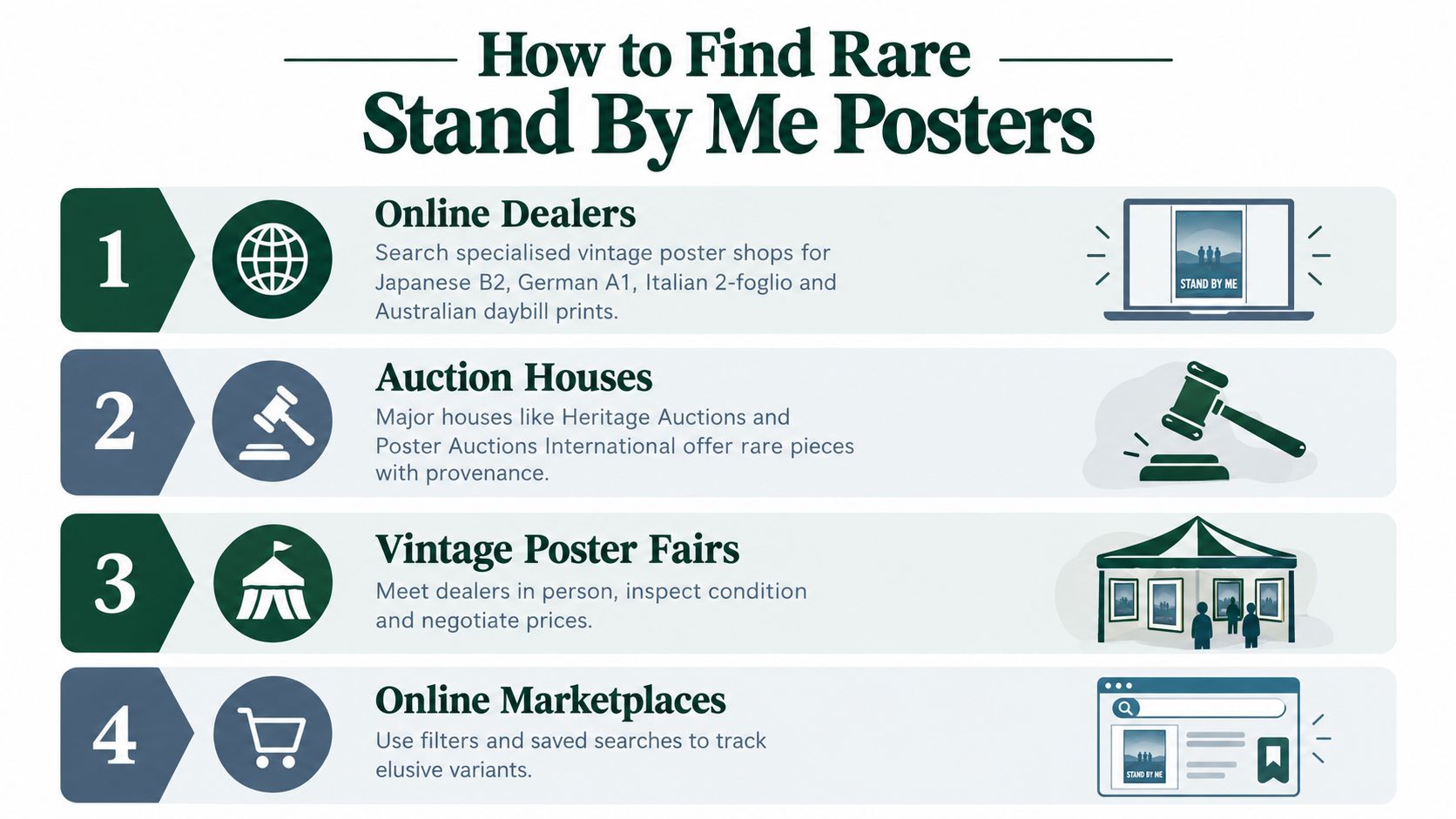
The less familiar variants require a different search strategy. Start with specialist vintage poster dealers, then check auction houses, poster fairs and saved searches on established marketplaces. Japanese B2, German A1, Italian 2-foglio and Australian daybill examples are more likely to appear through international networks than on a general UK listing.
Use a Request a Poster service properly
A useful sourcing request should include the title, release year, preferred format and an artwork reference. Say whether you want the British illustrated quad, the photographic US one sheet or a particular international design. If you ask for “a rare Stand By Me poster”, you may receive an offer for a reproduction, reissue or format you didn't want.
Before paying a deposit, ask for:
- Exact measurements: Request unframed dimensions and the orientation.
- Condition photographs: Ask for front, reverse, folds, edges and close-ups of repairs.
- Authenticity details: Confirm printer marks, copyright information and provenance.
- Total cost: Check delivery, insurance and any customs charges before agreeing.
- Deposit terms: Establish whether the deposit is refundable if the supplied sheet doesn't match the description.
Your action plan is straightforward. Set a budget ceiling, choose the format, select the artwork, then decide how much condition matters. Don't overpay for a “rare” reprint, ignore international shipping costs or trust an unverified social media seller because the photograph looks convincing.
A UK buyer who wants local theatrical history should prioritise the original quad. Choose the US one sheet if the portrait format suits your room, and choose a foreign edition when the design itself is the reason you're collecting. Once you've made that decision, join a recognised poster society and monitor auction-house archive databases for comparable lots.
Famous Movie Posters offers verified original film posters, format guidance, framing options and a Request a Poster service that can help locate specific cinema paper through trusted partners. Visit Famous Movie Posters with your preferred format, artwork and budget ready, then ask for the evidence you'd want to see before buying any Stand By Me original.