



You've found what looks like the perfect Good, the Bad and the Ugly poster online. The colours are strong, the three figures fill the frame, and the seller calls it an “original”. Then you notice the measurements don't match your frame, the image is shown in portrait format, and the description says nothing about the printer. That's where an exciting purchase can become an expensive mistake.
A British collector approaches this title differently from a casual film fan. The first questions are practical: Is it a UK Quad or a different format? Is it an original theatrical issue or a later reproduction? Does the paper, fold pattern and printer information support the description? The answers affect how you compare listings, choose a frame and protect the poster once it arrives.
A vintage cinema poster is both artwork and a piece of film history. Treat it as an object with evidence, not simply as a large image.

Table of Contents
- Introduction to the Iconic Western Poster
- Understanding UK Quad and US One Sheet Formats
- Original Variants and Reissues You Will Encounter
- How to Spot an Authentic Original
- Condition Grading and What Affects Value
- Framing Display and Long Term Preservation
- Where to Source Your Poster with Confidence
Introduction to the Iconic Western Poster
The appeal is easy to understand. The film's Western imagery, stark character silhouettes and bold graphic composition give the poster a natural presence in a home cinema, study or collector's wall. Yet the visual familiarity can also create confusion, because similar artwork may appear across different national formats, cinema campaigns and reissues.
A gift buyer might search for a striking wall piece without knowing the difference between a British Quad and a US One Sheet. A new collector might see a listing described as “vintage” and assume that the word means original. An experienced buyer, meanwhile, will want to know whether the item is a UK theatrical poster, which printer produced it, how it has been stored and whether any restoration has altered the paper.
This guide takes the UK market as its starting point. You'll learn how to recognise the British Quad, compare it with the British One Sheet and understand why a poster's format matters as much as its artwork. You'll also see how printer attribution, folds, paper characteristics and condition work together when assessing an original.
The title is especially interesting because UK Quad records identify examples from the original campaign and later reissues in the same standard format. That consistency helps collectors compare like with like, but it doesn't make every Quad identical. Date, printer evidence, condition and restoration still need careful attention.
By the end, you should be able to look at a listing with a dealer's eye. You won't need specialist laboratory equipment. You will need the right questions, accurate measurements and a willingness to ask for clear photographs before committing to a purchase.
Understanding UK Quad and US One Sheet Formats
A buyer stands at the counter with a frame under one arm and a poster listing on their phone. The seller calls the print a Quad, but the measurements show a narrower sheet. Start with the format, because the correct shape affects the frame, storage and catalogue record.
A British Quad is the familiar UK cinema poster, measuring 30 x 40 inches. A British One Sheet is taller and narrower, measuring 27 x 40 inches. Both share the same height, but their proportions create different spaces for figures, lettering and empty areas. The distinction is set out in Original Film Art's UK size guide.
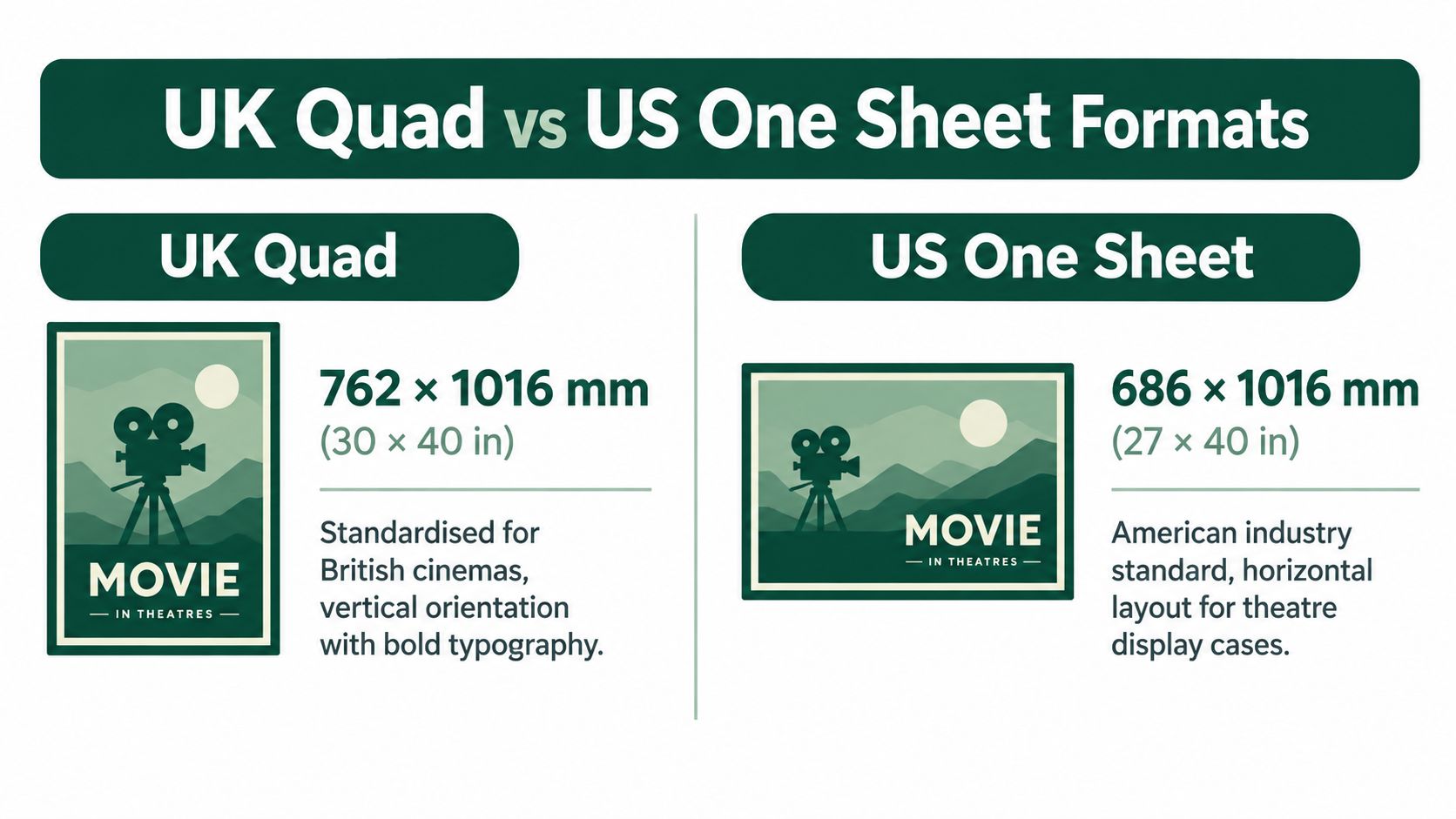
The measurements that prevent costly mistakes
For a British Quad, expect 30 x 40 inches, or 76 x 102 cm, with the longer measurement running horizontally. UK guidance may also record it as 40 x 30 inches, which describes the same sheet when its width is listed first. A British One Sheet is 27 x 40 inches, although some older examples are recorded at 27 x 41 inches. Measure the actual poster before ordering a frame, rather than relying on the seller's format label. These distinctions are explained in Art of the Movies' explanation of Quads and One Sheets.
The format affects three practical decisions:
- Framing: A Quad frame will not properly house a One Sheet without an unsuitable mount or unwanted space.
- Storage: Sleeves, folders and flat files must fit the poster's measured width and height.
- Cataloguing: A narrow sheet described as a Quad may be misclassified, so request measurements before buying.
The same check helps with digital presentation. If you are preparing a mock-up or wall plan, perfect poster sizes by pixel count can help convert the physical proportions into a suitable image canvas. It supports layout planning, not authentication.
For a further comparison, use this guide to One Sheet and Quad movie posters. Ask for the stated format, the measured dimensions and clear photographs of the full sheet. That small habit helps you buy the right original and avoid framing the wrong object.
Original Variants and Reissues You Will Encounter
A listing for a Good, the Bad and the Ugly poster may refer to an original UK Quad from the 1968 cinema cycle, a later UK reissue or a poster produced for another national market. The imagery may look familiar across the group, but the objects aren't interchangeable. A British Quad belongs to the UK tradition, while a US One Sheet follows a different proportion and should be assessed as its own format.
British Quads for this title are consistently specified at 30 x 40 inches, or 76 x 102 cm, and catalogue records identify UK examples from 1968 and later reissues at that size, as shown in the UK Quad listing at At the Movies. That gives you a useful first filter, not a complete authentication test. A correctly sized poster can still be a later issue, and a seller can still misdescribe a reproduction.
Compare the object, not just the artwork
| Variant | Size and Orientation | Key Identifying Traits |
|---|---|---|
| Original UK Quad | 30 x 40 inches, landscape | British theatrical format, campaign-specific typography, printer and paper evidence |
| Later UK Quad reissue | 30 x 40 inches, landscape | Same standard UK format, but issue details and production context may differ |
| US One Sheet | 27 x 40 inches, portrait-oriented format | American format, different proportions and market-specific layout |
| Unofficial reproduction | Varies | Modern production, uncertain paper, absent or inconsistent production evidence |
The table is a comparison tool, not a substitute for inspection. Look closely at the credit area, the edges and the fold pattern. Ask whether the seller has identified the year from documented evidence or has repeated a marketplace title.
Reissues deserve particular care. They can carry attractive, legitimate campaign artwork and may suit a collector who wants the film represented on the wall without pursuing the earliest issue. The mistake is treating “reissue” and “original 1968 UK Quad” as identical descriptions. They represent different collecting propositions, even when both are British Quads.
The same logic applies to the US One Sheet. Its familiar poster image may be appealing, but buying it when you intended to own the UK theatrical format affects framing, storage and comparisons with UK auction records. Decide first whether your collection is organised by artwork, national market, release period or format. Then buy the object that matches that decision.
How to Spot an Authentic Original
Authentication works best as a sequence of small checks. Don't rely on a single visual impression, because a convincing reproduction can imitate colour, layout and even artificial ageing. Start with the format, then examine production evidence and physical characteristics.
A UK listing for this title identifies an example as printed in England by Lonsdale & Bartholomew Limited, Nottingham. That printer attribution is valuable because printer information helps distinguish an original British theatrical issue from a later reissue or unofficial reproduction. The reference appears in the Propstore record for a 1968 UK Quad.
Five checks for a listing or dealer photograph
- Confirm the dimensions first. A claimed UK Quad should be consistent with the established British Quad format. If the seller gives only a vague description such as “large vintage poster”, ask for measured height and width.
- Read the printer information. Inspect the credit block rather than accepting a typed description. Lonsdale & Bartholomew Limited, Nottingham is a specific production clue for the UK example described above.
- Study the paper. Original theatrical posters generally have a different feel from modern glossy prints. Look for a paper surface and age characteristics that make sense alongside the stated issue, while remembering that paper alone cannot prove originality.
- Examine folds and edges. Fold lines, handling marks and edge wear should be considered together. A seller should show the full front, reverse, corners and credit area, not only a carefully cropped image.
- Inspect the printing closely. Magnification can reveal whether the image has the character of period printing or the smooth, uniform appearance of a modern digital reproduction. Colour saturation by itself isn't evidence of age.
The infographic's descriptions mention common checks such as printer attribution, paper stock, fold patterns, printing characteristics and edge wear. Treat those as prompts for questions, not as automatic proof. A folded poster can be genuine, restored or reproduced, and an apparently clean poster may have been conserved or backed.
For a wider UK buying checklist, use this guide to original movie posters in the UK. Ask the seller whether the poster has been linen-backed, whether colours have been retouched and whether the stated year comes from a catalogue record, printer evidence or an assumption based on the film's release date.
Here's a useful video reference for seeing how collectors approach vintage poster examination:
Dealer's rule: If a seller won't show the reverse, edges and credit block, you haven't been given enough evidence to make a confident purchase.
Condition Grading and What Affects Value
Condition records what has happened to the paper, rather than how strongly you respond to the artwork. Two posters carrying the same design may suit different collectors. One might retain crisp colour and original folds, while the other shows tears, fading, pinholes or restoration.
Start by separating wear from restoration. Fold lines, small splits and light handling marks can be normal on a folded theatrical original. Linen backing may stabilise the sheet and improve presentation, but it changes the object and must be disclosed. Tape residue, repaired tears, missing paper and retouched colour should be described clearly before prices are compared.
A practical way to read a condition description
- Colour: Check for fading, uneven tones and retouching that may have changed the original palette.
- Paper integrity: Look for tears, thinning, brittleness, pinholes and losses along the edges.
- Folds: Original folds are common on theatrical material. Splits and heavy creasing can affect display.
- Backing: Confirm whether the poster is linen-backed, paper-backed or unbacked.
- Restoration: Establish whether the work is limited and sympathetic or extensive enough to alter the image.
Condition principle: Buy the strongest example your budget and collecting purpose can justify, and only pay for condition the listing has documented.
Size variation can affect the practical cost of mounting and storage. The British One Sheet is usually described as 27 x 40 inches, although some older examples are listed at 27 x 41 inches. That extra height may change the mount design and sleeve choice, especially where the poster has generous margins or has been trimmed. For comparison, a British Quad is commonly listed as 30 x 40 inches, horizontal orientation, while some descriptions may use different wording for the same format. Measure the actual paper before ordering archival materials.
A useful condition description explains what appears at normal viewing distance and what becomes visible under close inspection. “Good for its age” provides too little information on its own. Request photographs taken under even lighting, including close views of damage, rather than relying on a single polished room image.
Value depends on more than condition. Format, authenticity, issue identification, artwork appeal and restoration history all shape a collector's decision. A modestly worn original with convincing provenance may matter more to a serious collector than a reproduction that looks pristine. Keep the photographs, measurements and restoration details with your purchase records, so future framing or resale decisions are based on evidence rather than memory.
Framing Display and Long Term Preservation
The best framing plan starts before the poster reaches the wall. Confirm the format, measure the paper and decide whether you want the original object presented with visible margins or surrounded by a mount. For a British Quad, plan around the orientation rather than assuming a standard portrait cinema frame will work.
A conservation-minded frame should keep the poster away from direct contact with unsuitable materials. Acidic paper and non-archival plastics can contribute to discolouration, brittleness and surface damage, which is why independent poster-care guidance recommends acid-free materials for long-term preservation. The advice is particularly important for valuable folded originals and examples you plan to store for extended periods. See the poster-care guidance on acid-free materials.
Build the display around the paper
Use a reputable framer who understands works on paper and can discuss reversible mounting. The poster shouldn't be permanently glued to a board to remove a ripple. A suitable mount can create separation between the paper and glazing while giving the frame a balanced visual border.
Glazing also deserves attention. A frame placed in strong daylight faces a different preservation challenge from one displayed in a dim home cinema. Ask the framer about UV-filtering glazing, but remember that glazing is only one part of care. Positioning, temperature, humidity and handling still matter.
For advice on choosing suitable tools and wall types for hanging art, consider the wall construction and the frame's final weight before installation. Use secure fixings appropriate to the wall, and avoid hanging valuable paper directly above a radiator, fireplace or other heat source.
Storage requires the same discipline. Keep the poster in an archival enclosure, use acid-free tissue where appropriate and avoid ordinary plastic sleeves that may trap or react with moisture. Store it flat when the format and facilities allow, with enough support to prevent bending or pressure on folded areas.
The guide to framing a poster can help you think through mount, glazing and presentation choices. A good frame should make the artwork easier to enjoy while keeping future conservation options open.
Where to Source Your Poster with Confidence
The safest purchase begins with a seller who can explain what the poster is, where the identification comes from and what condition it's in. A specialist retailer may provide format, issue details, condition notes and photographs of the paper. Auction houses can offer catalogue descriptions and established bidding records, but you still need to read the lot carefully and account for buyer terms, restoration notes and collection arrangements.
Private sellers can have genuine material, especially when a poster has come from a long-held collection. The difficulty is verification. A confident seller should answer straightforward questions about measurements, folds, printer credits, backing and any repairs. If the listing uses only promotional language and avoids physical details, pause before paying.
A final buying checklist
- Match the format to your aim: Decide whether you want a UK Quad, a British One Sheet or another national issue.
- Request measurements: Compare the seller's figures with the stated format and inspect whether the paper may have been trimmed.
- Ask for production evidence: Request a clear photograph of the credit block and printer information.
- Clarify condition: Ask about tears, pinholes, fading, tape, backing and restoration.
- Check packaging: Valuable paper should travel with suitable support and protective materials, not loose inside an oversized parcel.
- Keep the paperwork: Save the listing, photographs, invoice and any written description for your collection records.
Famous Movie Posters is one UK sourcing option, offering verified original film posters across formats including UK Quads and US One Sheets. Its catalogue is organised by collecting categories, and its services include framing support, protective packaging and a Request a Poster route for titles that aren't currently listed.
A collector who started with a vague search can finish with a precise brief: original UK Quad, documented issue, measured dimensions, disclosed condition and suitable archival handling. That clarity won't remove every decision, but it will stop the most common format and authenticity mistakes.
If you're ready to find an original Good, the Bad and the Ugly poster, browse the verified cinema poster catalogue at Famous Movie Posters, or use its sourcing service when the exact UK issue isn't listed. Before you buy, compare the format, printer evidence and condition details so the poster you choose is the one you want to frame and keep.