



You've just pulled a poster from a thin mailer and found the sort of edge curl that doesn't look dramatic at first, then refuses to relax. The tube seemed fine on arrival, the parcel wasn't crushed badly enough to worry you, and yet the paper has taken the shape of the container. That's the problem with archival storage tubes, the wrong one can leave a memory in the sheet that lasts far longer than the delivery itself.
A good tube is part protection and part restraint. It keeps a poster safe in transit, but it also shapes how the paper behaves afterwards, which is why tube choice matters long before anything goes on a wall or into a frame. The practical questions are simple enough, what size, what material, what goes around the roll, and where the tube lives once it gets home.
Table of Contents
- When a Poster Arrives in the Wrong Kind of Tube
- What Counts as an Archival Storage Tube
- Sizing Tubes for One Sheet and UK Quad Posters
- Protecting the Poster Inside the Tube
- Packing a Poster for Safe Transit
- Where to Keep the Tube Once It Is Home
- A Quick Story and a Checklist Worth Keeping
When a Poster Arrives in the Wrong Kind of Tube
The most familiar mistake is the flimsy postal tube, the kind that gets flattened at one end or arrives dented from the courier van. You cut it open, slide out a poster, and there's a pale crease near the edge where the paper has been pressed against unsupported cardboard. Sometimes the damage is obvious. More often, it's a memory line, a curl that stays with the poster until you flatten it properly, and sometimes longer.
That's why tube choice is the first preservation decision, not a packaging afterthought. A proper archival storage tube supports the paper evenly, avoids sharp bends, and gives the roll a controlled shape rather than a tight squeeze. The Archives and Records Association UK recommends a tube that's at least 2 inches, about 5.1 centimetres, longer than the widest object, so the paper edges don't sit beyond the support and get abraded during handling storage enclosures guidance.
A tube that is too short is worse than no tube at all, because the unsupported ends take the knocks first.
For movie posters, that simple point matters immediately. A US One Sheet measures 27 x 40 inches, 68.6 x 101.6 cm, while a UK Quad measures 30 x 40 inches, 76.2 x 101.6 cm. The tube should fit the format, not force it. If a poster has been rolled too tightly, the paper can keep that shape for weeks, and sometimes for good if the fibres have been stressed.
The rest of the process is just as important. Sizing, materials, packing, and storage all work together. Miss one, and the tube becomes a temporary parcel rather than a preservation support.
What Counts as an Archival Storage Tube
A real archival tube is more than a cardboard cylinder with caps on both ends. It is a support system for paper, with enough strength, the right diameter, and safe internal contact to protect an original poster rather than just move it. UK practice points back to BS 4971:2017, which says packaging should fit documents without forcing folds or other adaptations, withstand handling and document weight, protect against pollutants and light, and avoid materials that harm paper through direct contact or vapour exchange.
What to look for
A proper listing should make the build clear at a glance. Look for an archival or conservation-grade core, a diameter that does not force a tight curl, and end caps that seal well.
That is the practical test. A tube described only as a “mailing tube” is usually a shipping item until the seller proves otherwise. By contrast, a product page that names acid-free construction, buffered interiors, and secure plastic or metal end caps gives you something to work with. A plain cardboard cylinder with no material detail is a weak sign for long-term storage, even if it looks tidy on arrival.
For a collector, the trade-off is simple. An ordinary cardboard tube can be fine for a short courier trip if the poster is wrapped properly and the journey is brief. It is a poor home for an original poster because the material may not be acid-safe, the diameter may be too tight, and the ends can still leave the sheet vulnerable. Smaller specialist options, such as Grainmark Leather pocket tubes, show the difference between basic postage packaging and a storage product made with the contents in mind. A tube that is built for storage protects the paper more evenly and gives you a better starting point before the poster ever reaches the room where it will sit.
The storage room matters too. A good tube still loses ground if it is left in a hot loft, a damp cupboard, or beside a radiator. A cheap hygrometer often tells you more about poster safety than another step up in tube quality, because the room conditions decide whether the paper stays stable once it is home.
Sizing Tubes for One Sheet and UK Quad Posters
A One Sheet rolls along its 40-inch height. A UK Quad needs the same care across its widest side, even though it is displayed horizontally. In both cases, the aim is a loose roll that supports the paper without squeezing it into a tight spiral.
| Format | Poster dimensions | Recommended tube length | Recommended internal diameter |
|---|---|---|---|
| US One Sheet | 27 x 40 inches, 68.6 x 101.6 cm | At least 41 inches, 104 cm | Wide enough for a loose roll |
| UK Quad | 30 x 40 inches, 76.2 x 101.6 cm | At least 41 inches, 104 cm | Slightly larger to avoid a tight curl |
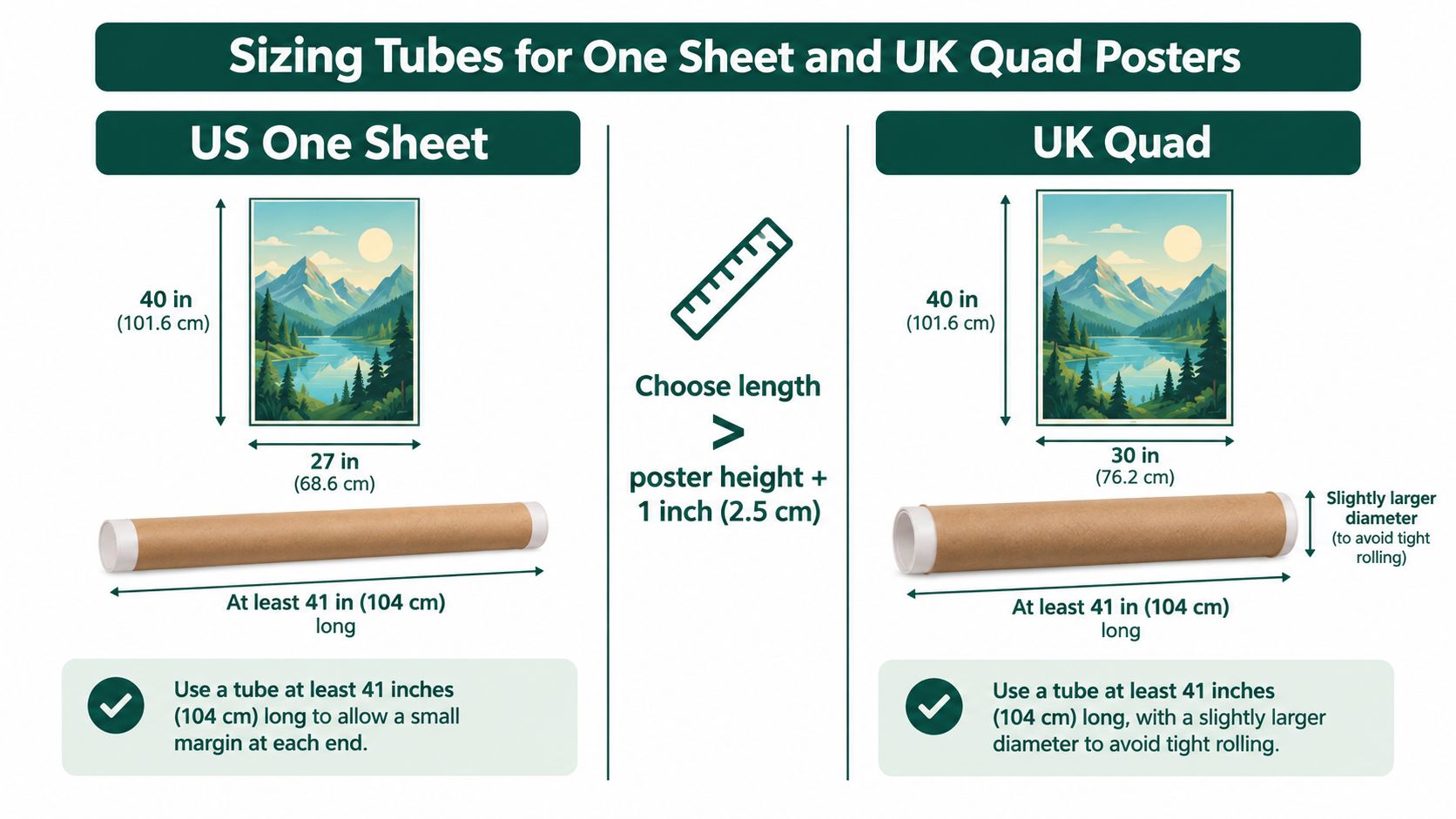
What Is the Difference Between a One Sheet and a Quad Movie Poster is worth checking if you want a quick refresher before buying.
The practical rule is straightforward. Choose a tube that gives the poster a little extra length, so the edges sit fully on support and do not catch on the end caps during movement. A gentler curve is better than a compact roll, especially on wider formats.
That same approach applies to less common sizes. Three-sheets, half-sheets, and lobby cards still need room for the paper to sit naturally, without being forced into shape. If a size falls between standard tube lengths, a custom-cut tube is usually the cleaner choice.
For me, diameter matters as much as length. A tube can be long enough and still be wrong if the bore is too narrow, because a tight roll puts more stress on the fibres and makes old paper harder to flatten later. A slightly wider tube is often the safer trade-off, even if it takes up more shelf space.
Protecting the Poster Inside the Tube
A poster can be ruined inside a tube long before it reaches the wall. Cardboard contact, dust, and a tight roll all leave their mark, and cheap materials add chemical risk over time. Start with acid-free tissue against the print, then add unbleached kraft paper or Tyvek as the outer wrap so the surface is never rubbing directly on a rough tube.
Practical rule: the printed surface should never be rubbing directly against a rough interior.
Roll the poster image side inward so the print sits within its own curl. If the tube core is wide enough, use it. A broader roll puts less strain on the fibres and is kinder to older posters that have already dried out. For a damaged piece, there are times when you have to work back from the problem, as you would if you find peeling beach poster for bathroom and need a recovery approach rather than a simple storage fix.
Once the inner wrap is in place, secure it with unbleached cotton tape tied in an easy-release bow. That matches the basic handling approach used in UK conservation guidance for rolled items, paper wraps, Tyvek, and cotton ties. Sticky tape on the poster is a bad trade-off. It seems quicker, then the adhesive becomes the thing you have to remove later, and that usually causes more harm than the original storage mistake.
If a poster has just come back from a supplier or auction, leaving it rolled under light weight for a short period can help the fibres relax before unrolling. That is often safer than forcing the sheet open straight away. If the paper feels brittle, stop there and hand it to a specialist.
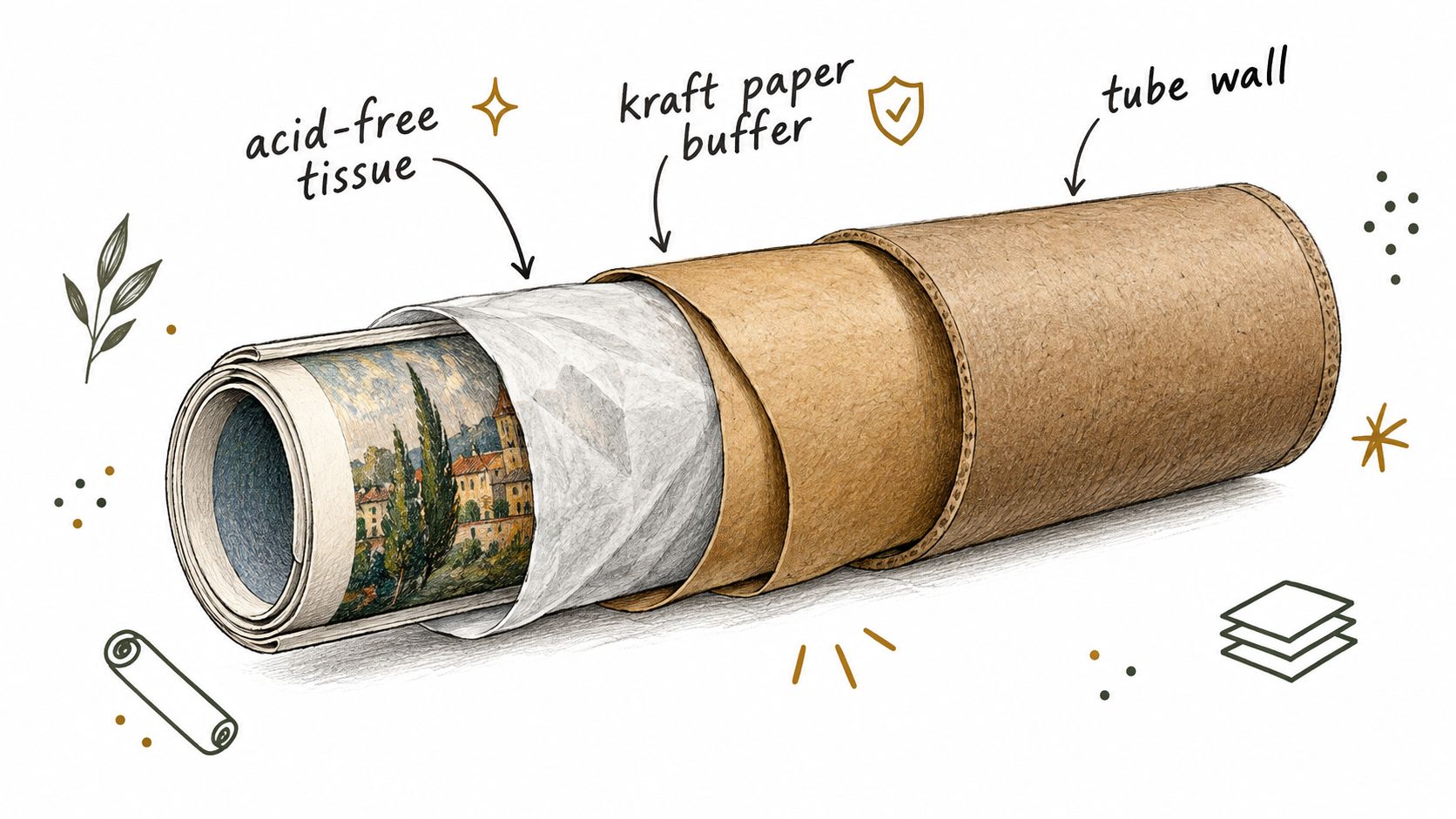
If you are comparing replacement materials, the advice at Shipping Protection Material is a useful benchmark for the layers that matter in transit.
Packing a Poster for Safe Transit
Packing starts with the roll direction. Face the image inward, keep the roll gentle, and let the paper take a broad curve rather than a sharp coil. The purpose is not to compress the poster into the smallest possible package. It's to keep it stable enough that the tube protects it instead of squeezing it.
Build the layers in the right order
Start with acid-free tissue against the print. Add unbleached kraft paper or Tyvek on the outside, then place the roll into the tube with the end caps fitted securely at both ends. Tape the cap seam so it can't pop free during handling, especially if the parcel is going through a busy courier network rather than a direct handoff.
A roll that fits too snugly is a warning sign. The poster should be able to move very slightly inside the tube, with the tissue absorbing the motion rather than the paper being crushed. If it rattles heavily, the diameter is probably too wide. If it won't slide in without resistance, it's too tight.
A little movement inside the tube is acceptable. Compression is not.
Mark the outside clearly. Write the format on the tube, add fragile orientation arrows, and label both ends, which follows the National Archives' approach for rolled records preparation of records guidance. That won't stop rough handling, but it does help anyone opening the parcel know how the contents were stored and how they should be removed.
When the poster is travelling to a framer, going back to a seller, or moving house, the courier choice matters as well. Use a service that tracks parcels properly, and insure high-value pieces if the replacement cost would hurt. That's collector common sense, not a luxury.
Where to Keep the Tube Once It Is Home
A tube can be built well and still fail if it lives in the wrong room. Paper reacts to the space around it, not just the wrap around it, and that is where many collectors lose condition without noticing. The National Archives recommends roughly 13–20°C and 35–60% relative humidity for paper-based archival material, with stability mattering more than chasing a single number environmental management guidance.
The room matters more than the tube
A loft can overheat in summer and dry out badly. A basement or garage can stay damp, which raises the risk of mould. Exterior walls are another weak point because they cool overnight and can create condensation around cardboard tubes, even when the poster inside is wrapped well. If you want a tube to do real preservation work, keep it somewhere cool, dry, and seasonally steady.
The same guidance puts the mould threshold at 65% RH and warns that prolonged humidity below 40% dries paper out and makes it brittle. A cheap hygrometer does more useful work here than a costly upgrade from a good tube to a better one.
A simple digital hygrometer near the tube rack tells you more than guesswork ever will. Check it now and then, especially after cold weather, damp weather, or a move between rooms. If a poster arrives damp, quarantine it instead of opening it straight away. If you need a wider storage solution for multiple pieces, Archival Storage Boxes covers the cases where tubes are not the best fit.
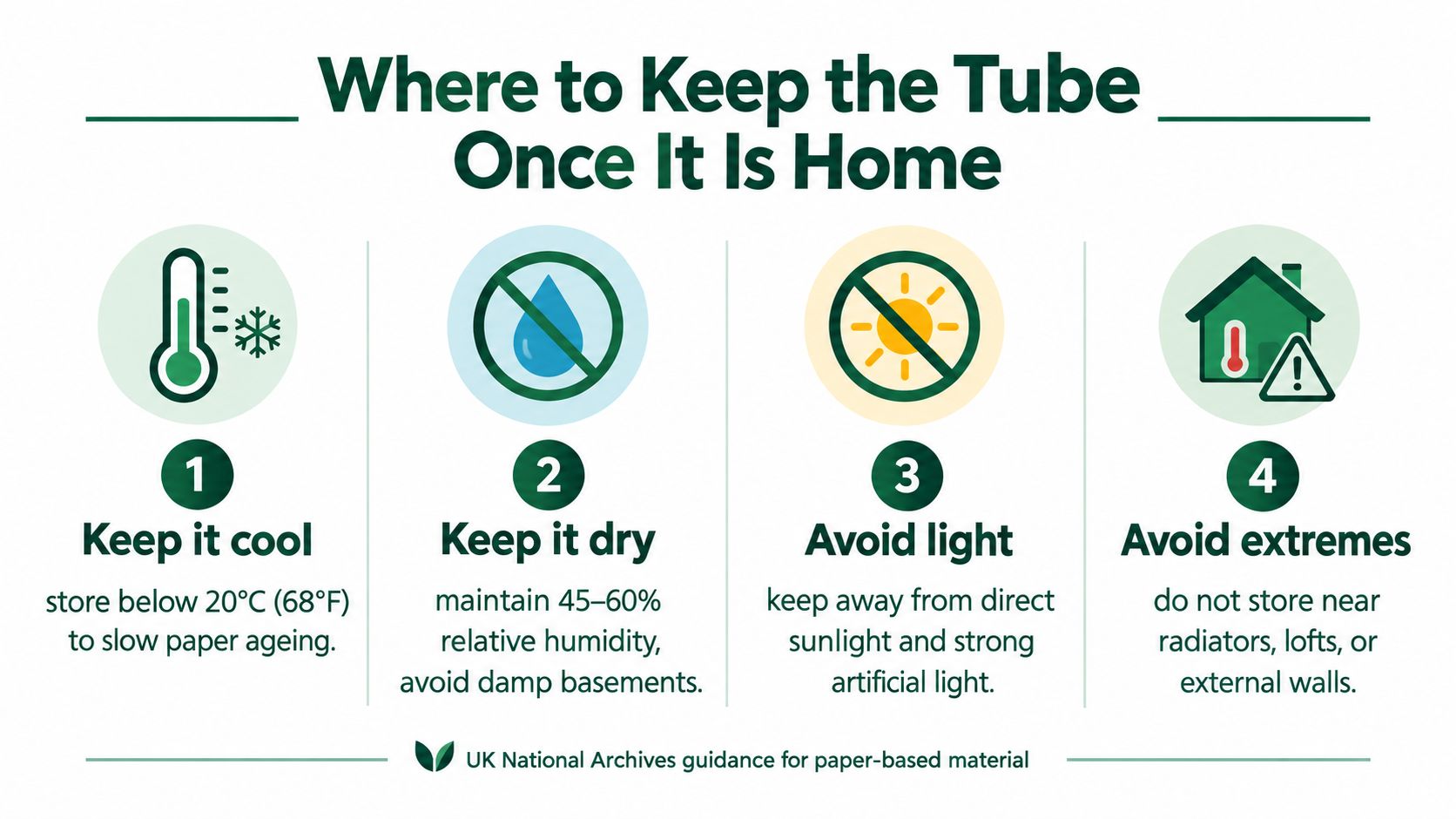
Let the delivered tube sit for about a day before you unwrap it, so the contents can adjust to the room rather than the room shocking the paper. That pause costs nothing and often prevents avoidable handling stress.
A Quick Story and a Checklist Worth Keeping
A 1970s UK Quad once came in a generic mailing tube that looked fine from the outside. Inside, one edge had picked up a light dust line, and the roll memory held stubbornly for a fortnight under weight before the poster relaxed properly. Nothing catastrophic happened, but it was a neat reminder that one weak link, tube, wrap, packing, or room, is enough to spoil the result.
When all four parts are done well, the difference is obvious. The poster opens cleanly, flattens predictably, and stays in better shape while it waits for framing or display.
Keep this checklist close:
- Tube type: use an archival or conservation-grade tube, not a basic mailing tube.
- Sizing: match the length to One Sheet or UK Quad dimensions, with support beyond the widest edge.
- Internal buffering: use acid-free tissue, then kraft paper or Tyvek outside.
- Packing: roll gently, cap both ends, tape the seam, and label the tube clearly.
- Room conditions: store it cool, dry, and stable, away from lofts, basements, and exterior walls.
Treat the tube as a long-term home, not a temporary parcel, and the poster will usually reward you for it.
If you're building a collection, or you've just bought a poster that needs to travel safely, Famous Movie Posters offers original UK Quad and US One Sheet posters with protective packaging and storage knowledge built around real handling experience. Browse the catalogue, then use the same standards at home that sensible packers use in transit, because the right storage habits start the day the poster leaves the tube.