



The usual advice is to start with the biggest hits. I'd argue the opposite: the 1980s produced more enduring cult favourites than any other decade, and the most rewarding discoveries are often the films that disappointed on release before becoming someone's lifelong obsession. Box-office success isn't the best guide to what you'll want to watch again, or hang on your wall.
British audiences helped build those second lives through home video. By 1989, 13.8 million British homes had video recorders, according to Cambridge University Press's history of film and video censorship, giving films a route into homes that didn't depend on a successful cinema run. Rental-shop discoveries became repeat watches, shared jokes and collecting interests.
Collect the film you love, not just the familiar image
The 1980s remains a favourite browsing ground for original-poster collectors because its horror, science fiction and outsider comedies offer such distinctive artwork. Searching for cult movies 80s is a useful starting point, but choosing an original requires more than recognising the title.
These films deserve attention for their cultural afterlives as much as their stories. Each also offers a different collecting decision: UK quad or US one-sheet, theatrical artwork or later reissue, pristine presentation or honest cinema wear. Buy with those distinctions in mind, and you'll build a collection with personal meaning rather than a wall of interchangeable nostalgia.
Table of Contents
- Collect the film you love, not just the familiar image
- 1. The Thing (1982)
- 2. The Evil Dead (1981)
- 3. Escape from New York (1981)
- 4. Videodrome (1983)
- 5. Repo Man (1984)
- 6. Re-Animator (1985)
- 7. Big Trouble in Little China (1986)
- 8. Hellraiser (1987)
- 9. Heathers (1988)
- 10. They Live (1988)
- The 80s Cult Films at a Glance
- Start Your 80s Cult Poster Collection the Right Way
1. The Thing (1982)

Trust is the monster in John Carpenter's Antarctic horror. A research team discovers an alien that can imitate living creatures, leaving every conversation, blood sample and closed door open to suspicion.
Carpenter revisits the earlier screen adaptation of John W. Campbell's Who Goes There?, replacing reassuring heroics with uncertainty. Released into a cinema era captivated by E.T., it found its lasting audience through its practical creature effects, claustrophobia and refusal to provide a comforting ending. For viewers drawn to creature horror, including the kind of bodily distortion associated with Dead Space, it remains a compelling reference point.
Choose the format around the wall
The hooded figure and explosive light of the familiar theatrical artwork make this an effective standalone purchase. Don't assume familiar artwork means an original printing, though: this is precisely the sort of recognisable image that buyers encounter as reproductions.
Check the credit block, studio marks, paper and print definition together, and request photographs of the actual sheet rather than a stock image. Sharp printing helps, but it isn't proof by itself.
For a shallow wall above a desk, a UK quad can be easier to accommodate. A portrait US one-sheet works better on a narrow hallway wall, while either format needs measuring before you commit to a position above a sofa.
2. The Evil Dead (1981)

Sam Raimi turns an isolated cabin, a disturbing book and a recorded incantation into a relentlessly inventive horror film. Bruce Campbell's Ash anchors the chaos, while the restless camera and handmade nastiness explain why viewers kept passing it on.
Its British history needs careful wording. The BFI's account of X-certificate films records that The Evil Dead received an X certificate for theatrical release in 1982, subsequently appeared on the DPP's video-nasty list and was removed in 1985 after distributors successfully argued that it wasn't obscene. A theatrical classification and a video prosecution were different matters.
Buying rule: A poster's connection to controversy doesn't establish its release history. Identify the actual printing before paying for the story attached to it.
For a first purchase, the Evil Dead poster guide is a useful starting point for thinking about the artwork alongside the film.
Inspect fold intersections, edge tears and paper loss, not just whether the image looks clean from a distance. Deep splits through the image can matter more than light surface handling, although location and repair quality also count.
A UK quad makes a strong cinema-room centrepiece. Alternatively, pair a portrait original with sequel artwork, including Evil Dead II and Army of Darkness, to show the shift from oppressive horror towards Ash's increasingly comic screen identity.
3. Escape from New York (1981)
Snake Plissken doesn't arrive looking interested in saving anyone. Kurt Russell's weary, hostile performance gives John Carpenter's prison-city rescue story its appeal: the nominal hero seems almost as unimpressed by authority as the people holding the President captive.
The premise turns Manhattan into a sealed penal colony, then sends Snake inside when the President's aircraft comes down. Carpenter's synthesiser score and grim urban spaces make the setting persuasive without explaining every corner of it. The character's afterlife extends beyond Escape from L.A. into the vocabulary of games and dystopian action, with Metal Gear an obvious companion interest.
Match the artwork to the space
For a collector who likes architectural imagery, this is a good alternative to a straightforward star portrait. Seek a UK quad for a broad wall or a US one-sheet for a tall, narrow position, then compare the actual designs rather than choosing by format alone.
- Check the sheet: Confirm the measured paper dimensions, including any trimming, before ordering a frame.
- Inspect the printing: Look closely at small lettering and colour registration, but don't treat crispness as a standalone authentication test.
- Plan the setting: A restrained black frame suits an office or hallway without competing with the artwork.
Say you're building a Carpenter display with The Thing. Matching the outer frames can unify different designs, but forcing mismatched sheets into identical apertures risks cropping credits or concealing damaged edges you should assess first.
4. Videodrome (1983)
A television executive discovers a broadcast he can't stop investigating, even as his body and sense of reality begin to change. David Cronenberg makes that curiosity extremely unpleasant, with James Woods as Max Renn and Debbie Harry contributing to the film's seductive, threatening atmosphere.
The lasting attraction isn't its grotesque effects. Videodrome asks what happens when someone treats increasingly extreme images as ordinary entertainment, making it a rewarding watch alongside contemporary arguments about screens and manipulation. Its ambiguity also gives repeat viewers more to discuss than a neatly explained conspiracy would.
Keep the artwork unsettling, not the paperwork
An abstract design can work particularly well in a study, editing room or office. Choose a UK quad if you want a broad composition above a cabinet; favour a one-sheet when the available space is vertical.
Request a written condition description covering creases, pinholes, staining, repairs and any backing. Cinema handling isn't automatically a reason to reject a poster, but undisclosed restoration makes it harder to judge what you're buying.
A decorative reprint can suit a room. It simply shouldn't be described or priced as an original cinema-issued poster.
For a home-office display, try the design against your wall colour before choosing the mount. Leave breathing room around dense or disturbing imagery rather than squeezing it between shelves.
The film's uneasy relationship between screen imagery and physical reality is central to its appeal.
5. Repo Man (1984)
A repossession job is hardly the usual route into science fiction. Alex Cox follows punk drifter Otto into a Los Angeles populated by exhausted workers, suspicious officials and a Chevrolet Malibu nobody should open.
Emilio Estevez and Harry Dean Stanton make the collision of workplace comedy, alien paranoia and punk attitude feel oddly natural. The soundtrack's association with Iggy Pop and the Circle Jerks gives music collectors another route into the film, while its deadpan refusal to explain itself neatly is part of the pleasure.
That overlap makes Repo Man particularly useful for a mixed film-and-music wall. Collect the connection, rather than adding unrelated posters just because their colours match.
Build a punk corner with a genuine theatrical sheet
A portrait US one-sheet can sit comfortably alongside record sleeves, while a UK quad offers a broader anchor above a turntable cabinet. Neither is automatically the better purchase: choose the artwork you want and the release history you can establish.
Check the distributor details and credit block against the claimed territory and release. A copyright line alone doesn't prove when a particular sheet was printed, and a later authorised edition isn't automatically an original-release poster.
For example, place Repo Man beside a punk concert poster in separate archival frames. Keep both clear of direct sunlight and leave room above the turntable so changing records doesn't put hands, sleeves or equipment against the glazing.
6. Re-Animator (1985)
Herbert West approaches death as a technical problem, then behaves as though everyone else is unreasonable for objecting to his methods. Jeffrey Combs makes that certainty both funny and frightening in Stuart Gordon's adaptation of H. P. Lovecraft's Herbert West–Reanimator.
The glowing serum supplies an instantly recognisable motif, but the film lasts because its outrageous effects and dark comedy work together. Brian Yuzna's involvement, the later sequels Bride of Re-Animator and Beyond Re-Animator, and the story's suitability for theatrical reinterpretation all offer collectors routes beyond a single title.
British home-video regulation is relevant background, not a label to attach indiscriminately. The BFI's discussion of censorship and domestic viewing explains how the Video Recordings Act 1984 established classification with special regard to viewing in the home.
Establish territory before comparing prices
A US one-sheet and a UK quad aren't interchangeable versions of the same object. They may use different artwork, carry different distribution details and appeal to different collecting interests.
- For a cinema room: A quad can sit above seating without filling the wall vertically.
- For a home bar: Choose a position away from splashes, heat and strong daylight.
- For authentication: Establish territory, printing and release campaign before judging whether the asking price makes sense.
If you're pairing it with another horror-comedy, match the framing rather than insisting on matching artwork styles. That gives the display coherence without obscuring the individual posters.
7. Big Trouble in Little China (1986)

Jack Burton thinks he's the action hero. Much of the fun comes from watching Kurt Russell play a man whose confidence runs ahead of his understanding as a supernatural conflict unfolds around him in San Francisco's Chinatown.
Carpenter mixes martial arts, fantasy, comedy and monster-movie spectacle without trying to make the combination respectable. Its disappointing initial reception matters less to returning viewers than its ensemble energy and the joke that Burton often needs rescuing himself.
For British collectors, that rediscovery belongs to a wider rental culture. The National Library of Scotland's account of video nasties describes VHS becoming a regular household fixture and independent distributors helping establish the early market.
Give the colour enough room
This is a strong choice for someone who wants illustrated spectacle rather than minimalism. Compare the UK quad and US one-sheet compositions before deciding which characters, lettering and action details you want most prominent.
A vivid design works well on a feature wall or in a shared games room. For a playroom, judge the actual imagery and household suitability rather than assuming a colourful fantasy poster is automatically appropriate.
Ask for the poster's source, release identification and detailed photographs. In a practical display above a games cabinet, keep the frame clear of opening lids and moving equipment, and avoid placing it opposite a window where glare will flatten the colour.
8. Hellraiser (1987)
Clive Barker's adaptation of The Hellbound Heart makes domestic space feel contaminated by something much stranger than a conventional haunting. Frank's pursuit of extreme sensation, Julia's complicity and the puzzle box connect family betrayal to the Cenobites' disturbing world.
Doug Bradley's Pinhead became the franchise's defining image, but the original film is worth revisiting for its atmosphere and physical design rather than treating it solely as an introduction to an icon. Hellbound: Hellraiser II gives a collector an obvious companion piece without requiring a wall devoted to every sequel.
Don't confuse horror notoriety with release history
The BFI's history of British video nasties distinguishes titles on the DPP list from films merely described as shocking. That distinction matters whenever a seller uses video nasty as a loose promotional label.
Buy the documented poster, not the most dramatic description of the film.
For Hellraiser, a portrait one-sheet can emphasise a central figure, while a UK quad may suit a broader franchise arrangement. Compare colour strength, edge condition and creases across dark areas, where handling damage can be conspicuous.
A dedicated cinema room is a better default setting than a welcoming hallway if other household members dislike the imagery. For a paired display, align the frames and leave separation between the designs rather than making a crowded collage that weakens both.
9. Heathers (1988)
Not every cult collection needs another monster. Heathers turns school popularity into a vicious social system, with Winona Ryder's Veronica drawn towards Christian Slater's dangerous outsider.
Michael Lehmann directs Daniel Waters's script with a sharp contrast between polished surfaces and ugly behaviour. Its later musical incarnation offers another way into the story, but the film's discomfort matters: the cruelty isn't just decorative, and its teenage characters aren't reliable guides to their own cleverness.
British cult viewing also developed against a strained cinema economy. UK Cinema Association admissions figures place the historic low at 54 million admissions in 1984, useful context for a decade whose enduring favourites weren't defined solely by busy first-run cinemas.
Make a teen-film display with an edge
A Heathers poster works well alongside other teen films precisely because its tone differs. Use the guide to 80s cult classic movies to consider companion titles, then choose artwork that makes the contrast visible.
Verify the printing and actual dimensions, particularly when a listing identifies a UK quad. Don't assume a wide image has been photographed without cropping, or that every sheet bearing the title belongs to the original campaign.
For a bedroom or dressing-room gallery, try a quad above a chest of drawers. A one-sheet is often easier beside a mirror, provided the composition doesn't become visually crowded and the frame remains safely secured.
10. They Live (1988)
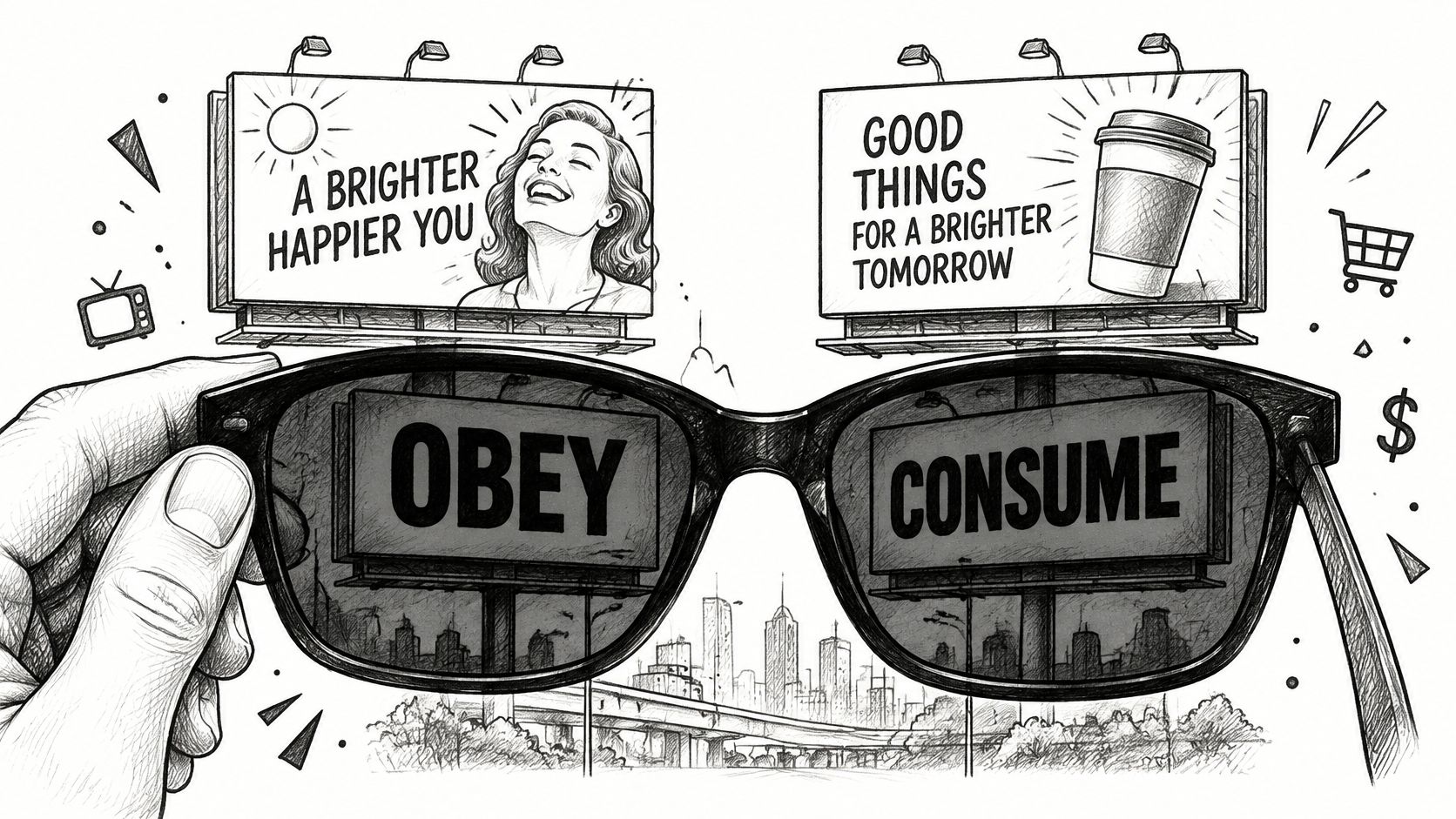
A pair of sunglasses exposes the commands behind everyday advertising. Carpenter builds They Live around that wonderfully simple device, casting Roddy Piper as Nada, a drifter who discovers that ordinary public life conceals alien control.
Adapted from Ray Nelson's Eight O'Clock in the Morning, it combines political satire with physical action, including its famously prolonged fight. The attraction isn't subtle prediction; it's the blunt pleasure of seeing consumer persuasion turned into something the hero can finally recognise and resist.
Choose restraint around a confrontational image
A minimalist frame can give the poster room to speak in a modern living room. Choose a US one-sheet for a vertical focal point or a UK quad above a low cabinet, but compare the actual campaign designs before settling on either.
The science-fiction poster guide provides a useful route into related collecting interests. For this title, pay particular attention to territory, distributor markings and whether the artwork belongs to a theatrical campaign or a later interpretation.
Say you want a display about media and manipulation rather than a Carpenter-only wall. Pairing They Live with Videodrome makes thematic sense, even if their palettes differ.
Don't buy a striking alternative-art print under the assumption that it advertised the original release. It may be an enjoyable object, but originality, licensing and theatrical use are separate questions.
The 80s Cult Films at a Glance
| Film | Year | Director | Genre | Best poster format to seek |
|---|---|---|---|---|
| The Thing | 1982 | John Carpenter | Science fiction horror | US one-sheet for a bold display; UK quad for smaller walls |
| The Evil Dead | 1981 | Sam Raimi | Supernatural horror | Early original theatrical poster |
| Escape from New York | 1981 | John Carpenter | Dystopian action | Choose a territory-specific original, such as a UK quad or US one-sheet |
| Videodrome | 1983 | David Cronenberg | Body horror | Abstract print for a study or office |
| Repo Man | 1984 | Alex Cox | Science fiction comedy | Original theatrical poster for an alternative or retro display |
| Re-Animator | 1985 | Stuart Gordon | Comedy horror | Framed quad |
| Big Trouble in Little China | 1986 | John Carpenter | Fantasy action comedy | Vivid theatrical poster for a feature wall |
| Hellraiser | 1987 | Clive Barker | Supernatural horror | Original US one-sheet |
| Heathers | 1988 | Michael Lehmann | Teen black comedy | Original theatrical poster for a themed display |
| They Live | 1988 | John Carpenter | Science fiction thriller | Bold, minimalist theatrical poster |
Start Your 80s Cult Poster Collection the Right Way
Start with a film you actually want to live with. A recognisable image can attract attention, but personal attachment is a better reason to keep enjoying a poster after the novelty of buying it has passed.
This selection leans towards American genre cinema, not the whole of British cult taste. The BFI's selection of cult films from the decade also includes Burning an Illusion and Billy the Kid and the Green Baize Vampire, valuable reminders that political experience, local culture and unusual musical forms belong in the conversation too.
Check the object before committing
Use this buying checklist whether you're choosing a gift or starting a collection:
- Decide on format: Choose between a horizontal UK quad and portrait US one-sheet using the actual wall space and artwork. Neither format is automatically more desirable.
- Verify originality: Establish the release territory, campaign and printing. Examine photographs of the actual poster, including the full sheet, reverse and credit block.
- Inspect fold lines: Look for splitting, paper loss and wear where folds intersect. Ordinary distribution folds don't automatically make a poster a poor purchase.
- Compare colours: Ask whether fading, staining or restoration affects the image. Photographs taken under strong lighting can conceal differences.
- Examine the edges: Check tears, trimming, pinholes and repairs, including damage that a frame mount might hide.
- Plan preservation: Use suitable archival framing materials, keep paper away from the glazing and avoid direct sunlight, damp walls and nearby radiators.
Buy condition you understand, rather than chasing a supposedly perfect example with unclear provenance. A sound original with disclosed handling can be more satisfying than a cleaner-looking sheet whose history nobody can explain.
Famous Movie Posters sells only guaranteed original posters, with collections browsable by decade and genre, including an original 1986 Platoon theatrical poster. We offer free UK shipping and worldwide delivery to nearly every country, supported by protective, purpose-designed packaging.
For a hard-to-find 80s title, our Request a Poster service uses trusted partner sources to help locate it. Identify the film, preferred territory and format before submitting a request, and decide whether you'd consider a later theatrical reissue rather than assuming every original must come from the first release.
A focused starting point is enough: choose the film, measure the space and establish exactly what you're buying. You can add companion pieces once you've discovered which formats and designs you most enjoy displaying.
At Famous Movie Posters, we offer guaranteed original cinema posters for collectors who want a genuine piece of their favourite films' histories. Browse by decade or genre to find an 80s cult favourite, or use Request a Poster to pursue a title that's missing from your wall.