



You're browsing a weekend market stall or scrolling through a UK poster listing when a brightly coloured skull catches your eye. The seller calls it a Day of the Dead poster, but the description leaves you wondering whether it's Mexican festival artwork, a museum event poster, film memorabilia or a decorative print. Before you buy, you need to know what the image represents and what, exactly, you're paying for.
Table of Contents
- Why a Day of the Dead Poster Asks Two Different Questions
- What Day of the Dead Actually Commemorates
- Poster Formats You Will Actually See for Sale
- How to Authenticate an Original Without Guesswork
- Rarity and What You Should Realistically Pay
- Framing and Preservation for UK Conditions
- How Famous Movie Posters Can Help Source Your Piece
Why a Day of the Dead Poster Asks Two Different Questions
A compelling image isn't a complete description. With this subject, cultural meaning and collecting identity need separate checks: what does the artwork communicate, and what kind of physical object is being offered?
Those questions aren't interchangeable. A thoughtfully designed modern print might communicate the festival beautifully without being cinema memorabilia. An original promotional poster might have sound provenance while using skull imagery for entertainment rather than commemoration.
Identify the subject before the object
Read the lettering before judging the illustration. Look for an event organiser, venue, film title, distributor or artist credit. If a listing supplies none of those, ask the seller to explain what the poster originally advertised.
Then decide what you want:
- Cultural artwork: Choose an image whose description acknowledges remembrance, rather than treating Mexican imagery as anonymous seasonal decoration.
- Event history: Look for an identifiable festival, museum programme or community celebration, with supporting information about its publication.
- Film memorabilia: Establish the exact film and release campaign. A shared title or skull motif doesn't establish a connection to Día de Muertos.
- Decorative display: A clearly labelled contemporary print can be a perfectly reasonable purchase. The problem is misdescription, not newness.
The distinction matters in Britain because public presentation hasn't always preserved the tradition's meaning. A UK examination of Día de Muertos and cultural appropriation describes community engagement alongside interpretations that merge the festival with Halloween.
Set your buying standard early
Write down the description you'd expect on an invoice: original cinema poster, original event poster, artist edition or reproduction. That simple exercise makes vague terms such as vintage-style much easier to challenge.
Buying rule: Don't pay an originality premium until the seller has defined what “original” means for that particular piece.
Your intended use matters too. A gift buyer might prioritise recognisable artwork and straightforward framing; a collector might accept visible wear for a documented release. Neither choice is more serious, but each needs a different budget and a different standard of evidence.
What Day of the Dead Actually Commemorates
Día de Muertos is a commemorative tradition, not a Mexican equivalent of a horror night. Its imagery makes more sense when you start with the people being remembered rather than the skulls being illustrated.
The University of Southampton's Day of the Dead research identifies the annual observance as 1–2 November, with roots in Catholic and Aztec beliefs, and describes altars, music, dance and sugar-skull imagery. It also warns that commercialised interpretations can strip away commemorative, local and religious meaning.
Read the altar, not just the skull
An ofrenda, or altar, provides an especially useful visual reference. Photographs, favourite foods, flowers and candles connect the display to deceased relatives, rather than to an abstract fascination with death. The Mexican Embassy's account of the British Museum festival places family participation and remembrance at the centre of the celebration.
The altar makes that personal purpose visible.

Marigolds, also described as cempasúchil flowers, should be read in that commemorative setting, not merely as an orange colour accent. Similarly, a calavera can communicate remembrance and identity; its presence doesn't automatically make the image threatening.
Catrina figures, monarch butterflies and papel picado, the cut-paper banners associated with celebrations, belong within this broader visual vocabulary. Their inclusion can provide context, but a checklist of motifs isn't proof of cultural sensitivity. Examine how the designer combines them and what the accompanying wording says.
Give dates and institutions their proper weight
The Catholic calendar associates 1 November with All Saints' Day and 2 November with All Souls' Day, while the commemorative practices retain Indigenous Mexican influences. The British Museum's 2009 celebrations provide a UK institutional milestone, documented in this account of the museum's Day of the Dead programming.
Don't assume that every earlier event date signals an inaccurate poster. The Museum of Archaeology and Anthropology's altar explanation notes that celebrations generally begin around 28 October and peak on 2 November, the principal date for honouring deceased adults.
A respectful poster doesn't need to reproduce an altar literally. It needs to avoid turning remembrance into an unexplained horror aesthetic.
For home display, retain the artist's title and any useful explanatory text. That gives visitors a better starting point than a label describing the work as a Halloween skull print.
Poster Formats You Will Actually See for Sale
Start by separating cinema advertising formats from festival posters and artist prints. The same-looking image can be offered in each category, but the physical dimensions alone won't tell you which one you're buying.
For the principal cinema formats, a UK Quad is 30 × 40 inches, oriented horizontally, while the traditional US One Sheet is 27 × 41 inches, oriented vertically, as outlined in the guide to One Sheet and Quad movie poster differences. Always request the actual sheet measurements rather than buying a frame from the format name alone.
Day of the Dead poster formats at a glance
| Format | Dimensions (inches) | Orientation | Typical Era | Collecting Signal |
|---|---|---|---|---|
| UK Quad | 30 × 40, confirm the actual sheet | Landscape | Confirm the release campaign | UK cinema advertising format |
| US One Sheet | Traditionally 27 × 41, confirm the actual sheet | Portrait | Confirm the release campaign | US cinema advertising format |
| Lobby card | Request measured dimensions | Check the individual card | Establish the release or reissue | Smaller film-promotional item requiring its own identification |
| Half-sheet | Request measured dimensions | Confirm from photographs | Establish the release or reissue | Separate format, not simply a cropped larger poster |
| Insert | Request measured dimensions | Confirm from photographs | Establish the release or reissue | Requires format-specific comparison |
| Festival or museum poster | Publisher-dependent | Either | Named event or programme | Evidence of cultural-event history |
| Modern art print | Artist-dependent | Either | Contemporary publication or edition | Artist attribution and edition details matter |
The cinema dimensions above follow the linked format guide. For the remaining categories, measurements should come from the item itself, not an assumption based on a listing photograph.
Match paper and layout to the claimed purpose
Paper stock needs an item-specific explanation. Don't decide that heavier paper means a more valuable original, or that a smooth surface means a reproduction. Ask whether the described stock makes sense for the publication, printing process and intended use.
Layout offers a useful starting point. A wide composition may suit a Quad, while a portrait design may suit a One Sheet, but artwork can be rearranged or reproduced. Distributor credits, event details and publisher information are more useful than orientation alone.
A UK event poster can also be a worthwhile historical object without being a theatrical release. Camden Market's programme listed performers and children's workshops on 26–28 October 2023, from 12pm to 4pm, followed by a parade on 29 October, from 12pm to 4pm, developed with Somers Gallery.
That kind of schedule explains why practical information belongs on festival advertising. Venue names, workshop details and procession times can establish what an event poster was designed to communicate, rather than being visual clutter to trim away.
How to Authenticate an Original Without Guesswork
Authentication is a comparison exercise, not a collection of ageing tricks. Start with the claimed identity, then test whether the printing, paper, credits and provenance support it.
The guide to original movie posters in the UK is a useful starting point for the terminology. For a specific purchase, however, you still need photographs and evidence relating to that actual sheet.
Build an evidence file
Ask for an uncropped front photograph, the reverse, all corners, the credit area and close-ups of damage. For an expensive item, request a written explanation of its release attribution and any restoration, backing or mounting.
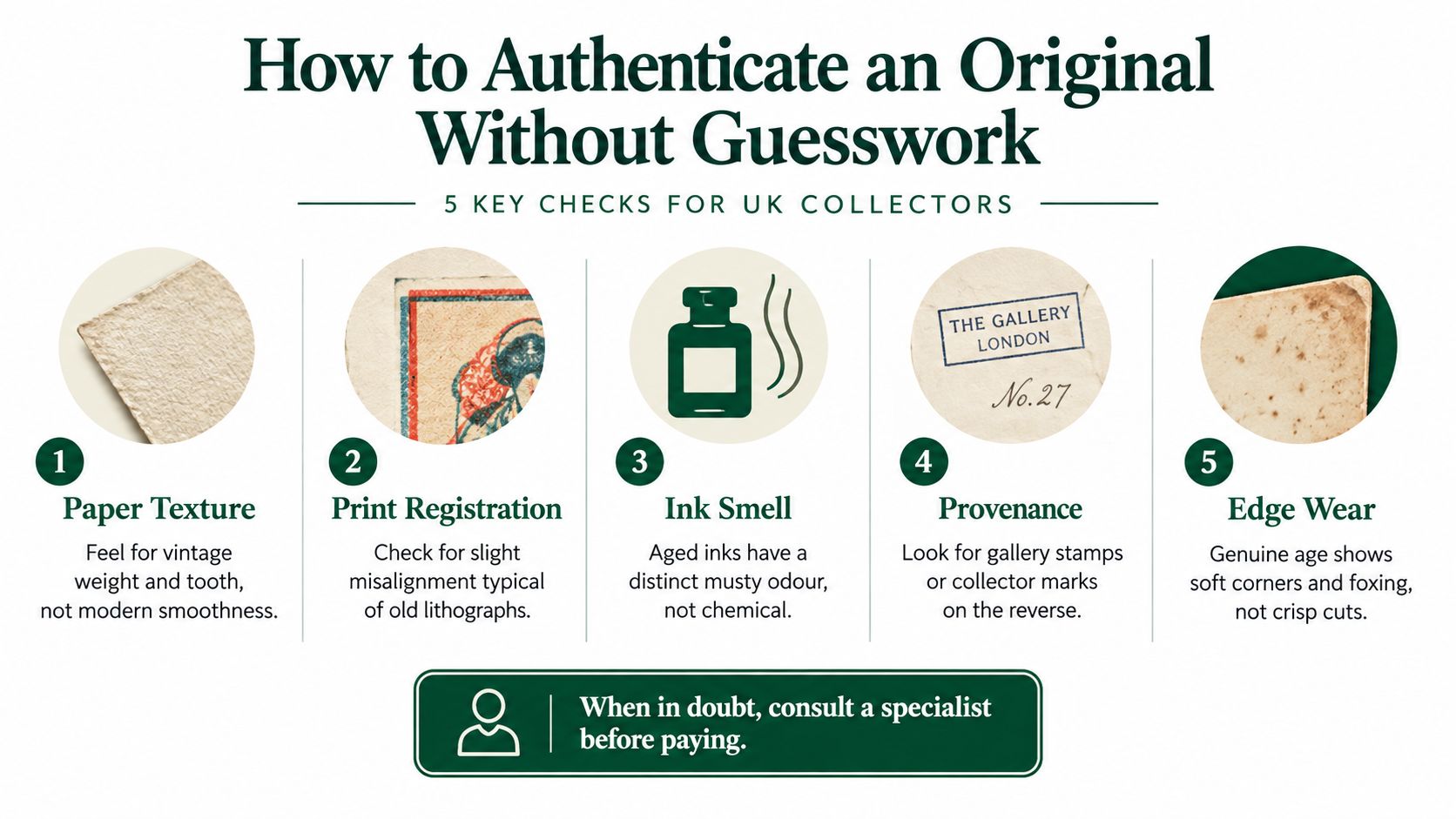
- Paper and finish: Compare the surface with a documented example of the claimed issue. Don't equate vintage paper with roughness.
- Folds and edges: Examine their relationship to the whole sheet. Wear is a condition observation, not an authenticity certificate.
- Printed information: Check printer's marks, copyright lines, distributor credits and edition stamps against the seller's description.
- Ink and image detail: Ask for close photographs of lettering and fine lines. If the printing method is uncertain, seek specialist examination rather than inferring it from screen images.
- Provenance: Request the known acquisition and storage history, including gaps. A plausible story without supporting documentation remains a story.
Use the visual checklist as a prompt for questions, not as a pass-or-fail test.
Separate useful observations from false certainty
Texture, misregistration, odour, stamps and edge wear can't establish originality individually. Don't authenticate by smelling the paper, and don't reject a clean, crisp-edged sheet because it lacks visible age. A stamp also needs interpretation: who applied it, and what does it establish?
A rolled modern festival poster may well be an original publication. The problem arises when a seller presents it as an older cinema issue, or leaves that distinction conveniently unresolved. Likewise, a digitally enlarged image requires scrutiny of its source and printing history, not just praise for its sharpness.
Before paying: Ask the seller to put the claimed issue, condition and authenticity commitment in writing.
There's a useful parallel in Glitz and Glamour vs. Reality's discussion of Caterina Valente biography authenticity: use it as a companion reading prompt about provenance in digital publishing, not as evidence for authenticating paper.
Among UK dealer options, Famous Movie Posters states that it sells only verified originals, offers no reprints and sources inventory through trusted partners. That policy addresses the category of stock offered; the buyer should still understand the individual poster's attribution and condition.
Rarity and What You Should Realistically Pay
Rare isn't a price explanation. Before accepting a premium, ask the seller to identify what is scarce: the release, format, artwork variation, documented event association or surviving condition.
The image below illustrates the kind of piece you might want to live with, but the purchase decision needs more than visual appeal.
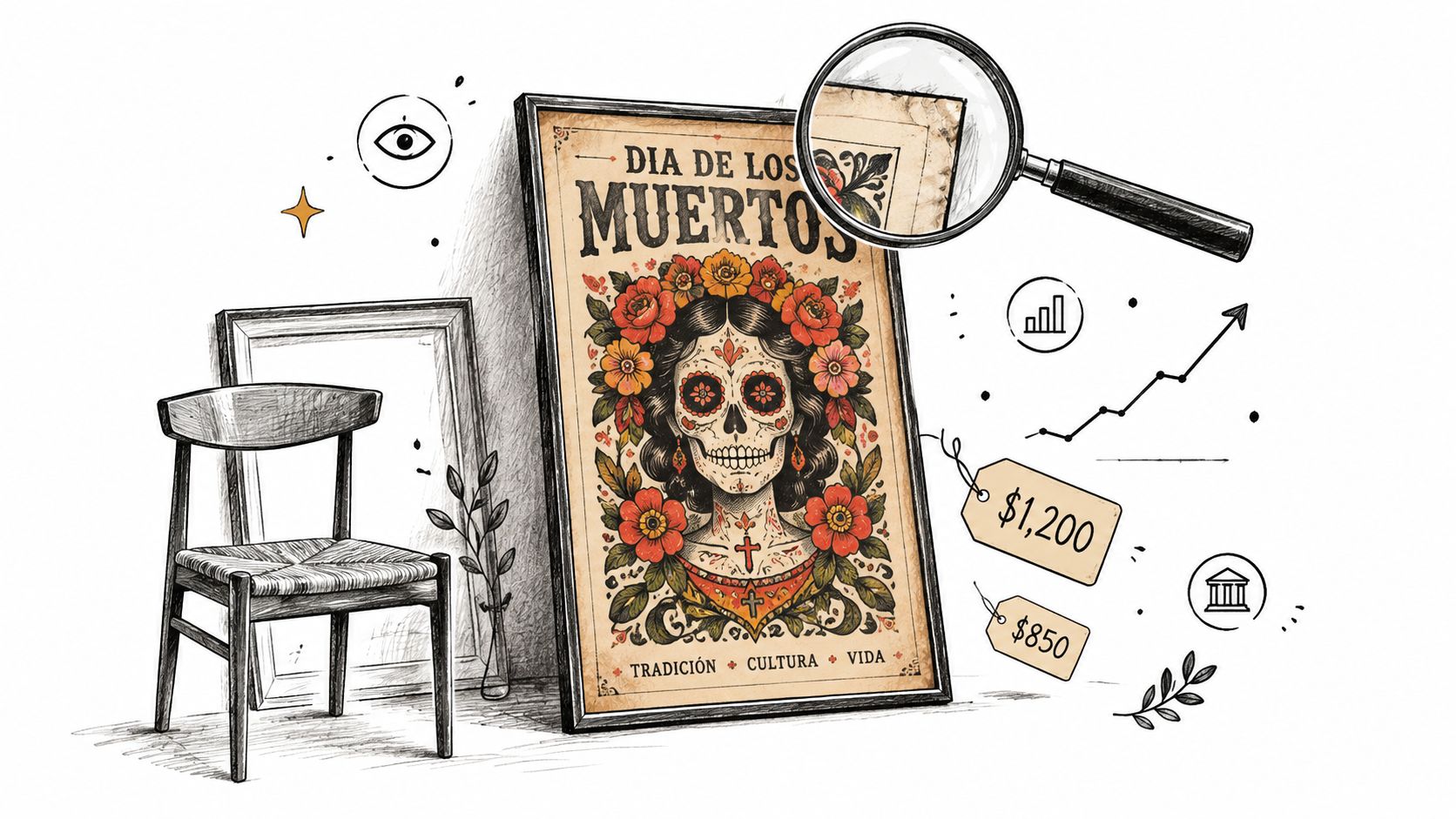
A sensible budget distinguishes purchase price from display-ready cost. Ask separately about framing, delivery, any proposed conservation work and the consequences of buying a backed or previously mounted sheet. A cheaper poster isn't necessarily cheaper to own if it requires work you hadn't allowed for.
Use evidence-based budget bands
Without comparable completed sales for a clearly identified issue, precise price bands would be guesswork. Instead, set expectations according to what the seller can demonstrate.
| Buying category | What should support the asking price | What shouldn't |
|---|---|---|
| Decorative purchase | Artwork you like, clear print description and acceptable finish | Unsupported claims of vintage scarcity |
| Identified original | Specific publication or release, disclosed condition and credible provenance | The word “original” without a defined issue |
| Collector-premium purchase | Close comparables, documented distinction and condition detail | A cultural theme presented as an automatic premium |
For a film poster, compare the same release and format, not just another poster featuring the same title. A festival poster needs a different comparison set, while an artist edition needs clear publication and edition information.
An older Mexican theatrical poster shouldn't automatically cost more than a later US release. Equally, don't assume the reverse. Those are different objects, and a defensible valuation requires their actual identities, condition and relevant sales evidence.
The accompanying video can provide another visual pause, but it shouldn't replace seller documentation or comparable sales.
Read condition descriptions literally
Don't rely on a grade such as excellent without a defect list. Ask about tears, paper loss, stains, pinholes, adhesive residue, trimming, fading and retouching, then compare the written account with photographs.
For a Quad, request photographs showing folds and their intersections rather than assuming a general grade tells you enough. For any format, restoration should be disclosed before you decide whether it suits your collection.
The Cambridge Museums Day of the Dead altar event supplies a useful cultural distinction: this is a living tradition presented through participation and interpretation. Cultural relevance can make a poster meaningful to you, but it doesn't, by itself, establish financial rarity.
Framing and Preservation for UK Conditions
Choose the room before the frame. A well-made frame won't compensate for a damp exterior wall, direct afternoon sunlight or a radiator beneath the artwork.
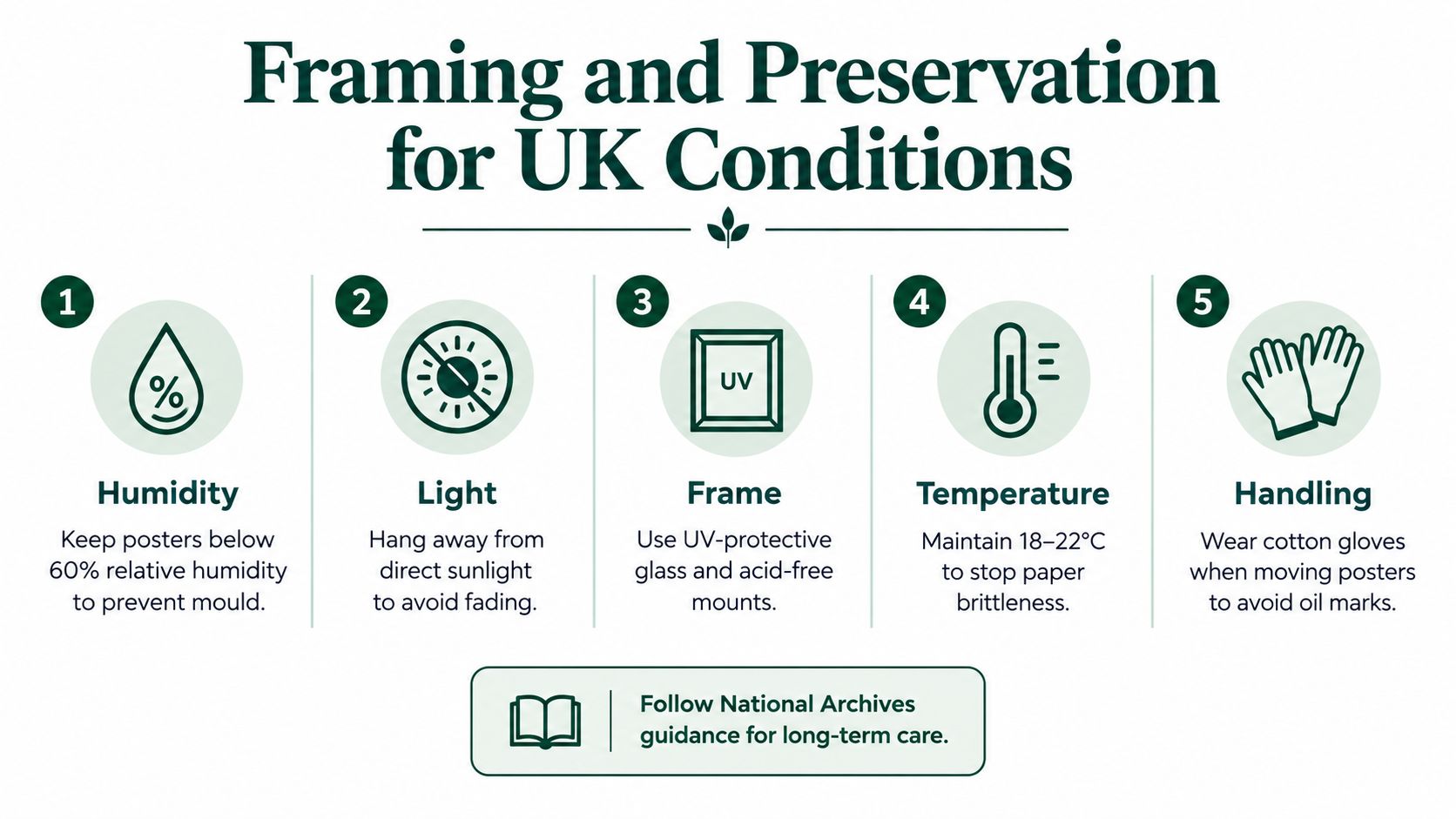
For paper-based archival material, the National Archives' environmental management guidance recommends approximately 13–20°C and 35–60% relative humidity, alongside protection from daylight and conservation-quality mounts or acid-free folders. It explains that excessive damp encourages mould and insect activity, while excessively dry conditions can make paper brittle.
Make the display location stable
A sheltered indoor wall is a better starting point than a kitchen, bathroom or position showing condensation. Keep the poster away from radiators and assess where sunlight falls throughout the day, not just when you first hang it.
Light exposure is cumulative, according to the National Archives guidance. UV-rich daylight contributes to fading, yellowing and embrittlement, so saturated colours and fine lettering deserve careful placement even when UV-filtering glazing is fitted.
The infographic provides a quick visual reminder, but its simplified temperature advice shouldn't replace the National Archives range above.
A hygrometer can help you assess the chosen room rather than guessing from how comfortable it feels. If damp affects several rooms, Home Dehumidifier Reviews' guide to when you need a whole house dehumidifier is a useful starting point for investigating broader humidity management, not a poster-specific conservation specification.
Specify the framing method
Ask a framer for a written description of the materials and mounting approach. The movie poster framing guide provides a starting point for discussing suitable options.
- Mount and backing: Request conservation-quality materials and ask whether they're suitable for the particular paper and printing medium.
- Glazing: Discuss UV-filtering options, reflections and the practical weight of the finished frame. Keep placement away from sunlight regardless.
- Attachment: Ask for a reversible approach appropriate to the sheet. Don't approve trimming or permanent adhesion to fit a convenient frame.
- Undisplayed storage: Keep the poster flat in suitable acid-free folders or conservation materials, protected from daylight.
Buffered storage materials deserve a specific conversation with the supplier or conservator, rather than a blanket assumption that every alkaline product suits every print. Likewise, handling should prioritise secure support and clean contact; gloves aren't a substitute for a clear workspace.
Preservation priority: Choose stable conditions and suitable materials before paying for decorative frame upgrades.
If a valuable sheet already has staining, mould or fragile folds, consult a paper conservator before attempting cleaning, flattening or repair. Treat conservation and framing as separate decisions, with separate written proposals.
How Famous Movie Posters Can Help Source Your Piece
A dealer is most useful when it turns your preference into an identifiable object. For this subject, that means clarifying whether you want a film release poster, commemorative event artwork or an artist print before searching for a particular image.
Turn the idea into a sourcing request
Give the dealer the film title where applicable, preferred format, acceptable condition and intended display position. If you're open to alternatives, say whether you'd change the format or artwork before accepting restoration or significant damage.
The publisher offers a catalogue organised by decade, genre and franchise, alongside a Request a Poster service for specific titles. Those routes suit cinema memorabilia searches, but they shouldn't imply that every festival image belongs in a film-poster catalogue.
- For your own collection: Ask for release attribution, actual measurements, detailed condition photographs and any known restoration history.
- For a gift: Consider a gift voucher if you don't know the recipient's preferred issue or tolerance for wear.
- For display: Discuss framing before ordering so the available wall space and chosen sheet are compatible.
Ask how the sheet will be handled
The publisher describes archival flat-file storage, protective polyester pockets for premium items and purpose-designed shipping tubes matched to principal cinema formats. Its packing approach uses acid-free tissue and kraft paper, with free UK shipping and international rates quoted at checkout.
Ask which packing method applies to the actual poster, particularly if its condition makes rolling a concern. Also confirm the delivery arrangements and what to do if the parcel arrives damaged.
Poster Point store credit may be useful for repeat purchases, but it shouldn't influence the attribution decision. Choose the right object first, then assess the service around it.
For verified original cinema posters, format guidance and help sourcing a specific title, visit Famous Movie Posters. If you're looking for a Day of the Dead poster, send the film or event details, preferred format and budget so the distinction between memorabilia and commemorative artwork is clear before you buy.