



You've found the poster you wanted, it's on its way in a tube, and you're wondering what should sit between the printed surface and the packaging. Or perhaps you've just unrolled a treasured original and noticed foxing, tide lines or brittle edges. In either case, an acid free tissue paper roll can be a useful part of protecting a poster, but it works best as one layer in a careful packing and storage routine.
For UK collectors, the practical question isn't whether a roll says “acid free”. The tissue needs to suit the poster, sit in the right place in the package, and be supported by stable storage conditions. It can reduce contact with less suitable materials, but it won't repair damage or compensate for a damp room, tight rolling or poor support.
Table of Contents
- What an Acid Free Tissue Paper Roll Is and Why Posters Need One
- The Chemistry Behind Acid Free Tissue and What UK Buyers Should Check
- How to Wrap, Roll and Interleave Posters With a Tissue Roll
- Storage Conditions That Decide Whether the Tissue Works
- When Tissue Alone Is Not Enough and a Conservator Steps In
- Buying Guide Specifications and a Final Checklist
What an Acid Free Tissue Paper Roll Is and Why Posters Need One
An acid free tissue paper roll is a supply of thin paper intended for wrapping or interleaving objects that could be marked or abraded by direct contact with other materials. The UK National Archives identifies translucent acid-free tissue as suitable for interleaving or wrapping small prints, drawings and watercolours, while advising against plastic sleeves for those materials (National Archives guidance on caring for prints). For a movie poster, that makes tissue a useful low-contact layer during handling, packing and storage.
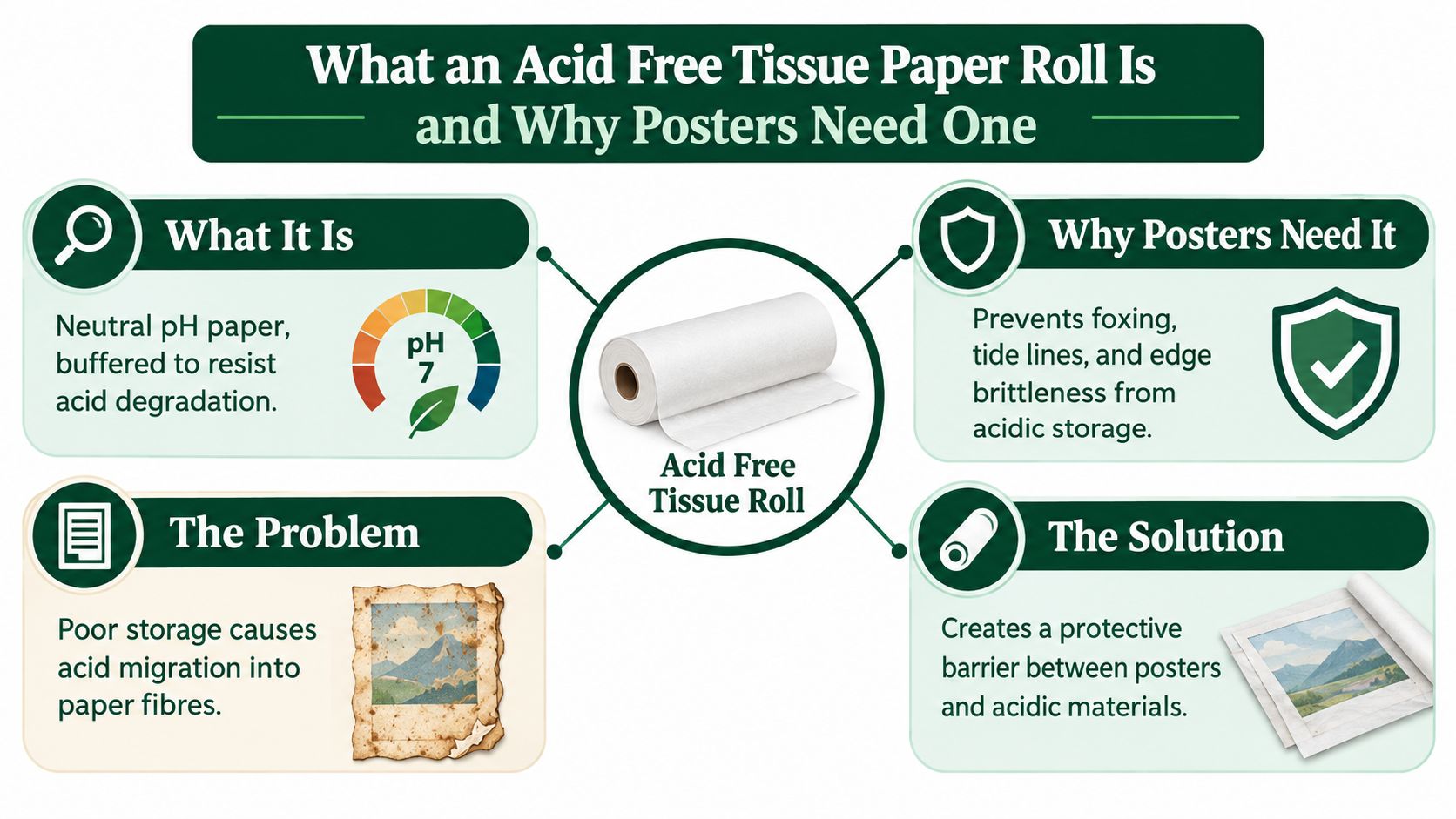
Ordinary wrapping paper can be acidic, and materials in direct contact with a print may contribute to deterioration over time. Tissue creates separation between the poster and other packaging layers, helping limit rubbing and unwanted contact. It's not a treatment for existing foxing, tide lines or brittleness, and it can't stop every form of ageing.
Buffered and unbuffered tissue
Some tissue is buffered with an alkaline reserve intended to help neutralise acids; other tissue is unbuffered. The right choice depends on the object and the supplier's specifications. Older posters can be printed on variable paper stocks, so the label alone doesn't tell you everything about compatibility or long-term suitability.
The roll format is handy for retailers and collectors handling posters of different dimensions. You can cut a clean sheet to cover the printed surface without folding a large sheet into awkward shapes or dragging the whole roll across the artwork. That's particularly useful when a poster is being rolled for shipping inside a purpose-designed tube.
Practical rule: Treat tissue as a separator and handling layer, not as a complete preservation system.
A sensible shipping arrangement keeps the tissue against the poster, with suitable outer wrapping and a properly sized tube providing further protection. The National Archives also recommends individual acid-free folders and a purpose-designed Solander box to protect prints from light and dirt. That layered approach is a better model than relying on tissue alone.
The Chemistry Behind Acid Free Tissue and What UK Buyers Should Check
“Acid free” describes a material's chemistry, not a guarantee that it meets every standard for long-term archival use. The National Archives defines acid-free paper or board as having a neutral or slightly alkaline pH. It explains that an alkaline reserve, commonly calcium or magnesium carbonate, can help neutralise acids and slow degradation associated with ageing or pollution (National Archives guidance on evaluating archival box board).
That distinction matters when comparing rolls. A basic product labelled acid free may have no stated buffer content or supporting test information. A buffered archival tissue specifies the alkaline reserve, giving you more to assess than a broad marketing phrase. Buffering isn't a substitute for checking whether the material is suitable for a particular poster, but it can be a useful part of the product specification.
What the standards tell you
The National Archives identifies ISO 11108:1996 as covering archival paper requirements for permanence and durability, and ISO 9706:2000 as covering paper-document permanence. These are not interchangeable labels for “good tissue”. Ask a supplier which standard applies to the product and whether it can provide supporting test details.
Permanence depends on more than chemical stability. Physical durability matters too, including strength and fibre quality. A tissue that's chemically suitable but too fragile to handle can tear during wrapping, leaving the poster exposed or creating extra friction as you work.
Before buying, look for a clear pH statement, whether the tissue is buffered, what the buffer contains, and any available testing or standards information. If a product page says only “archival”, ask what that means for the actual roll. When a poster may remain wrapped in storage for a long time, those details are more useful than choosing by price or apparent thickness alone.
How to Wrap, Roll and Interleave Posters With a Tissue Roll
Set up a clean, clear table before bringing out the poster. Check that the surface is free from grit, tape and food or drink, then cut tissue to suit the job. A roll that's wide enough for the poster makes it easier to protect the printed face without joining several narrow strips.
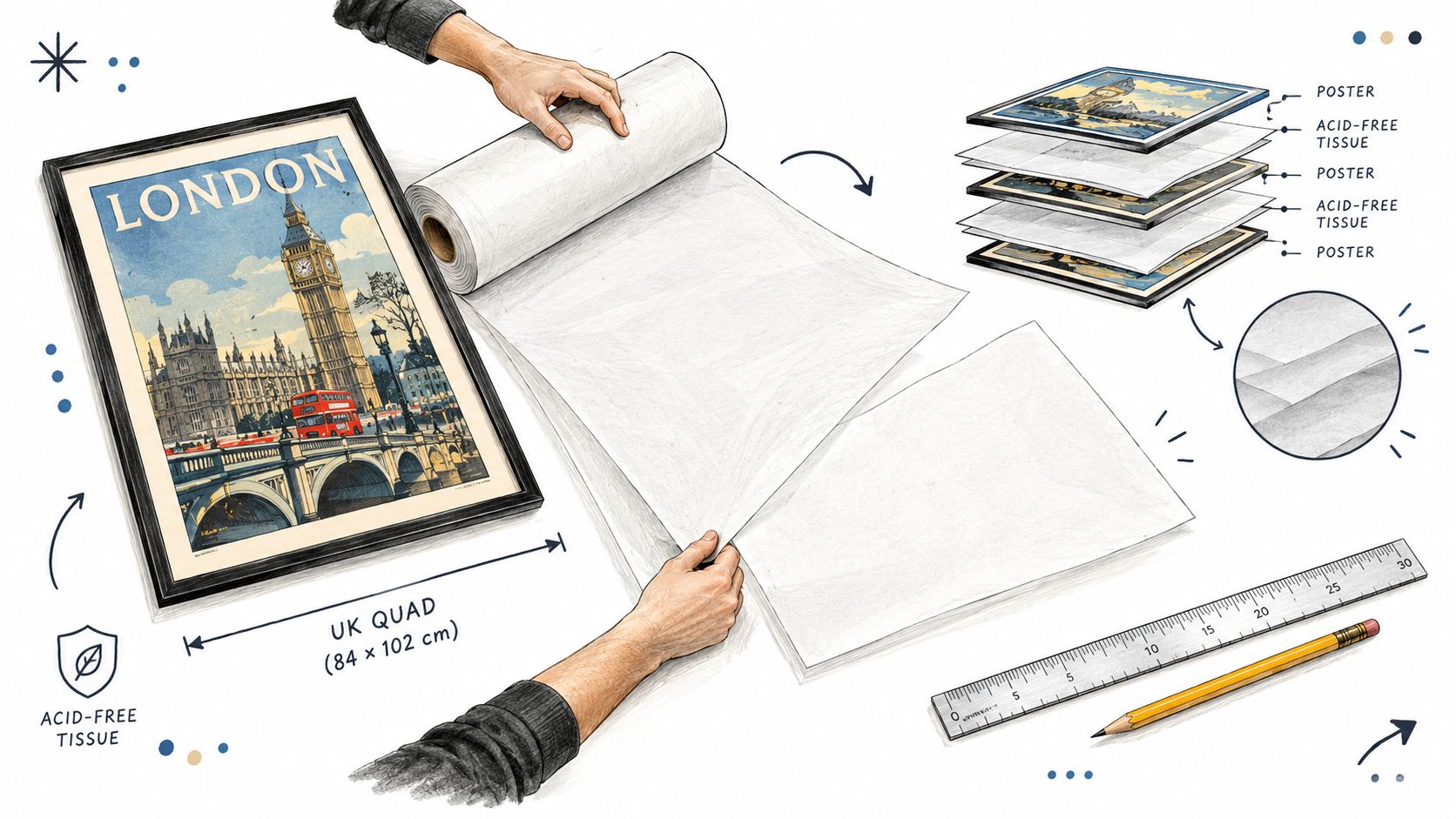
A careful tube-packing routine
- Check the format and tube. UK Quads and US One Sheets need different widths of tissue and appropriately sized tubes. Match the roll width to the poster you handle most often, and make sure the finished roll fits the tube without being forced.
- Cut a clean sheet. Measure enough tissue to cover the printed face and separate it from the outer wrapping. Don't feed the whole tissue roll into the tube. A loose, bulky layer can bunch up and create pressure points.
- Lay the tissue flat. Place the poster on the tissue with the print facing it, keeping the sheet smooth. Align the edges before rolling, so a crooked fold or trapped wrinkle doesn't become a crease.
- Roll evenly, without tightening. Let the poster follow a gentle curve. If it has been rolled for years and springs back, pause and allow it to relax naturally. Don't press it flat or force a tighter roll to make it fit.
- Add the outer layer. Place kraft paper or another suitable protective wrap over the outside of the tissue. Keep tape on the packaging, not on the poster or the tissue touching its surface. A packing materials guide can help compare the materials used for outer packaging.
- Fit and cap the tube. Slide the wrapped poster in without pushing against the ends, then secure the caps so the contents can't work loose. For more on choosing the tube itself, see this guide to archival storage tubes.
If you're packing flat, lay tissue on the base of a suitable folder or box, place the poster on top, and add a separate tissue sheet between it and anything stored above. In a flat file or Solander box, the poster should rest on the tissue, not slide against bare card as you move it.
The short demonstration below offers another visual reference for careful handling and wrapping.
Storage Conditions That Decide Whether the Tissue Works
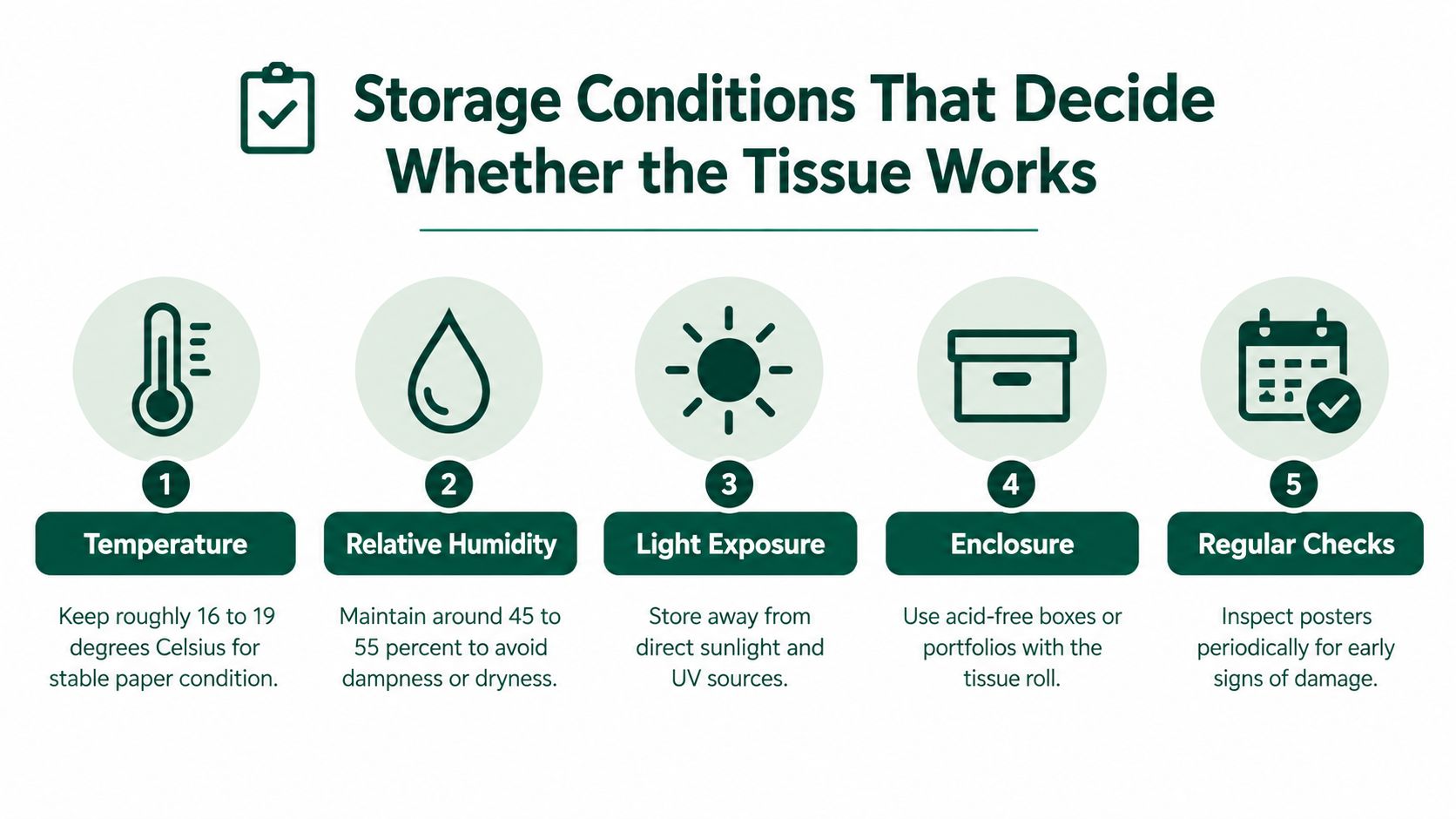
Good tissue can't protect a poster from a poor storage environment. The Institute of Conservation recommends 16–19°C and 45–60% relative humidity for works on paper, and warns against damp cellars and uninsulated attics (Institute of Conservation guidance via Tameside Archives). For a collector at home, a dark, clean, stable cupboard or room is generally a more sensible choice than a loft that heats and cools sharply or a cellar prone to damp.
Store the wrapped poster horizontally with enough support to prevent sagging. Keep it away from radiators, direct sunlight and other strong light sources. A simple hygrometer can help you notice persistent dampness, but avoid chasing a particular reading with sudden changes to the environment. Stability matters, and keeping relative humidity below 60% helps reduce mould and pest risk.
Inspect the poster, not just the packaging
Check periodically for cockling, staining, odour, mould or insect activity. If the tissue becomes marked or damp, don't wrap it again and put the poster back. First assess whether the print itself has been affected, and address the storage conditions that caused the problem.
Tameside guidance suggests changing interleaving paper once or twice per year when it's being used to absorb migrating acids. That's a specific use, not a rule that every collector should replace clean tissue on a fixed schedule. For advice on a suitable outer enclosure, see this guide to archival storage boxes.
Avoid wrapping a poster in tissue and then putting it into ordinary plastic. The National Archives advises against plastic sleeves for prints and works on paper, so the sleeve can undermine the care you've taken with the contact layer. Choose an enclosure designed for the material rather than adding plastic by default.
When Tissue Alone Is Not Enough and a Conservator Steps In
Acid-free tissue is a handling and interleaving barrier, not a cure for paper that's already acidic, foxed or physically damaged. If an old poster has staining or brittle edges, adding a new wrap won't reverse that condition. Deacidification is a separate conservation intervention. Surrey County Council explains that it neutralises acids and deposits an alkaline reserve, but inks and decoration must be checked for solubility before treatment (Surrey County Council guidance on deacidification).
Ask a professional conservator to assess the poster before wrapping or further handling if you notice:
- Active mould or a musty smell. Keep the affected item apart from other posters and don't brush or wipe the surface.
- Tide lines or fresh staining. These can indicate past or continuing moisture problems.
- Flaking or unstable ink. Even careful tissue contact may disturb a fragile printed surface.
- Brittle, torn or unusually fragile paper. Avoid rolling it until someone qualified has assessed its condition.
- A valuable older poster on unknown paper. The paper stock and printing process may affect what protection is suitable.
UK museum practice favours layers rather than a single material. Trowbridge Museum describes combining inert packaging, individual packing where appropriate, polyester sleeves, acid-free board and tissue. A polyester pocket may add value for a premium item that needs a more contained handling barrier, but it should be selected for conservation suitability rather than assumed to be safe because it's transparent.
There's also a difference between protecting an intact poster and treating a damaged one. If restoration or backing is being considered, get advice on the likely effect on the object before proceeding. This overview of linen backing for posters can help you understand the subject, but it isn't a substitute for an individual conservation assessment.
Buying Guide Specifications and a Final Checklist
Buy for the poster and the way you'll use the tissue, not for a vague “archival” label. A retailer shipping large formats may need a wider roll for clean, continuous coverage, while a collector storing smaller prints may prefer a width that's easy to handle without excess waste. Check the roll length and the tissue's stated grammage too, but don't assume that a heavier sheet is automatically more protective.
Compare the details that matter
| What to check | Why it matters |
|---|---|
| pH statement | Look for a clear neutral or slightly alkaline specification, not just a broad marketing claim. |
| Buffer content | Ask whether the tissue is buffered and whether the reserve is identified, such as calcium or magnesium carbonate. |
| Standards and testing | Ask whether the supplier can provide relevant information relating to ISO 11108:1996 or ISO 9706:2000. |
| Width and length | Match the roll to your poster formats and packing routine, so you can cut suitable sheets without awkward joins. |
| Strength and handling | Consider whether the paper can be cut and placed without tearing or dragging across the print. |
| End-of-life guidance | Ask whether the tissue is uncoated and how the supplier recommends handling it after use. |
Before ordering, run through this checklist:
- Buffered or unbuffered? Choose with the poster and product evidence in mind.
- Right width for the format? Check it against the posters you handle.
- Suitable for the tube or box? Make sure the wrapped poster will fit without compression.
- What does “archival” mean here? Request supporting specifications if the product page is unclear.
- Can the tissue be reused or recycled? Reuse only clean tissue when it remains suitable for conservation. Separate paper from plastic and tape, and check your local council's recycling rules, since collection requirements vary.
Clean, uncoated tissue may be more compatible with paper recycling than material contaminated by adhesive, dust or ink transfer, but don't assume every product or council accepts it. The National Trust notes that acid-free tissue can deteriorate over time and that some stored items are repacked every five to ten years (National Trust guidance on caring for stored collections). The point isn't to replace tissue automatically, but to inspect it and avoid unnecessary layers or waste.
Famous Movie Posters sells guaranteed original film and cinema posters and uses acid-free tissue, kraft paper and purpose-designed tubes in its shipping workflow. If you're looking for an original to collect or frame, visit Famous Movie Posters to browse the catalogue and its collecting guidance.