



You've probably got the poster in front of you already. It's folded, a bit tired, maybe split on the cross-folds, maybe just soft enough at the edges that you're nervous every time you pick it up. The usual question follows fast. Should you get it linen backed?
My view is simple. Linen backing for posters is sometimes the right move, but it's nowhere near an automatic one. Too many collectors hear the term and assume it means "properly restored" or "made safe forever". It doesn't. In the UK, the better question is whether the specific poster in your hands needs reinforcement, and if it does, whether linen, Japanese tissue, or no backing at all is the most defensible choice.
A good decision comes down to condition, materials, reversibility, and where the poster will live afterwards. A poorly chosen treatment can solve one problem and create another. A well chosen one can make a damaged original safer to handle, flatter to frame, and easier to keep stable for years.
Table of Contents
- What Linen Backing Actually Means for a Poster
- Linen Backing Versus Japanese Tissue and Dry Mounting
- How a Professional Linen Backing Job Actually Works
- When a Poster Does Not Actually Need Backing
- Storing and Displaying a Treated Poster in a UK Home
- Choosing a UK Conservator and Disclosing Treatment
- Linen Backing Checklist and Common Questions
What Linen Backing Actually Means for a Poster
If you've inherited an old UK Quad or bought a folded US One Sheet, linen backing usually gets mentioned the moment someone sees creases, tears, or weakness in the paper. In UK conservation terms, it's a long-established treatment used to reinforce fragile film and advertising posters, not just a cosmetic upgrade. The poster is mounted onto linen or cotton, typically with an intermediate paper layer and a reversible adhesive, so the weak paper is supported, folds can be flattened, repairs can hold properly, and handling becomes safer, as outlined by AntikBar's poster restoration guidance.
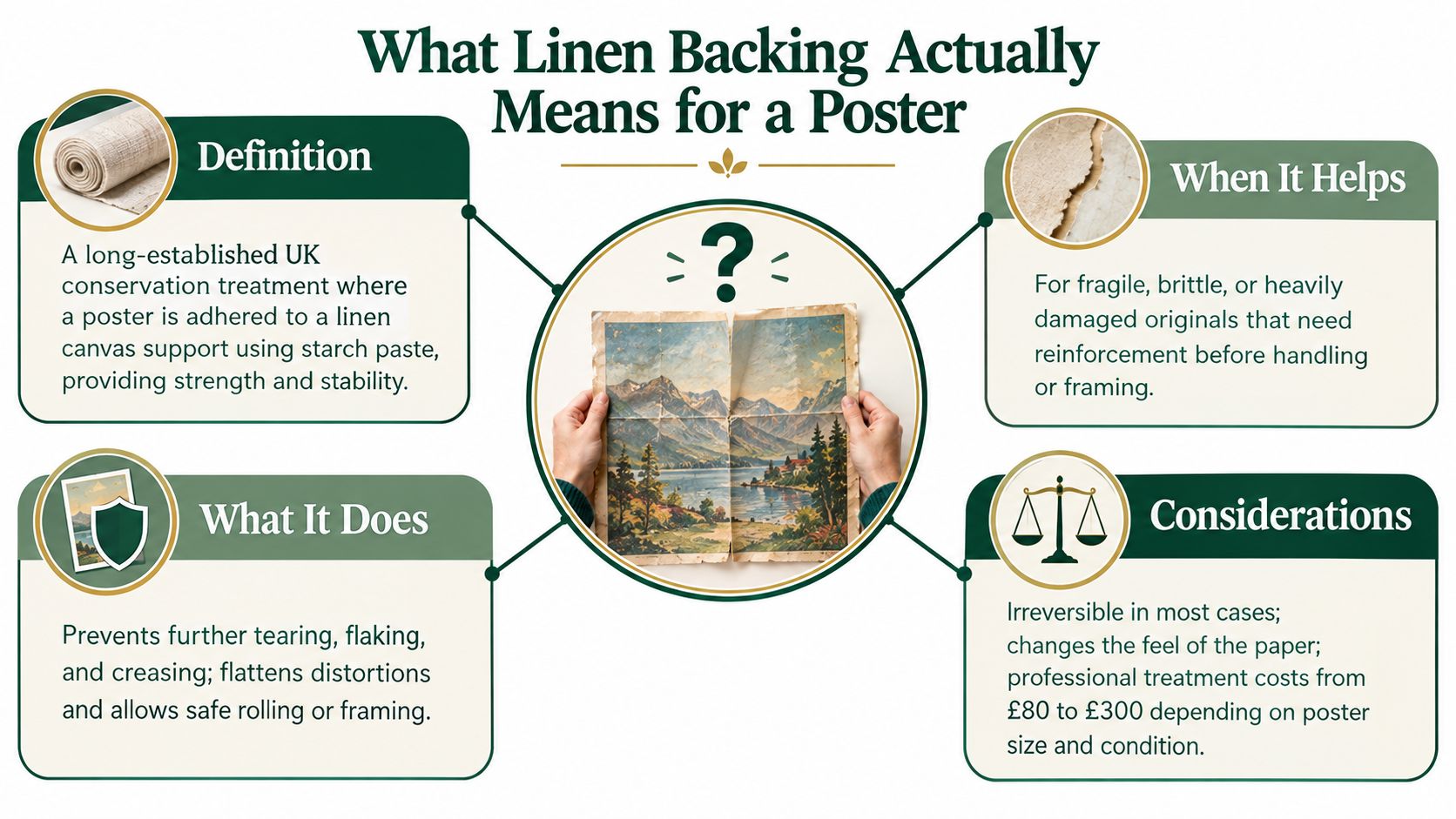
That sounds straightforward, but collectors often miss the important part. Linen backing is a treatment category, not a single recipe. The fabric matters. The adhesive matters. The pH matters. Whether the whole thing is reversible matters even more. One UK restoration source explicitly says it avoids traditional linen backing because some adhesives may decay and destabilise paper over time, preferring low-pH Japanese tissue or acid-free cartridge paper instead, according to UK poster restoration advice from Fine Art Restoration.
What the treatment is trying to achieve
A professionally lined poster is usually being asked to do four jobs:
- Reinforce weakness so tears don't travel further when the sheet is handled.
- Reduce distortions so old folds and ripples sit flatter.
- Support repairs where losses, splits, or fragile edges need a stable base.
- Improve practicality for reframing, storage, or in some cases rolled storage.
Practical rule: If the poster is only mildly folded but otherwise sound, don't assume backing is the answer. Treatment should solve a real structural problem, not just tidy up a look you happen not to like.
Why fabric gets mentioned at all
Collectors also tend to assume “linen” means a magical archival cloth. It doesn't. It means a textile support chosen because it offers flexibility and strength when paired with suitable lining materials. If you want a simple fabric primer before speaking to a conservator, this explainer on whether premium linen resists stretching is useful context for understanding why textile behaviour matters when a support layer is under tension.
That's why I'd never judge a backing job by the phrase alone. Ask what was used, how it was applied, and whether the treatment respects the original paper instead of overpowering it.
Linen Backing Versus Japanese Tissue and Dry Mounting
Collectors are usually steered towards one of three treatments, traditional linen backing, Japanese tissue or low-pH paper lining, or dry mounting. They are not the same job. Each one solves a different problem, and each carries a different level of risk for an original poster.
UK conservation practice puts the emphasis on reversible treatments and chemically stable materials. That matters because the treatment should not leave the next conservator, or the next owner, with a problem that cannot be undone. For poster work, that usually pushes the decision towards lower-impact paper linings rather than a default linen backing, as noted in Fine Art Restoration's discussion of conservation lining options.
Treatment options compared for original movie posters
| Treatment | Reversibility | Typical use case | Main risk |
|---|---|---|---|
| Traditional linen backing | Often intended to be reversible, but depends on materials and method | Large, brittle, creased, torn posters needing flexible support | Adhesives may age poorly and destabilise paper over time |
| Japanese tissue or low-pH paper lining | Favoured where a more conservation-led, lower impact support is wanted | Fragile originals needing repair support while preserving paper character | Tissue repairs can be visible on thin or glossy poster stocks if toned poorly |
| Dry mounting | Permanent | Display-led mounting where future removal is not a priority | Removal can damage the poster and compromise collectability |
My blunt view on each option
Traditional linen backing still has a place. If you are dealing with a large, heavily folded, structurally weak original that needs support and will be handled, it can be justified. I would not call it the default answer. Too many people reach for it because they know the term, not because the poster needs that much intervention.
Japanese tissue lining is often the better conservation choice for original cinema posters. It supports creases and tears while keeping more of the poster's original character intact, and it fits the UK preference for low-pH, reversible materials.
A good conservator does not start by asking how to back the poster. They start by asking whether it needs backing at all, and if it does, which method will solve the problem with the least interference.
Dry mounting is the option I would avoid for original film posters unless you accept the consequences. Art of the Movies on condition and backing makes the distinction plainly. Professional linen backing is meant as a stabilising conservation process, while dry mounting permanently adheres the poster to a board, which makes removal risky and can damage collectability.
If you own an original and care about future options, reversibility is the baseline.
How a Professional Linen Backing Job Actually Works
A proper job is slow, methodical, and frankly a bit fussy. That is exactly what you want. If someone treats backing like a quick workshop add-on, walk away.
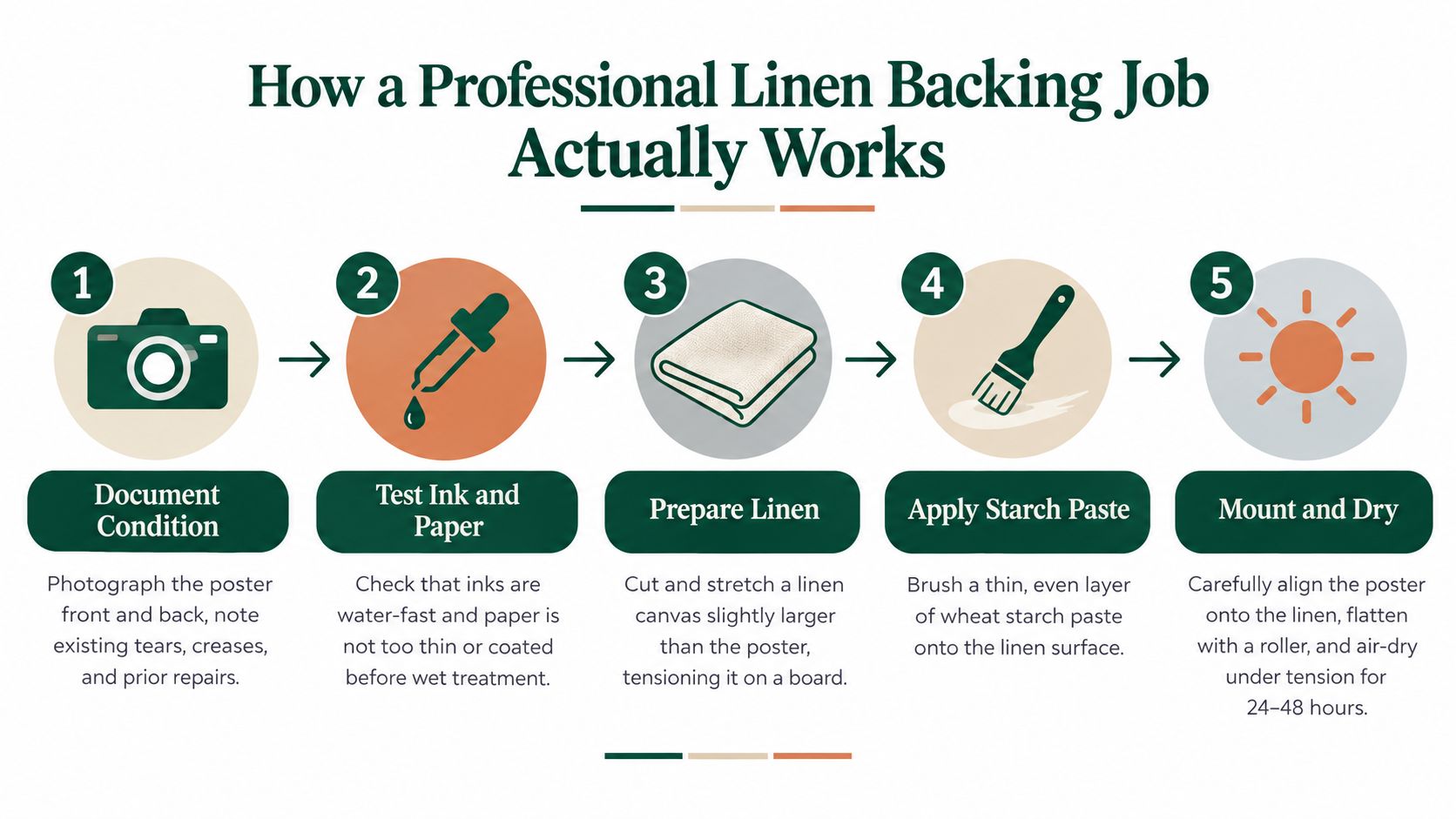
UK conservation practice follows a sensible sequence. The poster's condition is documented first, with every tear, stain, and previous repair recorded before anything else happens. Ink and paper stability are tested. The sheet is surface-cleaned and tears are repaired. It is then humidified and flattened under controlled conditions before any support is prepared. If textile lining is chosen, the linen is prepared and tensioned, a reversible conservation-appropriate adhesive is applied through an intervening lining layer, the poster is dried evenly under restraint, and the conservator checks for distortion, staining, adhesive penetration, and edge failure. As noted earlier, this workflow is standard practice in conservation studios rather than a matter of individual taste.
What you are actually paying for
The cost is not just fabric and paste. It is judgement.
-
Condition recording
The conservator needs a record of tears, staining, fold fatigue, previous repairs, and any losses before touching the sheet. -
Testing before moisture
Some inks and some papers do not behave kindly around humidification. Testing reduces the chance of turning a repair job into a rescue job. -
Controlled flattening
Old folds can often be reduced, but not by brute force. Paper has memory, and forcing it flat too quickly can leave stress elsewhere. -
Support preparation
Textile support must be properly prepared and kept under even tension if it is being used.
Where rushed jobs go wrong
Large posters are especially vulnerable if moisture is not distributed evenly before attachment. Uneven expansion can cause cockling or permanent distortion. Once that happens, you have not preserved the poster. You have altered it badly.
Dealer's advice: Ask who is doing the work, what adhesive system they use, whether there is an intervening paper layer, and how they check for staining or edge failure before the poster leaves the studio.
If you are also thinking about the end result on the wall, it helps to understand how conservation treatment and framing work together. A practical poster framing service guidance overview can help you match the treatment decision to the way the piece will be displayed.
This is not a home project. It is paper conservation.
When a Poster Does Not Actually Need Backing
Here's the part many sellers and framers won't say clearly enough. A lot of posters don't need backing at all.
If a poster is stable, the paper is sound, the folds aren't actively splitting, and you're willing to store it properly, leaving it alone is often the best conservation decision. The British Library notes that its small conservation team treats more than 1,500 collection items each year, while also acknowledging that this is only a fraction of material needing attention, which is a useful reminder that conservation is resource-intensive and condition-led rather than automatic for every paper object in a collection, as described on the British Library conservation pages.
Leave it alone if the structure is still good
Backing is justified by condition, not by habit. I'd treat lining as defensible when one or more of these are true:
- The paper is weak and handling risks further tearing.
- Fold lines are splitting or old repairs are failing.
- The poster is brittle or stained in a way that needs stabilisation work first.
- You need rolled storage and the object needs extra flexibility to survive it safely.
- The sheet is large and awkward enough that support materially reduces handling risk.
The value question collectors often get wrong
Original film posters and editioned fine-art prints shouldn't be lumped together. In the poster market, backing is common enough that buyers understand it. With editioned fine-art prints, textile backing may harm value because the market expects the original paper object to remain closer to its issued state. That distinction matters.
So before you approve any treatment, decide five things:
-
Paper type
Is it a strong later sheet or an older, more fragile stock? -
Actual damage
Are you solving structural weakness or just chasing a flatter appearance? -
Intended display
Will it be framed, stored flat, or transported rolled? -
Reversibility
Could a future conservator safely revisit the treatment? -
Future resale
Will a buyer want untouched paper, or accept a documented conservation lining?
If the answer points to storage rather than treatment, start with proper housing. Good archival storage boxes often do more for a stable poster than an unnecessary restoration ever will.
Storing and Displaying a Treated Poster in a UK Home
You get a poster back from treatment, it looks flatter, cleaner, easier to frame, and it is tempting to assume the hard part is done. It is not. In a UK home, the room matters as much as the treatment. Linen backing can make a damaged poster more manageable, but it does not protect it from damp, heat, sunlight, or bad framing choices.
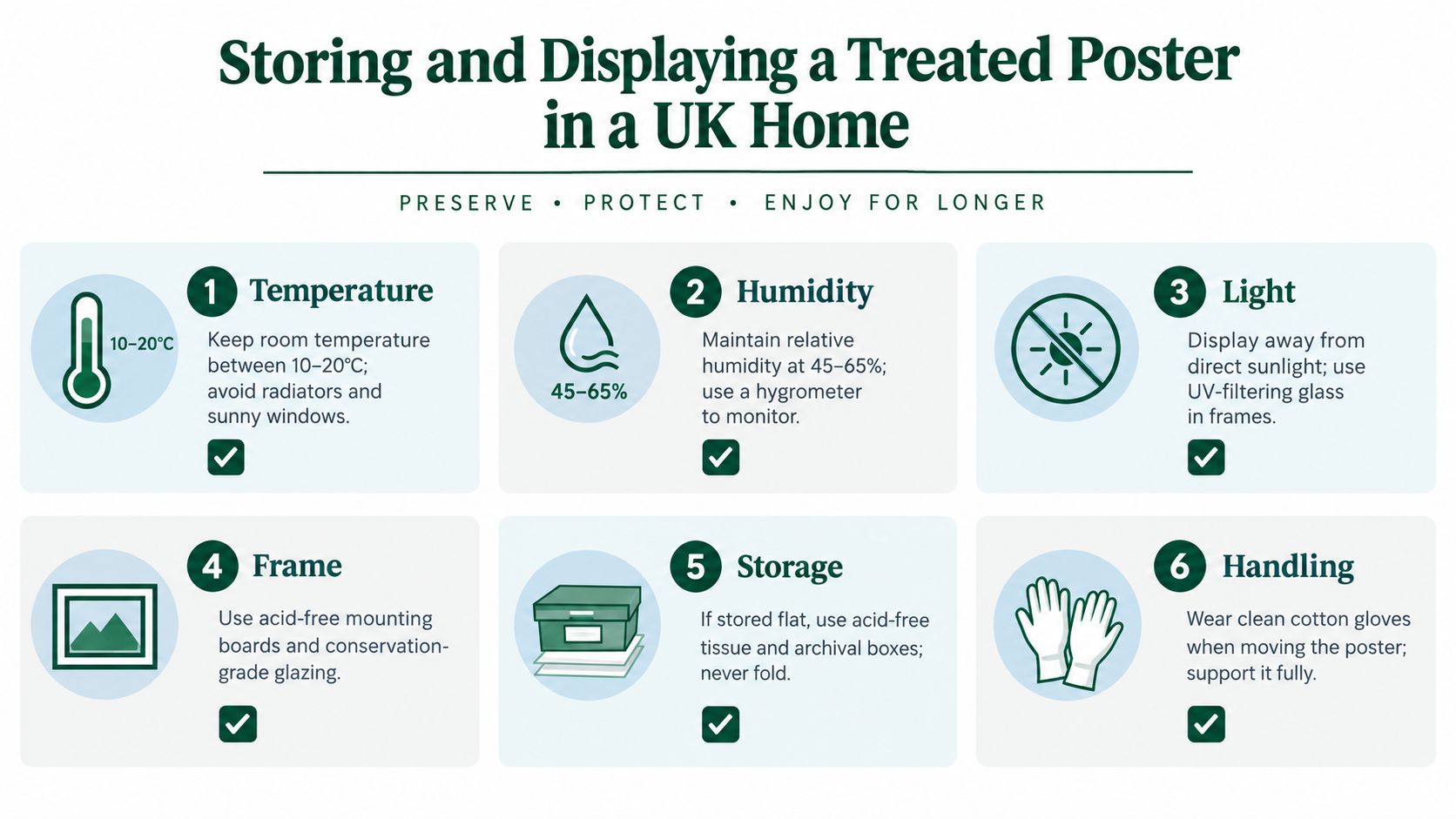
Museums Galleries Scotland advises keeping paper collections at 10–20°C and 45–65% relative humidity, with daily humidity change ideally kept to no more than ±5%. It also warns against attics and basements. That applies directly to collectors. A lined poster is still a paper object, and UK houses are full of problem spots.
What that means in a real house
Skip the obvious trouble areas. Do not hang a treated poster over a radiator. Do not put it on an external wall that turns cold in winter and damp after rain. Do not leave it facing strong daylight and assume glazing will sort everything out.
Collectors get caught out. They pay for backing, then hang the poster in the worst part of the room. The treatment is not the mistake. The setup is.
A sensible home setup looks like this:
- Use a hygrometer and check the room properly.
- Keep it out of lofts and basements unless those spaces are controlled.
- Avoid direct sun even after treatment.
- Use conservation framing materials rather than standard cardboard and cheap backing boards.
- Let the poster acclimatise after delivery before unrolling or reframing.
Rolled or flat after treatment
A linen-backed poster can usually be rolled for transport more safely than a weak unbacked copy. That is one reason collectors choose the treatment in the first place. For long-term storage at home, flat storage is still the safer default if you have the space. Less tension, less curl, less chance of edge wear from repeated handling.
Materials matter just as much as the room. Our own storage uses PAT-tested flat file boxes with a 3% calcium-carbonate buffer, and premium items are kept in acid-free polyester pockets. That is done to reduce handling and limit exposure to acidic materials. For framing, use proper mounts, boards, and glazing rather than whatever a high-street framer has on hand. If you need that route, follow this poster framing and storage guidance.
UK museum guidance also points collectors towards conservation paper and card made from 100% cotton or a high proportion of alpha-cellulose fibres, sometimes buffered or fitted with molecular sieves. Ordinary wood-pulp board and random plastic sleeves are poor long-term choices.
Backing can make a poster easier to handle and display. It cannot compensate for a hot room, a damp wall, a poor frame, or bad storage materials.
If you're framing rather than storing, follow the framing guidance linked above.
Choosing a UK Conservator and Disclosing Treatment
If it's an original movie poster, a trained paper conservator is the person you want. Not a general framer offering backing as an extra. Not someone who mainly works on decorative display pieces. And not a workshop that talks more about making the poster “look new” than documenting what they're changing.
Who should handle the job
A paper conservator approaches the poster as a paper object first. That matters because the inks, paper stock, old tape residues, previous repairs, and existing folds all need assessing together. A fine-art restorer may also be suitable if they have real paper conservation experience. A framing service, on its own, usually isn't.
Ask direct questions:
- What materials will you use
- Is the treatment documented as reversible
- Will you test ink and paper stability first
- How will tears and old repairs be handled
- Will you give me before-and-after documentation
What should be written down
A proper condition report should record the poster's state before treatment and after treatment. It should identify the support materials used, the adhesive system, whether there's an intervening paper layer, and whether the lining is considered reversible. If old tape, acidic backing, or historic repairs were found, that should be noted too.
What buyers hate: surprises. Undisclosed backing isn't just untidy paperwork. It can make a future buyer wonder what else hasn't been said.
Treatment should stay with the poster's provenance. If you ever sell the piece, disclose the backing clearly. For some buyers, documented conservation work is acceptable or even reassuring. What damages confidence is hidden intervention, vague language, or a seller who can't explain what was done.
Linen Backing Checklist and Common Questions
If you want the shortest route to a sound decision, use this checklist and be honest with yourself.
The checklist
-
Assess condition properly
Look for active tears, fold splits, brittleness, staining, and previous repairs that are already failing. -
Decide whether treatment is justified
If the poster is stable and can be stored well, leave it alone. -
Choose the least invasive suitable method
For some originals that means linen backing. For others it means Japanese tissue lining, or no backing at all. -
Use a trained paper conservator
Don't hand an original over to a basic framing add-on service. -
Get everything in writing
Ask for condition reports, materials used, and whether the treatment is reversible. -
Control the environment afterwards
Good treatment plus bad storage is still bad preservation.
Common collector questions
How can I tell if a poster has already been lined
Check the back. A lined poster usually shows a support layer and won't feel like a loose raw sheet. If you're unsure, don't guess. Ask a conservator to inspect it before buying or reframing.
Can a backed poster be rolled for posting
Often, yes. That's one reason textile support is sometimes selected. But roll it for transport, not because you want to ignore better long-term storage.
Does backing affect value
It can. In the movie poster market, documented stabilisation may be acceptable. Undisclosed, poorly executed, or irreversible work is another matter entirely.
Should a stable poster be backed anyway for peace of mind
No. If it's sound, keep it sound. Unnecessary treatment isn't caution. It's intervention without a clear conservation reason.
What matters most, backing or storage
Storage. The treatment decision matters once. The environment affects the poster every day.
If you're weighing up whether an original should be lined, framed, stored flat, or left alone, Famous Movie Posters offers original film posters alongside practical guidance on archival storage, framing, and handling. If you want to buy with preservation in mind, it's a useful place to start before you make an expensive conservation decision you can't easily undo.